

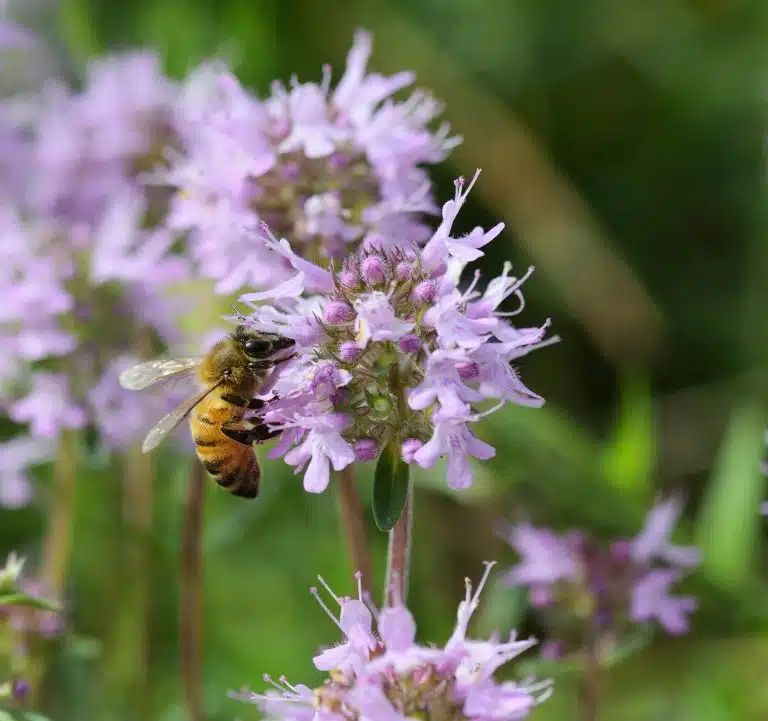
At a glance
Thyme honey
Thymus spp.
Colour
Light amber to amberup to 84 mm Pfund, sometimes reddish
Aroma
Floral and phenolicvery intense and persistent
Taste
Sweet and tartdistinct acidity
Crystallisation
Lowusually stays liquid
Season
Late springand summer
Region
Spain’s two central plateauslimestone areas and foothills
Pollen reference
12%the same as for rosemary honey
Electrical conductivity
up to 0.60 mS/cmtwice the limit for rosemary honey
Thyme and rosemary belong to the same plant family, grow on similar limestone soils and share a 12% pollen reference in the Iberian guide. In the jar, their characters are quite different.
Both are important nectar plants in Iberian scrubland. Bees may work them from the same apiary and sometimes during the same weeks. Rosemary honey is usually very pale with a delicate aroma. Thyme honey tends towards amber, with a strong, lingering scent and a more pronounced acidity.
Colour is a starting point, but a side-by-side tasting makes the differences easier to recognise.
Reading and tasting thyme honey


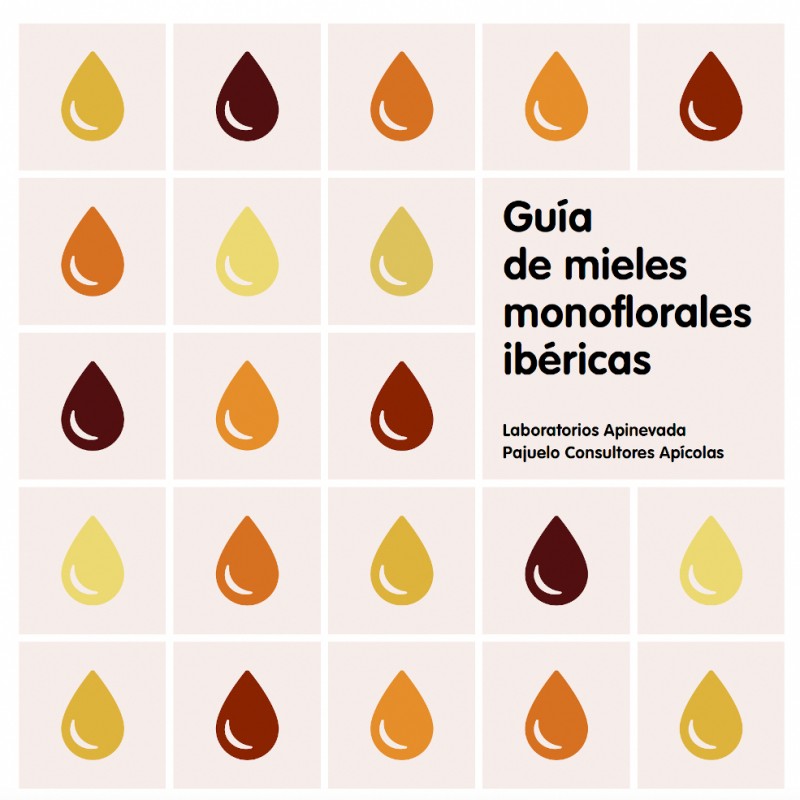
This Spanish-language field guide compares botanical origin, tasting and laboratory findings. Use the profile together with the traceability of the lot.
Compare thyme and rosemary
- Taste for aroma, persistence and acidity.
- Compare your notes with the declared origin and lot.
Thyme and rosemary compared
| Thyme | Rosemary | |
|---|---|---|
| Colour | up to 84 mm Pfund (often 50–84) | up to 35 mm Pfund |
| Aroma | Floral with a distinctly phenolic note, very intense and persistent | Mild, moderately persistent, with notes of camphor and fresh beeswax |
| Taste | Sweet with a clear tart note | Clean sweetness |
| Crystallisation | Low | Fine or coarse crystals form |
| Electrical conductivity | up to 0.60 mS/cm | up to 0.30 mS/cm |
| Pollen reference | 12% Thymus | 12% Rosmarinus |
| Season | Late spring to summer | Early spring |
The flows follow one another. As rosemary finishes, thyme starts, so many inland beekeepers can harvest both from the same hives without moving them. See our rosemary honey (in Spanish) profile.
When both flower in the same harvest
A late rosemary flow can overlap an early thyme flow. When neither qualifies on its own as the main source, the guide describes an Iberian mint-family honey, miel de labiadas. The principal contributors are often rosemary and thyme.
Mixed mint-family honey. Light amber, up to 84 mm Pfund. The floral aroma has a variable phenolic note that becomes more apparent on the palate. The taste is sweet with lingering acidity. Crystallisation is slow, with medium-sized crystals.
Minimum pollen content: 15% mint-family pollen in total. Conductivity is at most 0.70 mS/cm. The guide allows up to 18.5% moisture, half a percentage point more than for most of its profiles. It comes from dry limestone areas in the north-eastern quarter of the Iberian Peninsula, in late spring.
The guide gives this mixed botanical profile its own sensory description and analytical reference values. It can be a distinctive harvest in its own right.
Colour
The guide describes light amber to amber, with an upper reference of 84 mm Pfund. Many Iberian samples fall between about 50 and 84 mm, sometimes with a faint reddish hue.
The Pfund scale: where thyme honey falls
Thyme honey is in the lighter-to-middle range, just above rosemary honey. The colours on screen are illustrative. A laboratory measures colour with an instrument.
Aroma, taste and texture
Sensory profile
Our interpretation of the descriptions in the Guía de mieles monoflorales ibéricas. The dots represent our comparison of the guide’s written descriptions and are not laboratory scores.
Aroma
The aroma is strongly floral with a dry, herbal, slightly medicinal or phenolic note. It lingers after swallowing and accounts for much of the recognisable character of thyme honey.
The eucalyptus profile illustrates a different relationship between plant and honey: the honey is commonly described as smelling of wet wood rather than eucalyptus leaves. For thyme, the guide specifically records a marked phenolic aroma in the honey.
Taste
The sweetness is balanced by a distinct acidity. This gives the honey a different profile from the milder sweetness of rosemary. Bitterness is not a dominant feature in the guide’s thyme description.
Crystallisation
Thyme honey often crystallises slowly. It can stay fluid for months without that texture proving either heating or fine filtration. The other plants in the batch can alter the rate. See why honey crystallises.
Interpreting the laboratory profile
| Parameter | Reference in the guide | How to interpret it |
|---|---|---|
| Colour | up to 84 mm Pfund | Light amber to amber, frequently 50–84 mm Pfund. A reddish hue is possible. |
| Moisture | up to 18% | Above this value the risk of fermentation increases. The general legal limit for blossom honey in the EU is 20%. Moisture plays a major part in how well honey keeps. |
| Fructose and glucose combined | at least 60% | A characteristic of blossom honey. This figure on its own cannot exclude added syrup. |
| Sucrose | up to 5% | One of the sugars reported in the analysis. |
| Electrical conductivity | up to 0.60 mS/cm | Twice the limit for rosemary honey in this guide. Thyme honey is generally richer in minerals, in keeping with its darker colour. |
| Free acidity | up to 50 meq/kg | Free acidity can increase during fermentation. It is measured in the laboratory and is distinct from perceived tartness. |
| HMF | up to 40 mg/kg | Tends to rise with heat and time. Levels are usually low in freshly harvested honey. |
| Diastase activity | at least 8 Schade units | Indicator of enzyme activity, which can decline with heat. |
| Thymus pollen | at least 12% | Like rosemary, thyme yields abundant nectar and relatively little pollen. This figure is a share of the pollen counted. |
Reference ranges from the Guía de mieles monoflorales ibéricas, fourth edition (2023). These characterise the variety. Spanish statutory limits are set by Royal Decree 1049/2003 as amended by Royal Decree 68/2025, including a general maximum of 20% moisture and 40 mg/kg HMF, subject to the exceptions in the legislation.
What pollen analysis found in 103 suspected thyme honeys
The Iberian guide uses 12% Thymus pollen as a reference and lists other mint-family plants, rockroses, white wall-rocket and viper’s bugloss as common companions. Between 2020 and 2022, Pajuelo’s laboratory examined 103 samples submitted as possible thyme honey by professional beekeepers and packers. The team reported the findings at the 11th Spanish National Beekeeping Congress in Málaga in 2023.
| Classification | Samples | How to interpret it |
|---|---|---|
| Monofloral thyme honey | 77 (74.8%) | Met the guide’s profile. |
| Thyme with a marked contribution from another flower | 13 (12.6%) | Some had a strong contribution from rosemary, sainfoin, lime, or rosemary and almond together. Other pairings included almond, spike lavender, fruit trees and sunflower. |
| Thyme as a secondary source | 9 (8.7%) | Thyme was present in a honey of another origin. |
| Multifloral honey | 4 (3.9%) | No single flower predominated. |
Percentages from Gonell Galindo and colleagues (2023). Sample counts are calculated from those percentages and the total of 103. We grouped the results into four categories.
About a quarter of the submitted samples were not classified as unifloral thyme honey. Only four were classified simply as blossom honey. More often thyme was present alongside another important source such as rosemary, sainfoin, almond, lavender or sunflower. Placing the hives near thyme gives valuable context, but does not by itself establish the origin of the finished lot.
Seventy-five plant taxa across the samples
The researchers identified 75 plant taxa across the 103 submissions. Pajuelo published the full plant list. The groups below show how diverse the surrounding forage can be.
Other mint-family plants
Rosemary, spike lavender, French lavender, savory, sage, hyssop, pennyroyal and other mints
Legumes
Sainfoin, broom, bird’s-foot trefoil, clover, vetch, albaida and carob
Trees and crops
Almond and other fruit trees, sunflower, lime, sweet chestnut, eucalyptus, citrus blossom and avocado
Plants of field margins and roadsides
White wall-rocket, wild mustards, viper’s bugloss, weld, thistles and mallow
Pollen sources without floral nectar
Rockroses, holm oak, kermes oak, olive, pine, mastic, grasses, maize, poppy and plantain, among others
Other material
Honeydew elements (HDE)
White wall-rocket and viper’s bugloss also occur in Iberian rosemary and orange blossom harvests. The guide associates viper’s bugloss (Echium) with a slightly oily mouthfeel. White wall-rocket may encourage more noticeable crystals where crystallisation occurs.
Fourteen of the 75 taxa were recorded as pollen sources without a nectar contribution in this analysis, including rockroses, oaks, olive, pine and grasses. Finding their pollen does not show that their nectar contributed sugars. The sediment may also contain honeydew indicators, including microscopic fungal or algal material. These are not pollen grains.
The laboratory adapted sample preparation to preserve fragile rosemary pollen and honeydew indicators. It reported centrifuging at 2,500 rpm and omitting acidification for that particular analysis.
Growing areas and harvest season
Thyme grows on sunny, dry limestone scrubland across Spain’s two central plateaux and on the foothills of mountain ranges. The genus Thymus includes many Iberian species. Productive sites extend well beyond the distribution of common thyme alone.
The crop is sensitive to spring drought. In 2023 Pajuelo’s team reported that recent dry springs had reduced local thyme honey production. A hillside full of flowers may still supply little nectar when water is limiting.

Thyme honey flow
Flowering Flowering and harvest
The guide places it in late spring and summer, just after rosemary. The many Iberian species of Thymusextend the season at different altitudes. Flowering starts earlier on the plains and later in the foothills.

How to recognise thyme honey
- 1Start with the aroma. Look for an intense, persistent aroma with a dry, phenolic note. A faint aroma is a poor match for the profile.
- 2Look for amber tones. Many samples fall between 50 and 84 mm Pfund, sometimes with reddish undertones. Exceptionally pale honey is closer in colour to rosemary or to a pale mixed mint-family honey.
- 3Taste for acidity. A clear tart note is characteristic. A purely sweet sample calls for other checks before identifying it as thyme honey.
- 4It often stays liquid. The tendency to crystallise is low, so fluid honey is quite typical here.
- 5Compare conductivity with 0.60 mS/cm. A higher reading falls outside the guide’s profile. Honeydew or heather is one possible explanation, best checked against the pollen and sensory findings.
For a broader view, see how to assess honey quality and our guide to Spanish honey labelling requirements.
Composition and health claims
Thyme has a long history of use as a herb. Claims about its essential oil or an infusion cannot simply be transferred to honey. Food health claims in the EU require the relevant authorisation and conditions of use.
These are characteristics that can be compared by tasting or analysis.
- A lasting aroma. The guide places thyme among the Iberian honeys with the most intense and persistent scent.
- Often easy to pour. Its natural tendency to remain liquid makes warming unnecessary in many cases. Prolonged heating can increase HMF and reduce enzyme activity.
- At the table. Its acidity suits aged sheep’s cheese, dressings, marinated dishes and roasts. It also pairs well with nuts and almond pastries.
- For a comparative tasting. Thyme and rosemary are useful together in a blind tasting because their aroma and intensity differ so clearly.
- A University of Barcelona study compared 73 Spanish honeys in 2023. The thyme samples had the highest average antioxidant capacity in the FRAP assay, about 2.2 mg Trolox equivalents per gram, ahead of honeydew honeys and heather honey. This measures a chemical property in the laboratory and does not establish a health benefit from eating the honey.
Who should take particular care?
Children under 12 months. Do not give honey to infants under one year. It can contain spores of Clostridium botulinum that may cause infant botulism. This applies to all types of honey.
Diabetes. honey is a source of sugars. This also applies to natural and monofloral honeys when planning a diet.
Known allergy. Anyone with a diagnosed allergy to honey or bee products should consult their clinician if unsure what is safe for them.
Frequently asked questions
How do thyme honey and rosemary honey differ?
Both come from the mint family and share a 12% pollen threshold in this guide. Rosemary honey is very pale, up to 35 mm Pfund, with a delicate aroma and clean sweetness. It crystallises readily. Thyme honey ranges from light amber to amber, up to 84 mm Pfund. Its lingering floral aroma has an intense phenolic note, its sweetness is accompanied by distinct acidity, and it usually stays liquid. Rosemary flowers in early spring and thyme in late spring and summer.
Why does my thyme honey stay liquid?
Thyme honey naturally has a low tendency to crystallise. It can remain liquid for months. Fluidity alone tells you little about heating or fine filtration.
Does thyme honey taste of thyme?
It can bring the plant to mind. The guide describes a floral aroma with a strong, lingering phenolic note. It is that dry, herbal impression that people recognise as thyme. With eucalyptus, by contrast, the familiar leaf aroma is not characteristic of its honey.
What is mixed mint-family honey?
It is honey from a mixture of mint-family plants, usually rosemary and thyme, with neither contributing enough for its own monofloral profile. The guide describes light amber honey up to 84 mm Pfund, with at least 15% mint-family pollen, electrical conductivity up to 0.70 mS/cm and moisture up to 18.5%. It comes from dry limestone areas in the north-eastern quarter of the Iberian Peninsula in late spring.
Does thyme honey contain pollen from other plants?
Yes. The guide sets a minimum of 12% Thymuspollen because thyme supplies abundant nectar and relatively little pollen. Tests on 103 possible thyme honeys from 2020 to 2022 identified 75 different plants. About one in four samples failed to meet the monofloral profile. In about half of these, thyme was accompanied by a strong secondary source such as rosemary, sainfoin or almond.
Where is thyme honey produced in Spain?
Look to the limestone soils of Spain’s two central plateaus and the foothills of its mountain ranges. The many Iberian species of Thymus support bee forage in a wide range of districts, from the plains to the mountains.
Who should take particular care?
Never give honey to a baby under 12 months because of the risk of infant botulism. People with diabetes should count its sugars in their diet. Anyone with a diagnosed allergy to hive products should seek individual medical advice.
Where to buy thyme honey
A beekeeper in a producing area can tell you more about the site and the harvest. If you do not have one nearby, our shop carries Spanish raw thyme honey.

Sources
The reference ranges come from the fourth edition (June 2023) of the Guía de mieles monoflorales ibéricas by J. Orantes, F. Gonell, C. Torres and A. Gómez-Pajuelo, published by Laboratorios Apinevada and Pajuelo Consultores Apícolas. Their work draws on a series reaching back to 1980 and more than 3,600 analyses a year across the two laboratories. The printed guide in Spanish is available in our shop.
The pollen results are from F. Gonell Galindo and colleagues, “Plantas identificadas en mieles de tomillo durante los años 2020 a 2022”, presented at the 11th Spanish National Beekeeping Congress in Málaga in 2023. Pajuelo’s report on plants found in thyme honeys includes the full list of 75 taxa.
The antioxidant data are from Fernández-Estellé and colleagues, “Characterization and Classification of Spanish Honeydew and Blossom Honeys Based on Their Antioxidant Capacity”, published in Antioxidants in 2023.
Explore the rest of our series on Iberian honeys. Taste thyme beside rosemary (in Spanish) for contrast, or compare it with the darker heather and chestnut honeys.


