

A cream can smell fresh and look smooth while harbouring microorganisms. Another may release oil or water for purely physical reasons. Three things can go wrong with a cosmetic: the emulsion can separate, the fats can turn rancid, or microorganisms can grow.
If you prefer a ready-made cream

The manufacturer’s instructions apply to this cream in its own packaging. Check the label and ingredient list. A homemade emulsion needs a separate preservation and shelf-life assessment.
Record the formula and the container together
- Record the ingredients, batch, date and intended use.
- Track emulsion stability, oil oxidation and microbiological preservation separately.
This guide explains the preservation steps mentioned briefly in the recipes in our series on hive products in cosmetics.
Separation, oxidation and contamination
TEXTURE · FATS · MICROBIOLOGY
Three problems with different causes
PROBLEM 01
Separation
The structure changes
Oil or water separates out. Check the emulsion and how it was made.
PROBLEM 02
Oxidation
The fats change
Oils can turn rancid. An antioxidant slows this process. A preservative serves a different purpose.
PROBLEM 03
Contamination
Microorganisms are involved
There may be no visible changes. The preservation system needs to be assessed for the specific formula.
A cream can look fine even when it is inadequately preserved. Physical instability, oxidation and contamination can occur together.
| Problem | What you may notice | What helps prevent it |
|---|---|---|
| Physical instability | Water or oil separates from the cream | An appropriate emulsifier, a suitable process and packaging |
| Oxidation | The oil smells rancid | Stable oils, protection from light and heat, and antioxidants |
| Microbial contamination | Bacteria, yeasts or moulds grow, sometimes with no visible sign | Good hygiene and a preservation system suited to the formula |
The same product can have more than one problem. Fixing a separating emulsion does nothing to establish its microbiological safety. Adding a preservative cannot repair an unstable emulsion.
What makes a cosmetic microbiologically low risk?
Some formulations make it difficult for microorganisms to grow. ISO 29621 gives guidance on identifying them. The German Society for Cosmetic Science (DGK) describes several factors in its review.
| Factor | Examples |
|---|---|
| Water activity below 0.75 | Water-free balms and ointments, or powders, provided they stay dry |
| Alcohol content above 20% | Perfumes and some toners in containers that prevent alcohol evaporation |
| pH below 3 or above 10 | Acid peels and hair straighteners |
| Aluminium chlorohydrate content above 25% | Antiperspirants |
One factor or a combination may support a low-risk classification. The assessment applies to the specific formula, manufacturing process, packaging and intended use.
ISO also gives filling temperature as an example. Hot filling may reduce the initial microbial load. As the DGK points out, it cannot prevent later contamination during filling, through the container or during use.
Most creams, low-alcohol toners and water-based extracts have none of these low-risk characteristics. They need a preservation system whose efficacy has been checked in the finished formula.
What water activity tells you
What matters to microorganisms is how available the water is. This is called water activity, measured on a scale from 0 to 1.
- Many emulsions have a water activity close to 0.97, high enough for a wide range of microorganisms to grow.
- Most bacteria stop multiplying below about 0.91. Many yeasts and moulds can grow at lower values.
- A value below 0.75 is one reference point used when assessing whether a product is microbiologically low risk.
Glycerine and honey lower water activity. Measurements on glycerine–water mixtures by Nakagawa and Oyama (2019) put a mixture containing roughly one-third glycerine at around 0.89. This helps explain why pollen extract in glycerine and water needs attention. The study did not measure the extract itself. Its complete formulation and preservation system need their own assessment.
A dry product can lose this advantage if it gets wet in use. A solid shampoo standing in a puddle in the shower is in different conditions from the bar in its box. Dipping wet fingers into balm can introduce water in the same way.
What preservatives and antioxidants do
Tocopherol (vitamin E) slows the oxidation that makes oils turn rancid. A preservative helps control bacteria, yeasts and moulds. Vitamin E alone cannot protect a water-containing cream against microbial growth, and a preservative cannot stop an oil smelling rancid.
An essential oil is an unreliable substitute for a tested preservative. Its presence in the ingredient list says little about protection of the finished product, and some essential oils can irritate the skin.
In the EU, cosmetic preservatives have specified conditions of use and maximum permitted levels. The European Commission explains how they are evaluated. Check the supplier’s technical data for the working concentration, pH range and incompatibilities. A recipe that simply says “add 0.5% preservative” is missing the identity of a crucial ingredient.
Why pH matters
Many preservatives work well only within a particular pH range. Choose one suited to the full formula, then measure pH with a pH meter using a consistent method.
A pH reading cannot detect contamination or predict how a preservative will perform over the coming months. A pH strip has little meaning in a balm consisting entirely of wax and oil, since it has no aqueous phase to measure.
How preservation is assessed
Professional formulators can commission a preservative efficacy test, also called a challenge test, to assess whether a finished product controls microbial contamination over time. ISO 11930 sets out the reference method and how to interpret the results.
ISO 29621 allows testing to be reduced for a demonstrably low-risk product. The DGK notes that a challenge test is generally unnecessary when water activity is below 0.75, provided the product-specific risk assessment supports that conclusion. A conventional water-containing cream would ordinarily have its preservation tested.
A microbiological count describes the batch on the day of testing. A preservative efficacy test assesses how the formulation copes with contamination that it may encounter during use.
Hygiene and packaging
- Clean the work surface and use clean, dry utensils.
- Record the batch number of each raw material.
- Keep surplus weighed ingredients out of the original container.
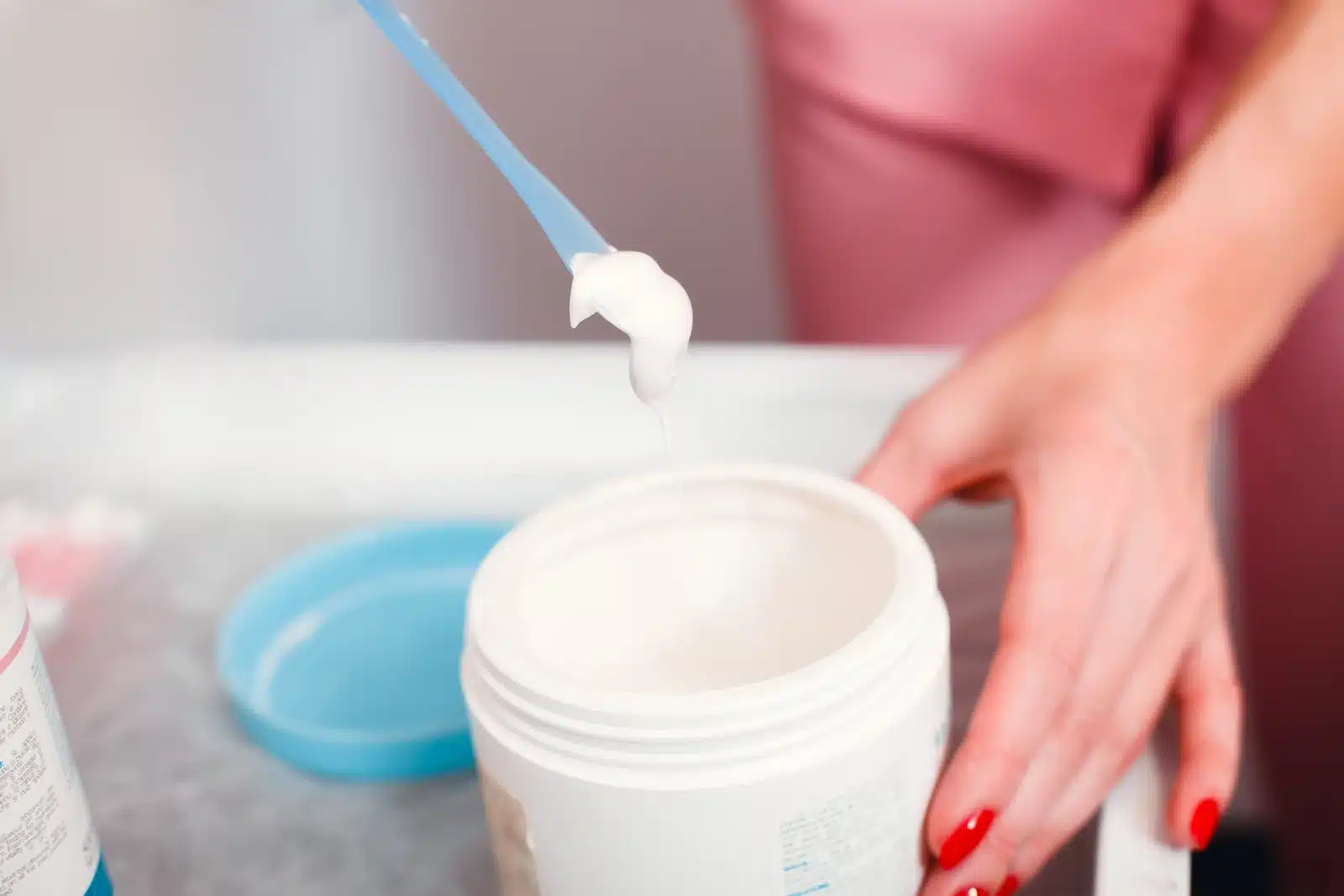
- Use a clean spatula to take product from a jar.
- A pump or tube reduces contact with the contents. It complements a suitable preservation system.
- Refrigeration slows the growth of some microorganisms. A fridge cannot make an unpreserved cream safe.
When to throw a cosmetic away
Discard a product if you see mould, notice an unusual smell or find that it is producing gas. Scraping off the visible patch or reheating it cannot make it safe.
Three ways a cosmetic can change
Appearance offers clues. The formula still needs to be assessed.
Oil or water has separated from the cream. What does that mean?
It is a sign of physical instability. Fixing the emulsion tells you nothing about its protection against microorganisms.
The oil smells rancid. Does it need a preservative?
Rancidity is oxidation. Antioxidants and preservatives serve different purposes. Adding preservative cannot restore an oxidised oil.
The cream looks and smells normal. Is it safe to use?
Appearance alone cannot tell you. Check preservation in relation to the specific formula, process, container and intended use.
How shelf life is established
Shelf life depends on the entire formula, its packaging, storage conditions and use. The date on the honey jar or the most stable ingredient cannot establish a finished product’s expiry date. Manufacturers use testing. The US Food and Drug Administration explains the effects of time, humidity, temperature and handling.
For home use, date each small batch and keep a record of the actual weights, suppliers, ingredient lot numbers, process and container. This helps you identify what changed when a batch behaves differently. A few weeks of observation describe what happened under those conditions. They cannot establish a use-by date.
IN OUR SHOP
If you prefer a ready-made cream
Use the product as supplied and follow the directions for use and storage on its packaging.

Glossary
- Water activity (aw). A measure from 0 to 1 of the water available to microorganisms in a product.
- Anhydrous. Formulated without water. Water or dirt introduced during use can still contaminate it.
- Antioxidant. Slows the oxidation of oils and fats.
- Preservative. Helps inhibit bacteria, yeasts and moulds.
- q.s. Sufficient quantity to bring the formula to the required total. “Water, q.s. to 100” means adding enough water to reach 100%.
- Emollient. Softens the skin and improves how it feels.
- Emulsifier. Helps water and oil stay mixed in an emulsion.
- Preservative efficacy test or challenge test. A laboratory assessment of how well the finished formulation controls microbial contamination.
- Humectant. Attracts and retains water.
- INCI. The standardised name used to identify a cosmetic ingredient. The name itself offers no certification.
Before making a water-containing recipe, check that it identifies the ingredients, their quantities, the preparation method, the required pH and the preservation system. To practise with a simpler formula, try a water-free beeswax and oil ointment or lip balm.


