

At a glance
Lavender honey
Wild lavender (Lavandula latifolia, L. vera) and cultivated lavandin
Colour
White to amberup to 70 mm Pfund for wild lavender
Aroma
Strong lavender aromaphenolic, with vanilla notes in lavandin
Taste
Sweet with tart notessalty if honeydew contributes
Crystallisation
Moderate, often small crystalsintermediate rate of setting
Season
Summerboth profiles
Region
Northern plateauwild lavender and lavandin
Pollen reference
5% and 1.5%two very low pollen thresholds
Sucrose
up to 15%among the highest sucrose limits
Lavender honeys can smell remarkably like the flowers behind them. In Spain the same everyday name covers a harvest from wild lavender and another from lavandin fields grown for essential oils.
The guide describes an especially intense aroma in wild lavender honey and a scent close to lavender blossom in lavandin honey. Smelling the jar is a useful first step before looking at pollen and laboratory results.
The two crops have separate profiles. The difference is particularly striking when a laboratory looks for pollen in honey from cultivated lavandin.
Reading and tasting lavender honey


This Spanish-language field guide compares botanical origin, tasting and laboratory findings. Use the profile together with the traceability of the lot.
Check whether the forage was wild lavender or lavandin
- Record the aroma and whether the crop was cultivated.
- Compare the pollen count with the laboratory marker and the origin.
Wild lavender and the cultivated lavandin hybrid
The guide’s wild-lavender group includes Lavandula latifolia, true lavender (called L. vera in the guide) and their natural hybrids. Cultivated lavandin is a hybrid of L. latifolia and L. angustifolia, selected for essential-oil production. Beekeepers harvest honey during the flowering period before cutting.
| Wild lavender | Cultivated lavandin | |
|---|---|---|
| Plant | Lavandula latifolia, L. vera and natural hybrids | Hybrids of L. latifolia × L. angustifoliaselected for essential oil |
| Colour | up to 70 mm Pfund white to amber | up to 40 mm Pfund pale |
| Conductivity | max. 0.40 mS/cm | at least 0.40 mS/cm |
| Pollen reference | 5% | 1.5% with acetovanillone |
| Aroma | Lavender note particularly intense, with phenolic nuances | Intense and persistent phenolic scent with slight vanilla notes |
| Region | Northern plateau | Northern sub-plateau |
Compare the conductivity limits. Wild lavender has an upper limit of 0.40 mS/cm and lavandin a lower reference of the same value. The two reference limits meet at 0.40 mS/cm. The guide makes a comparable distinction between heather and chestnut at 0.80 mS/cm.
Why lavandin pollen can be scarce
Cultivated lavandin hybrids produce relatively little viable pollen. Under the microscope, the grains may be sparse and incompletely developed.
Cultivated hybrids produce little viable pollen. Grains can be sparse and appear only partly formed. The guide therefore accepts a threshold of 1.5% when the sensory profile matches and the laboratory finds acetovanillone.
At 1.5%, the lavandin threshold is particularly low, even compared with the 8% figures used for some other honeys. This is why the guide also asks for sensory and chemical evidence.
Acetovanillone as a marker of lavandin
Acetovanillone is one of several plant-associated markers used in this series. Other examples include methyl anthranilate in citrus blossom honey and perseitol in avocado honey. A chemical marker is especially helpful where pollen is naturally sparse.
The guide records a slight vanilla-like nuance in lavandin honey alongside its strong phenolic aroma. That tasting note and the laboratory marker are complementary observations.
Colour
Wild lavender ranges from white to amber, up to 70 mm Pfund, and can be darker if honeydew contributes. The lavandin profile is paler, with an upper value of 40.
Lavender honeys on the Pfund scale
The wild lavender profile extends across the three highlighted bands. The lavandin profile covers the two palest of them. On-screen colours are approximate. The laboratory measures actual colour.
Aroma, taste and texture
Sensory profile of wild lavender honey
Our interpretation of the descriptions in the Guía de mieles monoflorales ibéricas. Alongside thyme, heather and eucalyptus, wild lavender ranks among the more intense and persistent aromas in the guide.
Aroma
Wild lavender has a strong and lasting floral lavender aroma with phenolic notes. The lavandin profile has a pronounced, persistent phenolic component, a suggestion of vanilla and a close resemblance to the blossom. Both can become more vivid on the palate.
Taste
Both are sweet with tart notes. A darker wild-lavender honey that includes honeydew may also carry a little saltiness. The guide does not give the pronounced bitterness associated with heather or chestnut.
Crystallisation
Crystallisation is moderate. The grains in lavandin honey are often small. This is between the slow set of acacia and the quicker set of albaida. See our guide to how honey crystallises.
Interpreting the laboratory profile
| Parameter | Wild lavender | Lavandin | How to interpret it |
|---|---|---|---|
| Colour | up to 70 | up to 40 | In mm Pfund. The wild-lavender range is wider, partly because honeydew can contribute. |
| Moisture | up to 18% | up to 18% | Fermentation risk increases above the guide value. The general EU limit for blossom honey is 20%. |
| Fructose and glucose combined | at least 60% | at least 60% | A characteristic of blossom honey. This figure on its own cannot exclude added syrup. |
| Sucrose | up to 15% | up to 15% | A particularly high sucrose allowance, three times the usual maximum. Lavender nectar can be naturally rich in sucrose. |
| Conductivity | up to 0.40 | at least 0.40 | In mS/cm. One is an upper guide value and the other a lower value. |
| Free acidity | up to 50 | up to 50 | In meq/kg. Free acidity can rise during fermentation. |
| HMF | up to 40 | up to 40 | In mg/kg. HMF increases with heat and storage. |
| Diastase | at least 8 | at least 8 | In Schade units. This enzyme is sensitive to heat. |
| Pollen | 5% | 1.5%* | *With acetovanillone and a matching sensory profile. Both pollen thresholds are low. |
Reference ranges from the Guía de mieles monoflorales ibéricas, fourth edition (2023). These characterise the variety. Spanish statutory limits are set by Royal Decree 1049/2003 as amended by Royal Decree 68/2025, including a general maximum of 20% moisture and 40 mg/kg HMF, subject to the exceptions in the legislation.
Why the sucrose allowance is higher
The reference for lavender honeys is up to 15% sucrose, compared with the usual 5%. Lavender nectar can be naturally rich in sucrose. Citrus and certain eucalyptus honeys also have higher allowances, up to 10%. A sucrose measurement needs the botanical origin and the rest of the analysis for interpretation.
Other pollen in lavender honey
- Other mint-family plants
- Daisy family (Asteraceae)
- Legumes
- Rockroses (Cistaceae)
- Oak family, including holm oak and other oaks
Oak-family pollen is consistent with the surrounding woodland. Oak honeydew can darken wild-lavender honey and add a salty note.
Growing areas and harvest season
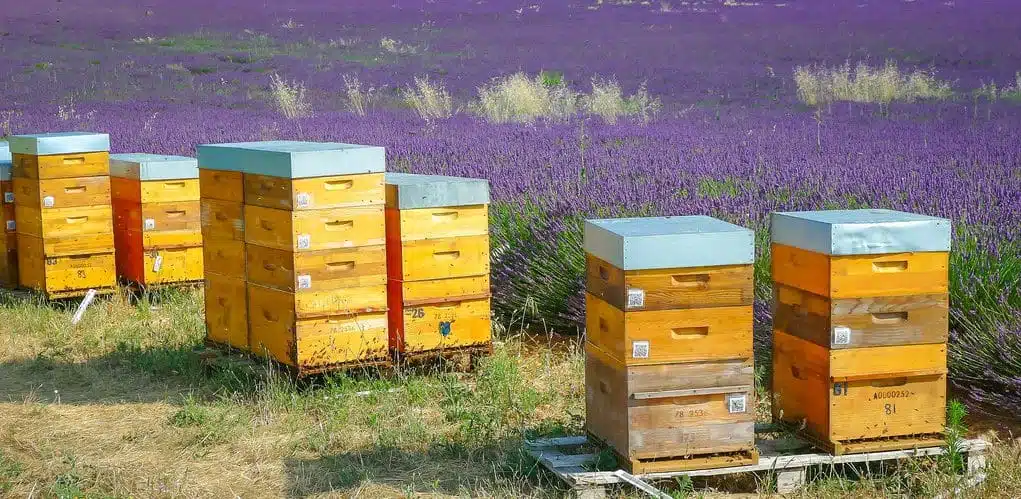
Both profiles describe summer harvests on the Spanish plateaus, wild lavender in open country and lavandin in planted fields. Relevant areas include Guadalajara, Cuenca, Soria, Burgos, the Alcarria and parts of Castile and León.
Lavender honey flows
Flowering Flowering and harvest
The guide places both in summer. Lavandin is cut for distillation once the essential oil is ready, so the foraging window also depends on the harvest date.
How to recognise lavender honey
- 1Look for the lavender aroma. A recognisable floral lavender scent is a central feature. Check its persistence and the rest of the profile.
- 2Taste for acidity. Both are sweet with tart notes. A purely flat sweetness is less typical.
- 3Look for a relatively pale colour. The guide gives up to 70 mm Pfund for wild lavender and 40 for lavandin. A dark sample calls for checking honeydew and other forage.
- 4Read sucrose in context. Up to 15% is permitted for lavender honey. One reading cannot diagnose feeding.
- 5For lavandin, check acetovanillone. Where pollen is as low as 1.5%, sensory and chemical findings support the floral description.
For a broader view, see how to assess honey quality and our guide to Spanish honey labelling requirements.
Composition and health claims
The use of lavender essential oil in fragrance or aromatherapy cannot establish a relaxing or sleep-promoting effect for its honey. These products have different compositions. Food health claims are regulated in the European Union.
The useful differences show up in analysis, tasting and cooking.
- The close resemblance to the smell of lavender blossom is one of the most distinctive features in the guide.
- The guide allows sucrose up to 15%, reflecting the composition of lavender nectar.
- The medium to fine grain gives the set honey a pleasant spreading texture.
- Its aroma suits baking, herbal tea and fresh goat’s cheese, and offers an interesting contrast with lamb.
Who should take particular care?
Children under 12 months. Do not give honey to infants under one year. It can contain spores of Clostridium botulinum that may cause infant botulism. This applies to all types of honey.
Diabetes. honey is a source of sugars. This also applies to natural and monofloral honeys when planning a diet.
Known allergy. Anyone with a diagnosed allergy to honey or bee products should consult their clinician if unsure what is safe for them.
Frequently asked questions
How do wild lavender and lavandin honey differ?
The wild group in the guide includesLavandula latifolia, L. vera and natural hybrids. Its honey reaches 70 mm Pfund with conductivity up to 0.40 mS/cm. Cultivated lavandin is a hybrid selected for essential oils. Its honey is paler, up to 40 mm Pfund. Its guide profile gives conductivity from 0.40 and can include a light vanilla note.
Does lavender honey help with sleep or relaxation?
The composition of the honey differs from that of lavender essential oil. The scent or use of the oil does not demonstrate a sleep or relaxation benefit from eating the honey.
Why is the sucrose limit higher for lavender honey?
Lavender nectar can naturally be rich in sucrose. The relevant maximum is up to 15%, compared with 5% for many other blossom honeys. The botanical origin and the full analysis are needed to interpret a result.
What is acetovanillone and why is it measured?
It is a compound used as a marker in the lavandin profile. Because cultivated hybrids produce little viable pollen, the guide considers the chemical finding and sensory profile alongside a pollen threshold of 1.5%.
What does lavender honey taste like?
Sweet with tart notes and a clear lavender aroma. In wild lavender honey the aroma can be particularly intense and persistent. The scent often becomes stronger during tasting. A darker lot with honeydew can also have salty notes.
Who should take particular care?
Never give honey to a baby under 12 months because of the risk of infant botulism. People with diabetes should count its sugars in their diet. Anyone with a diagnosed allergy to hive products should seek individual medical advice.
Where to buy lavender honey
Ask about the crop and harvest area when choosing a jar from a beekeeper. Our shop carries raw lavender honey harvested in Spain.

Sources
The reference values come from the fourth edition of the Guía de mieles monoflorales ibéricas (June 2023), by J. Orantes, F. Gonell, C. Torres and A. Gómez-Pajuelo, published by Laboratorios Apinevada and Pajuelo Consultores Apícolas. It gives separate entries for wild lavender and lavandin. The printed guide in Spanish is available from our shop.
This profile belongs to our series on Iberian honeys. Compare the phenolic aroma with thyme honey or explore another botanical marker in our orange blossom honey profile.


