

At a glance
Forest honey
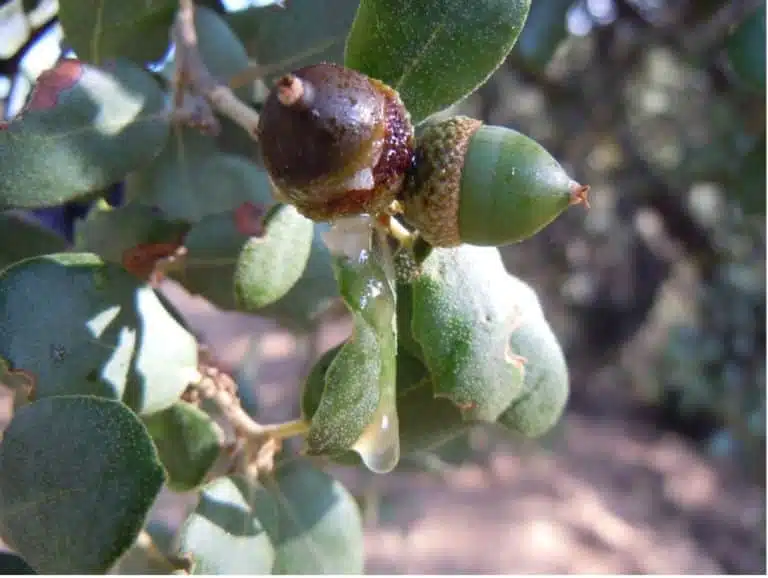
Woodland blossom nectar and honeydew from holm oak and other oaks (Quercus spp.)
Colour
Amber to dark amberat least 90 mm Pfund
Aroma
Maltyreminiscent of toasted cereal
Taste
Sweet and savourydistinct salty notes
Crystallisation
Absent or very slowcan remain fluid for a long time
Season
Late summerafter summer storms
Region
Mountain rangesinland Iberia, beyond the coastal strip
Pollen profile
Crop pollen absentor present only in trace amounts
Conductivity
0.70–0.90 mS/cman intermediate range
The Iberian guide gives forest honey a specific botanical and analytical profile. It describes the forage behind the name as well as the colour of the jar.
“Forest honey” can be used broadly in everyday conversation. Here we use the Iberian guide’s sense: nectar and oak honeydew from a recurring woodland plant community, with a characteristic pollen spectrum.
Reading and tasting forest honey


This Spanish-language field guide compares botanical origin, tasting and laboratory findings. Use the profile together with the traceability of the lot.
Look for blossom and honeydew together
- Record the floral and malt notes separately.
- Compare the spectrum of woodland pollen with the measured conductivity.
What the pollen says about the landscape
Crop pollen absent or present only in trace amounts.
This criterion also occurs in the guide’s separate mountain honey profile. It limits what the pollen spectrum of a woodland lot not can contain. A substantial presence of sunflower, oilseed rape, citrus or other crop pollen warrants a closer look at the source.
Pollen analysis can show whether cultivated plants made a substantial contribution to a sample. The guide expects them to be absent or only trace constituents. Combine the pollen report with apiary locations and harvest records. See why honey pollen is analysed.
How blossom nectar and oak honeydew combine
This honey draws on flowers in the woodland and on honeydew from holm oak and other oaks. Several measurements help place the sample between a typical blossom honey and an oak honeydew honey.
| Blossom honey | Forest honey | Holm oak honeydew honey | |
|---|---|---|---|
| Fructose and glucose combined | at least 60% | at least 45% | at least 45% |
| Conductivity | general limit up to 0.8 mS/cm, with named exceptions | 0.70–0.90 | at least 0.90 |
| Honeydew elements (HDE) | not | present | present |
| Aroma | floral | floral and malty | distinctly malty |
| Crystallisation | variable | absent or very slow | usually absent or very slow |
The conductivity range of 0.70–0.90 in this guide reflects mixed forage, between ordinary blossom profiles and the dark holm oak honeydew profile. For forest honey the guide gives both a lower and an upper reference value honey.
The aroma retains a floral background with a distinct impression of malt. In the guide’s holm oak honeydew profile, the malty character is more dominant.
Colour
Amber to dark amber, at least 90 mm Pfund, with no upper value specified. It shares this minimum with the guide’s holm oak honeydew profile.
Forest honey on the Pfund scale
In the darkest bands, with no upper limit stated. A medium-coloured honey would fall outside this Iberian profile. The colours on screen are indicative. Actual colour is measured in a laboratory.
Aroma, taste and texture
Sensory profile
Our interpretation of the descriptions in the Guía de mieles monoflorales ibéricas. The guide notes moderate persistence, somewhat less than in its holm oak honeydew profile.
Aroma
Floral, with a distinct note of malt or toasted cereal. The aroma is intense and moderately persistent. The malt becomes more evident as the aroma reaches the nose from the palate.
Taste
The taste is sweet with a distinct salty note. The guide uses a minimum of 45% combined fructose and glucose for this mixed profile, compared with 60% for ordinary blossom honeys. These thresholds concern composition. Perceived sweetness must be assessed by tasting.
Crystallisation
The guide describes very slow or sometimes barely visible crystallisation. A forest honey can remain fluid for a long time. Appearance alone does not establish its processing history. See why honey crystallises.
Interpreting the laboratory profile
| Parameter | Reference in the guide | How to interpret it |
|---|---|---|
| Colour | at least 90 mm Pfund | Amber to dark amber, without a stated upper limit. The holm oak honeydew profile starts at the same value. |
| Moisture | up to 18% | Fermentation risk rises as moisture increases. The general Spanish statutory limit is 20%. |
| Fructose and glucose combined | at least 45% | The guide uses the combined-sugars threshold for honeydew and its blends with blossom honey, rather than the 60% blossom-honey minimum. |
| Sucrose | up to 5% | One of the sugars reported in the analysis. |
| Electrical conductivity | 0.70–0.90 mS/cm | A range with both limits, consistent with a mixture of blossom nectar and honeydew. |
| Free acidity | up to 50 meq/kg | Can rise with fermentation or extended storage. |
| HMF | up to 40 mg/kg | HMF increases with heat and time in storage. |
| Diastase activity | at least 8 Schade units | Indicator of enzyme activity, which can decline with heat. |
| Pollen | Crop pollen absent | Or present only in traces. The guide’s mountain honey profile shares this criterion. |
| HDE | Present | Microscopic honeydew indicators include fungal or algal elements. Their abundance can vary with local conditions. |
Reference ranges from the Guía de mieles monoflorales ibéricas, fourth edition (2023). These characterise the variety. Spanish statutory limits are set by Royal Decree 1049/2003 as amended by Royal Decree 68/2025, including a general maximum of 20% moisture and 40 mg/kg HMF, subject to the exceptions in the legislation.
What appears in forest honey?
- Legumes
- Rockroses (Cistaceae)
- Some mint-family pollen
- Heather frequently present
- Bramble
- Honeydew indicators: algae and fungal elements
The pollen reflects scrub, heather and brambles in the woodland. In the Iberian profile, cultivated plants contribute at most traces of pollen.
Growing areas and harvest season
The guide identifies inland Iberia, especially mountain ranges, rather than the coastal strip. Summer moisture and local weather influence when honeydew is available on the oaks and whether this overlaps with flowering plants.
Forest honey flow
Flowering and honeydew Harvest
The guide places it in late summer. The flow varies between years. Woodland flowering and honeydew from Quercus oaks need to overlap, which depends in part on rainfall and local weather.
How to recognise Iberian forest honey
- 1Look for a dark colour. The guide gives at least 90 mm Pfund. A medium-coloured sample falls outside that particular profile.
- 2Look for a malt note. It resembles toasted cereal on a floral background. A purely floral scent suggests a different balance.
- 3Sweetness with a salty undertone. Taste the sample alongside a blossom honey. The guide’s sugar minimum is a compositional threshold, not a sweetness score.
- 4It often stays liquid. Very slow or absent crystallisation is typical.
- 5Check the pollen spectrum and conductivity. The guide gives little or no crop pollen and 0.70–0.90 mS/cm.
For a broader view, see how to assess honey quality and our guide to Spanish honey labelling requirements.
Composition and health claims
The relatively high conductivity is a valid analytical observation. It cannot, by itself, support a health claim about minerals. EU rules govern health claims on foods.
These characteristics matter when tasting or using the honey.
- Its reference conductivity range is 0.70–0.90 mS/cm, substantially higher than for a typical rosemary honey.
- The minimum for combined fructose and glucose is 45%, versus 60% for ordinary blossom honey. It still contributes sugars to the diet.
- Traces or absence of pollen from crops, alongside woodland pollen and honeydew elements, help interpret the origin of the sample.
- Try it with mature cheese, game, rye bread, dark chocolate or a roast-meat sauce.
Who should take particular care?
Children under 12 months. Do not give honey to infants under one year. It can contain spores of Clostridium botulinum, which pose an infant botulism risk. The advice applies to every type of honey.
Diabetes. a less sweet taste does not remove its sugars. Count them in the diet.
Known allergy. uncommon, but possible. Seek individual advice if you have a diagnosed allergy to hive products.
Frequently asked questions
What exactly is Iberian forest honey?
The guide describes a plant-community honey combining woodland flowers with honeydew from holm oak and other oaks (Quercus spp.). The profile gives colour of at least 90 mm Pfund, conductivity of 0.70–0.90 mS/cm, honeydew elements and little or no pollen from cultivated plants.
How does it differ from a multifloral honey?
Multifloral honeys cover many different floral combinations. The Iberian forest profile describes a particular combination of woodland flowers and oak honeydew, with a dark colour, a malty note and very little crop pollen.
How does it differ from holm oak honeydew honey?
Forest honey retains an appreciable floral aroma alongside malt. In the holm oak profile the malt note is more prominent. The forest reference range is 0.70–0.90 mS/cm and the oak honeydew profile starts at 0.90. No one reading proves origin.
Why does my forest honey stay liquid?
Very slow or absent crystallisation is typical in the guide. A jar that stays fluid is consistent with this profile. Fluidity alone does not show whether it was heated or filtered.
Where is forest honey harvested in Spain?
The guide describes inland Iberia, especially mountain woodland, with a late-summer harvest. Local humidity and weather influence the overlap between the woodland flowers and the oak honeydew.
Who should take particular care?
Never give honey to a baby under 12 months because of the risk of infant botulism. People with diabetes should count its sugars in their diet. Anyone with a diagnosed allergy to hive products should seek individual medical advice.
Where to buy forest honey
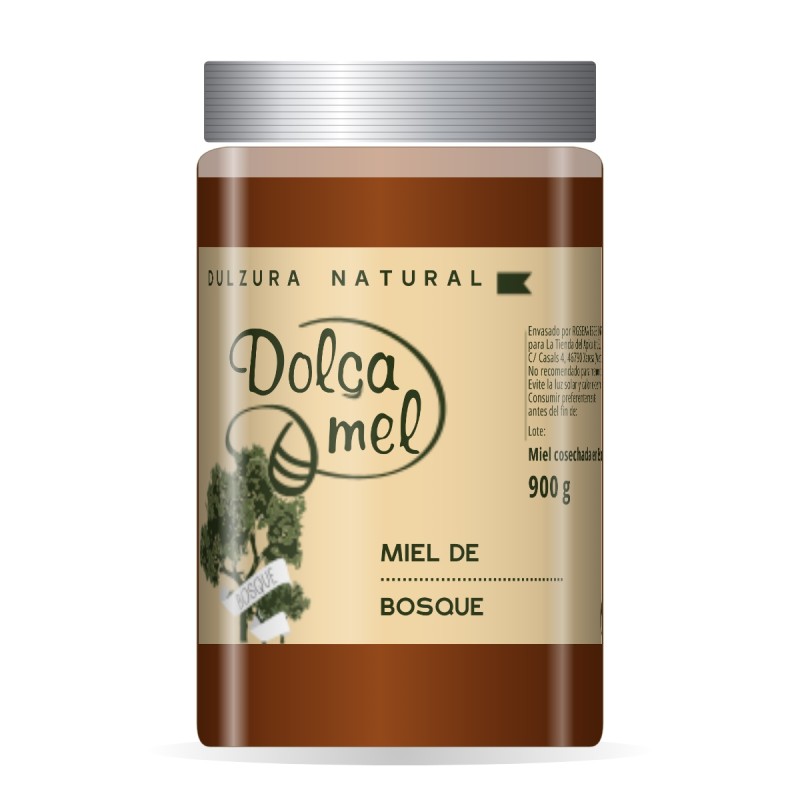
Ask about the apiary and the harvest when choosing a woodland lot. Our shop carries raw forest honey harvested in Spain.
Sources
The reference values come from the fourth edition of the Guía de mieles monoflorales ibéricas (June 2023), by J. Orantes, F. Gonell, C. Torres and A. Gómez-Pajuelo. Laboratorios Apinevada and Pajuelo Consultores Apícolas include forest honey in their plant-community section. The printed Spanish-language guide is available in our shop.
See our series on Iberian honeys. Compare this mixed profile with holm oak honeydew honey, or explore other woodland flavours in heather and chestnut honey.


