

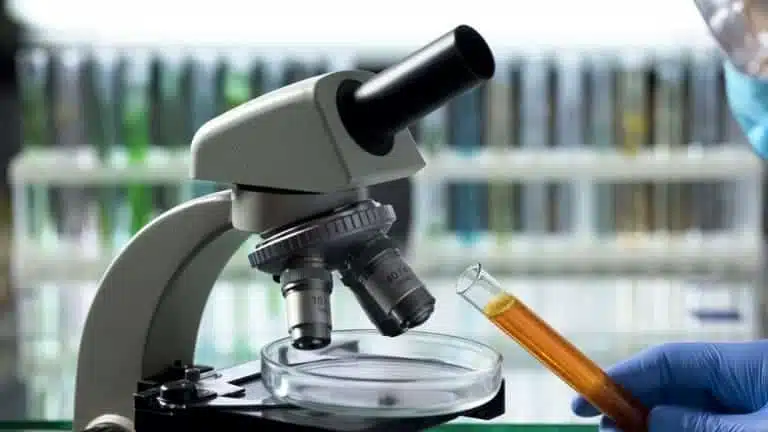
Pollen analysis of honey, or melissopalynology, helps establish whether a honey fits its stated botanical origin. A specialist identifies grains under the microscope and compares the pollen spectrum with the plants in the area, the harvest history and the sensory and physicochemical results.
The analysis in four steps
- Dilution. In the method described here, three parts water are used to one part honey. Dilution reduces viscosity and allows the grains to move more freely.
- Centrifugation. The source laboratory describes 10–20 ml at 2,500–3,000 rpm for 15–20 minutes, depending on the sample. The grains collect at the bottom. Actual centrifugal force also depends on the rotor radius, so laboratories use their validated equipment settings.
- Slide preparation. Glycerine helps the grains swell, gelatin holds them in place, and basic fuchsin makes details of the outer wall more visible.
- Counting. In this example, about 300 grains are identified at 400× magnification and the frequency of each pollen type is calculated.
Further reading on honey pollen analysis

This Spanish-language field guide compares botanical origin, tasting and laboratory findings. Use the profile together with the traceability of the lot.
Keep the sample and its report linked
- Record the apiary, sampling date and lot number.
- Read the whole report before attributing a botanical origin to the honey.
How pollen gets into honey
Honey bees forage on the plants flowering around the apiary (in Spanish). A radius of 1–1.5 km is useful in this field example, although bees can fly considerably farther. Individual bees may gather nectar or pollen (in Spanish). As they visit flowers, their hairs pick up grains, some of which eventually enter the honey.

A pollen grain has a protective wall enclosing the cells and reserves involved in plant reproduction. Its size, shape and the pattern on its outer wall can provide identifying features. A specialist compares these features with reference material, as illustrated by Hesse and colleagues (2009).
Checking the floral origin on the label
People often seek out the honeys of a familiar landscape, whether rosemary or orange blossom from eastern Spain, or heather from the north. How can a laboratory check that a jar really matches that origin?
The choice matters because plants give honeys distinctive colours, aromas and tastes. Their composition, including phenolic compounds, can also differ. Avocado blossom honey is one example of a recognisable sensory and analytical profile for which customers may specifically ask.
When a shopper cannot meet the beekeeper or see the apiary, traceability and testing help support the label. Pollen identifies plants associated with the harvest and can support botanical or geographical origin. Other findings are needed before attributing a particular floral name.
How a laboratory prepares the sample

The authors describe diluting one part honey in three parts water so the pollen can move through the liquid, then centrifuging 10–20 ml (see Louveaux, 1978). The volume and the treatment depend on how much pollen the sample contains and how fragile the relevant grains are.
| Honey sample | Volume used | Speed in the source laboratory | Reason |
|---|---|---|---|
| Honey from supers or a short, intense nectar flow | At least 20 ml | 2,500–3,000 rpm | Relatively little pollen means a larger sample is needed. |
| Honey from a slower flow | 10 ml may be sufficient | 2,500–3,000 rpm | More pollen can be present, so a smaller sample can suffice. |
| Honey containing rosemary pollen | Depends on the sample | Up to 2,500 rpm in the equipment described | Rosemary grains are fragile and can rupture if subjected to excessive centrifugal force. |
The supernatant is removed and the pollen sediment prepared on a slide. Three components have different functions.
- Glycerine helps the grains swell so their features can be seen.
- Gelatin holds the grains in position.
- Basic fuchsin stains the grain, helping to reveal the ornamentation of the outer wall used for identification.

How a pollen specialist learns to identify grains
Training begins with pollen from known plants and a labelled reference collection, a palynotheca. For the Iberian Peninsula, useful references cited by the authors include Carretero (1989) and Valdés (1987). Image databases can also be searched using the plant’s scientific name and the word “pollen”.

Distantly related plants can have clearly different pollen, as in Figures 1 and 3. Closely related plants can be very similar. In Figure 4 the location and length of the spines matter. A list of plants in flower during the season (in Spanish) helps narrow the possibilities.
How to interpret a pollen report
In the example described, the specialist identifies about 300 grains at 400× magnification and calculates the percentage of each type. One important adjustment is needed before relating the percentages to the nectar sources.
Which pollen is left out of the nectar-source calculation?
Plants that contributed pollen but no nectar to the honey are excluded from that part of the calculation. The source gives rockroses and olive among its examples (Louveaux, 1978). Otherwise a prolific pollen producer could appear to have supplied much more nectar than it actually did. The presence of its pollen is still useful to record.
The pollen indicator for a monofloral honey depends on the plant. Citrus and heather cannot be judged against a single percentage because the amount of pollen they contribute relative to nectar differs. Published references include Louveaux (1978), Persano Oddo and colleagues (2004) and the Apinevada–Pajuelo guide (2023).
What the microscope cannot determine alone
Microscopic evidence is one part of the assessment. Spain’s honey standard, Royal Decree 1049/2003, links a floral designation to the honey coming wholly or mainly from the indicated source and having its characteristic sensory, physicochemical and microscopic properties.
| Evidence | What is checked |
|---|---|
| Microscopic | The pollen spectrum and the appropriate plant-specific reference after non-nectar contributions are considered. |
| Physicochemical | Whether the relevant measured values fit the expected profile. |
| Sensory | Colour, aroma and taste characteristic of the claimed source. |
A pollen count alone is insufficient to justify a monofloral label.
Apinevada and Pajuelo Consultores publish the Guía de mieles monoflorales ibéricas, in its fourth edition in 2023. Its profiles are technical references for the main Iberian honeys. The source article reports their use in honey-quality discussions in Spain and elsewhere in the EU. The statutory requirements remain those in the applicable standard.
A real case: what a jar from Castellón revealed
Pajuelo’s laboratory described interpreting honey from a mountain apiary in Castellón. Along the final kilometre to the hives there were rosemary, some French lavender and later thyme. Almond and other fruit trees had flowered earlier. Rockroses were abundant and a large eucalyptus stood beside the road. The beekeeper was unsure whether the bees reached it. This is what the slide revealed.
| What the laboratory found | Reason |
|---|---|
| Rosemary, at a low percentage | The spring had little rain and few bright hours, and the rosemary flowered poorly. The laboratory had seen similar results in rosemary honeys (in Spanish) from dry years. |
| More thyme | It contributed the phenolic aroma typical of thyme honey. |
| Winter-flowering heather and tree heath (Erica arborea) | They flowered around the apiary in spring. |
| Fruit trees, white wall-rocket and wild mustards | These were consistent with nearby smallholdings, orchards and field margins. |
| No almond pollen | The researchers’ likely explanation was that the colony used the early almond stores during spring development. |
| Carob and ling heather (Calluna vulgaris) | Carob was unexpected at the apiary’s altitude. Ling heather was also unusual for the area. |
| Spurges, members of the carrot family, French lavender, a legume and rampion bellflower | Field and roadside plants. The last three were represented in smaller amounts. |
| Eucalyptus | Its pollen helped answer the question about the tree by the road. The blog also has a profile of eucalyptus honey. |
| Bramble, ivy and honeydew elements | The researchers associated these with the previous summer’s apiary in the Maestrazgo of Teruel. |
| Buckthorn, holm oak, kermes oak, olive, rockroses and plantain | These were recorded as pollen-only contributions in the interpretation of this particular case. |
Three observations from the case apply to other harvests.
- A flower seen nearby need not feature in the jar. Almond was visible but missing from the count, while unexpected ling heather appeared.
- The season changes the percentages. A dry spring produced relatively little rosemary pollen in honey from an apiary surrounded by rosemary.
- The sample can carry traces of an earlier location. Bramble, ivy and honeydew from the previous summer in Teruel appeared in the spring honey from Castellón. This is particularly relevant when colonies are moved between flows.
The same laboratory examined larger groups submitted as monofloral honey: 103 possible thyme honeys, 255 rosemary honeys (in Spanish) and 133 citrus blossom honeys. Each group contained pollen from many plants. The linked profiles describe the findings.
Frequently asked questions
What does pollen analysis of honey tell us?
It identifies plants visited by the bees and helps assess the stated botanical and geographical origin. The pollen findings should be read with traceability, tasting and physicochemical analysis before confirming a floral description.
How is a honey pollen analysis carried out?
In the method described here, the laboratory dilutes one part honey in three parts water, centrifuges 10–20 ml for 15–20 minutes using its validated settings, then mounts and stains the sediment. The source laboratory reports 2,500–3,000 rpm on its rotor. About 300 grains are identified at 400× magnification and the relative frequencies calculated.
Is a pollen result sufficient for a monofloral label?
No. Spain’s honey standard requires characteristic microscopic, physicochemical and sensory properties for the declared origin. A pollen threshold alone is insufficient.
Why are some pollen types left out of the calculation?
Some plants can contribute pollen without contributing nectar to the sample. Examples include rockroses and olive. They are recorded but excluded where appropriate from the calculation used to interpret nectar origin.
Why does the laboratory use a lower speed for rosemary?
Rosemary pollen is fragile and can rupture under excessive force. The source laboratory describes a maximum of 2,500 rpm on its rotor to preserve identifiable grains. Laboratories should follow their validated settings for the equipment in use.
Why might the pollen of a nearby flowering plant be missing?
Early stores such as almond may have been consumed while the colony built up. Plants producing pollen alone may be excluded from the nectar-source count. Weather can also limit nectar even where a plant is abundant. Conversely, grains can persist from an earlier site visited by migratory colonies.
Further reading
Apinevada and Pajuelo Consultores Apícolas (2023). Guía de mieles monoflorales ibéricas, 4th edition.
Carretero, J. L. (1989). Análisis polínico de la miel. Ediciones Mundi-Prensa, 124 pp. ISBN 84-7114-230-9.
Hesse, Halbritter, Zetter et al. (2009). Pollen Terminology: An Illustrated Handbook. Springer, Vienna and New York, 268 pp. ISBN 978-3-211-79893-5.
Louveaux, Maurizio and Vorwohl (1978). Methods of melissopalynology. Bee World 59(4), 139–157.
Spanish Ministry of Agriculture, Food Quality Coordination Committee (2023).
Pajuelo Consultores Apícolas (2022). La miel, un paisaje que podemos ver al natural y al microscopio.
Persano Oddo, L. et al. (2004). Main European unifloral honeys: descriptive sheets. Apidologie 35, S38–S81.
Valdés, B., Díez, M. J. and Fernández, I. (1987). Atlas polínico de Andalucía occidental. Instituto de Desarrollo Regional no. 43, Universidad de Sevilla and Diputación de Cádiz, 450 pp. ISBN 84-600-5039-4.


