

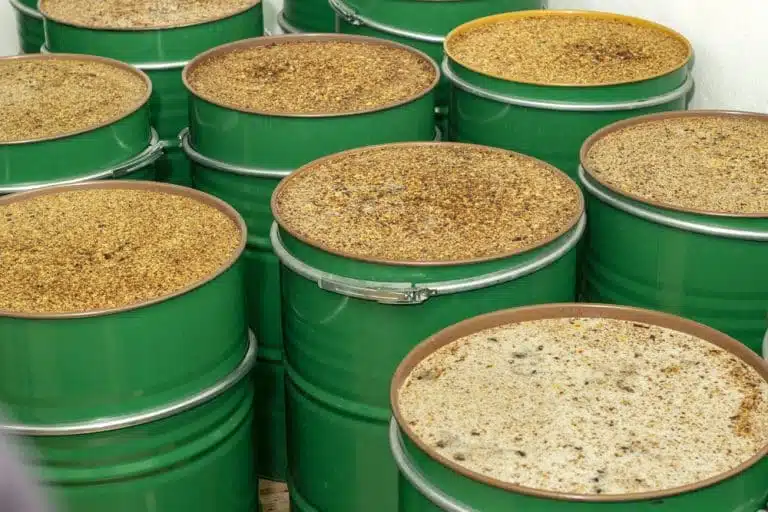
Packers blend suitable lots of honey to meet an agreed specification or to give returning customers a consistent product. Moisture and HMF can be estimated from the mass and composition of each lot. Colour needs an instrument check, and a pollen estimate also requires the total number of grains. Mixing cannot undo heat or storage damage. Test the finished batch against the applicable standards.
What can change when honeys are blended?
| Parameter | Reference | How to check it | Points to watch |
|---|---|---|---|
| Moisture | 17–18% is a common working target. The general Spanish legal maximum is 20%. | Honey refractometer | Spanish Royal Decree 1049/2003 sets out exceptions. Higher moisture increases fermentation risk. |
| HMF | The general maximum is 40 mg/kg, subject to the statutory exceptions. | Validated analytical method or laboratory | HMF usually rises with time and temperature. There is no universal monthly increase. |
| Colour | Consistent with the stated floral origin | Honey colour meter | A little dark honey may alter a pale batch noticeably. Lightening a dark lot takes much more pale honey. |
| Aroma and taste | Characteristic of the stated origin and free from defects | Sensory assessment | A calculation cannot correct a sensory defect. |
| Pollen profile | Depends on the unifloral honey concerned | Pollen analysis | Percentages alone are insufficient. Request the total pollen count for each lot as well. |
Tools for small honey blends


The manual disc mixer can be used for small batches. The twin-paddle shaft is supplied without a motor and needs a compatible 10 mm hex drive. Check the vessel, viscosity and drive before choosing.
Keep a blending record
- Record the input lots, proportions and equipment.
- Verify the finished batch before packing or declaring its origin.
In this guide
- Quality parameters and their limits
- Equipment and methods for blending
- References
Blending is common among small and industrial honey packers alike. It can bring suitable lots closer to a customer’s specification or make successive batches more consistent. Under Spain’s honey quality standard, honey placed on the market must fulfil the composition rules governing the finished product.
A worked blending calculation. If 60% of the blend by weight comes from honey at 16% moisture and the other 40% from honey at 19%, the predicted moisture is 0.60 × 16 + 0.40 × 19 = 17.2%. This assumes a representative analysis of each lot and no gain or loss of water during processing.
In practice, packers generally have one of two aims.
- Bring compliant, released lots together to obtain a more uniform commercial specification. Keep a non-compliant or suspect lot separate for its own assessment, including any signs of contamination, residues or fermentation.
- Offer consumers a consistent product when two suitable harvests differ within their accepted ranges.
Honey quality parameters
EU Honey Directive 2001/110/EC sets compositional requirements for honey. Spain implements them through Royal Decree 1049/2003, as amended. Use the current text for the market and product category concerned.
When planning a blend of suitable lots, the following parameters deserve particular attention.
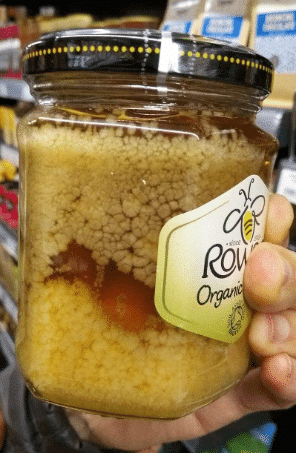
- Moisture. A working target of 17–18% is common. The general Spanish statutory maximum is 20%. Specific exceptions cover ling heather and baker’s honey. Low moisture makes honey more viscous. High moisture can increase the risk of fermentation, particularly if crystallisation leaves a wetter liquid layer on top. Check the final mixture with a honey refractometer.
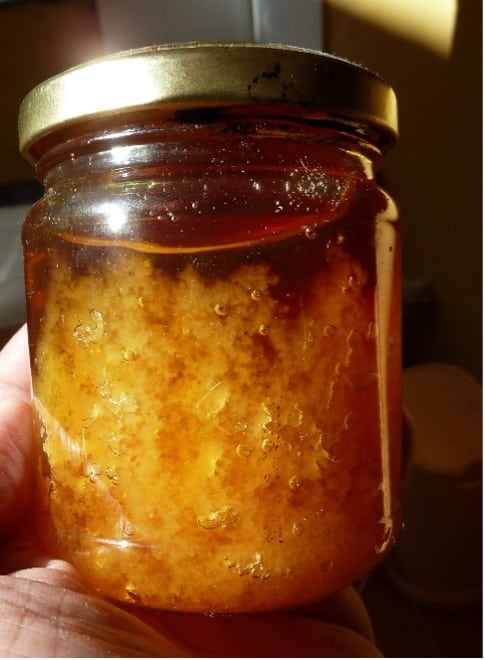
- HMF (hydroxymethylfurfural). HMF forms as sugars degrade. Freshly harvested honey often has a low value, though it cannot be assumed to contain zero. An EFSA scientific assessment describes how storage time, temperature, pH, water activity and composition affect its formation. There is no universal increase of 1.7 mg/kg per month. Under Spain’s honey quality standard, the general limit after processing and blending is 40 mg/kg, with exceptions including baker’s honey and a limit of 80 mg/kg for honey of declared origin from tropical regions and blends of such honeys. A mass-weighted estimate cannot reverse damage or replace testing of the final lot.
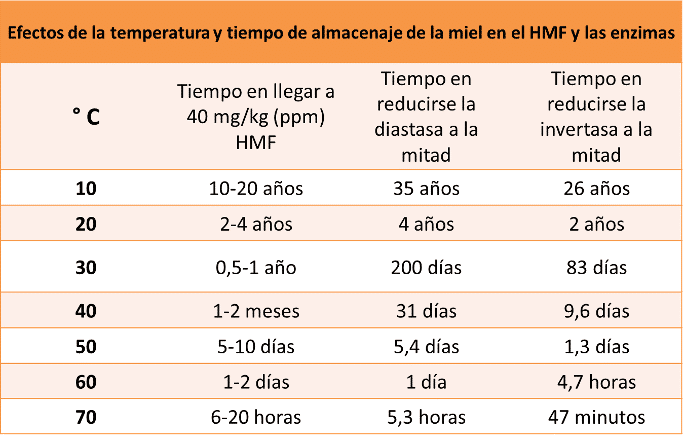
Storage comparison from Bogdanov (2008). The time needed for a change in HMF or enzyme activity depends on the honey’s initial composition and storage conditions. The table illustrates the effect of temperature.
- Colour. A floral description must be consistent with the honey’s sensory, physicochemical and microscopic characteristics. The Spanish decree does not prescribe a colour value for every variety. Published profiles, including Persano and colleagues (2004) and the Apinevada/Pajuelo Iberian guide (2023), provide reference ranges. A little dark honey may noticeably darken a pale lot, while a substantial proportion of pale honey may be needed to move a dark lot appreciably.
- Aroma and taste. A trained taster can compare acceptable lots and adjust the sensory profile. A fermented odour or another defect calls for separate assessment of the lot.
For a mass-based concentration such as moisture, multiply each lot’s fraction of the total mass by its measured value, then add the results. The same example gives 0.60 × 16 + 0.40 × 19 = 17.2% water. HMF mass concentration can be estimated similarly if the mixing process causes no appreciable change. For colour, make a trial blend and measure it. Linear arithmetic on Pfund readings is an approximation.
Use a refractometer covering the honey range for moisture. Determine HMF using an appropriate validated method, such as a suitable reagent-strip system operated within its specified range, or send a sample to a laboratory. Measure colour with a honey colour meter.
- Pollen. Suppose one rosemary honey has 24% rosemary pollen and another 9%, and the desired reference is 12%. The blending ratio depends on the total grains per gram in each lot. If the first lot has very little pollen in total, it contributes fewer rosemary grains than its 24% suggests. Request both relative percentages and absolute counts. In the Maurizio system, class I covers less than 2,000 grains per gram and class V more than 100,000. A small test blend followed by pollen analysis can check the estimate.
Before release, check a representative sample of the homogeneous finished batch. Review HMF, diastase, moisture, sensory characteristics, declared origin, labelling and traceability together.
Equipment and method
Choose the lots and proposed proportions using your own verified measurements, external analyses and sensory assessment. Record the source and mass of each input before starting.
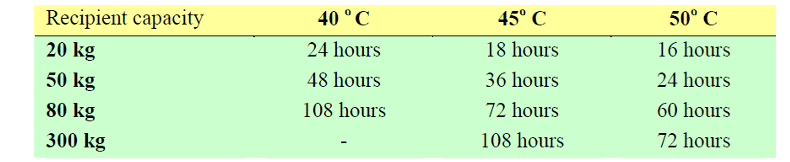
Warm the honey only enough for it to flow and mix. The time required depends on its starting temperature, viscosity, container size and equipment. A water bath or warm-air system may be used as appropriate. Longer or hotter treatment can increase HMF and reduce aroma. Use temperature and time records and verify the finished honey.
Table 2. Bogdanov’s 2008 examples of the time needed for containers of different sizes to reach 40, 45 or 50 °C. The values illustrate the effect of container size and equipment.
Some industrial packers use a brief higher-temperature process to delay crystallisation. Quality depends on the actual time, temperature and honey. Table 1 is a comparison for interpreting the effects of heat, not a validated process for every lot.
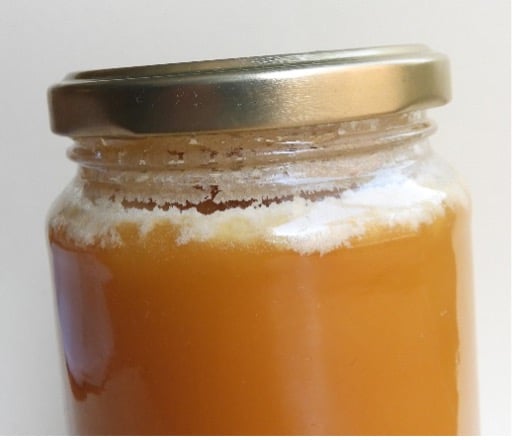
Once the component honeys can flow, use a suitable food-contact vessel with a shaft and paddles that move the honey without drawing in air. Excessive speed or blades that break the surface can entrain bubbles, which rise after packing and may form a white layer at the top of the jar. Keep the paddles submerged and adjust speed to the actual fill level and viscosity.
Honey mixers and homogenising tanks come in several capacities. The time to obtain a uniform batch depends on both the equipment and the product. Verify uniformity with samples from representative positions before packing.


References
- Apinevada and Pajuelo Consultores Apícolas (2023). Guía de mieles monoflorales ibéricas (in Spanish).
- Bogdanov, S. (2008). Storage, Crystallisation and Liquefaction of Honey. Bee Product Science.
- Bosch, J. and Serra i Bonvehí, J. (1986). “Evolución del contenido en HMF en las mieles procesadas y situadas en el mercado español”. <em>Alimentaria</em>, XXIII (175), 59–61.
- Mesa de Coordinación de la Calidad Alimentaria, Spanish Ministry of Agriculture (2023). Harmonised honey quality guidance. The document was subsequently withdrawn from the Ministry portal.
- Persano Oddo and colleagues (2004). Main European unifloral honeys: descriptive sheets.
Frequently asked questions
Is it legal to blend honeys?
Yes. Blending suitable honey lots is a normal packing operation. The finished honey must meet the applicable compositional criteria, retain traceability and carry an accurate label. Check the current origin-labelling rules where it is sold.
What moisture should commercial honey have?
17–18% is a common working target. Spain’s general legal maximum is 20%, with the exceptions listed in Royal Decree 1049/2003. Check the homogeneous final batch with a honey refractometer.
What is the legal HMF limit in honey?
The general maximum after processing and blending is 40 mg/kg. The legislation distinguishes baker’s honey and makes specific provision for honey from declared tropical regions and blends of such honeys. HMF increases with time and heat at a rate that varies between lots.
Can you lighten dark honey by blending it?
The colour of a dark lot can be reduced by adding pale honey, but a large proportion may be needed for a small change. Make a trial blend and measure it before committing an entire lot.
How do you estimate the composition of a blend?
Multiply the measured concentration in each lot by its fraction of the total mass, then add the contributions. This estimates moisture and HMF under suitable conditions. Measure colour directly and include absolute pollen counts when predicting pollen percentages.
Why is pollen difficult to predict?
Each lot contributes a different number of grains per gram. A lot with a high percentage of a particular pollen but few grains overall may have less influence than its percentage suggests.
Further reading
- Moisture in honey and how to measure it
- Filtering honey before packing
- Pollen analysis in honey and the interpretation of origin
- Honey labelling and the information that may be declared


