

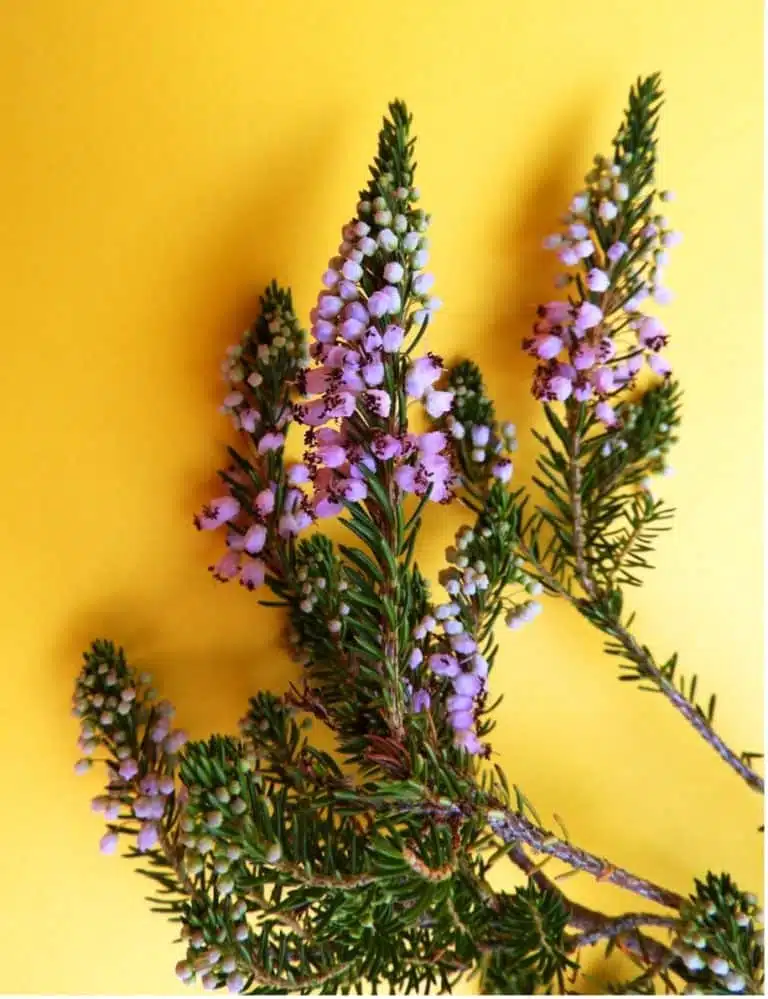
At a glance
Heather honey
Erica species, known locally in Spain as urces
Colour
Amber to dark amber49–114 mm Pfund, sometimes reddish
Aroma
Intense and persistentautumn leaves, humus and mushrooms
Taste
Sweet, bitter and savouryperceived as less sweet than many honeys
Crystallisation
Variabledepends on other forage in the harvest
Season
Summerlate summer for ling heather
Region
Upland heath on siliceous soilsacross the Iberian Peninsula
Pollen reference
30%Erica pollen
Conductivity
0.50 to over 0.80 mS/cmsubstantially higher than rosemary honey
A jar labelled “heather honey” can contain one of two distinct botanical types. Taste, texture and analysis help tell them apart.
If you usually buy rosemary or orange blossom honey, the first spoonful of heather can be a surprise. It is dark, often reddish, and smells like woodland in autumn. The sweetness comes with a noticeable bitterness and a savoury edge. Those flavours belong in its sensory profile.
The common name covers honey from Erica species and honey from ling heather, Calluna vulgaris. Their analytical ranges differ and the difficulty of extracting ling heather honey can affect its price.
Resources for tasting heather honey


The printed guide is in Spanish. Use it to compare sensory, botanical and analytical profiles. For the jar, check its stated origin, processing information and batch.
Distinguish Erica heathers from ling before comparing harvests
- Check the botanical name used for the batch.
- Consider colour, aroma, texture and laboratory findings together.
Erica heathers and ling heather
Both groups belong to the heath family and may grow on the same moorland. The Iberian guide gives them separate profiles, even though their honeys share a common name.
| Heathers (Erica species) | Ling heather (Calluna vulgaris) | |
|---|---|---|
| Spanish local names | Urces | Biércol, brecina |
| Colour | 49–114 mm Pfund | at least 70 mm Pfund |
| Moisture | up to 18% | up to 23% for ling heather |
| Electrical conductivity | 0.50 to over 0.80 mS/cm | at least 0.60 mS/cm |
| Pollen reference | 30% Erica | 8% Calluna |
| Texture | Crystallisation varies with other forage | Glossy, rippled gel |
| On the palate | Sweet, bitter and savoury | Similar flavours with a jelly-like mouthfeel |
| Season | Summer | Late summer |
Two features of the ling heather profile stand out: its higher permitted moisture and its lower pollen reference.
Why the moisture limit is higher for ling heather
The guide sets an 18% moisture reference for most honeys it describes. In Spain the general legal maximum is 20%, while Calluna honey can contain up to 23%. Ling heather honey is thixotropic: it forms a gel at rest and flows when stirred. Its distinctive structure does not remove the need to monitor moisture and fermentation.
That gel helps explain the price. An ordinary centrifugal extractor struggles to empty the cells unless the gel is first loosened, traditionally with a heather honey loosener fitted with pins. Pressing the comb is another option. Both add work per kilogram. See our guide to moisture in honey.
Why the guide gives ling heather an 8% pollen reference
The pollen of ling heather can be under-represented relative to its nectar contribution. The guide uses 8% for ling, compared with 12% for rosemary and 75% for chestnut. A pollen percentage is not a measure of purity. Plants differ in the amount of pollen that enters their nectar and honey. Our rosemary honey profile (in Spanish) includes a comparison.
Colour on the Pfund scale
The guide gives Erica honey a range of 49–114 mm Pfund, often with reddish reflections. A rosemary honey may be as pale as 35 mm Pfund or below. Ling heather starts at around 70 mm and can exceed 114 mm.
Where heather sits on the Pfund scale
The guide gives Erica honey a range of 49–114 mm Pfund, while ling heather can extend into dark amber. The colours shown are screen approximations. An instrument reading provides the actual measurement.
Aroma, taste and texture
Sensory profile
Our interpretation of the descriptions in the Guía de mieles monoflorales ibéricas. The dots represent our comparison of the guide’s written descriptions and are not laboratory scores.
Aroma
Expect a strong, lingering aroma of fallen leaves, humus and mushrooms, reminiscent of damp woodland. Honeydew in the harvest can add malt or toasted-grain notes that become apparent as you taste.
Taste
Alongside the sweetness there is distinct bitterness and a savoury or saline note. The latter can become more pronounced when honeydew is present. It is a useful variety to try if you find lighter honeys too sweet.
Crystallisation
Crystallisation varies with the other forage sources. Meadow legumes can encourage it, whereas honeydew often slows it. Ling heather behaves differently: crystals can form within the gel, giving a distinctive slightly crunchy texture. Our guide to honey crystallisation explains the process.
Interpreting the laboratory profile
| Parameter | Reference in the guide | How to interpret it |
|---|---|---|
| Colour | 49–114 mm Pfund | Usually amber, often with reddish tones. A notably pale sample calls for closer examination. |
| Moisture | up to 18% | Higher moisture can increase the chance of fermentation. The general Spanish legal maximum is 20%, rising to 23% for Calluna honey. |
| Fructose and glucose combined | at least 60% | A characteristic of blossom honey. This figure on its own cannot exclude added syrup. |
| Sucrose | up to 5% | One of the sugars reported in the analysis. |
| Electrical conductivity | 0.50 to over 0.80 mS/cm | Influenced by mineral salts. A useful piece of evidence when assessed with taste and pollen. |
| Free acidity | up to 50 meq/kg | Can rise with fermentation or extended storage. |
| HMF | up to 40 mg/kg | Tends to rise with heat and time. Levels are usually low in freshly harvested honey. |
| Diastase activity | at least 8 Schade units | Indicator of enzyme activity, which can decline with heat. |
| Erica pollen | at least 30% | A botanical reference for the profile. It is not a percentage of nectar or purity. |
Reference ranges from the Guía de mieles monoflorales ibéricas, fourth edition (2023). These characterise the variety. Spanish statutory limits are set by Royal Decree 1049/2003 as amended by Royal Decree 68/2025, including a general maximum of 20% moisture and 40 mg/kg HMF, subject to the exceptions in the legislation.
When chestnut pollen dominates the count
In summer harvests from northern Spain, chestnut pollen can be so over-represented that the count alone suggests chestnut rather than heather. The guide asks the laboratory to consider three criteria together: the expected sensory profile, a value below 400 mg/kg for the marker it calls ácido quinoleico, and electrical conductivity below 0.8 mS/cm. The botanical conclusion rests on the combined results.
Our article on pollen analysis in honey explains what the pollen count adds to other evidence of botanical origin.
Other plants represented in the harvest
- Legumes
- Rockroses (Cistaceae)
- Bramble
- Daisy family (Asteraceae)
- Often honeydew too
Growing areas and harvest season
Iberian heather honeys come from scrubland on acid, often siliceous mountain soils. Rosemary is more typical of limestone country. Important heather areas include Galicia, Asturias, León, Zamora, the Central System and Extremadura. Heaths also occur on suitable soils in Sierra Nevada and other Andalusian ranges.
Heather calendar
Flowering Flowering and harvest
The guide places the main Erica harvest in summer and ling heather in late summer. Different species of Erica flower in succession. Some bloom in spring in particular areas, though the main commercial unifloral harvest described here is a summer one.
How to recognise heather honey
- 1Look at the colour. The profile starts around 49 mm Pfund and often shows a reddish tint. Check a very pale jar against the other evidence.
- 2Smell it. Look for a strong, lingering scent of leaf litter and humus. A faint floral aroma alone is a poor match.
- 3Taste beyond sweetness. Bitterness and a savoury note belong in the profile.
- 4For ling, check the gel. At rest the surface is often glossy and rippled, with a jelly-like feel in the mouth. Stirring changes its consistency.
- 5Ask about conductivity. The guide’s Erica profile starts at 0.50 mS/cm. Compare the result with the pollen, flavour and origin of the batch.
For a broader view, see how to assess honey quality and our guide to Spanish honey labelling requirements.
Composition and health claims
The dark colour and mineral content of heather honey sometimes prompt claims about treating anaemia or urinary infections. Its composition and colour provide no clinical evidence for either use. EU rules require an authorised health claim and its conditions of use before such claims may be made for food.
The analyses and tasting notes do support a number of observations.
- High electrical conductivity. The guide gives 0.50 to over 0.80 mS/cm, well above the rosemary profile. Mineral salts contribute to that measurement.
- Less pronounced sweetness on the palate. Bitter and savoury notes moderate the impression of sweetness without establishing a lower sugar content.
- In a University of Barcelona study of 73 Spanish honeys (2023), heather and honeydew honeys had the highest mean flavonoid values by one assay, above 1.5 mg quercetin equivalents per gram. Heather ranked third in the antioxidant assay behind thyme honey and honeydew honeys. These are laboratory measurements of honey samples. A health benefit from eating them was not tested.
- In the kitchen. Its strong flavour holds its own with mature cheeses, game, rich sauces and rye bread, where a milder honey can get lost.
Who should take particular care?
Children under 12 months. Do not give honey to infants under one year. It can contain spores of Clostridium botulinum that may cause infant botulism. This applies to all types of honey.
Diabetes. Heather honey still contributes sugars, even when its bitterness makes it taste less sweet. Account for it in the dietary plan.
Known allergy. Anyone with a diagnosed allergy to honey or bee products should consult their clinician if unsure what is safe for them.
Frequently asked questions
Why does heather honey taste bitter?
Sweetness, bitterness and a savoury edge are characteristic of this honey. Honeydew in the harvest can make the saline note more noticeable and add a malty aroma.
What is the difference between Erica and ling heather honey?
Heather honey may come from species of Erica , with a guide range of 49–114 mm Pfund and a moisture reference of up to 18%. Ling heather honey comes from Calluna vulgaris , starts around 70 mm Pfund and may contain up to 23% moisture. It forms a glossy gel that flows when stirred.
Why can heather honey be expensive?
The moors can be difficult to reach and yields vary from year to year. With ling heather, loosening the gel in each comb or pressing the comb adds work per kilogram.
Does heather honey crystallise?
It depends on other forage in the harvest. Meadow legumes often encourage crystallisation and honeydew tends to slow it. Ling can form crystals within its gel, giving both a soft and a crunchy sensation.
Can a heather honey appear to be chestnut honey in a pollen count?
Yes. Some northern Spanish summer crops contain disproportionately large amounts of chestnut pollen. The lab interprets the count alongside sensory characteristics, conductivity and the chemical criteria in the guide.
Who should take particular care?
Never give honey to an infant under one year. People with diabetes should count its sugars, and anyone with a diagnosed allergy to bee products should seek individual advice if unsure.
Where to buy heather honey
Buying from a local beekeeper lets you ask about the site, the harvest and the batch. If there is no beekeeper near you, our shop also stocks Spanish raw heather honey.

Sources
The reference ranges come from the fourth edition (June 2023) of the Guía de mieles monoflorales ibéricas by J. Orantes, F. Gonell, C. Torres and A. Gómez-Pajuelo, published by Laboratorios Apinevada and Pajuelo Consultores Apícolas. Their work draws on a series reaching back to 1980 and more than 3,600 analyses a year across the two laboratories. The printed guide in Spanish is available in our shop.
The measurements of flavonoids and antioxidant activity come from Fernández-Estellé and colleagues, “Characterization and Classification of Spanish Honeydew and Blossom Honeys Based on Their Antioxidant Capacity”, published in Antioxidants in 2023.
This article is part of our series on Iberian honeys. Compare heather with chestnut honey, which shares some of its growing areas, or with rosemary honey (in Spanish) for a much paler, milder profile.


