

At a glance
Holm oak and oak honeydew honey
Honeydew from Quercus spp. (mela)
Colour
Very dark amberat least 90 mm Pfund, nearly black
Aroma
Maltyvery intense and persistent
Taste
Sweet and savourydistinct salty notes
Crystallisation
Very slowoften remains liquid
Season
Late summer and autumnafter summer storms
Region
Montane belt600–1,800 m with sufficient moisture
Pollen reference
No floral thresholdhoneydew elements help identify it
Conductivity
at least 0.90 mS/cma high guide minimum
This Iberian guide profile starts with a resource outside the flowers. Understanding what the bees collect helps explain why a beekeeper and a laboratory describe this honey differently from a blossom honey.
The honey is very dark and often glossy, with a lasting malt aroma, relatively restrained sweetness and a salty undertone. It comes primarily from honeydew associated with oaks rather than nectar from their flowers.
The origin affects its composition, the indicators used by laboratories and the name used in Spanish food law.
Reading and tasting holm oak honeydew honey

This Spanish-language field guide compares botanical origin, tasting and laboratory findings. Use the profile together with the traceability of the lot.
Identify the source of the honeydew
- Record the vegetation and the harvest period before comparing jars.
- Read conductivity, colour and the pollen spectrum together.
Honeydew, mela and miel de mielada
Spain’s Royal Decree 1049/2003 uses miel de mielada for honeydew honey. Spanish beekeepers also use mielato and mela, often for the sweet material itself or for the flow. The commercial name miel de bellota, literally “acorn honey”, refers to the association with acorns.
The guide groups holm oak and other oaks under the single heading for honeydew from Quercus species.
Where the sweet material comes from
Many European honeydew flows come from sap-feeding insects, including aphids and scale insects. They feed on the plant and excrete a sugary liquid that bees can collect.
Pajuelo Consultores also report a second route in the Mediterranean areas they studied. In dry summer conditions they observed sweet plant secretions on trees in the oak family, including chestnut and oak, without finding the large insect populations expected under the first explanation.
On holm oak, droplets were often observed at the join between the acorn and its cup.
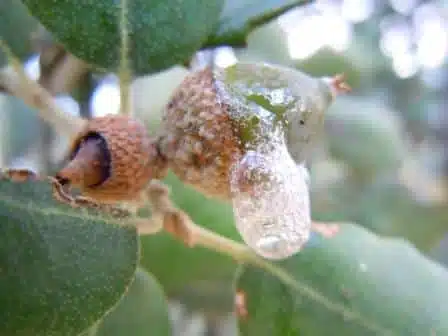
The legal definition allows for both insect excretions and secretions from living plant parts. For holm oak, Pajuelo proposes a particular mechanism: when moisture increases sap pressure, vessels feeding the acorn from its cup may rupture. The acorn would then dry and fall. Locally such acorns are called picadas, or “pricked”. This is a proposed explanation of a field observation, rather than a general mechanism for every honeydew flow.

The field account associates the flows with moderate temperatures and sufficient humidity, from summer storms between July and September or morning dew in mountain areas. Even productive woodland does not yield this crop every year.
What beekeepers observed
Pajuelo compared notes with four professional beekeepers harvesting honeydew, one in southern Galicia, one in the Sierra de Gata and two who move hives from Alicante and Cuenca, as well as with honey specialist Josep Serra i Bonvehí. Their accounts describe when a flow appeared or stopped in those apiaries.
- They looked for aphids on the leaves of the oaks that were yielding droplets and reported finding none on those trees.
- They associated the droplets with the presence of acorns. In years when cold destroyed the acorn crop, they did not observe the same flow.
- One beekeeper reported roughly 30°C by day and 14°C at night during a flow. These are site observations rather than universal temperature thresholds.
- A dry wind could stop collection. A shower could wash away existing droplets, but the beekeepers observed new droplets afterwards. These observations helped prompt the plant-secretion hypothesis.
- Sometimes visible droplets did not attract bees. Serra suggested the proportion of readily available sugars could vary. In the field account, up to 60% of the sap’s carbohydrates could be starch, which bees cannot use as readily as simple sugars. This is a proposed explanation, not a measurement of every flow.
Over decades of pollen analysis and fieldwork, Pajuelo reported seeing aphids produce honeydew in sheltered, irrigated garden firs in a Mediterranean climate and in the Lleida Pyrenees during an unusually wet year. The examples illustrate the importance of the local conditions.
Why can oak honeydew honey be so dark?
Fresh droplets observed on the tree can be clear. Pajuelo’s field account proposes browning reactions, including Maillard-type reactions as the material changes over time, as a contribution to the dark colour and toasted aroma. Colour by itself cannot identify a particular mechanism or origin in an individual lot.
When the droplets become very thick
In dry conditions the material can become too thick for bees to take up easily. The field report describes bees carrying sticky material on the hind legs in a manner reminiscent of propolis collection, and deposits appearing at the entrance. That is an observation in particularly arid sites.
The dark end of the Pfund scale
Very dark amber, at least 90 mm Pfund in the guide, with no upper limit stated. Its minimum is well above the 49 mm figures used for some chestnut and heather profiles.
Oak honeydew honey on the Pfund scale
In the two darkest bands, with no upper value specified. This is among the guide’s highest starting values. The colours on screen are illustrative. A laboratory measures the actual value.
Aroma, taste and texture
Sensory profile
Our interpretation of the descriptions in the Guía de mieles monoflorales ibéricas. The guide places the tendency to set at the bottom of the scale and describes it as usually absent or very slow. In practice individual lots can vary.
Aroma
The malt aroma is intense and persistent. Toasted cereal or dark beer are useful comparisons, sometimes over a faint floral background. The guide treats that impression as a characteristic of the profile.
Taste
The taste is sweet with a pronounced salty undertone, often perceived as less sweet than many blossom honeys. The compositional minimum is 45% fructose and glucose together, compared with 60% for ordinary blossom honey. Actual contents and perceived sweetness vary between lots.
Crystallisation
The guide describes this honey as remaining liquid. In practice a sample may take a very long time to set, and crystallisation is still possible. Fluidity alone tells you little about heating or filtration. See our guide to honey crystallisation.
Interpreting the laboratory profile
| Parameter | Reference in the guide | How to interpret it |
|---|---|---|
| Colour | at least 90 mm Pfund | Very dark amber, with no upper value stated. Among the highest minimums in the guide. |
| Moisture | up to 18% | Fermentation risk rises as moisture increases. The general Spanish statutory limit is 20%. |
| Fructose and glucose combined | at least 45% | A different sugar reference. The ordinary minimum for blossom honey is 60% combined fructose and glucose. Honeydew and blends with blossom honey have a different sugar profile. |
| Sucrose | up to 5% | One of the sugars reported in the analysis. |
| Electrical conductivity | at least 0.90 mS/cm | High conductivity reflects, among other things, the dissolved minerals. |
| Free acidity | up to 50 meq/kg | Can rise with fermentation or extended storage. |
| HMF | up to 40 mg/kg | Tends to rise with heat and time. Levels are usually low in freshly harvested honey. |
| Diastase activity | at least 8 Schade units | Indicator of enzyme activity, which can decline with heat. |
| Pollen | No minimum percentage of oak pollen | The guide expects honeydew elements, with a caveat for dry areas. Floral pollen alone cannot identify oak honeydew. |
| Microscopic criterion | The guide gives a ratio of HDE to pollen grains not exceeding 0.1 | This is the guide’s particular Iberian reference for comparing the elements and grains under a microscope. |
Reference ranges from the Guía de mieles monoflorales ibéricas, fourth edition (2023). These are guide values. Spain’s Royal Decree 1049/2003 separately gives a legal conductivity minimum of 0.8 mS/cm for honeydew honey, subject to the named exceptions.
What are honeydew elements?
In blossom honeys, pollen can help identify the flower source. The guide gives examples of 12% for rosemary, 30% for heather and 75% for chestnut. Its oak honeydew profile sets no minimum for oak pollen. Oak flowers and the honeydew flow occur in different seasons.
Honeydew elements, often abbreviated HDE, include microscopic algae and fungal material incorporated into the honey. The guide notes that they can be apparent at humid sites and scarce or absent at dry sites. A dryland lot therefore needs interpretation in context.
Fungal fragments may come from sooty mould growing on droplets on the leaves. Airborne algae can also stick to the sugary material. Oaks flower in spring, whereas an important part of the oak honeydew flow may occur from mid-August onwards.
Some traditional European criteria used a ratio above three honeydew elements per pollen grain. Pajuelo and colleagues working with the University of Seville examined 59 Spanish samples drawn from beekeepers, cooperatives and packers. The Mediterranean lots often fell well below this ratio. A criterion from humid European regions cannot simply be applied to all Iberian samples.
A study of 58 Spanish oak honeydew honeys identified 23 phenolic compounds. Salicylic acid was the most abundant. Researchers proposed a panel that also included p-coumaric, p-hydroxybenzoic and syringic acids, naringenin and galangin as potential origin markers. This is a laboratory comparison rather than a test available by tasting at home.
Other plants and particles in an oak honeydew sample
- Rockroses (Cistaceae)
- Legumes
- Heather often present
- Bramble
- Honeydew indicators: algae and fungal elements
The guide describes a woodland spectrum with no significant cultivated forage. The accompanying pollen can show which plants were flowering near the apiary.
Growing areas and harvest season
The guide gives a montane range of 600–1,800 metres where enough moisture is available. Summer storms or morning dew can favour a flow. A dry lowland holm oak grove may offer quite different conditions.
Oak honeydew flow
Honeydew flow Flow and harvest
The calendar shows the honeydew flow. The guide places it in late summer and autumn, when summer storms or mountain dew can provide the moisture needed. Availability varies by site and year.
How to recognise Iberian oak honeydew honey
- 1Look for a very dark, glossy honey. The guide gives at least 90 mm Pfund. A lighter sample warrants checking other possible origins.
- 2Look for malt on the nose. A note of toasted cereal is characteristic. An overwhelmingly floral aroma points towards a different balance of nectar and honeydew.
- 3Restrained sweetness and a salty note. Compare it with a typical blossom honey. One tasting impression is insufficient to establish whether a lot was blended.
- 4It often stays liquid. Remaining liquid is common. Fluidity does not establish heating or filtration.
- 5Read the conductivity report. The guide gives at least 0.90 mS/cm. Spain’s ordinary legal minimum for honeydew honey is 0.8 mS/cm, but chestnut and certain other honeys can also have high values.
For a broader view, see how to assess honey quality and our guide to Spanish honey labelling requirements.
Composition and health claims
High mineral content and conductivity are measurable aspects of composition. They do not, by themselves, support therapeutic promises. EU rules govern health claims on foods.
The useful differences show up in analysis, tasting and cooking.
- The guide’s minimum conductivity of 0.90 mS/cm is three times the upper limit it gives for rosemary honey. Minerals are a major influence on conductivity, with acids and proteins contributing too.
- The minimum for fructose and glucose together is 45%, compared with 60% for ordinary blossom honey. It remains a source of sugars in the diet.
- In the studies of 59 Spanish lots, total phenols averaged about 130 mg per 100 g, all were dark, and potassium, phosphorus, magnesium and calcium were among the main minerals measured. In another study of 73 Spanish honeys, honeydew samples had a high polyphenol index and ranked behind thyme honey in the antioxidant-capacity comparison. These are laboratory measurements on samples and cannot establish health effects in people.
- Long-lasting fluidity makes it easy to pour without warming. Heating and prolonged storage can increase HMF and reduce diastase activity.
- Its malt and salt notes suit blue cheese, red meat, roast sauces, rye bread and dark chocolate. It holds its own alongside strongly flavoured ingredients.
Who should take particular care?
Children under 12 months. Do not give honey to infants under one year. It can contain spores of Clostridium botulinum, which may cause infant botulism. The advice applies to honeydew honey as well as other honeys.
Diabetes. a less sweet taste does not remove the sugars. Include them when planning carbohydrate intake.
Known allergy. Anyone with a diagnosed allergy to honey or bee products should consult their clinician if unsure what is safe for them.
Frequently asked questions
Does holm oak honeydew honey come from oak blossom?
Its principal source is honeydew associated with oaks. Sap-feeding insects can produce honeydew, and sweet plant secretions are also recognised. Pajuelo’s Mediterranean field observations describe droplets appearing at the join between the acorn and its cup.
Do mielato, mela and miel de mielada mean the same thing?
They are related Spanish expressions. Miel de mielada is the statutory name for honeydew honey. Mielato and mela can refer to the sweet substance or flow in everyday beekeeping. Some retail labels use miel de bellota, literally acorn honey.
Why is oak honeydew honey nearly black?
Dark amber colour is characteristic of this profile, with a guide minimum of 90 mm Pfund. Fresh droplets can be much lighter. Pajuelo proposes that browning reactions over time contribute to colour and malt notes. Colour alone cannot explain the history of an individual batch.
Why can it remain liquid so long?
The guide describes a very low tendency to crystallise. It has a different sugar composition from many blossom honeys. A liquid jar may be perfectly consistent with that origin, and does not by itself indicate heating or fine filtration.
How is honeydew origin assessed without an oak pollen threshold?
Laboratories examine honeydew elements, including microscopic algal and fungal material, and the wider pollen spectrum, conductivity and other findings. Dryland samples may contain few honeydew elements. High conductivity by itself is insufficient, as chestnut honey can also have high readings.
Why are good oak honeydew years intermittent?
Beekeepers interviewed by Pajuelo linked local flows with acorns, moderate temperatures, summer humidity and the absence of drying winds. They sometimes observed droplets that did not attract bees. These are field observations rather than a reliable forecast for every woodland.
Who should take particular care?
Never give honey to babies under 12 months because of infant botulism risk. People with diabetes should count the sugars even when the honey tastes less sweet. Anyone with a diagnosed allergy to hive products should seek individual medical advice.
Where to buy holm oak honeydew honey
Our shop offers holm oak honeydew honeycomb harvested at about 1,500 metres in the Sierra Norte de Guadalajara. If you prefer a woodland honey with a more noticeable floral contribution, see our raw forest honey.
Sources
The profile values are from the fourth edition of the Guía de mieles monoflorales ibéricas (June 2023), by J. Orantes, F. Gonell, C. Torres and A. Gómez-Pajuelo, published by Laboratorios Apinevada and Pajuelo Consultores Apícolas. The acorn observations and proposed mechanism come from Pajuelo’s fieldwork. Photographs are by P. Lobez and Pajuelo. The printed Spanish guide is available in our shop.
Pajuelo published the field observations in Mielatos de encina y roble in March 2021. The Spanish samples are described by A. Terrab and colleagues in Palynological and geographical characterisation of Spanish oak honeydew honeys and M. J. Jara-Palacios and colleagues in Physicochemical properties, colour, chemical composition, and antioxidant activity of Spanish Quercus honeydew honeys. For the 58-sample phenolic study, see D. Hernanz and colleagues in LWT (2023). The comparison with other Spanish honeys is by M. Fernández-Estellé and colleagues in Antioxidants (2023).
See the rest of our series on Iberian honeys. Compare the dark, strong character with chestnut honey and heather honey. Rosemary honey (in Spanish) provides a much paler, milder contrast.


