

At a glance
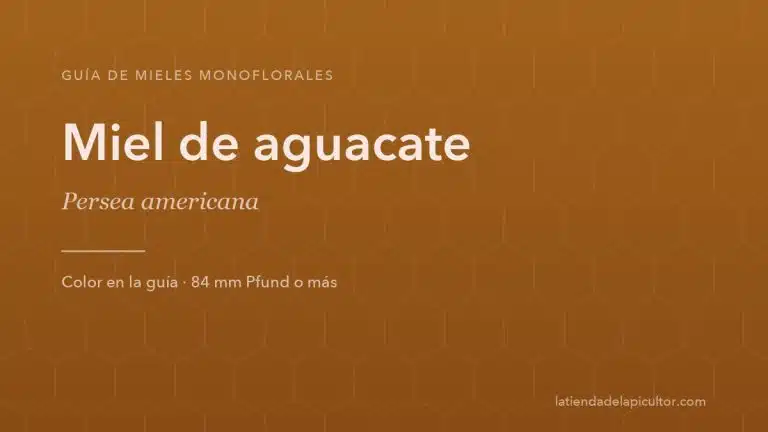
Avocado blossom honey
Persea americana
Colour
Almost blackat least 80 mm Pfund
Aroma
Floral and fruitywithout a malt note
Taste
Sweet and savourydistinct salty notes
Crystallisation
Slow, sometimes unevenwith relatively high moisture
Season
Late springApril to June
Region
Granada and MálagaSpain’s subtropical coast
Pollen reference
25%possibly less with the required perseitol
Chemical marker
Perseitol ≥0.2%a laboratory marker
Almost black, only moderately sweet and a little salty. Avocado blossom honey looks and tastes quite different from the pale flesh of the fruit.
The colour comes as a surprise. Avocado blossom can produce a very dark amber honey, almost black in the jar. The Iberian guide gives at least 80 mm Pfund, a range that can overlap with honeydew honeys.
This colour overlap makes identification by sight unreliable. Tasting and a laboratory marker provide two further clues.
Reading and tasting avocado blossom honey


This Spanish-language field guide compares botanical origin, tasting and laboratory findings. Use the profile together with the traceability of the lot.
Use more than the dark colour
- Compare fruit and malt notes while tasting.
- Read perseitol together with the pollen results and harvest records.
Distinguishing dark blossom honey from honeydew
A very dark Spanish honey might be holm oak honeydew honey, a forest honey or a dark chestnut honey. Avocado can look similar, but its aroma in the Iberian profile is quite different.
The guide describes a floral aroma with distinct fruit notesand no malt note.
. Honeydew often evokes malt or toasted cereals. Avocado honey, despite its dark colour, smells fruity. The aroma is one useful difference to assess before looking at the laboratory results.
Perseitol as a botanical marker
The guide gives a reference of at least 0.2% perseitol, a sugar alcohol associated with the genus Persea. It is another example of a chemical marker used alongside pollen, as methyl anthranilate is in citrus honey.
The guide’s usual pollen threshold is 25%. It makes provision for a lower count where the sensory profile matches and perseitol reaches the stated level. A laboratory should read those findings together.
Colour
Very dark amber, sometimes almost black, from 80 mm Pfund upwards. This puts avocado among the guide’s darker honeys.
Avocado honey on the Pfund scale
In the dark bands, with no stated upper limit. A pale colour would fall outside this guide’s profile. On-screen colours are approximate. A laboratory measures the actual value.
Aroma, taste and texture
Sensory profile
Our interpretation of the descriptions in the Guía de mieles monoflorales ibéricas. The dots represent our comparison of the guide’s written descriptions and are not laboratory scores.
Aroma
Floral with distinct fruit notes and without the malty impression common in honeydew honey. Colour may suggest one profile while the nose points towards the other.
Taste
The taste is sweet with salty notes. Its body and savoury undertone set it apart from many pale blossom honeys.
Slow or uneven crystallisation
The guide describes slow crystallisation, sometimes uneven, and notes that samples can have relatively high moisture, at or above 18.5%.
A more liquid layer may form above coarse or uneven crystals. The guide’s reference is up to 18.5% moisture, half a percentage point above most of its profiles. The general EU legal limit for ordinary blossom honey is 20%.
An uneven set can occur naturally, but higher moisture also increases the risk of fermentation. Keep the jar tightly closed and check the condition of the lot if other changes appear. See our guide to moisture in honey.
Interpreting the laboratory profile
| Parameter | Reference in the guide | How to interpret it |
|---|---|---|
| Colour | at least 80 mm Pfund | Very dark, with no upper colour limit given. Holm oak honeydew is another honey at the dark end of the scale. |
| Moisture | up to 18.5% | Half a percentage point above the guide’s usual reference. Some lots can have relatively high moisture. |
| Fructose and glucose combined | at least 60% | Consistent with a blossom honey despite its dark colour. |
| Sucrose | up to 5% | One of the sugars reported in the analysis. |
| Electrical conductivity | at least 0.80 mS/cm | The guide presents a high lower reference. For sale as blossom honey, Spain’s ordinary 0.8 mS/cm upper limit applies to avocado, which is not among the named exceptions. |
| Free acidity | up to 50 meq/kg | May rise during fermentation. Relatively high moisture warrants particular attention. |
| HMF | up to 40 mg/kg | HMF increases with heat and time in storage. |
| Diastase activity | at least 8 Schade units | Indicator of enzyme activity, which can decline with heat. |
| Perseitol | at least 0.2% | A sugar alcohol associated with Persea honey. |
| Persea pollen | at least 25% | A lower pollen count may be accepted in the guide profile if the sensory findings fit and the perseitol criterion is met. |
Reference ranges from the Guía de mieles monoflorales ibéricas, fourth edition (2023). These characterise the variety. Spanish statutory limits are set by Royal Decree 1049/2003 as amended by Royal Decree 68/2025, including a general maximum of 20% moisture and 40 mg/kg HMF, subject to the exceptions in the legislation.
Other pollen in avocado blossom honey
- Legumes
- Some mint-family plants
- Rockroses (Cistaceae)
- Daisy family (Asteraceae)
Growing areas and harvest season
On Spain’s southern coast, the guide identifies the avocado-growing areas of Granada and Málaga. As with citrus blossom honey, the harvest follows orchard flowering and the area planted, as well as the weather during the flow.
Avocado honey flow
Flowering Flowering and harvest
The guide places the main harvest in late spring. Large numbers of flowers open in the orchards. Bees visiting them also contribute to pollination.
How to recognise avocado blossom honey
- 1Look for a very dark colour. The guide gives at least 80 mm Pfund. A pale honey falls outside the profile.
- 2Look for fruit on the nose. A dominant malt or toasted-cereal aroma is more characteristic of honeydew. Consider it with the full analysis.
- 3Taste for a salty undertone. The sweetness is accompanied by salty notes.
- 4An uneven set can occur. Higher moisture can produce an uneven set in this honey.
- 5Check the perseitol result. The guide uses at least 0.2% as a botanical marker, including where a lower pollen count occurs and the sensory profile matches.
For a broader view, see how to assess honey quality and our guide to Spanish honey labelling requirements.
Composition and health claims
High conductivity is a measurable feature of the profile. It does not support broad health promises about minerals. Food health claims in the EU are subject to their own rules.
These characteristics matter when tasting or using the honey.
- The guide gives a conductivity reference of 0.80 mS/cm, also the ordinary upper legal limit for non-exempt blossom honeys.
- Its salty undertone gives an alternative to the straightforward sweetness of many blossom honeys.
- Bees that visit the flowers also help pollinate a valuable orchard crop on Spain’s subtropical coast.
- Try it with mature cheese, grilled meat, roast vegetables or a savoury glaze. It also makes a striking topping for avocado on toast.
Who should take particular care?
Children under 12 months. Do not give honey to infants under one year. It can contain spores of Clostridium botulinum, which pose a risk of infant botulism. This advice applies to every type of honey.
Keep the jar tightly closed. A relatively high moisture content increases its susceptibility to fermentation. Store it away from humidity.
Diabetes. honey contributes sugars and should be counted accordingly.
Known allergy. uncommon, but possible. If you have a diagnosed allergy to hive products, seek individual medical advice.
Frequently asked questions
Why is avocado blossom honey so dark?
The Iberian profile is very dark amber, close to black, from 80 mm Pfund. The pale colour of the edible fruit says little about the honey, which comes from the nectar of the flowers.
How can it be distinguished from a dark honeydew honey?
The aroma offers one clue. Honeydew often evokes malt or toasted cereal. The guide describes avocado honey as floral and fruity, with no malt note. The usual combined fructose and glucose minimum is 60% for blossom honey and 45% for honeydew honey.
What is perseitol?
A sugar alcohol associated with the genus Persea that can enter the honey and help identify its botanical origin. The guide uses at least 0.2% and allows some samples below 25% avocado pollen where the marker and sensory profile agree.
Why has my avocado honey crystallised unevenly?
This can occur naturally. The honey often sets slowly and relatively high moisture can lead to coarse crystals or separation. The guide’s reference is up to 18.5% moisture. Check storage and the condition of the individual lot.
Where is avocado blossom honey harvested in Spain?
The guide identifies Andalusia, particularly the avocado orchards on the coast of Granada and Málaga, with a late-spring harvest.
Who should take particular care?
Never give honey to a baby under 12 months because of the risk of infant botulism. People with diabetes should count its sugars in their diet. Anyone with a diagnosed allergy to hive products should seek individual medical advice.
Where to buy avocado blossom honey
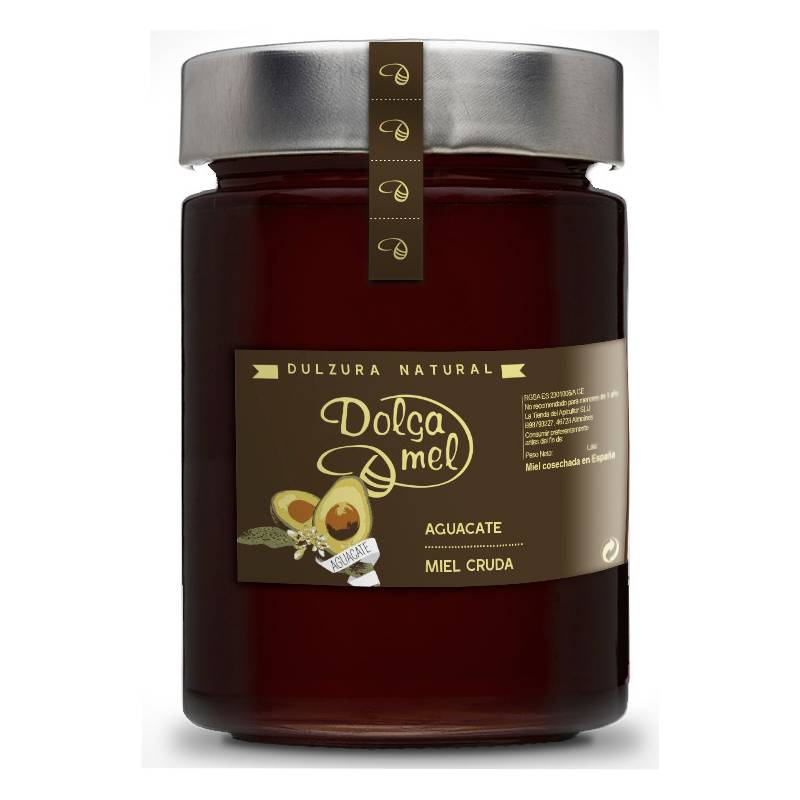
Buying from an identifiable beekeeper makes the lot easier to trace to its harvest. In our shop you can find raw avocado blossom honey harvested in Spain.
Sources
The sensory and laboratory references come from the fourth edition of the Guía de mieles monoflorales ibéricas (June 2023), by J. Orantes, F. Gonell, C. Torres and A. Gómez-Pajuelo, published by Laboratorios Apinevada and Pajuelo Consultores Apícolas. The printed Spanish-language guide is available in our shop.
This entry is part of our series on Iberian honeys. At a tasting, compare it with holm oak honeydew and chestnut honey for colour, or with citrus blossom honey for another example of a chemical marker.


