

At a glance
Blackberry blossom honey
Rubus spp. · bramble, blackberry
Colour
Light amber to amber49–90 mm Pfund
Aroma
Fruity and intenseearthy with heather
Taste
Sweet and tartsalty notes with honeydew
Crystallisation
Rapidsometimes separating in layers
Season
Late summerafter the main scrubland flows
Region
Montane beltplateaus and mountain ranges
Pollen reference
>45%strictly greater than 45% in the guide
Conductivity
up to 0.60 mS/cmmoderate
Bramble grows along tracks throughout Spain, and its pollen occurs in many woodland honeys. Far fewer jars are sold under its own floral name.
It occurs as a companion plant in profiles such as heather, chestnut and holm oak honeydew honey. When bramble nectar predominates, it gives a honey with a distinctly fruity aroma.
Reading and tasting blackberry honey

This Spanish-language field guide compares botanical origin, tasting and laboratory findings. Use the profile together with the traceability of the lot.
Link the taste to the woodland forage
- Record the fruit and tart notes with any signs of honeydew.
- Keep the moisture reading and harvest area with the lot.
Why the guide says “more than 45%”
The wording matters when interpreting a pollen report. For blackberry the guide uses a strict “greater than” sign.
Minimum pollen proportions: Rubus spp. >45%.
The threshold is above 45%, not 45% inclusive. Bramble contributes abundant pollen and occurs in many Iberian woodland honeys. Interpret the count alongside the sensory profile.
A honey that recalls blackberries
Like loquat honey, blackberry honey can recall the fruit of its plant. The guide describes a floral aroma with an intense, moderately persistent fruity note that becomes more apparent during tasting.
Other woodland forage can change the profile. Heather can add forest-floor and malt notes. Heather and honeydew can bring saltiness, and honeydew can deepen the colour.
Colour
Light amber to amber, from 49 to 90 mm Pfund. A larger honeydew contribution generally gives a darker sample.
Blackberry honey on the Pfund scale
In the middle-to-darker range. Honeydew can influence the colour within this band. The on-screen colours are approximate. The actual value is measured in the laboratory.
Aroma, taste and texture
Sensory profile
Our interpretation of the descriptions in the Guía de mieles monoflorales ibéricas. The bitterness and acidity row reflects the distinct tartness described in the guide.
Aroma
Floral with an intense fruity note of moderate persistence. With heather in the flow, earthy and malty impressions may also appear.
Taste
Sweet with distinct acidity, sometimes with salty notes from heather or honeydew. The tartness is a useful comparison with orange blossom and thyme honey.
Crystallisation
The honey can crystallise quickly, with a more liquid layer above the crystals when moisture is relatively high. As with avocado, strawberry tree and loquat honey, texture and measured moisture are best considered together. The Iberian profile gives up to 18.5% moisture.
Interpreting the laboratory profile
| Parameter | Reference in the guide | How to interpret it |
|---|---|---|
| Colour | 49–90 mm Pfund | Light amber to amber. Darker with a larger honeydew contribution. |
| Moisture | up to 18.5% | Half a percentage point above the guide’s usual value. Some lots have relatively high moisture. |
| Fructose and glucose combined | at least 60% | A characteristic of blossom honey. This figure on its own cannot exclude added syrup. |
| Sucrose | up to 5% | One of the sugars reported in the analysis. |
| Electrical conductivity | up to 0.60 mS/cm | Moderate. A higher reading may suggest a larger honeydew or heather contribution. |
| Free acidity | up to 50 meq/kg | Worth checking when moisture is high. Free acidity in a laboratory report is distinct from tartness in the mouth. |
| HMF | up to 40 mg/kg | HMF increases with heat and time in storage. |
| Diastase activity | at least 8 Schade units | Indicator of enzyme activity, which can decline with heat. |
| Rubus pollen | >45% | The guide uses a strictly greater-than threshold. |
Reference ranges from the Guía de mieles monoflorales ibéricas, fourth edition (2023). These characterise the variety. Spanish statutory limits are set by Royal Decree 1049/2003 as amended by Royal Decree 68/2025, including a general maximum of 20% moisture and 40 mg/kg HMF, subject to the exceptions in the legislation.
Other forage in blackberry honey
- Legumes
- Daisy family (Asteraceae)
- Heathers
- Honeydew
- Chestnut in some areas
Growing areas and harvest season
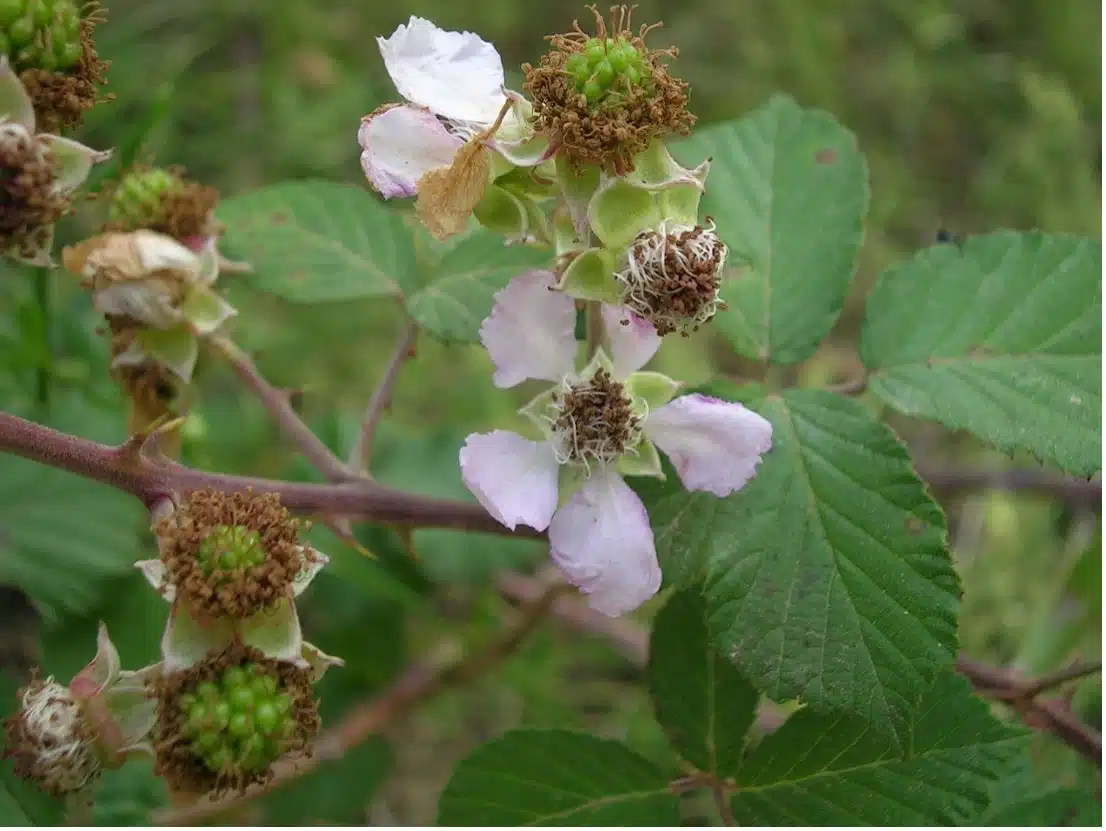
The guide describes a late-summer flow in the mountains of the two central plateaus and the northern and southern ranges. Bramble flowers along moist woodland margins, riverbanks and clearings, often after the main aromatic-scrub flows.
Blackberry honey flow
FloweringFlowering and harvest
The guide places the main harvest in late summer. It follows thyme and spike lavender and can overlap with honeydew from Quercus, helping explain the frequent contribution of honeydew.
How to recognise blackberry blossom honey
- 1Look for fruit notes. A strong fruity component distinguishes the aroma. A purely generic floral scent is less typical.
- 2Taste for acidity. Distinct tartness is part of the description.
- 3Between 49 and 90 mm Pfund. Darker examples can include more honeydew.
- 4Separation into layers can occur. Relatively high moisture can contribute to this behaviour.
- 5Compare conductivity with 0.60 mS/cm. Above the guide value, consider whether honeydew or heather contributed more strongly and look at the complete analysis.
For a broader view, see how to assess honey quality and our guide to Spanish honey labelling requirements.
Composition and health claims
Health claims on food are regulated in the EU. The distinguishing features here are its floral origin, conductivity and sensory profile.
These characteristics matter when tasting or using the honey.
- Its aroma can recall the fruit itself, as in loquat honey.
- The tart note balances sweetness and lends itself to a range of food pairings.
- This profile comes from wild montane forage in late summer.
- Try it with dairy foods, red berries, tart pastries and goat’s cheese.
Who should take particular care?
Children under 12 months. Do not give honey to infants under one year. It can contain spores of Clostridium botulinum that may cause infant botulism. This applies to all types of honey.
Diabetes. honey is a source of sugars. This also applies to natural and monofloral honeys when planning a diet.
Known allergy. Anyone with a diagnosed allergy to honey or bee products should consult their clinician if unsure what is safe for them.
Frequently asked questions
Does blackberry blossom honey taste of blackberries?
The aroma can recall the fruit. The guide describes a strong fruity note with moderate persistence that develops on the palate. Loquat honey is another Iberian example where the aroma recalls the fruit.
Why has my blackberry honey separated into layers?
It can crystallise quickly and relatively high moisture can encourage separation. The guide gives up to 18.5% moisture. Keep the jar closed and check the moisture and condition of the lot if fermentation is suspected.
Why does the guide use “more than 45%” for pollen?
It specifies a strict greater-than value for Rubus. Bramble sheds plenty of pollen and is often present in Iberian woodland honeys. A substantial percentage and a matching sensory profile help distinguish a monofloral harvest.
When is blackberry honey harvested?
Late in summer, after many aromatic shrubs have finished flowering. The flow may overlap with honeydew from holm oak and other oaks, which can darken the honey.
Who should take particular care?
Never give honey to a baby under 12 months because of the risk of infant botulism. People with diabetes should count its sugars in their diet. Anyone with a diagnosed allergy to hive products should seek individual medical advice.
Where to buy blackberry blossom honey
We do not currently stock monofloral blackberry honey. Much of the bramble crop forms part of forest or multifloral honey. Ask beekeepers at montane apiaries in the north or south of Spain about individual lots. For another woodland profile, see our raw forest honey.
Sources
The reference ranges come from the fourth edition (June 2023) of the Guía de mieles monoflorales ibéricas by J. Orantes, F. Gonell, C. Torres and A. Gómez-Pajuelo, published by Laboratorios Apinevada and Pajuelo Consultores Apícolas. Their work draws on a series reaching back to 1980 and more than 3,600 analyses a year across the two laboratories. The printed guide in Spanish is available in our shop.
Explore our series on Iberian honeys. Compare the fruit notes with loquat honey and the accompanying woodland forage with heather and forest honey.


