

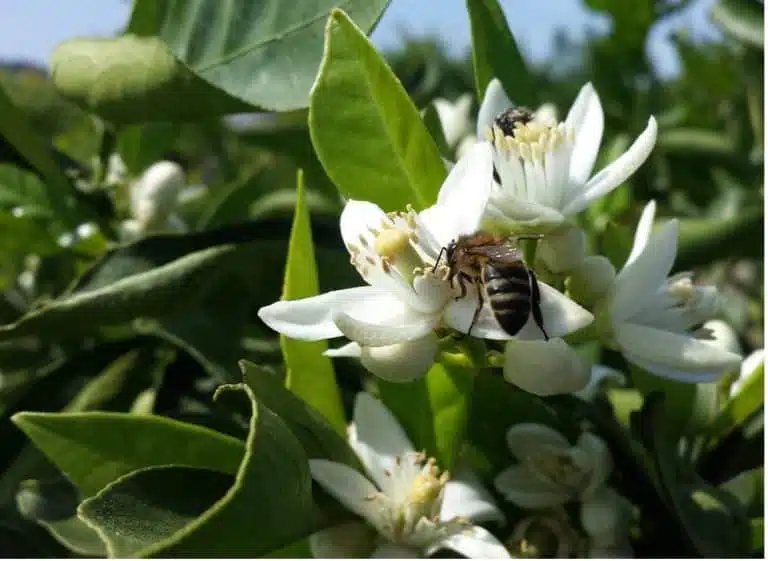
Quick profile
Orange blossom honey
Citrus spp. · orange, mandarin and lemon
Colour
Paleup to 45 mm Pfund
Aroma
Orange blossomintense and persistent
Taste
Sweet and tangypronounced acidity
Crystallisation
Slow and finecoarser with white wall-rocket
Season
Springshort, intense flowering
Region
Andalusia and eastern Spainsouth-western and eastern coasts up to the Ebro
Pollen reference
15%Citrus pollen
Chemical marker
Methyl anthranilate ≥ 1.2 ppmspecified in the Iberian guide
A freshly opened jar can smell remarkably like an orange tree in flower. Yet pollen alone can be a poor clue to where the nectar came from. One reason is the way seedless oranges have been bred.
Orange blossom honey owes much of its scent to methyl anthranilate, an aromatic compound also found in citrus blossom. Of the unifloral honeys described in the Iberian guide cited below, this is the one whose identification criteria expressly include a named aromatic marker.
Why look for a chemical marker as well as pollen? Many Spanish orchards grow seedless orange varieties that shed very little pollen.
Why pollen alone can be misleading
Many Spanish sweet orange cultivars belong to the Navel group. Pollen sterility and anthers that fail to open, a trait known as anther indehiscence, help explain why the trees produce seedless fruit and little pollen reaches the hive.
Nectar from these trees can therefore produce genuine citrus honey with a surprisingly low percentage of Citrus pollen. The count reflects how much pollen the trees released as well as where the bees gathered nectar. Our guide to pollen analysis (in Spanish) explains what the count can tell us.
The Iberian guide allows two ways of meeting its identification criteria.
| Route | Criterion | When to use it |
|---|---|---|
| Pollen | At least 15% pollen from Citrus spp. | When the sample contains enough citrus pollen. |
| Chemical marker | Sweet orange (Citrus × sinensis) > 5%, provided that methyl anthranilate exceeds 1.2 ppm | Useful with low-pollen Navel varieties. Interpret the chemical marker alongside the pollen count. |
The guide accepts 8% pollen for ling heather but asks for 75% for chestnut. These percentages reflect how each plant sheds pollen; they are not percentages of nectar purity. In orange blossom honey, selection for seedless fruit adds a further reason for low counts.
What is methyl anthranilate?
Methyl anthranilate contributes to the scent of citrus blossom and can be measured in its honey. The guide uses 1.2 mg/kg (1.2 ppm) as its reference concentration. It is particularly useful when pollen is scarce. The laboratory interprets it alongside pollen, sensory characteristics and the history of the lot.
Colour
The guide gives a maximum of 45 mm Pfund. Typical colours range from white to extra-light amber. Orange blossom honey is usually darker than rosemary honey and much paler than heather or chestnut honey.
Orange blossom honey on the Pfund scale
Orange blossom honey falls in the paler bands. Screen colours are illustrative. Use an instrument for a Pfund reading.
Aroma, flavour and texture
Sensory profile
Our interpretation of the descriptors in the Guía de mieles monoflorales ibéricas. The guide uses words; the dots visualise those descriptions across the series.
Smell and aroma
The scent is floral, with a distinct, persistent orange-blossom note associated with methyl anthranilate. The aroma often seems stronger in the mouth: volatile compounds reach the nose from the back of the mouth as you taste.
Taste
The sweetness is balanced by noticeable acidity. Taste it alongside a mild rosemary honey and the citrus honey’s sharper edge becomes apparent. It pairs especially well with fruit, yoghurt and milk-based desserts.
Crystallisation
It usually crystallises slowly, with fine crystals. When white wall-rocket (Diplotaxis erucoides) contributes appreciably to the crop, larger crystals may develop. This common plant of Mediterranean farmland can also affect rosemary honey. Read more in our guide to honey crystallisation.
How to read the laboratory profile
| Parameter | Guide reference | Interpretation |
|---|---|---|
| Colour | Maximum 45 mm Pfund | Pale. A distinctly amber colour may indicate another nectar source. |
| Moisture | Maximum 18% | Fermentation risk rises with moisture. The general legal maximum is 20%. |
| Fructose + glucose | Minimum 60% | Typical of blossom honey. Meeting this threshold alone does not establish authenticity. |
| Sucrose | Maximum 10% | Twice the general maximum. Citrus nectar is naturally rich in sucrose, some of which remains in the honey. |
| Electrical conductivity | Maximum 0.55 mS/cm | Reflects mineral and other ion content. Oak honeydew can contribute to this value. |
| Free acidity | Maximum 50 meq/kg | Can rise during fermentation and storage. It is measured separately from perceived sourness. |
| HMF | Maximum 40 mg/kg | An indicator of heating and storage. Freshly harvested honey normally has very little. |
| Diastase activity | Minimum 8 Schade units | Usually decreases with heat. Honey with naturally low enzyme content, such as citrus honey, may qualify at 3 or more if HMF is no higher than 15 mg/kg. |
| Methyl anthranilate | Minimum 1.2 ppm | A marker specified for citrus honey in this guide. |
| Citrus pollen | Minimum 15% | Or more than 5% sweet orange pollen with over 1.2 ppm methyl anthranilate. |
Reference values from the Guía de mieles monoflorales ibéricas, 4th edition (2023), for describing this honey. General legal limits in Spain come from Royal Decree 1049/2003, as amended by Royal Decree 68/2025; they include 20% moisture and 40 mg/kg HMF, subject to the exceptions in the standard.
What pollen analysis found in 133 samples
- Legume family
- Daisy family
- Rockrose family
- Olive
- Holm or kermes oak (Quercus spp.)
- White wall-rocket
Holm oak and kermes oak help explain the guide’s conductivity reference of up to 0.55 mS/cm, almost twice that for rosemary honey. These Quercus species can contribute honeydew, whose mineral content tends to raise conductivity.
Between 2021 and 2023, the Pajuelo laboratory examined pollen from 133 samples submitted by professional beekeepers and packers as possible citrus honeys. Fina Gonell and colleagues reported the results at Spain’s 11th National Beekeeping Congress in Málaga in September 2023. They identified 78 plant taxa. Two observations stand out.
Why citrus pollen was unusually abundant in a dry spring
Little rain fell in spring 2023, and few other plants flowered alongside the citrus trees. Samples from that season made up 32% of the study and had unusually high citrus pollen counts. In its later account, the laboratory reported similar results in 2024 in Mediterranean areas where drought persisted. It also described the honeys as excellent in tasting.
The pollen percentage is relative. A Navel orange tree sheds little pollen, but that small amount accounts for a larger share of the total when few other plants flower. In a wetter spring the same orchard can yield honey with much less citrus pollen. That is why the guide provides two routes to identification.
Avocado is appearing more often
Avocado plantations are expanding in citrus-growing areas, and avocado pollen is turning up more often in citrus honeys. Avocado honey (in Spanish) has its own profile and a characteristic sugar alcohol, perseitol. Almond, strawberry, cotton, sunflower and palm were also among the 78 taxa. The pollen spectrum changes as the crops around a citrus orchard change.
Thirteen of the 78 plants supply no nectar, among them olive trees, rockroses, pines, holm oak and kermes oak. Bees can collect their pollen for food, and some reaches the honey. Oaks may also supply honeydew; the laboratory found microscopic honeydew elements in these samples.
Where it is produced and when it is harvested
The main Spanish producing area follows Andalusia and the south-western and eastern coastal citrus belt as far as the Ebro. It includes the Guadalquivir valley, Huelva, Málaga, Murcia and the Valencian Community. Unlike many heather or rosemary crops, this honey comes mainly from cultivated orchards.
Citrus blossom calendar
Flowering Flowering and harvest
The guide places the crop in spring. Orange trees flower briefly and intensely, earlier in Andalusia than on Spain’s eastern coast. Weather during these few weeks can determine the harvest.
How to recognise orange blossom honey
- 1Smell the honey first. A distinct orange-blossom note is typical. A faint or generic aroma calls for a closer look at the lot.
- 2Check the colour. The guide places it at up to 45 mm Pfund. An amber colour may indicate a contribution from other flowers.
- 3Taste for acidity. The characteristic sweetness has a tangy edge.
- 4Look at the crystals. Slow, fine crystallisation is typical. If a jar has remained clear and liquid for years, ask about heating, filtration and storage.
- 5Ask about the analyses. Methyl anthranilate can complement pollen analysis when citrus pollen is scarce. Neither appearance nor taste authenticates a jar by itself.
For a broader assessment, see how to judge honey quality and what information a honey label must carry.
Properties and health claims
Orange blossom honey is sometimes described as calming. That reputation comes from the traditional use of orange flower water and infusions of the blossom. Honey has a different composition. A shared aroma is no evidence of a shared physiological effect.
Under the EU rules on health claims in food marketing, there is no authorised claim that orange blossom honey promotes relaxation. The relevant framework is Regulation (EC) No 1924/2006.
The tasting notes and laboratory profile do support several practical observations.
- A distinctive floral signature. Its orange-blossom note is pronounced enough for the Iberian guide to include the corresponding aromatic compound among its identification criteria.
- A relatively high sucrose allowance. Citrus nectar is naturally rich in sucrose, and the applicable maximum for citrus honey is 10 g per 100 g, twice the general maximum.
- A useful acidity in the kitchen. Its tang balances yoghurt, fresh cheese, custard, sponge cake and roasted fruit, especially when a milder honey might taste cloying.
Who should take care?
Infants under 12 months. Do not give honey to infants. It can contain spores of Clostridium botulinumthat can cause infant botulism.
Diabetes. Honey contributes sugars and should be accounted for in a dietary plan.
Allergy. If you have a diagnosed allergy to honey or have reacted to it previously, seek individual medical advice before consuming it.
Frequently asked questions
Does orange blossom honey help you relax?
This reputation comes from orange flower water and infusions of the blossom. Honey has a different composition. No EU-authorised health claim attributes a relaxing effect to orange blossom honey.
Is it from orange or lemon trees?
The Iberian guide’s profile for Citrus spp. includes orange, mandarin and lemon. It also has a separate profile for lemon honey (Citrus × limon), with its own references. Methyl anthranilate is especially relevant to predominantly sweet orange honey.
Why would a laboratory measure a chemical marker?
Navel oranges often shed little pollen. In the guide’s alternative route a sample with more than 5% sweet orange pollen can qualify if methyl anthranilate exceeds 1.2 ppm.
What does it taste like?
Sweet with noticeable acidity and a persistent orange-blossom aroma. The floral note often grows stronger in the mouth.
Does it crystallise?
Yes, typically slowly and with fine crystals. If white wall-rocket (Diplotaxis erucoides) contributed to the crop, the crystals can be coarser. Crystallisation is normal in raw honey.
Why does citrus pollen vary so much from jar to jar?
Pollen percentages depend on what else is flowering. In the dry spring of 2023, citrus pollen made up an unusually large share because alternative flowers were scarce. The guide accepts at least 15% pollen of Citrus, or more than 5% sweet orange pollen with over 1.2 ppm methyl anthranilate.
Are there any precautions?
Never give honey to infants under 12 months. It contains sugars that people with diabetes need to account for. Anyone with a diagnosed honey allergy or a previous reaction should seek individual medical advice.
Where to buy orange blossom honey
Buying from a beekeeper near you supports local beekeeping and the pollination it provides. If citrus honey is hard to find locally, our shop offers raw orange blossom honey harvested in Spain.
Sources
The figures come from the Guía de mieles monoflorales ibéricas, 4th edition (June 2023), by J. Orantes, F. Gonell, C. Torres and A. Gómez-Pajuelo, published by Laboratorios Apinevada and Pajuelo Consultores Apícolas. Their work draws on more than 3,600 analyses a year between the two laboratories, in a series dating to 1980. The printed guide in Spanish is available in our shop.
The study of 133 samples is by F. Gonell Galindo and colleagues, “Plantas identificadas en mieles de azahar durante los años 2021 a 2023”, presented at the 11th National Beekeeping Congress in Málaga (2023). Pajuelo’s Spanish-language account of the study (August 2024) lists all 78 taxa.
This guide is part of our series on Iberian unifloral honeys (in Spanish). Compare rosemary honey (in Spanish), which may share white wall-rocket as a companion crop, with heather honey (in Spanish), at the darker end of the colour scale.


