

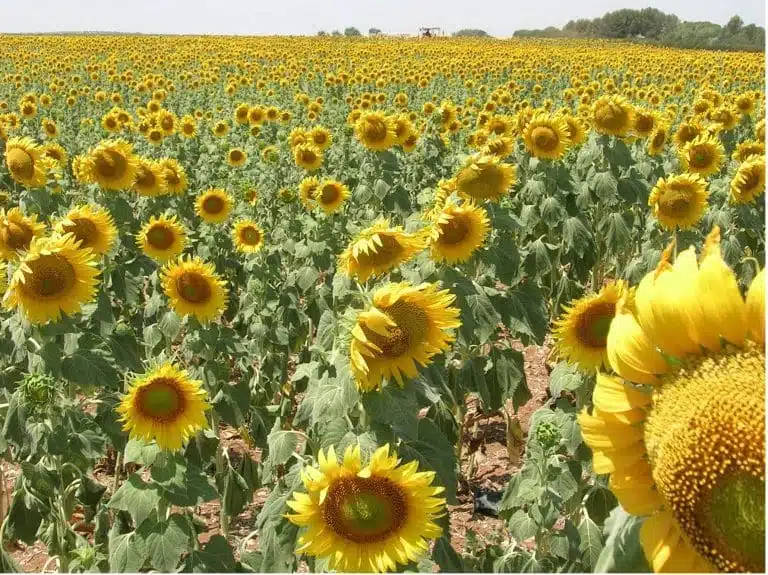
At a glance
Sunflower honey
Helianthus annuus
Colour
Very light amber to amber30–65 mm Pfund
Appearance
Yellow-orange tonesa characteristic tint
Aroma
Floral with oily notesreminiscent of oil
Taste
Distinctly sweeta possible urge to clear the throat
Crystallisation
Rapid, coarse-grainedsets firmly
Season
Summerbrief mass flowering
Region
Central Iberian PeninsulaLa Mancha and Andalusia
Pollen reference
45%pollen is over-represented
The Iberian guide records an unusual observation for sunflower honey. Alongside the sweetness, tasters may notice a brief tickle in the throat.
The series usually describes colour, aroma, taste and texture. In this profile the authors also describe an impulse to clear the throat. It is a tasting observation and can vary from one person or sample to another.
Reading and tasting sunflower honey

This Spanish-language field guide compares botanical origin, tasting and laboratory findings. Use the profile together with the traceability of the lot.
Record the sensory impressions separately
- Note the colour, taste and texture of the sample.
- Treat any throat sensation as a tasting observation, with no medical inference.
An unusual tasting note
The guide describes pronounced sweetness and a slight tickle high in the throat that can prompt the taster to clear it.
A brief subjective sensation is one of several tasting observations. It cannot establish origin or explain persistent irritation.
A throat sensation has been reported for other honeys too. The Iberian guide records the observation without establishing its chemical cause. It cannot establish the origin of a jar on its own.
A yellow-orange tint
From very light amber to amber, between 30 and 65 mm Pfund. A yellow-orange cast is particularly characteristic. Like the greenish reflections sometimes seen in eucalyptus and chestnut honey, it is a useful observation when holding the jar up to the light.
Sunflower honey on the Pfund scale
A middle band with both a lower and an upper limit. On-screen colours give an approximate visual guide. A laboratory measures the actual value.
Aroma, taste and texture
Sensory profile
Our interpretation of the descriptions in the Guía de mieles monoflorales ibéricas. In this chart the bitterness and acidity row represents the throat sensation described in the guide, which is a separate sensory impression.
Aroma
A floral aroma with an oily note. This is the particular sensory description used in the guide for honey from one of Spain’s major oilseed crops.
Taste
The taste is distinctly sweet, with little pronounced acidity, bitterness or saltiness. Some tasters notice the light throat sensation described above.
Crystallisation
It crystallises rapidly into a dense, usually coarse-grained mass. Like oilseed rape honey, it can set firmly within weeks. A solid jar is typical.
Interpreting the laboratory profile
| Parameter | Reference in the guide | How to interpret it |
|---|---|---|
| Colour | 30–65 mm Pfund | Very light amber to amber, with yellow-orange tones. The guide gives both limits. |
| Moisture | up to 18% | Fermentation risk increases above the guide value. The general EU limit for blossom honey is 20%. |
| Fructose and glucose combined | at least 60% | A characteristic of blossom honey. This figure on its own cannot exclude added syrup. |
| Sucrose | up to 5% | One of the sugars reported in the analysis. |
| Electrical conductivity | up to 0.45 mS/cm | Low-to-moderate conductivity for this field-crop honey. |
| Free acidity | up to 50 meq/kg | Can rise with fermentation or extended storage. |
| HMF | up to 40 mg/kg | HMF increases with heat and time in storage. |
| Diastase activity | at least 8 Schade units | Indicator of enzyme activity, which can decline with heat. |
| Helianthus pollen | at least 45% | Sunflower produces abundant pollen. The proportion of grains counted is distinct from the share of nectar. |
Reference ranges from the Guía de mieles monoflorales ibéricas, fourth edition (2023). These characterise the variety. Spanish statutory limits are set by Royal Decree 1049/2003 as amended by Royal Decree 68/2025, including a general maximum of 20% moisture and 40 mg/kg HMF, subject to the exceptions in the legislation.
Other pollen in sunflower honey
- Legumes
- French lavender (Lavandula stoechas)
- Viper’s bugloss
- Rockroses (Cistaceae)
Growing areas and harvest season
The guide identifies the central Iberian Peninsula, Castile-La Mancha and Andalusia. The flow comes in summer. As with oilseed rape, large planted areas can provide a brief, abundant flowering for nearby apiaries.
Sunflower honey flow
FloweringFlowering and harvest
The guide places the main harvest in summer. As with oilseed rape, extract ripe honey promptly. Honey that has set in the comb is much harder to extract.
How to recognise sunflower honey
- 1Look for an orange tint. Yellow-orange reflections are characteristic when viewed through the jar.
- 2Expect it to set quickly. It sets quickly and usually has coarse grains, like oilseed rape. If it remains liquid for months, check its history.
- 3Notice any light throat sensation. Some tasters experience a brief tickle. Its presence or absence does not authenticate a jar.
- 4Straightforward sweetness. Little marked acidity, bitterness or saltiness.
- 5Between 30 and 65 mm Pfund. A colour outside this band calls for a closer look at the sample and its origin.
For a broader view, see how to assess honey quality and our guide to Spanish honey labelling requirements.
Composition and health claims
Health claims on food are regulated in the EU. The distinguishing features here are its floral origin, conductivity and sensory profile.
These characteristics matter when tasting or using the honey.
- Sunflowers occupy large areas of farmland, making this an important field-crop honey in Spain.
- Its rapid, compact set can be put to use when preparing creamed honey under controlled conditions.
- The yellow-orange hue is a characteristic worth recording before tasting.
- Its direct sweetness and firm set make it a useful everyday honey for spreading.
Who should take particular care?
Children under 12 months. Do not give honey to infants under one year. It can contain spores of Clostridium botulinum that may cause infant botulism. This applies to all types of honey.
Diabetes. honey is a source of sugars. This also applies to natural and monofloral honeys when planning a diet.
Known allergy. Anyone with a diagnosed allergy to honey or bee products should consult their clinician if unsure what is safe for them.
Frequently asked questions
Why can sunflower honey give an urge to clear the throat?
Some tasters describe a brief tickle alongside the sweetness. The Iberian guide records this as a sensory observation. It does not establish the cause and does not by itself identify a honey.
Why has my sunflower honey set hard?
It naturally crystallises quickly, forming coarse grains and a compact mass, as oilseed rape honey does. If a jar remains fluid months after packing, ask about the harvest and how it was handled.
Why does it have an orange tint?
A faint yellow-orange cast is characteristic of the Iberian profile. It can be seen through the glass and is one clue to consider alongside tasting and analysis.
What does sunflower honey smell like?
The guide describes a floral aroma with an oily note. This is an aroma descriptor for the honey of an oilseed crop.
Who should take particular care?
Never give honey to a baby under 12 months because of the risk of infant botulism. People with diabetes should count its sugars in their diet. Anyone with a diagnosed allergy to hive products should seek individual medical advice.
Where to buy sunflower honey
We do not currently stock sunflower honey. Yields follow the farming season, and much goes into processing or blends. For another mild Spanish honey in our range, see our raw rosemary honey.
Sources
The reference ranges come from the fourth edition (June 2023) of the Guía de mieles monoflorales ibéricas by J. Orantes, F. Gonell, C. Torres and A. Gómez-Pajuelo, published by Laboratorios Apinevada and Pajuelo Consultores Apícolas. Their work draws on a series reaching back to 1980 and more than 3,600 analyses a year across the two laboratories. The printed guide in Spanish is available in our shop.
Explore our series on Iberian honeys. Oilseed rape honey also sets rapidly, while eucalyptus honey provides another example of a distinctive colour cast.


