

At a glance
Oilseed rape honey
Brassica napus
Colour
Very pale, almost whiteup to 35 mm Pfund
Aroma
Mild aromanotes of green grass
Taste
Clean sweetnessno other marked tastes
Crystallisation
Very rapid, coarse crystalssets very firmly
Season
Late springbrief mass flowering
Region
Where the crop is plantedvaries with farming policy
Pollen reference
45%pollen is over-represented
Conductivity
up to 0.30 mS/cmamong the lowest in the guide
Oilseed rape produces one of the fastest-setting honeys in the Iberian guide. Its Spanish production map can change with farm rotations, oil prices and agricultural policy.
Oilseed rape is a field crop. Where a profile of a wild honey might name a mountain range, plateau or stretch of coastline, the entry for this honey points beekeepers towards the areas planted that season.
Reading and tasting oilseed rape honey

This Spanish-language field guide compares botanical origin, tasting and laboratory findings. Use the profile together with the traceability of the lot.
Compare the natural set
- Record how firm the sample is and the size of the crystals.
- Read those observations alongside the lot and its storage history.
A honey flow that moves with the crop
Production area. The guide identifies the areas planted in a given season and notes that these change with the Common Agricultural Policy.
The area is determined by the crop. EU agricultural policy and the price of oil influence where growers plant it. A harvest also depends on weather and hive access.
Castile and León and Andalusia have both seen seasons with extensive areas under oilseed rape, followed by years with much less. Migratory beekeepers need to check the planted fields each season before moving their hives.
Why it sets so quickly
Acacia honey can remain liquid for a long time. Oilseed rape honey soon develops large crystals and a dense set.
Setting can take days or a few weeks. A jar left to crystallise unaided can become hard to spoon. This tendency is useful in controlled creaming. Albaida honey (in Spanish) is also valued for creaming, chiefly for its naturally fine crystals.
If a jar remains liquid for months, ask about its age, storage, processing and any blending. Its appearance alone cannot identify what happened. See why honey crystallises.
Colour
Very pale, up to 35 mm Pfund, the same upper limit as rosemary and acacia. When it sets it becomes almost opaque white.
Oilseed rape honey on the Pfund scale
At the pale end of the scale. Rosemary and acacia share its upper limit. The on-screen colours are a visual guide. A laboratory measures the value.
Aroma, taste and texture
Sensory profile
Our interpretation of the descriptions in the Guía de mieles monoflorales ibéricas. Its very rapid crystallisation stands out in this profile.
Aroma
The aroma is mild and floral, with a little freshly cut grass and sometimes a hint of cut cabbage typical of the mustard family. These notes are easier to pick up on the palate.
Taste
A clean sweetness with little pronounced acidity, bitterness or saltiness. Acacia and albaida have similarly mild tastes.
Crystallisation
It sets quickly and very firmly, usually with coarse crystals when it crystallises without intervention.
Interpreting the laboratory profile
| Parameter | Reference in the guide | How to interpret it |
|---|---|---|
| Colour | up to 35 mm Pfund | Very pale, almost white. An amber colour falls outside the guide’s profile. |
| Moisture | up to 18% | Fermentation risk increases above the guide value. The general EU limit for blossom honey is 20%. |
| Fructose and glucose combined | at least 60% | A characteristic of blossom honey. This figure on its own cannot exclude added syrup. |
| Sucrose | up to 5% | One of the sugars reported in the analysis. |
| Electrical conductivity | up to 0.30 mS/cm | Among the lowest values, alongside rosemary, acacia and albaida. |
| Free acidity | up to 50 meq/kg | Can rise with fermentation or extended storage. |
| HMF | up to 40 mg/kg | HMF rises with heat and time. It is one piece of evidence to consider when assessing a long-stored liquid sample. |
| Diastase activity | at least 8 Schade units | Indicator of enzyme activity, which can decline with heat. |
| Brassica pollen | at least 45% | This crop produces abundant pollen. Its share of the grains counted is distinct from the nectar contribution. |
Reference ranges from the Guía de mieles monoflorales ibéricas, fourth edition (2023). These characterise the variety. Spanish statutory limits are set by Royal Decree 1049/2003 as amended by Royal Decree 68/2025, including a general maximum of 20% moisture and 40 mg/kg HMF, subject to the exceptions in the legislation.
Other pollen in oilseed rape honey
- Legumes
- Rockroses (Cistaceae)
- Viper’s bugloss
- Some mint-family pollen
Growing areas and harvest season
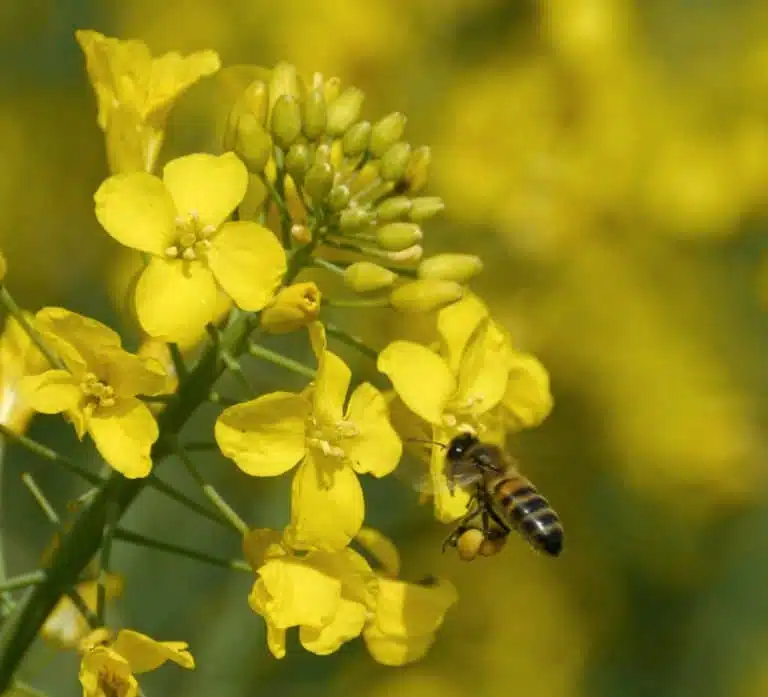
In Spain the guide places the flow in late spring, wherever enough oilseed rape has been planted. Whole fields turn bright yellow together. For a few weeks they can support a substantial nectar flow.
Oilseed rape honey flow
FloweringFlowering and harvest
The guide places the main harvest in late spring. The flowering period is short. Extract ripe honey promptly. Once it sets in the comb, extraction becomes much harder.
How to recognise oilseed rape honey
- 1Expect it to set quickly. It may crystallise in days. A jar still clear and liquid long after harvest calls for a closer look at its history.
- 2Pale and firm. Up to 35 mm Pfund, becoming nearly white and dense when set.
- 3Coarse natural crystals. The grain is more evident than in albaida honey.
- 4Look for a green, grassy note. It is characteristic of flowers in the mustard family.
- 5Taste for clean sweetness. Little marked acidity, bitterness or saltiness.
For a broader view, see how to assess honey quality and our guide to Spanish honey labelling requirements.
Composition and health claims
EU rules govern health claims on food. The features that distinguish this honey concern its floral origin, chemistry and texture.
These qualities are particularly useful in the kitchen and honey room.
- It sets quickly, a useful characteristic when preparing a controlled, fine-grained creamed honey or working with a seed honey.
- Its mild sweetness has little effect on the other flavours in a dish.
- It has a low mineral content and conductivity of up to 0.30 mS/cm in the guide.
- Once set, its firm texture makes it a good everyday honey for spreading.
Who should take particular care?
Children under 12 months. Do not give honey to infants under one year. It can contain spores of Clostridium botulinum that may cause infant botulism. This applies to all types of honey.
Diabetes. honey is a source of sugars. This also applies to natural and monofloral honeys when planning a diet.
Known allergy. Anyone with a diagnosed allergy to honey or bee products should consult their clinician if unsure what is safe for them.
Frequently asked questions
Why does oilseed rape honey harden so quickly?
Very rapid crystallisation and a firm, usually coarse set are characteristic. It may take only days or a few weeks. A hard jar by itself is consistent with this floral origin.
Should oilseed rape honey still be liquid?
Freshly extracted honey can be liquid. If it remains so for months, check harvest date, storage, handling and any blending. HMF can provide information about heat and age. Appearance alone cannot tell you whether it was heated.
Where does oilseed rape honey come from?
It follows the crop rather than a fixed Spanish region. Rotations, oil prices and the Common Agricultural Policy affect which areas are planted each year.
What does oilseed rape honey taste like?
It is mildly floral and straightforwardly sweet, with a faint grass-like or vegetal note. The aroma becomes more apparent on the palate.
Who should take particular care?
Never give honey to a baby under 12 months because of the risk of infant botulism. People with diabetes should count its sugars in their diet. Anyone with a diagnosed allergy to hive products should seek individual medical advice.
Where to buy oilseed rape honey
We do not currently carry oilseed rape honey. Supply follows each year’s crop, and much of the harvest is used in processing. For another pale, mild Spanish honey in our range, try raw rosemary honey.
Sources
The reference ranges come from the fourth edition (June 2023) of the Guía de mieles monoflorales ibéricas by J. Orantes, F. Gonell, C. Torres and A. Gómez-Pajuelo, published by Laboratorios Apinevada and Pajuelo Consultores Apícolas. Their work draws on a series reaching back to 1980 and more than 3,600 analyses a year across the two laboratories. The printed guide in Spanish is available in our shop.
This profile belongs to our series on Iberian honeys. Compare it with acacia honey for a very different crystallisation rate, and with rosemary (in Spanish) and albaida (in Spanish) for similarly pale colours.


