

At a glance
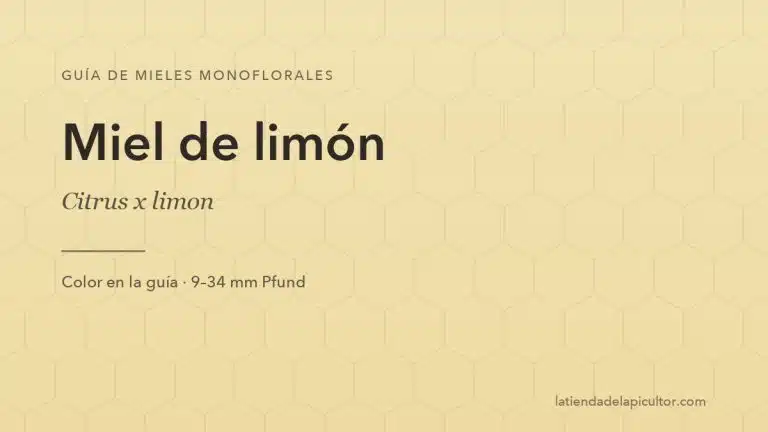
Lemon blossom honey
Citrus × limon
Colour
Paleup to 35 mm Pfund
Aroma
Faint floral aromawith methyl anthranilate notes
Taste
Sweet and tartacidity may be subtle
Crystallisation
Slow, fine crystallisationcoarser with white wall-rocket
Season
Springlemon blossom
Region
Alicante, Murciaand parts of Andalusia
Pollen reference
15%as in the broader citrus profile
Chemical marker
Methyl anthranilate ≥ 1.2 ppmshared with other citrus honeys
Among citrus honeys, the Iberian guide describes lemon blossom separately. It is a pale, delicate honey with lower electrical conductivity than the guide’s broader citrus profile.
One profile covers orange and other citrus blossom honeys as a group. A second focuses on the lemon tree itself. Differences in colour, conductivity and taste help distinguish the two.
Reading and tasting lemon blossom honey


This Spanish-language field guide compares botanical origin, tasting and laboratory findings. Use the profile together with the traceability of the lot.
Compare lemon and orange blossom with the labels to hand
- Check the floral name and harvest origin stated on each jar.
- Record the aroma and read the chemical marker with the rest of the profile.
Lemon blossom and the wider citrus profile
| Lemon blossom | Citrus blossom (Citrus spp.) | |
|---|---|---|
| Colour | max. 35 mm Pfund | up to 45 mm Pfund |
| Conductivity | max. 0.40 mS/cm | up to 0.55 mS/cm |
| Pollen reference | 15% Citrus × limon | 15% Citrus spp. |
| Methyl anthranilate | at least 1.2 ppm | at least 1.2 ppm |
| Taste | Sweet with tart notes sometimes subdued | Sweet with acidity clearly pronounced |
| Region | Alicante, Murcia and Andalusia | Andalusia and the coast as far as the Ebro |
Lemon blossom honey tends to be paler, lower in conductivity and milder on the palate than the wider citrus profile. Both use the same aromatic marker and pollen threshold. Citrus contributes relatively little pollen to its honey.
What methyl anthranilate tells us
For both profiles, the guide gives a minimum of 1.2 ppm methyl anthranilate. This aromatic compound contributes to the characteristic scent of citrus flowers. In lemon blossom honey, the floral impression can become more evident on the palate.
Citrus pollen is often under-represented in honey. As explained in our orange blossom honey profile, a chemical marker gives the laboratory another line of evidence to consider with pollen, origin and tasting.
Colour
Pale, up to 35 mm Pfund. This is ten points below the guide’s general citrus limit and matches the limits for rosemary and acacia.
Lemon blossom honey on the Pfund scale
In the palest bands. It is one of the lightest honeys in the guide. The colours on screen are approximate. A laboratory measures the actual value.
Aroma, taste and texture
Sensory profile
Our interpretation of the descriptions in the Guía de mieles monoflorales ibéricas. It is a milder expression of the general citrus blossom profile.
Aroma
A light floral scent recalls citrus blossom. It is usually quieter than the general citrus profile and becomes more pronounced during tasting.
Taste
The taste is sweet with a tart note that can be quite subtle. By comparison the guide describes a clearly marked acidity in its broader citrus profile.
Crystallisation
It usually crystallises slowly into fine grains. White wall-rocket (Diplotaxis erucoides), a common flowering plant around Mediterranean crops, can contribute nectar and lead to a coarser set. The guide makes the same observation for citrus honeys more broadly.
Interpreting the laboratory profile
| Parameter | Reference in the guide | How to interpret it |
|---|---|---|
| Colour | up to 35 mm Pfund | Pale. A clearly amber colour falls outside the guide’s profile. |
| Moisture | up to 18% | Fermentation risk increases above the guide value. The general EU limit for blossom honey is 20%. |
| Fructose and glucose combined | at least 60% | A characteristic of blossom honey. This figure on its own cannot exclude added syrup. |
| Sucrose | up to 10% | Twice the usual maximum. Citrus nectar can be rich in sucrose. |
| Electrical conductivity | up to 0.40 mS/cm | Lower than the 0.55 limit for the broader citrus profile. The guide describes less influence from oak honeydew. |
| Free acidity | up to 50 meq/kg | May rise during fermentation. Free acidity in the laboratory is distinct from tartness in the mouth. |
| HMF | up to 40 mg/kg | HMF increases with heat and time in storage. |
| Diastase activity | at least 8 Schade units | For naturally enzyme-poor honeys, EU rules allow a minimum of 3 when HMF is at most 15 mg/kg. |
| Methyl anthranilate | at least 1.2 ppm | A marker shared with the broader citrus profile. |
| Citrus × limon pollen | at least 15% | Citrus pollen is under-represented in these honeys. |
Reference ranges from the Guía de mieles monoflorales ibéricas, fourth edition (2023). These characterise the variety. Spanish statutory limits are set by Royal Decree 1049/2003 as amended by Royal Decree 68/2025, including a general maximum of 20% moisture and 40 mg/kg HMF, subject to the exceptions in the legislation.
Other pollen in lemon blossom honey
- Legumes
- Rockroses (Cistaceae)
- Mustard family
- Daisy family (Asteraceae)
Growing areas and harvest season
The guide lists Alicante, Murcia and parts of Andalusia, with a spring harvest. This is an orchard flow. The extent of the planted area, the flowering dates and the weather all affect what beekeepers can harvest.
Lemon blossom honey flow
FloweringFlowering and harvest
The guide places the main harvest in spring. Citrus trees flower intensely over a relatively short period.
How to recognise lemon blossom honey
- 1Look for a very pale colour. Up to 35 mm Pfund, paler than the broader citrus profile.
- 2A delicate citrus blossom scent. Methyl anthranilate contributes to the light floral note.
- 3Acidity may be subtle. It is usually less pronounced than in the general citrus profile.
- 4Slow crystallisation, fine grains. A contribution from white wall-rocket can make the grains coarser.
- 5Read the marker alongside the pollen report. Methyl anthranilate supports a citrus identification when interpreted with the other findings.
For a broader view, see how to assess honey quality and our guide to Spanish honey labelling requirements.
Composition and health claims
Food health claims are regulated in the EU. The honey and the lemon fruit are distinct foods. Properties attributed to the fruit cannot be assumed to apply to the honey.
These characteristics matter when tasting or using the honey.
- It is one of the guide’s palest, mildest honeys, with the same maximum Pfund value as rosemary.
- Citrus nectars can be relatively high in sucrose. The relevant limit for these honeys is up to 10%.
- Methyl anthranilate is one of the aromatic compounds a laboratory can measure when assessing citrus origin.
- Its gentle floral note suits delicate baking, dairy desserts and herbal tea.
Who should take particular care?
Children under 12 months. Do not give honey to infants under one year. It can contain spores of Clostridium botulinum that may cause infant botulism. This applies to all types of honey.
Diabetes. honey is a source of sugars. This also applies to natural and monofloral honeys when planning a diet.
Known allergy. Anyone with a diagnosed allergy to honey or bee products should consult their clinician if unsure what is safe for them.
Frequently asked questions
Is lemon blossom honey the same as orange blossom honey?
The Iberian guide describes both a general profile for citrus blossom ( Citrus spp.) and a separate lemon profile. Lemon is paler, up to 35 rather than 45 mm Pfund, and its conductivity limit is lower, 0.40 rather than 0.55 mS/cm. Its tartness can be subtle. Both profiles use a 15% pollen threshold and methyl anthranilate as a marker.
Why analyse methyl anthranilate?
Citrus produces relatively little pollen, so pollen alone can give an incomplete picture. Methyl anthranilate contributes to the scent of citrus blossom. The guide uses a minimum of 1.2 ppm as one criterion for the origin.
What does lemon blossom honey taste like?
It is sweet and gently floral, with acidity that may be quite subtle. The citrus aroma, associated with methyl anthranilate, becomes more apparent on the palate.
Why has my lemon blossom honey formed coarse crystals?
A contribution from white wall-rocket (Diplotaxis erucoides) is one possible explanation. Lemon honey normally crystallises slowly into fine grains. The same accompanying plant can affect other citrus and rosemary honeys.
Who should take particular care?
Never give honey to a baby under 12 months because of the risk of infant botulism. People with diabetes should count its sugars in their diet. Anyone with a diagnosed allergy to hive products should seek individual medical advice.
Where to buy lemon blossom honey
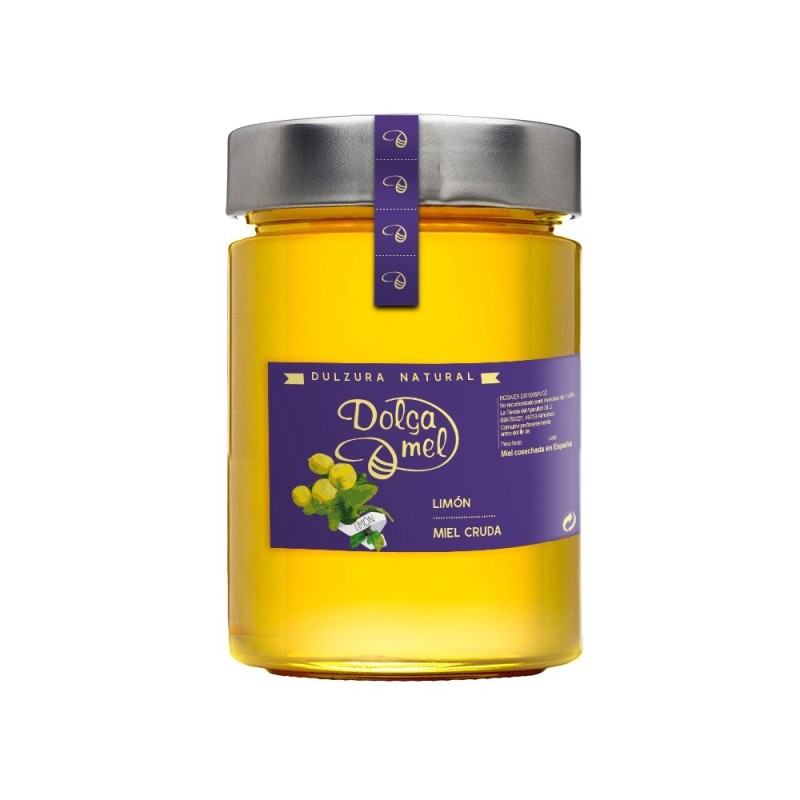
Buying directly from a beekeeper can help you identify the orchard and harvest. In our shop you can find raw lemon blossom honey harvested in Spain.
Sources
The reference ranges come from the fourth edition (June 2023) of the Guía de mieles monoflorales ibéricas by J. Orantes, F. Gonell, C. Torres and A. Gómez-Pajuelo, published by Laboratorios Apinevada and Pajuelo Consultores Apícolas. Their work draws on a series reaching back to 1980 and more than 3,600 analyses a year across the two laboratories. The printed guide in Spanish is available in our shop.
This profile belongs to our series on Iberian honeys. Orange blossom honey shares its botanical family and chemical marker, while rosemary honey (in Spanish) has a similarly pale colour.


