

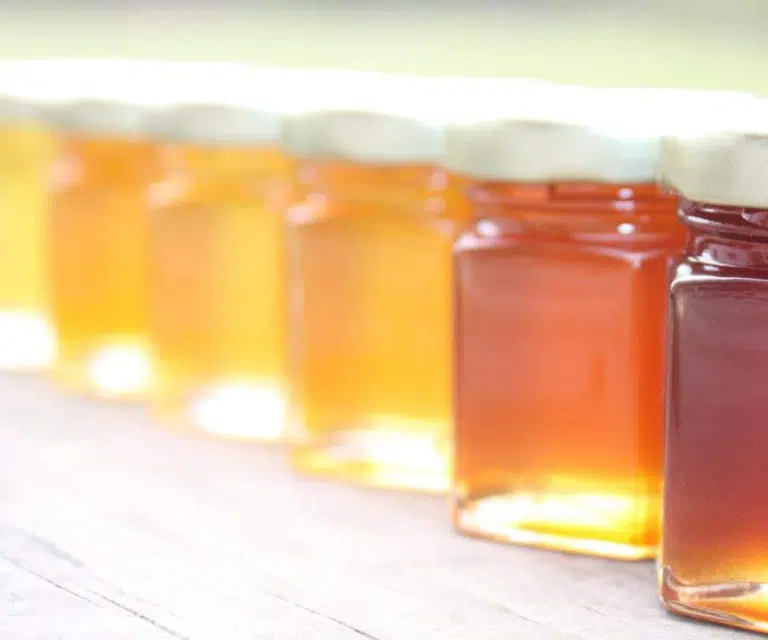
Honey fraud is a real problem, but the familiar water, alcohol and flame tests cannot establish whether a jar is authentic. Neither its country of origin nor its liquid or crystallised appearance settles the question. The useful distinction is between a reason to investigate and evidence that actually demonstrates adulteration.
Five common myths at a glance
| The claim | What the evidence supports |
|---|---|
| ‘All imported honey is adulterated’ | False. Country of origin alone does not establish authenticity. Controls help, but neither an imported nor a domestic origin guarantees that every jar is compliant. |
| ‘Liquid honey is adulterated’ | False. Consistency depends on temperature, moisture, sugar composition and crystallisation. Genuine honeydew and orange-blossom honeys can crystallise too. |
| ‘Honey has a genetic memory and forms hexagons’ | False. Honey may contain DNA traces, but surface patterns do not demonstrate a memory of the comb or authenticate the honey. |
| ‘A white precipitate with alcohol proves adulteration’ | False. A non-specific change in a mixture does not identify an added syrup. A precipitate is not a validated authenticity result. |
| ‘If honey-soaked paper burns, the honey is pure’ | False. Burning depends on several physical conditions, not just composition. The test is unreliable and introduces a fire risk. |
In this guide
- historical market figures;
- why imported honey is sold in Spain;
- what adulteration studies can tell us;
- the myths, one by one;
- Apimondia’s historical statement.
Editorial note: this article began as a discussion of the Spanish honey market in 2016–2020. Its charts, campaign material and historical examples remain clearly dated; they are not current market statistics. This English edition updates the scientific explanations and Spanish labelling information to September 2026. For newer economic figures, consult Spain’s Ministry of Agriculture.
The original discussion described a difficult period in the wholesale market: slower sales, stocks held by packers and pressure on beekeepers’ cash flow. Those were observations about that period, not a permanent description of the sector. Harvest size, stock levels, contracts and demand all affect how quickly a crop sells.
Imports, price competition and adulteration deserve scrutiny, but they are not interchangeable explanations. A lower-priced consignment is not necessarily fraudulent, and a poor season for sales does not quantify adulteration. We need to separate trade data, laboratory findings and commercial experience before drawing conclusions.
Where does Spanish honey go? Historical market data
Spain is a major honey-producing country, but production alone does not explain its trade. Honey is both imported and exported, sometimes for different markets, botanical types or price segments. The table below records monthly Spanish trade in 2020; it does not establish a lasting trade balance or identify which shipments, if any, were adulterated.

The original article discussed supplies from countries including China, Argentina, Ukraine and Romania. That list provides historical context, not a current ranking of suppliers or a judgement on the quality of an entire country’s honey. Commercial origin and authenticity must be checked separately.
The following chart is also historical. It shows Spain’s apparent honey consumption and self-sufficiency from 2004 to 2017. The final year is explicitly marked as an estimate in the Spanish original. These indicators describe a supply balance; they are not laboratory measurements of honey purity.

For 2017, the chart reports apparent consumption of about 0.9 kg per person and estimated self-sufficiency of 78.6%. Neither figure measures how much honey an individual actually ate or the proportion of fraudulent jars. Imports and exports can occur simultaneously, so consumption, domestic production and retail origin should not be confused.
Why is imported honey sold in Spain?
Why does imported honey appear on Spanish shelves? Price, continuity of supply, blending requirements and purchasing contracts can all influence sourcing. Understanding that business context is useful, but it does not replace checking the label and the product. Nor should a historical observation about supermarket shelves be presented as a fresh retail survey.
Clear origin information helps buyers make that choice. Spain’s rules applying from 14 June 2026 require the harvest countries in blends, with their percentages in descending order by weight, in the principal field of vision. Previously compliant products marketed or labelled before that date have a limited stock transition, no longer than 18 months from that date. See Royal Decree 68/2025 and our honey-labelling guide for the details and small-pack provision.

The campaign illustration shown here belongs to the earlier debate about clearer labels. It is historical advocacy material, not a statement of current law. In particular, its proposed contrast between ‘natural’ and heated honey should not be read as a purity test: heating and adulteration are different issues. We support clear, verifiable information that lets consumers choose knowingly.
Better labels are only part of the answer. The wine sector offers a useful analogy: people are more likely to value diversity when someone explains what they are tasting. Building a culture of honey appreciation means introducing floral sources, regions, aromas and textures, without assuming that a higher price by itself proves authenticity.
Beekeepers, associations, packers and retailers can contribute through tastings, honest descriptions and shared educational work. Whatever the sector’s organisational arrangements, long-term promotion is strongest when it explains both the product’s qualities and the evidence behind its claims.

A tasting can reveal how different genuine honeys can be. It is an excellent way to explore flavour, but it is not a substitute for an authenticity investigation. Equally, promoting local honey does not require treating all imported or heat-treated honey as inferior or fraudulent.
How much honey adulteration is there?
Yes, adulteration occurs. In the EU coordinated control work of 2015–2017, the Joint Research Centre found added sugar in 14% of the samples it tested. That finding concerns a particular sample set and analytical programme. It is not a reliable estimate that 14% of every country’s retail honey is adulterated.
Natural variation also matters when interpreting a result. Honey’s composition depends partly on its botanical origin, and the legal standard includes some origin-specific limits. A natural explanation does not automatically make a non-compliant product legal, however. Laboratories must identify the applicable criterion, the method’s limitations and the evidence supporting any allegation of deliberate addition.
The sensible position is neither ‘all honey is fake’ nor ‘the problem is exaggerated, so there is nothing to investigate’. Sound controls protect buyers and honest producers. A screening result, a confirmed compositional failure and a demonstrated act of fraud are related but distinct findings.
Authenticity assessment requires suitable sampling, trained analysts and methods appropriate to the question. Appearance can prompt an enquiry, but viral kitchen demonstrations cannot replace that work. Even an advanced laboratory result needs interpretation alongside the honey’s declared origin, production records and traceability.
An established brand is not an automatic guarantee of compliance, and an unfamiliar brand is not evidence of fraud. If something appears wrong, retain the jar, label, lot number and receipt, and raise a factual enquiry with the seller or the competent food-safety or consumer authority. Avoid turning an unverified suspicion into a public accusation.
Common myths about honey adulteration
‘All imported honey is adulterated’
Imported honey is not inherently adulterated. Import controls and operator obligations are important, but no border-control system guarantees that every fraudulent consignment will be detected. Fraud can also occur within the EU. The historical wording ‘blend of EU and non-EU honeys’ described origin, not proof of adulteration; it should not be mistaken for the current Spanish labelling rule.
Price alone cannot settle the issue either. Floral source, harvest conditions, scale, packaging and the route to market all affect the price of a jar. A low price may justify asking questions, but claims that every inexpensive or imported honey is tasteless or fraudulent are not a defensible way to promote Spanish beekeeping.
There are good reasons to buy local honey: knowing the producer, supporting nearby beekeeping and enjoying regional floral sources. Those are positive choices in their own right. They are strongest when supported by traceability and clear information, not by blanket allegations about everyone else’s product.
‘Liquid honey is adulterated’
Genuine honey can be liquid, partly crystallised or fully crystallised. Its consistency depends on temperature, water content, sugar composition and the presence of crystals. Moisture around 17.5% is only an example, not a universal target. The general legal maximum is 20%, with specified exceptions. Orange-blossom and honeydew honeys can crystallise too; their behaviour is not a simple yes-or-no test of purity.

How honey disperses in water depends on mixing, temperature and its physical properties. Neither sinking to the bottom nor dissolving quickly proves authenticity. The Spanish-language video above is retained as an example of the misleading ‘home tests’ being discussed, not as instructions to follow.
Heating can dissolve crystals and, under suitable processing conditions, reduce viable yeasts; it does not guarantee that all yeasts are eliminated. Excessive heating can damage quality, and honey sold as such must meet the applicable composition criteria. Heated honey is not automatically adulterated, and ‘raw’ honey is not automatically certified authentic. The separate legal category of baker’s honey must not be confused with ordinary retail honey.
The paper-and-flame trick is unreliable and introduces an unnecessary fire risk. Whether something burns depends on the moisture, the paper and the conditions, not simply on whether sugar syrup has been added. Do not use burning tests to assess food authenticity.
‘Honey has a genetic memory’
Honey does not remember the hexagons of its comb. That explanation of surface patterns is a myth. The reason is not that honey contains no DNA: studies have recovered plant and insect DNA from honey. Such traces can carry biological information, but they do not make a stirred liquid reproduce a honeycomb through ‘genetic memory’.
Historical social-media example: a viral ‘fake foods’ demonstration. Its visual effect is not an authenticated test of honey purity.
The original post linked to this example from 11 September 2018; it is retained for context, not endorsed as evidence.
‘A white precipitate with alcohol proves adulteration’
A white precipitate after adding alcohol does not establish adulteration. Changing the solvent can alter the solubility of components in a complex mixture. Honey contains more than just glucose and fructose, and authentic samples may differ in their other sugars and suspended material. The appearance of a precipitate does not reliably identify a particular adulterant or its source.
Food manufacturers use starch-derived syrups made from crops such as maize and rice. These are legitimate ingredients when used and labelled appropriately in foods. The fraud occurs when they are added to a product sold as honey without that product meeting the definition of honey. Their existence in the food industry is not itself evidence of a fraudulent jar.
At a broad level, starch processing produces glucose, and further processing can convert some glucose to fructose. That is different from simply splitting sucrose. The historical US chart below concerns high-fructose corn syrup across the food supply, not adulteration of honey. Its 2017 figure of 39.8 pounds is about 18 kg per person in a supply-based series, not a measured intake for each individual or a current figure.

Adding a food-grade syrup still breaches the definition of honey when the mixture is sold as honey. Conversely, a failed kitchen demonstration does not establish that syrup was added. Questions about food safety, legal composition and economic fraud should be assessed on their own evidence rather than collapsed into a single claim.
Laboratories use complementary approaches, including stable-isotope analysis, nuclear magnetic resonance (NMR) profiling and chromatographic methods. Their suitability depends on the suspected problem and the method’s validation. It would be misleading to say that every syrup is always detectable, or that one apparently unusual sugar necessarily proves fraud without checking the analytical and botanical context.
Claims about improvised fillers, aloe products or other supposed adulterants also need evidence. The practical response is not to invent a household test for each rumour, but to maintain a traceable supply chain and use competent laboratories when a specific concern arises. An account of something that could be added is not proof that it was added.
‘Honey is the world’s third most adulterated food’
The phrase ‘the world’s third most adulterated food’ needs context. The infographic reproduced below shows counts of recorded fraud cases in a historical database. A ranking of database entries is not a ranking of the percentage of retail products that are fraudulent. It depends on the reports collected, their dates and how cases were classified.

The original article challenged media headlines about those figures, but a low-looking percentage can be misused just as easily as a dramatic ranking. Without a clear denominator and sampling design, neither tells us the chance that a jar bought today is adulterated. The illustration is retained as a historical example of why those distinctions matter.
A 2018 study led by Macquarie University assessed 95 commercial honeys from 19 countries alongside five hive-collected reference samples. The authors classified 27% of the commercial samples as being of questionable authenticity under their combined analytical criteria. There were 38 Australian commercial samples in the set. These results cannot be treated as a representative survey of all honey sold worldwide.
More recently, the EU’s 2021–2022 ‘From the Hives’ action flagged 147 of 320 imported-honey samples, or 46%, as suspicious. That is not a finding that 46% of all retail honey was proven fraudulent. The sampling period and methods differed from the 2015–2017 work, so the two percentages do not by themselves measure a change in market-wide prevalence.
The original account also mentioned three suspect results among 94 samples attributed to APINEVADA in 2018. Without the underlying report, sampling details and analytical criteria, that account should remain a historical report rather than an independently verified prevalence estimate. It cannot be used to dismiss findings from a different investigation.
There is no single percentage in these examples that describes every jar, market and year. A useful report states what was sampled, when, how it was tested and whether the outcome was a screening flag, confirmed non-compliance or an established fraud. That is more informative than repeating a league table of ‘most adulterated’ foods.
For a careful discussion of analytical limitations, the UK government’s commissioned 2025 review of the ‘From the Hives’ methods is useful. It distinguishes flags that warrant further investigation from evidence sufficient to prove adulteration. That distinction should improve investigations, not become an excuse to ignore credible concerns.
Review of methods applied in the ‘From the Hives’ survey on honey authenticity — an expert methodological review commissioned for Defra and the Food Standards Agency, published in 2025.
Health claims also need care
Honey is a food, not a cure for colds or disease.
Selling honey in a pharmacy or describing it as traditional does not demonstrate that it treats an illness. It remains a sugar-rich food. This does not rule out a limited soothing effect for some symptoms, but symptom relief and curing the underlying illness are different claims.
A 2007 trial involving 105 children aged 2–18 found some short-term improvement in reported cough symptoms with honey compared with no treatment; it did not establish a cure. NICE describes the evidence for cough relief as limited. Honey must not be given to infants under 12 months because of the risk of infant botulism. It should not delay medical advice for worrying or worsening symptoms.
Apimondia’s 2020 statement
The attached document is Apimondia’s January 2020 statement on honey fraud, in Spanish. It is retained as the historical statement discussed by the original article, not presented as the organisation’s latest position.
On page 13, the statement recommends more advanced approaches, including NMR and high-resolution liquid chromatography–mass spectrometry, rather than relying on a single older isotope test. It also promotes traceability, audits and coordinated action. Its message should not be reduced to the idea that one instrument can answer every authenticity question on its own.
The original article questioned whether an NMR reference database represented enough types of honey. That is a legitimate methodological question, but the claim that NMR has one universal database of only ‘100 honeys’ is not supported here. Different methods and services use different reference collections. Their representativeness and validation matter more than a context-free sample count.
Europe’s wide range of floral sources helps explain why suitable reference material matters. The botanical diversity discussed in the 2004 work by Persano Oddo and colleagues is relevant background, but it does not show that a particular disputed result was wrong. A laboratory should explain whether its reference material and decision criteria are appropriate to the sample being assessed.
The original discussion also referred to rejected entries at the 2019 Montréal honey competition. Rejection can involve different quality or authenticity criteria. Without the individual reports and the competition’s decision records, it is not justified to say that all rejected entries were false NMR positives caused by unusual floral origins. The controversy should not be presented as proof that the method is generally unreliable.
Pajuelo Consultores’ reported experience with high-sucrose rosemary honeys raises a similar need for case-by-case assessment. Rosemary is not listed among the higher-sucrose exceptions in the current Spanish honey standard; the general maximum is 5 g/100 g. A possible natural explanation for a result does not waive that legal limit, and exceeding a limit alone does not establish the cause or deliberate adulteration. The original individual laboratory reports would be needed to resolve those cases.
A historical talk on the honey market
The final video is a Spanish-language talk by Antonio Gómez Pajuelo on the international honey market, published by Uruguay’s Ministry of Livestock, Agriculture and Fisheries. It is retained as a historical discussion of prices, trade and adulteration, not as a forecast or a statement of the market in 2026.

Conclusions
The aim of this article is to encourage informed discussion. The original author’s commercial experience provides context, but neither that experience nor a striking online demonstration replaces a documented investigation. Where older statements were too categorical, the useful response is to make the limits explicit.
Good communication should neither frighten consumers with unsupported claims nor minimise genuine fraud. It should explain what is known, what remains uncertain and what would establish the facts. That is how the sector can challenge unfair practices while preserving trust in honest beekeepers and suppliers.
Promote the diversity of honey, insist on traceability and clear labels, and support proportionate controls. For the buyer, the practical message is simple: choose informed suppliers, ask sensible questions and do not rely on water, alcohol, flames or crystallisation as a certificate of authenticity.
Sources
European Commission: honey controls, 2015–2017, and ‘From the Hives’, 2021–2022. Read the sampling and methodological qualifications alongside the percentages.
US Department of Agriculture, Economic Research Service: Sugar and Sweeteners Yearbook Tables. These supply-based statistics are not a survey of honey adulteration.
Pajuelo Consultores, November 2018: the professional commentary cited by the original Spanish article. It is historical context, not a substitute for the underlying laboratory reports. Additional scientific and official references are linked in the relevant sections above.
Spain’s Ministry of Agriculture: beekeeping-sector information and economic indicators. Always check the year and scope of each table before using it to describe the current market.
Frequently asked questions
Can I tell at home whether honey is adulterated?
Not with the popular water, flame or alcohol demonstrations. They are not validated authenticity tests. Keep the label, lot number and receipt if you have a concern, and seek advice from a competent laboratory or food authority rather than drawing a conclusion from a kitchen experiment.
Is liquid honey adulterated?
No. Genuine honey may be liquid, partly crystallised or solid. Temperature, moisture, sugar composition and crystallisation history affect its consistency. Neither a liquid jar nor a crystallised one proves that a honey is authentic or adulterated.
What does ‘blend of EU and non-EU honeys’ mean?
It is historical wording for a blend harvested in EU and non-EU countries, not proof of adulteration. Spanish rules applying from 14 June 2026 require harvest-country information and percentages for blends, subject to the specific packaging and limited transition provisions explained above.
How much honey on the market is adulterated?
There is no single reliable figure for all markets. The EU reported 14% in its 2015–2017 tested sample set; a different 2021–2022 investigation flagged 46% of 320 imported-honey samples as suspicious. Different samples and methods, and suspicion versus proof, must not be treated as equivalent.
Is pasteurised honey the same as adulterated honey?
No. Heating is a processing treatment; adulteration alters the composition, for example through added syrup. Heating can still damage quality if excessive, so legal composition requirements matter. ‘Raw’ is not an authenticity certificate either.
What should I do if I suspect a honey does not comply?
Keep the product, packaging, lot number, receipt and any relevant photographs. Ask the seller for clarification and contact the competent regional food-safety or consumer authority in Spain where appropriate. Report the facts and the reason for concern; do not present an unverified suspicion as proven fraud.
Further reading
- Honey labelling and the information that must be declared.
- Honey filtration: processing, pollen and traceability are related but distinct questions.
- How to assess honey quality.
- Pollen analysis (in Spanish) as one component of a wider assessment of origin and authenticity.


