

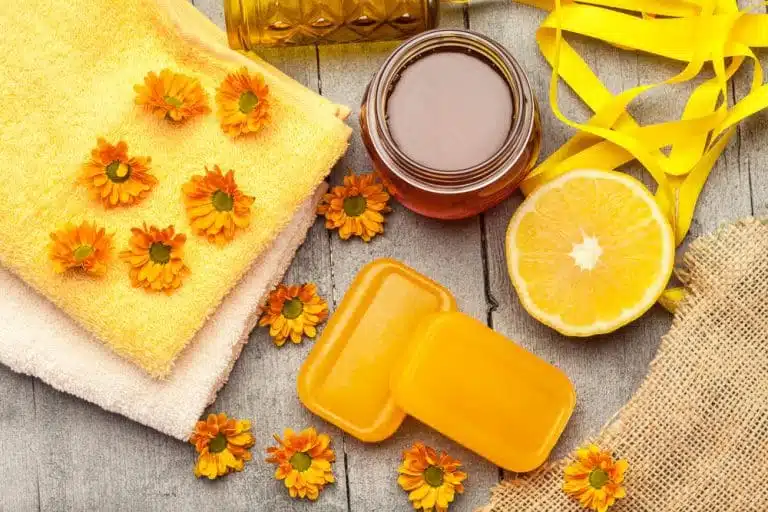
A glycerine melt-and-pour base lets you shape soap bars without handling raw lye. Cut it, melt it and pour it into a mould. For honey soap, choose a base that already contains honey, or a base whose manufacturer provides directions for adding it. The two routes call for different calculations.
Materials for a melt-and-pour trial


The 1 kg BM012 is an opaque white base. Check its own instructions if your recipe calls for another base. The six-cavity mould and the ready-made honey soap are separate products.
Identify the base before you weigh it
- Record the manufacturer and base reference.
- Keep the trial weight and additives with the batch notes.
Start with one plain bar without fragrance or decoration. You will have a useful reference when you try a formula containing pollen or a propolis extract.
Choose the base before weighing ingredients
Look for a product labelled “melt-and-pour soap base”. A bottle of liquid glycerine is a different raw material and will not set into a bar on its own.
| Base | What to check |
|---|---|
| Honey already included | Look for honey in the ingredients. Amber colour or a honey scent is insufficient. |
| Clear base without honey | Check whether its instructions allow honey and specify an addition rate. |
| Shea butter or other added fats | Check that base’s own composition and instructions. A clear base may behave differently. |
LYSON lists BM013 as its 1 kg transparent base and BM011 as the 1 kg shea-butter base. Check the manufacturer’s product sheets for the one you have. Transparency does not tell you whether a base contains shea butter or how much honey it can take.

Your first bar of honey soap
The simplest first batch is 100 g of a soap base that already contains honey, with nothing else added. If yours contains no honey, make a plain trial bar to learn the process, then use a documented honey formula for that particular base.
You will need the base, a scale, a heat-resistant container, a spatula, a thermometer and a silicone mould. Prepare clean, dry utensils and use a container with enough room to stir without splashing.
- Cut and weigh. Cut the block into similar-sized cubes so they melt evenly. Weigh 100 g before heating.
- Melt gently. Follow the directions for the base. Stir slowly and control the heat. If its instructions allow a microwave, use short intervals and stir between them. Avoid boiling or prolonged heating that drives off water.

- Pour once. When the base is liquid and uniform, fill the mould slowly. A single pour is enough for your first bar.
- Cool and unmould. Wait until the whole bar is cool and firm. The time depends on mould and bar size. A firm surface can hide a warm centre.
- Wrap and label. Protect the bar from damp air and record which base you used and when. Weigh the cooled result if you need the finished bar weight, since a little soap may remain in the container.

Melt-and-pour process
From soap block to finished bar
Step 1
Cut and weigh
Use the base specified in your formula.
Step 2
Melt
Follow the base instructions and control the heat.
Step 3
Pour
Fill the mould slowly in a single pour.
Step 4
Cool and wrap
Wait until the bar is cool and firm throughout.
The animation shows a base that already contains honey. Working times and temperatures depend on the base and equipment.
If you want to add your own honey
There is no universal honey percentage for melt-and-pour bases. In tests with its own formulations, Soap Queen suggests half a teaspoon of honey per pound of base, approximately 454 g of base. More honey could soften the bar or encourage droplets and separation. This is a supplier’s example, not a specification for LYSON BM013.
Use a formula documented for your base and weigh the ingredients. Once you have chosen a recipe, record the actual weight of the honey. A spoon measures volume and cannot be converted to grams without knowing what it contains.
Check the denominator when calculating percentages. Two grams added to 100 g of base make 102 g of mixture. For 100 g of finished mixture at 2%, use 98 g of base and 2 g of the additive. This is a calculation example.
Check the calculation: is 2 g added to 100 g the same as 2%?
It depends on the final weight. Add 2 g to 100 g of base and you have 102 g: 2 ÷ 102 × 100 = 1.96%. If you weigh 98 g of base and 2 g of an additive, the total is 100 g and the additive is 2%.
These are calculation examples, not recommended amounts of honey or propolis.
What changes when you add pollen?
Pollen can add colour and visible particles. Powder, whole pellets and a liquid extract disperse differently, change the texture and introduce different amounts of liquid.
Soap Queen’s pollen soap illustrates one documented formula using pre-dispersed pollen powder and particular bases. It does not establish how whole pollen pellets will behave in another bar.
Use the ingredient form and preparation method in your chosen formula. Check dispersion, clumping and whether loose particles fall away. For a repeatable honeycomb or bee design without added solids, use a shaped mould.
Choosing propolis for a soap formula
Identify the extract, including its composition, solvent, concentration and recommended use in soap. An alcohol tincture behaves differently from a glycerine extract. A food supplement is not automatically a suitable cosmetic substitute.
The percentage of extract added to a formula is different from the percentage of pure propolis. A darker colour cannot establish how much propolis a bar contains. Our guide to propolis and pollen extracts explains how to read those figures.
Choose a documented formula that identifies the base, extract and amounts. If the specified preparation contains alcohol, work away from flames and sparks and take the container off the heat before adding it.
Propolis can cause contact allergy. Avoid it if you know you react to it, and avoid honey or pollen if you have a known allergy to those ingredients. A cosmetic soap should not be presented as a treatment for wounds or acne. Read about propolis contact allergy.
Before adding an ingredient
Three ingredients, three checks
Honey
Does the base already contain it?
Choose a base containing honey or a documented addition rate for that base.
Pollen
Powder, whole pellets or extract?
They disperse differently and give different textures.
Propolis
Which extract and carrier?
Check the solvent, concentration, recommended amount and compatibility.
Ingredient form matters as much as weight. Use these checks to choose a formula with documented quantities.
Troubleshooting a finished bar
| What you see | What to check |
|---|---|
| Droplets on the surface | Room humidity, wrapping and the amount of additives. |
| Soft or sticky bar | Added quantities, compatibility with the base and heating history. |
| Bubbles | Stirring, pouring speed and the base manufacturer’s procedure. |
| Lumps or loose particles | The form of pollen, how it was dispersed and how much was used. |
| Layers separating | Layer temperatures and bonding technique. Try a single pour while learning. |
Keep a small bar of plain base for comparison. Change one thing at a time. If you alter honey, temperature and mould together, it is hard to tell which change made the difference.
Do droplets mean the soap has spoiled?
Moist air can produce surface droplets on glycerine soap. Check the wrapping, storage and additives. Droplets alone neither diagnose contamination nor establish that the soap is safe.
Storage and use
Protect bars from heat and damp. During use, a draining soap dish stops the bar sitting in water. Adding ingredients changes the formula, so the shelf life given for the original base does not automatically apply.
Stop using a bar that develops unusual marks, odours or changes. Looking normal does not by itself establish microbiological safety. Our guide to preserving homemade cosmetics explains the difference.
Materials and ready-made alternatives
Our soapmaking equipment section includes containers and moulds. If you are buying a base for a particular formula, make sure its product sheet matches that formula.
If you prefer a finished bar, compare honey and pollen soap, honey and propolis soap and honey and beeswax soap.
In our shop
Ready-made honey soaps
These three finished bars combine honey with different hive ingredients.

Honey and flower pollen soap
Individually wrapped 100 g honeycomb-shaped bar with honey and flower pollen.
View product and price →
Honey and propolis soap
A 100 g honeycomb-shaped bar with honey and propolis. Check the ingredients before choosing it.
View product and price →
Honey and beeswax soap
A ready-to-use 100 g honeycomb-shaped bar with honey and beeswax.
View product and price →
Frequently asked questions
Can I make honey soap without handling lye?
Yes. With a melt-and-pour base the soap has already been made. You melt and shape it. An alkali may still have been used to manufacture the original base.
Does adding more honey improve the soap?
More honey can change hardness, lather and surface moisture. Use the amount documented for the specific formula and base.
Does the bar need to cure for several weeks?
A melt-and-pour bar needs to cool and set. It does not go through the cure used for cold-process soap. Follow the instructions for your base.
How much honey can I add to LYSON BM013?
The public product sheet consulted did not specify a honey addition rate. Ask for directions specific to that base or start with one that already lists honey in the ingredients.
This guide draws on LYSON product documentation and formulations published by Soap Queen. The photographs illustrate techniques and materials; they are not records of trials carried out by LTA.


