

Should you open or close the bottom entrance when you put the slide into a Cloake board? If you have turned the bottom box around to redirect the foragers, open its rear entrance. In Gilles Fert’s setup for cold nights, close the bottom entrance and keep air moving through a ventilated floor. The upper entrance stays open in both setups. The difference is where you want the bees to be when you graft.
How the board turns a starter into a finisher
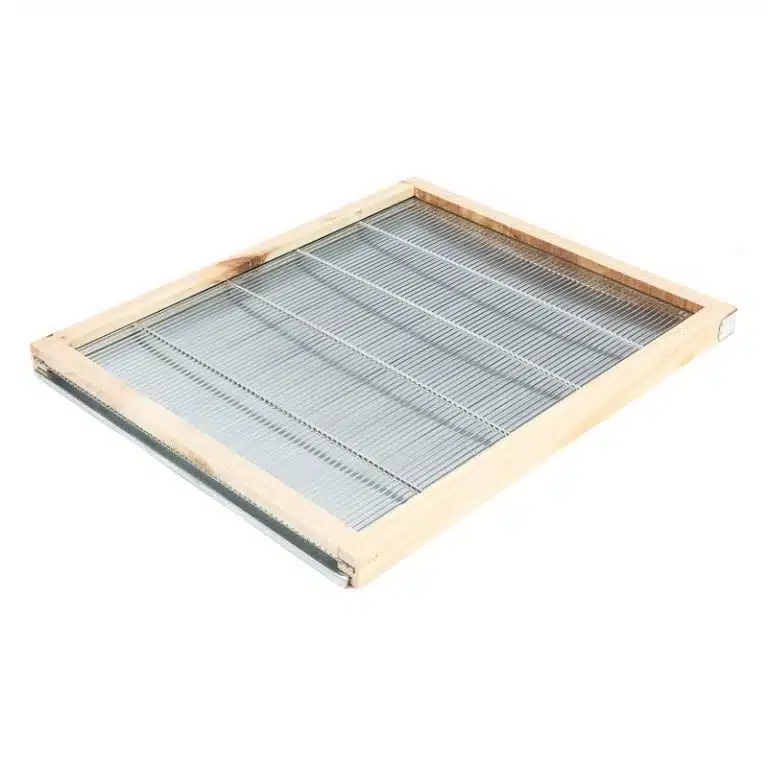
A Cloake board sits between two brood boxes. The queen excluder keeps the queen in the bottom box while allowing workers to pass. The solid slide cuts off that passage when you insert it. Nurse bees in the queenless top box then start queen cells. Pull the slide out and workers can move through the excluder again. The colony finishes the cells with the queen downstairs and the graft frame still in place.
Start with a healthy colony with food stores and enough bees to cover the brood in both boxes. Check that the queen is below the excluder and there are plenty of nurse bees upstairs. Our queen-rearing guide covers choosing larvae and making your first graft.
The classic rotation: out the back, home through the front
Several days before grafting. In Susan Cobey’s setup, turn the bottom box and floor through 180°. The bottom entrance now faces the rear. Keep it closed. The board entrance faces the original flight line. Leave the slide out and bring open brood upstairs to draw nurse bees through the excluder. Make sure the queen stays below.
The day before grafting. Insert the slide and open the lower rear entrance. Foragers can fly out from below and return to the familiar front of the hive, where the open entrance leads into the top box. Remove the open brood from upstairs so it does not compete with the grafts for attention. On grafting day, place the cell bar frame among the nurse bees.

The day after grafting. Look for accepted grafts: nurse bees will have fed the larvae and begun drawing out the cups. Pull the slide out, leave the excluder in place and close the rear entrance again. Workers in both boxes can now reach the upper entrance.
Without rotating: how Fert keeps bees on the brood on cold nights
Fert wants enough bees left downstairs to cover the brood when nights turn cold. He keeps the hive facing its original direction. One to two hours before grafting, he inserts the slide and closes the lower entrance. The bottom box needs airflow through a ventilated floor for as long as that entrance is closed. The board entrance stays open and the top box must already have enough nurse bees.

About 24 hours after grafting, Fert pulls the slide out and reopens the lower entrance. He moves a frame of open brood next to the cell bar frame to draw nurse bees to the developing cells. Check that the queen stays downstairs before moving the brood. If the bees are already stretched thin over the brood, or ventilation is inadequate, postpone grafting.
When to take the ripe queen cells
Record grafting day as day 0. Fert usually removes ripe cells around day 10. The age of the larvae at grafting affects the time left until emergence. Prepare the mating nucs ahead of time and take the ripe cells before the first virgin emerges. When you lift out the bar, check the floor for any cell that may have fallen.
Sources. The rotation and entrance sequence follow Susan Cobey’s Cloake board protocol. Fert describes his setup in his Bees.Academy course, part one, at 1 hr 42 min to 1 hr 46 min. The Honey Bee Research Centre’s rearing schedule gives another example of how to plan grafting and collection dates.


