

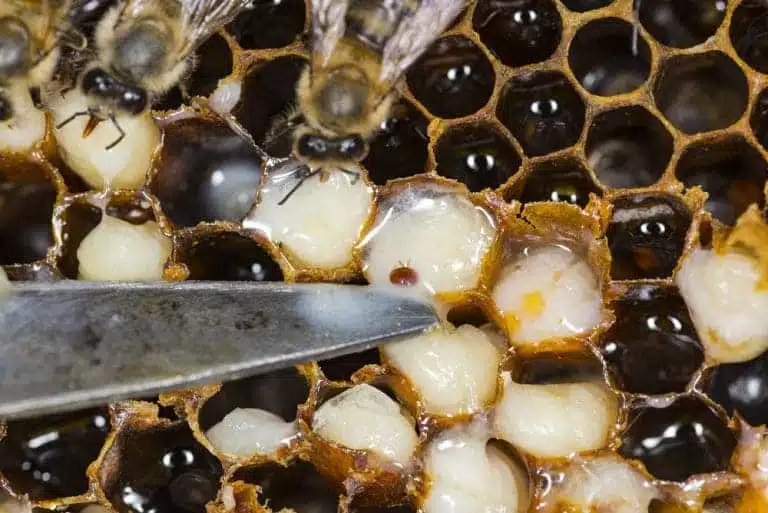
Varroa destructor is one of the most serious health problems facing managed western honey bees. It damages developing and adult bees. A strong-looking colony may already have a substantial infestation by the time mites are seen on workers.
Equipment for monitoring and further reading


Use a consistent sampling method and record the number of bees examined. The accompanying Spanish-language reference places monitoring in the wider context of colony health.
Keep the starting count with the follow-up
- Record the hive, date, brood conditions, method and sample size.
- Repeat a comparable count after the labelled course and consult your local programme if the result is still high.
The reddish-brown adult female resembles a tiny, flattened tick. Feeding damages the bee’s tissues, including the fat body, which supports immune function and winter survival. Developing bees can emerge in poor condition.
Varroa is also associated with viruses, notably deformed wing virus. A badly affected colony can dwindle within a season. Monitoring is most useful before that damage becomes obvious.
Managing Varroa: the essentials
Integrated control combines regular counts, authorised medicines at the right time and compatible husbandry practices. Keep records throughout the year, including what the follow-up count shows.
1. Monitor the colonies and record the result
Check at several points in the season, for example before spring supers, after the spring crop and before and after the main late-season treatment. More than 3 mites per 100 adult bees (alcohol wash) is already a serious risk; the thresholds for each method and for worker brood are set out below. In Spain at least one treatment a year is compulsory. A Varroa EasyCheck-type monitoring device can help standardise sampling.
2. Match the timing to the brood and the flow
Many treatments mainly reach mites on adult bees. During active brood rearing a large proportion of the mites may be under cappings. Check the brood situation, label and honey flow when choosing a suitable product and timing.
3. Products based on organic acids or essential-oil constituents
Their origin does not make these treatments harmless or interchangeable. Check the exact product, permitted route, temperature, supers and harvest restrictions. Organic producers also need to check their applicable certification rules.
- Oxalic acid. Authorised products have different routes, including trickling, spraying, evaporation or strips. Compare the registered oxalic acid products. VarroMed combines oxalic and formic acids and has its own directions.
- Formic acid. The only active substance that reaches mites under the cappings, so it also works with brood. It is very temperature-dependent: with FormicPro, the daytime maximum on the day of application must be between 10 and 29.5 °C, according to its product information. Consult the FormicPro product information for its own conditions.
- Thymol. Gel and strip formulations are used under different conditions. Check the specific label, for example Apiguard or Thymovar.
4. Other registered acaricides
Amitraz, flumethrin and tau-fluvalinate are examples of active substances in commercial medicines. Check the prescription status and authorisation of the exact product, such as Apivar. In Spain, mites with reduced susceptibility to amitraz, linked to a mutation in their octopamine receptor, have already been described (Hernández-Rodríguez et al., 2025, Pest Management Science), and pyrethroid resistance has been known for years. Count again after treating and rotate modes of action.
5. Biotechnical measures
Managed brood interruption, appropriate drone-brood removal, screened floors and selection for hygienic behaviour can contribute to a programme. Each has limitations, labour costs and a need for follow-up.
Golden rule: always treat with the honey supers off, follow the leaflet for dose and duration, respect the stated temperature and renew the comb every three years so residues do not build up. Check the mites after the intervention.
Where are the mites?
Some mites are on adult bees, while others are hidden in capped brood. Their distribution changes as brood area changes. While the colony is rearing brood, roughly three-quarters of the mites are inside capped cells and only a quarter are on adult bees.
For every mite you see on a bee there may be three more under the cappings, so mites visible to the naked eye already point to an advanced infestation.
If you can easily see mites on several bees, carry out a standardised assessment promptly.
How does Varroa reach a colony?
Originally associated with Asian honey bees, Varroa became established in western honey bees and was recorded in Spain in the mid-1980s. It is now a routine part of bee health management even in apiaries that look healthy.
Think about risk at several levels when organising your inspections.
Within a colony
- Mites can be present on adult bees as well as in the brood nest. Both parts of the colony matter when interpreting a count.
- The capped brood hides much of what cannot be seen by looking at adult workers.
Within an apiary
- Drifting and robbing mean that a healthy-looking neighbouring hive cannot be assumed free from mites.
- Keep the health history of combs, colonies and equipment traceable. Do not exchange suspect material.
- Inspect several hives at a site, since one colony’s result does not describe all its neighbours.
Between apiaries
- Monitor again after changes in neighbouring apiaries or managed colony movements.
- Record the origin of new colonies and swarms and assess their health before combining them with existing stock.
Across regions
- Follow the movement, health certification and veterinary requirements for the area, including for migratory beekeeping.
Once the mite is established, a one-off check at purchase or arrival is insufficient. Make subsequent monitoring part of the colony record.
How Varroa weakens bees

Varroa damages the tissues of individual bees, especially the fat body. Developing and adult bees may lose condition and resilience, with consequences for brood survival and the colony’s working life.
Signs can include shortened adult life, poor development, deformed wings and a declining population. Confirm mite pressure and consider additional health problems when investigating them.
The damage does not disappear the day a treatment ends. Viral signs and poor brood survival may persist while the population turns over. Review queen replacement and drone-laying colonies only after assessing brood, stores and mite history.
The Varroa life cycle and its implications for control
The practical distinction is between mites exposed on bees and mites protected beneath a cell capping. The proportions change with the season and the colony.

1. Mites on adult bees
Adult females can be found on workers, often partly hidden beneath abdominal plates. This is the stage sampled by a standard adult-bee wash.
2. Mites in capped brood
The foundress enters a cell holding a 5–6-day-old larva just before it is capped, preferring drone brood, and hides in the brood food. About three days after capping she lays a first, unfertilised egg that becomes a male, then a female egg roughly every 30 hours. Daughters take about 5.8 days to mature and the male about 6.6, so only daughters that finish before the bee emerges leave the cell; the male and immature females die. Each female can complete one to three reproductive cycles, and drone brood, at 24 days, lets more daughters mature. A count on adult bees does not measure this population directly.
The cap means that treatments acting by contact on adult workers may leave mites protected inside the comb. This matters when interpreting an apparently low count.
3. What an opened cell may show
An examination of capped brood may reveal adult females and lighter immature stages. Record the type and amount of brood examined before comparing results.
Pale stages present in brood can be difficult to identify accurately. Magnification and a field guide can help.
4. Why worker and drone brood counts differ
Drone and worker brood can have markedly different infestation levels. Record which you inspected; a threshold intended for worker cells cannot simply be applied to drone cells.

5. Recognising an adult female
An adult female is broadly oval, reddish brown and roughly 1–1.8 mm across. It resembles a small flattened lentil. Males are smaller and pale and are normally found within brood cells.
Monitoring Varroa in the apiary
Late-summer and autumn counts help assess the risk to the bees that will overwinter. If action waits until the adult population visibly declines, that generation may already have been damaged.
Repeated monitoring also shows whether a treatment achieved the reduction you expected and whether mite pressure has returned.
The cost of a standardised count is small compared with replacing a colony, feeding a nucleus and losing a honey crop while it rebuilds.

Why a busy entrance can be misleading
A full box, strong flight and ample stores are encouraging signs, but none tells you the mite count.
This is a common inspection mistake.
A colony with extensive sealed brood may appear particularly vigorous while a considerable infestation remains hidden.
Record the difference between what you observed and what you measured.
Write down both the number of mites found and the number of bees or cells examined.
Use that baseline to interpret the next inspection.
How often should you monitor?
At least four checkpoints are a useful starting point for the season described in Spain. Increase the frequency when local pressure or the health programme requires it.
- In early spring, before the first honey supers go on.
- After the main or spring harvest, to catch a rising infestation.
- In late summer, in time to protect developing winter bees.
- In autumn or winter, to assess the actual brood status and whether further authorised action is indicated.
These checks give you comparable observations throughout the year. Always record the method as well as the result.
The example calendar below links each count to a management question.

Monitoring methods
A useful monitoring method gives a result that can be repeated and compared with an appropriate local action threshold.
Four common approaches examined in this guide are:
- An adult-bee alcohol or validated detergent wash
- An icing sugar roll
- A purpose-designed carbon dioxide monitor
- Examination of capped brood

Our guide to detecting and assessing Varroa goes into the choice of method in more detail.
Sticky monitoring boards and inspection of drone brood can provide additional observations. Each measures something different from a standard adult-bee count.
Use the method your programme recommends and keep it consistent when assessing change.
Examining capped worker brood
An examination of worker brood measures what is hidden under the caps. Record how many cells were examined and distinguish infested cells from the total number of mites.
A representative area is important because mites are not evenly distributed. Follow the apiary health programme’s sampling plan and record the type and age of brood examined.
Cut out a piece of capped worker comb of about 100 cells, empty it onto a light surface and count the brood and the mature (brown) mites; pale immature stages do not count. Then:
% infestation = mites counted ÷ brood examined × 100. This is the figure the 9% and 20% brood thresholds refer to.
This approach can reveal a problem missed on adult bees, but it samples one part of the hive at one point in time.
Icing sugar roll
This method aims to estimate mites on adult bees while allowing most of the sampled bees to be returned. Recovery varies with technique and conditions, especially humidity.
Take about 300 bees (30 g), ideally from brood frames, and make certain the queen is not in the sample. Put them in a jar with a mesh lid of about 3 mm (8 mesh), add one or two tablespoons of icing sugar, shake, leave in the shade for 3–5 minutes and shake again over a white tray.
Count the detached mites against a measured number of workers and record the hive, date and method.
Damp sugar and windy conditions can make a result less reliable. If action depends on an uncertain result, confirm it with the method recommended locally.
Carbon dioxide monitoring
A purpose-designed device can temporarily immobilise sampled bees and allow detached mites to be counted. Compare results obtained by the same method.
Points to check with a commercial Varroa tester include the following.
- Use a consistent measured sample of workers and locate the queen first.
- Use only equipment designed for that method and follow its instructions.
- Handle the sample as directed and minimise unnecessary stress.
- Apply the manufacturer’s specified handling procedure consistently.
- Count all mites in the collection compartment and record the sample size.
The method avoids wet washing, but its mite recovery and effect on bees can vary. Record those limitations when interpreting a count.
Alcohol or validated detergent wash
An adult-bee wash is a widely used reference method because it generally gives more consistent mite recovery. It sacrifices the sample, so the queen must be excluded.
Use about 300 bees in alcohol (screenwash or soapy water also work), shake for one minute and strain through a mesh of about 3 mm (8 mesh) that holds back the bees and lets the mites through. Record the result as mites per 100 adult bees.
A commercial device such as Varroa EasyCheck can help standardise the sample and collection.
Follow the device instructions on cleaning, fluid handling and disposal. Avoid carry-over or counting mites from a previous sample.

How to interpret an adult-bee count
For a sugar roll, wash or other adult-bee method, use the actual sample size. A result from two methods can differ even when the colony is the same.
Mites per 100 adult bees = mites found ÷ bees sampled × 100.
For example:
Twelve mites from 300 workers gives 4 mites per 100 bees. Eight mites from 200 workers gives the same result. Write the denominator in the field record.
More than 3 mites per 100 adult bees with an alcohol wash, or more than 2 per 100 with an icing sugar roll (which leaves some mites on the bees), already signals a serious risk of losing the crop, and the colony itself if winter is near: treat within a month. At 6 per 100 (wash) or 4 per 100 (sugar roll), treat straight away.
Floor counts measure natural mite fall over a known interval. They are useful for trends but cannot be exchanged directly for an adult-bee percentage.
- As a guide, a natural fall of more than 3–4 mites a day in autumn calls for action; in spring or summer the threshold can rise to 10 a day. Adjust these figures to each apiary’s history and area.
- Natural fall changes with season, brood emergence and recent treatments. A number used in summer may not suit an autumn colony.
Interpret counts with the colony’s history, current brood and neighbouring mite pressure.
When should you act against Varroa?
A fixed calendar on its own cannot account for differences in forage, brood, colony strength and past treatment.
Plan around the brood cycle, measured infestation, honey crop and the applicable legal programme.
Before the main season: late winter or early spring
Assess the need before the first supers, using the local climate and mite count.
Reasons to check early include the following.
- Residual infestation carried through winter.
- The risk that mites will rise as spring brood expands.
- Brood that continued through a mild winter, or an autumn intervention whose effect was uncertain.
- Changes in pressure at the apiary, including robbing or neighbouring colonies deteriorating.
In places with an early nectar flow the available window can be short. Check the product’s conditions and its compatibility with the harvest.
After the main crop: protecting the winter generation
Review mite pressure promptly after the last main crop, often in July or August in the areas described. Local harvests and the official programme may differ.
Reasons to check early include the following.
- Mite pressure can already be high by late summer.
- As drone brood declines, the remaining worker brood, including developing winter bees, becomes particularly important.
- A late pollen flow may support brood rearing without reducing mite pressure.
- A declining adult population has less capacity to absorb losses in the next generation.
Waiting for completely broodless conditions can allow avoidable damage if counts are already high. Consult the programme about the appropriate authorised option.

Treatment can reduce the infestation that remains. It cannot restore the lifespan of winter bees already damaged while developing.
Registered Varroa treatments
In most established areas the aim is sustainable suppression. Recheck colonies because a successful intervention does not give lasting immunity from reinfestation.
The main tools are authorised Varroa medicines, including products requiring veterinary prescription, with additional management equipment where appropriate.
Spain’s national programme requires at least one treatment a year with an authorised veterinary medicine, under the supervision of the holding’s veterinarian. It is normally carried out between September and November, although each autonomous community can set different dates.
After a summer crop, mite pressure can rise while the brood area is shrinking. Check early enough to choose an appropriate labelled option.
The condition of the colony determines urgency; the programme and authorised product information determine what can be done.
Spain’s Royal Decree 608/2006 sets the national framework. Follow the competent autonomous community’s arrangements, including prior notification where applicable outside the prescribed period.
A statutory minimum does not eliminate the need for monitoring throughout the beekeeping year.
To decide when to act, use the percentage of mites in capped worker brood: at 9%, treat within a month; at 20%, treat straight away. At around 50% of worker brood infested, the colony collapses and does not recover. On adult bees the same two levels are 3 and 6 mites per 100 bees with an alcohol wash, or 2 and 4 per 100 with an icing sugar roll. Do not compare a count from brood with a threshold derived from adult bees. The table and step-by-step sampling are in Varroa diagnosis and decisions.
The Teruel beekeeping health association’s good-practice guide puts a cost on a 3% adult-bee infestation: about 5 kg less honey per hive at the summer harvest and, in autumn, winter losses of more than 30%.

The following active substances and trade names illustrate the Spanish market. Always check the current CIMA Vet entry, presentation, route, prescription status and label before use.
Amitraz

Amitraz is the active ingredient in several veterinary medicines. Susceptibility varies between areas, so a product that worked previously still needs a follow-up count.
- Amicel Varroa, a registered veterinary presentation. Follow its own instructions.
- Apitraz treatment strips. Check the pack, prescription and label.
- Apivar treatment strips. Check the exact presentation and instructions.
- Optivar is another Spanish registration. Check its current marketing status in CIMA Vet before planning to use it.
Oxalic acid

Oxalic acid products differ in formulation. A device such as the InstantVap 18V Compact is relevant only where the chosen medicine permits vaporisation. Calistrip Biox is a different presentation, with its own authorised route and duration.
Examples of Spanish and EU veterinary products are listed below. A similar active ingredient does not make their instructions interchangeable.
- VarroMed combines oxalic and formic acids and uses its own trickling directions and harvest restrictions.
- Ecoxal: authorisation revoked in October 2023; no longer available.
- Oxybee: a product with an authorised trickling route.
- Api-Bioxal: check the pack carefully. The powder and ready-to-use liquid do not have the same authorised routes.
- Varroxal: follow the instructions for the intended route, season and brood condition.
- Calistrip Biox: an oxalic acid strip presentation. Follow the specific label.
Formic acid

The suitability of a formic acid product depends on temperature, ventilation, colony strength and label conditions. Check forecasts and the complete instructions before choosing it.
- MAQS appears in older references. Check the currently authorised presentation for your country and the date of the information.
- FormicPro.
- VarroMed combines formic and oxalic acids and has a different formulation and route.
Coumaphos

Coumaphos is present in older treatment and residue literature. A historical study or an old product listing does not establish current authorisation or supply.
CheckMite is a historical example. Check the current Spanish veterinary register before considering any medicine.
Thymol

Thymol products have specific temperature ranges, placement and harvest conditions. Check the authorised formulation and any organic-certification requirements.
Hive architecture affects access to the treatment area. The Teruel bee health association’s guide discusses practical considerations for closed-top-bar Layens hives. Follow the authorised label.
Pyrethroids: flumethrin and tau-fluvalinate

Flumethrin and tau-fluvalinate have been used in registered strip treatments. Resistance can make their performance highly variable between apiaries.
Large-scale monitoring in the Valencia region (Universitat de València with local beekeeping health associations, 179 apiaries in 2018 and 2019) put figures on it. The expected efficacy of pyrethroids, estimated in the laboratory with each apiary’s mites, averaged 41% and 36%, ranging from apiaries where they had no effect to others where they worked well. Amitraz was more consistent, at 74–81% on average, slightly below the label claim. What works in one apiary may fail in the next, so count before and after treating. Hernández-Rodríguez and colleagues, 2021.
Examples discussed in the source include:
PolyVar is no longer an option: its Spanish authorisation (3526 ESP) was revoked on 21 July 2023 and CIMA Vet lists it as not marketed. If you see it in forums or older material, disregard it.
Practical checks for any treatment
Use the labelled duration and placement for the specific product and colony type. Shortening a course or leaving strips in after their intended period can compromise management.
Repeat a comparable count afterwards to establish whether the infestation fell to an acceptable level.
Check supply before the working window opens, store medicines as directed and keep enough time to complete the full treatment and follow-up.
Trial efficacy and the reduction in your own count
A reported efficacy figure may compare treated colonies with controls. A before-and-after count in your own hive answers another question: how far the measured infestation actually fell.
Controls help account for changes that would have happened during the trial. Without them a simple field reduction cannot be read as the same measure of efficacy.
Use the same field method and sample size at comparable points, record the interval and note brood and new mite pressure.
Randy Oliver discusses the distinction in “Testing Varroxsan: Part 1” (Scientific Beekeeping, 2026).
Unlicensed homemade treatments
In Spain, homemade Varroa treatments are illegal. Every substance applied in hives to treat or control disease must be a veterinary medicine authorised by the Spanish Agency of Medicines (AEMPS), and applying unauthorised treatments can amount to a criminal offence against public health.
Select authorised Varroa medicines with the responsible veterinarian or bee health service as appropriate. A substance sold for another purpose has not thereby been authorised for a food-producing colony.
Unauthorised use can expose bees, operators and the food chain to avoidable harm and can have regulatory consequences.
Complementary tools for managing Varroa
Husbandry measures can complement treatment and monitoring. Their practical value depends on local conditions and how consistently they can be carried out.
Open mesh floors and monitoring boards
A screened floor can let fallen mites pass out of reach of the bees. It can also provide a position for a monitoring board.
A removable tray makes it easier to examine debris and record mite fall over a defined period.
Use an appropriate monitoring insert for the floor design and protect the result from disturbance. Record when the board went in and when it came out.
On its own a mesh floor reduces the mite population by around 20–30% (Pajuelo estimates 26%): it helps but cannot control Varroa. Its great advantage is that it lets you count. Change the board every 24–72 hours; left longer, hive debris covers it and the mites can no longer be told apart.

Small-cell foundation
Changing the cell size of wax foundation has been proposed as a way to influence infestation. It also changes comb management and must be considered in the context of the colony.
Standard foundation has 5.4 mm cells. Advocates of returning to 4.9 mm cells, going through 5.1 mm first, claim it hinders the mite, but many colonies refuse the change, no study has yet supported it and, in Pajuelo Consultores’ experience in a Mediterranean climate, small-cell foundation has not worked.
Brood interruption through queen caging
Caging the queen for about 25 days stops egg laying, so that when the treatment is applied all the mites are on adult bees and an authorised product is far more effective. The method needs a planned colony, a successful return to laying and appropriate veterinary guidance.
Use equipment designed for the queen and suitable for the intended period. A marking cage is not a long-term confinement device.
Allow for labour, queen welfare, the weather and the timing of subsequent flows. Verify actual brood status and follow the medicine label.
Selecting colonies for hygienic behaviour
Some breeding programmes select for traits that improve a colony’s ability to cope with mites. This is a long-term complement to day-to-day monitoring.
Varroa-sensitive hygiene (VSH) involves workers recognising and removing affected brood. Assess the trait using an appropriate breeding programme rather than judging a queen from one observation.
Grooming is the removal of mites from adult bees. Its contribution varies between lines and colonies.


Each queen mates with 15 to 20 drones, so daughters in one colony do not all share the same paternal lineage. Consistent records over generations are more informative than a single queen’s appearance. The Teruel beekeeping health guide discusses this in practical apiary management.
Colony splits and artificial swarms
A planned split of a healthy colony can change the brood cycle and form part of the season’s management. Keep the identity, queen status and health record of both units.
A brood break alone does not establish that a colony is free of mites. Monitor again and use any authorised intervention under its own conditions.
Do not confuse routine Varroa management with the official response to a suspected exotic pest. See how to recognise and report Tropilaelaps.
Shook-swarm and related management approaches
Some professionally supervised programmes use a change of comb or a managed brood break as part of a wider bee-health plan. Choose the method for the particular colony and its diagnosis.
These are substantial interventions. Consider colony strength, nutrition, queen status and the time left to rebuild before winter.
Drone-brood removal
Removing a limited amount of drone brood can contribute to an integrated programme. Drone-brood infestation is not a substitute for a representative adult-bee or worker-brood assessment.
It requires regular attendance and a clear plan for handling the removed comb.
Beekeepers use several frame arrangements for this purpose.
- Frames intended specifically for drone comb.
- Partly drawn or purpose-designed frames that allow the colony to build a defined area of drone comb.
Once the drone brood is capped, remove the frame and destroy the brood (scrape, melt or freeze it) before the drones emerge. If you wait too long and they hatch, you will have bred more mites, not fewer.
Do not transfer untreated suspect comb into another colony. Keep track of any comb that leaves the brood nest.
The method is labour-dependent and cannot give an adequate degree of control on its own in every season. Check the mite count.

Working with neighbouring beekeepers
Colonies in the same area do not face mite pressure in isolation. Exchange information about monitoring results, unusual losses and treatment response with the local bee health group.
Coordinate within the official programme where appropriate and keep a record of what happened in each hive. Shared timing is more useful when each beekeeper also checks whether the intervention worked.
Where to learn more about Varroa
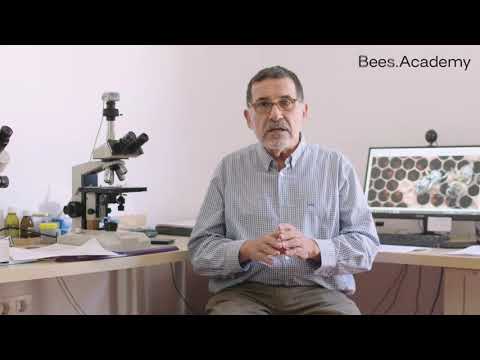
Antonio Gómez Pajuelo teaches a Spanish-language online course on Varroa for Bees.Academy.
View the Spanish-language course.

Varroa and a changing climate
Changing temperatures and flowering periods can alter how long colonies rear brood and when a beekeeper can intervene.
In regions with milder winters, brood rearing may continue through what used to be a substantial winter break. Check the colony rather than assuming it is broodless from the date.
Heat and disrupted forage can weaken the population while also narrowing the safe temperature windows of some medicines.
Record brood, weather and flow alongside mite counts so that changes are seen in time.
Frequently asked questions about Varroa control
When is the best time to treat for Varroa?
It depends on the measured infestation, brood, planned harvest, permitted weather conditions and local programme. Protect winter bees before damage accumulates rather than waiting solely for a calendar date.
Which treatment works best in winter?
A broodless period can make an authorised oxalic acid product effective against exposed mites. Check the actual brood, formulation, permitted route and local programme before choosing it.
Can Varroa be treated while brood is present?
Some products are authorised for particular conditions with brood, while other treatments mainly affect exposed mites on adults. Read the exact label and monitor the result.
How is oxalic acid administered?
Registered formulations may specify trickling, spraying, evaporation or strips. These are different products and routes. Choose the authorised instructions for the exact pack rather than adapting another method.
How often should a colony be treated?
Follow the official programme, current counts and the minimum and maximum use allowed by the label. One treatment a year and an absence of visible mites cannot demonstrate adequate control.
If I still find mites afterwards, did the treatment fail?
A large initial infestation can leave a significant number after a substantial reduction. Also check the method, brood status, timing and subsequent mite pressure. See trial efficacy and the reduction in your own count.
Reviewing the season
The most useful record connects a decision to an outcome. Note why you chose a product, when and how it was used, and what the comparable follow-up count showed.
Late intervention cannot undo earlier damage. An early treatment also needs a follow-up before you assume the winter generation is protected.
No single product or date suits every colony throughout the year. Local climate, forage, brood and medicine conditions shape the plan.
Common mistakes worth checking in your records
Review the following points when an expected reduction does not materialise.
- Using an incomplete course or an amount different from the approved instructions.
- Placing strips where the label does not direct, or where the bees do not contact them adequately.
- Treating at the wrong point in the brood cycle or honey flow.
- Leaving strips in beyond the authorised period.
- Using too much in the hope of a stronger effect.
- Repeating the same active substance without reviewing follow-up counts or local resistance advice.
- Substituting a homemade preparation for an authorised veterinary medicine.
Varroa requires continued management
After a successful intervention, set the date for the next count. That is how a fall in infestation becomes an ongoing bee health plan.
Share relevant observations with your bee health group, particularly after a poor response or a change in local pressure.
A simple field record, appropriate medicine and a follow-up inspection are more useful than relying on the apparent strength of a hive.


