 Apipasta with vitamins 15kg
 Beecomplet® Spring 14Kg
 Beekeeper suit with round veil
 Oxalic acid 1kg
 Beeswax Foundation 5kg
 Fresh royal jelly 20g
 Classic honey jar 1kg comb-lines TO77 - Pack of 16 units
 Promotor L Apis 1 litre


 Share in WhatsApp
0.71 g/g OXALIC ACID | 2 routes TRICKLING OR SUBLIMATION |
2 g PER HIVE, SUBLIMATED | 31-312 g THREE PACK SIZES |
Sugar-free veterinary medicine. Trickling or sublimation. Organic beekeeping compatible.
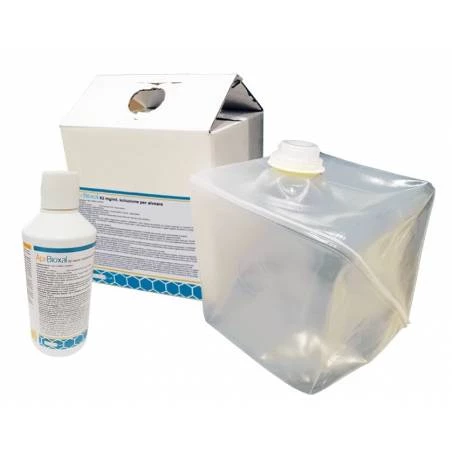
Api-Bioxal® Powder is a veterinary medicine based on oxalic acid (Reg. No. 3886 ESP; marketing authorisation holder Chemicals Laif, distributed by Véto-pharma). Its sugar-free formulation does away with caramelisation in sublimation. Available in three formats — 31 g, 156 g and 312 g — to cover everything from the hobbyist with 10 hives to the professional operation running over 100.
01 · EFFICACY
A 2021 study in southern Spain (Calatayud & Simó) applied Api-Bioxal® by trickling to 21 broodless colonies after queen caging and measured 97.4% efficacy, with the peak mite drop visible from the first day. Read the figure with its context: it is a small trial under very specific conditions —broodless and by trickling— which are precisely the ones the technical sheet requires.
02 · FORMULATION
The new Api-Bioxal® Powder formula has removed sugar from the excipient: the powder is oxalic acid with hydrated colloidal silica, and there is no caramelisation during sublimation in the vaporiser. On honey, the technical sheet states that, with correct administration, no increase in oxalic acid residues above the natural content of honey is expected.
03 · APPLICATION
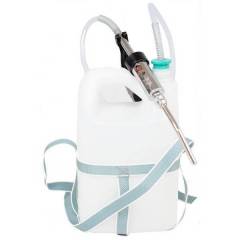
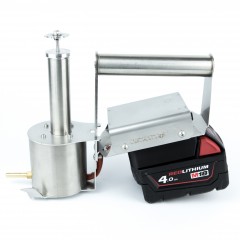
By trickling: dissolve the powder in syrup (1:1 water-sugar) and apply 5 ml per occupied bee space using a syringe. Ideal for the classic winter treatment or after queen caging in summer. By sublimation: load 2 g into your electric resistance vaporiser, seal the entrance and keep the hive closed for 15 minutes after treatment.
04 · PACK SIZES
Heat-sealed sachets. Unopened, the product keeps until the expiry date on the pack: in its original packaging, tightly closed to protect it from light and moisture, not refrigerated or frozen, and away from food. Once a sachet is opened, use it within 3 months. If you prepare the syrup, use it within 24 hours.
05 · WHEN TO TREAT
Remember that oxalic acid does not penetrate under the cappings: it only kills phoretic mites on direct contact. That's why the key is to treat with little or no sealed brood. In winter, take advantage of the natural brood break. In spring-summer, use queen caging (Nicot cage or similar) for at least 25 days to leave the colony broodless before applying. Trickling: up to 2 treatments per year (winter and/or spring-summer, broodless). Sublimation: 1 treatment per year, and it is not recommended in summer. Maximum dose: 50 ml per hive (trickling) or 2 g per hive (sublimation). And treat all hives in the apiary at the same time — if you leave one untreated, reinfestation through drifting or robbing will undo the work.
| 31 g | 500 ml (308 ml water + 308 g sugar) |
|---|---|
| 156 g | 2.5 L (1,540 ml water + 1,540 g sugar) |
| 312 g | 5 L (3,080 ml water + 3,080 g sugar) |
| Active ingredient | Oxalic acid 0.71 g/g (equivalent to 0.995 g oxalic acid dihydrate) |
| Pharmaceutical form | Fine white powder, sugar-free formulation |
| Available formats | Heat-sealed sachets of 31 g, 156 g and 312 g |
| Application methods | Trickling (dissolved in 1:1 syrup) or sublimation (2 g/hive) |
| Trickling dose | 5 ml solution per occupied bee space (max. 50 ml/hive) |
| Sublimation dose | 2 g per hive per application |
| Authorised treatments | Trickling: up to 2 per year (winter and/or spring-summer, broodless) · Sublimation: 1 per year, not recommended in summer |
| Withdrawal period (honey) | Zero days. Do not use with supers in place or during harvest |
| Shelf life | Until the expiry date on the pack (sealed sachet) · 3 months (opened sachet) · 24 h (prepared syrup) |
| Organic beekeeping | Compatible: oxalic acid is allowed under Regulation (EU) 2018/848 when applied with an authorised veterinary medicine. Check with your certifying body |
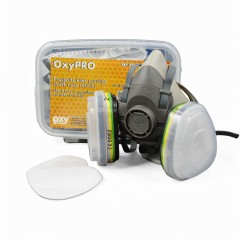
| PPE required | FFP2 mask (EN149), protective gloves and goggles |
| Registration No. | 3886 ESP |
| Manufacturer | Chemicals Laif S.p.A. (Italy) · Distributed by Véto-pharma |
Data sheet
Oxalic acid does not penetrate capped cells, so its effectiveness depends on treating with no brood, or as little as possible. The ideal times are the natural winter brood break or, in spring-summer, after caging the queen (Nicot-type cage or similar for 21-25 days) to leave the colony without capped brood. A maximum of two treatments a year is authorised (one in winter and/or one in spring-summer), never with honey supers on, and all colonies in the apiary should be treated at the same time.
Yes. Oxalic acid is among the substances permitted for Varroa destructor control in organic production under Regulation (EU) 2018/848, in force since 2022, alongside formic, lactic and acetic acid, menthol, thymol, eucalyptol and camphor.
Two points worth being clear about. The substance must be applied through an authorised veterinary medicine —not in bulk or in home-made preparations— and Api-Bioxal is one. And the body that validates its fit in a certified operation is your control authority or certifier: confirm it with them before applying.
Sorry, no results found.
Write your question