 Apipasta with vitamins 15kg
 Beecomplet® Spring 14Kg
 Beekeeper suit with round veil
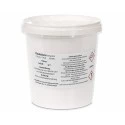 Oxalic acid 1kg
 Beeswax Foundation 5kg
 Fresh royal jelly 20g
 Classic honey jar 1kg comb-lines TO77 - Pack of 16 units
 Promotor L Apis 1 litre


 Share in WhatsApp
75 g JAR · 37 HIVES | 3 routes SUBLIMATE, TRICKLE, SPRAY |
0.71 g/g OF OXALIC ACID | 2-10 °C TO SUBLIMATE |
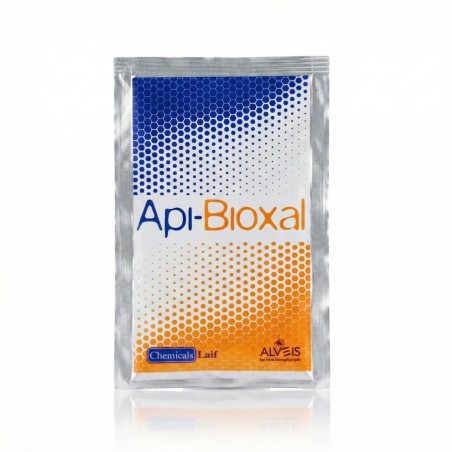
Oxalic acid powder, registered in Spain for all three routes: sublimation, trickling and spraying.
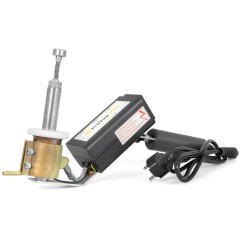
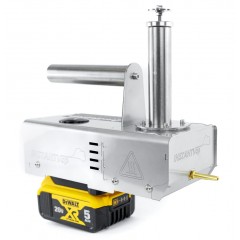
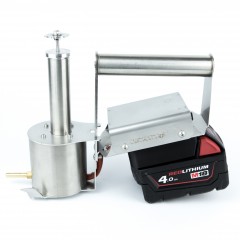
The75 g jar comes with a 1 g dosing spoon and covers37 hives by sublimation. Being a registered medicine matters here:its technical sheet expressly authorises evaporation —it names the Varrox and Varrox Eddy vaporisers as examples— and sets a temperature and a concentration for each route. Industrial oxalic acid does not come with that.
01 · THE NON-NEGOTIABLE CONDITION
Oxalic acid kills by contact anddoes not pass through the capping: the varroa in a capped cell is untouched. That is why the authorised indication is limited tobroodless colonies. Two practical consequences: if you treat a swarm or an artificial colony in summer, the sheet asks you tofollow it with a treatment in autumn/winter or spring; and in spring or summer it is best appliedat times when the bees are not flying, because with half the colony out in the field, half the colony goes untreated. Nor is it repeated lightly: treatingmore than once per worker generation harms the bees and saps the colony's strength.
02 · THE THREE ROUTES
It is the easiest mistake to make with this product. The sheet givestwo trickling concentrations: one for winter in northern and central Europe and another, more concentrated, forsouthern Europe and summer across Europe. Southern Europe falls in the second:6 sachets or 12 spoonfuls, not 4. Sticking with the northern one means treating at two thirds of the dose.
| ROUTE | DOSE AND MIX | TEMPERATURE |
|---|---|---|
| Evaporation (sublimation) | 2 g —1 sachet or 2 spoonfuls— per hive, in a vaporiser | Outdoors2 to 10 °C, autumn/winter |
| Trickling (southern Europe) | 6 sachets or 12 spoonfuls in 200 ml of warm 1:1 syrup → 4 hives. 6 % dihydrate solution | Outdoors above−15 °C |
| Spraying | 3 sachets or 6 spoonfuls in 200 ml of warm water → 3 hives. 3 % solution. Maximum 80 ml per hive | Outdoors above8 °C |
The mix is made in anon-metallic container —oxalic acid corrodes metal— and is applied warm and freshly dissolved. Trickling means0.25 ml/dm² per face: 3-4 ml per seam on a small frame and5-6 ml on Dadant; with two boxes, the lower one first. Spraying,0.3 ml/dm² with the combs tilted45° so as not to force product into the cells, and swarms at20-25 ml per kilo of bees.
03 · AFTER TREATING
After trickling the drop continues forthree weeks; after spraying,two. Worth knowing before you judge the treatment good or bad after three days. If you have sublimated,keep the entrance closed for a while afterwards. A second evaporation treatment two weeks later is only foreseen in two cases: heavily reinfested colonies —above6 %, more than one mite falling a day— or ones with capped brood areas in midwinter. And the sheet is honest about what to expect: increased bee mortality is listed as avery frequent event, in more than one in ten treated colonies.
04 · HONEY AND SUPERS
The honey withdrawal iszero days, and the very same section carries the two conditions that go with it:it is not used during the honey flow and, in producing hives,treatment is done with no supers on. It fits the indication —broodless colony— and puts the use where it makes sense: season closed, or in the broodless window of winter.
⚠ PRECAUTIONS
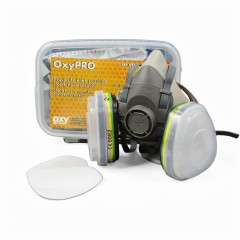
It is highly acidic, irritant and corrosive to skin, eyes and mucous membranes. Handle it with protective clothing,chemical-resistant gloves and safety goggles. And the mask changes with the route:FFP3 to evaporate or spray andat least FFP2 for trickling. Always prepare outdoors or in a well-ventilated area, and when evaporating or spraying standupwind, keeping an eye on who is around you.
Avoid hand-to-eye and hand-to-mouth contact, and do not eat, drink or smoke while handling it. If it splashes you, wash immediately with plenty of water. Used sachets and empty jars are disposed of at once, and the equipment is cleaned and storedout of reach of children.
05 · BEFORE YOU BUY
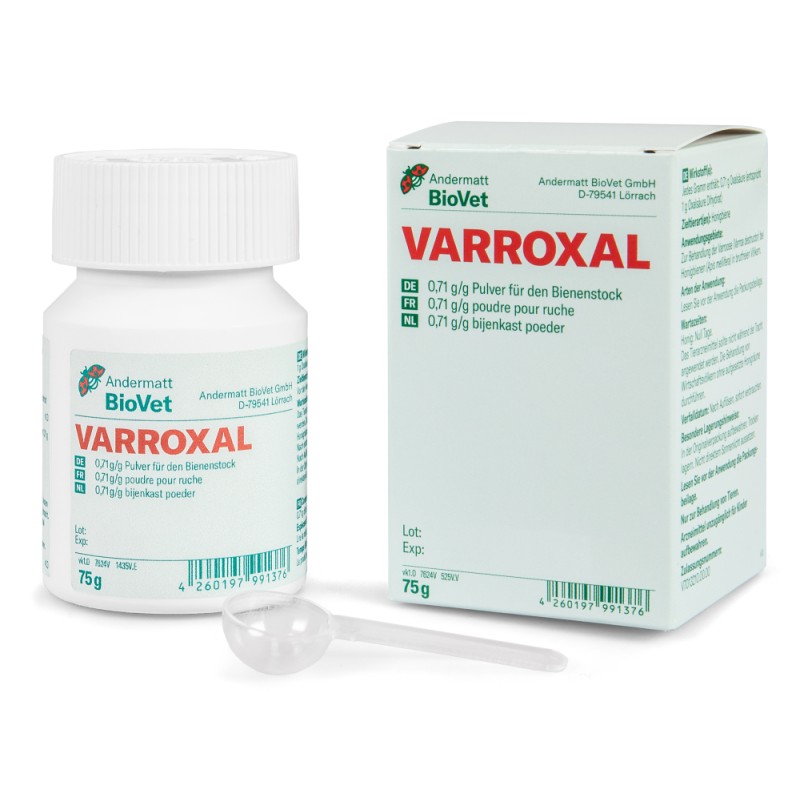
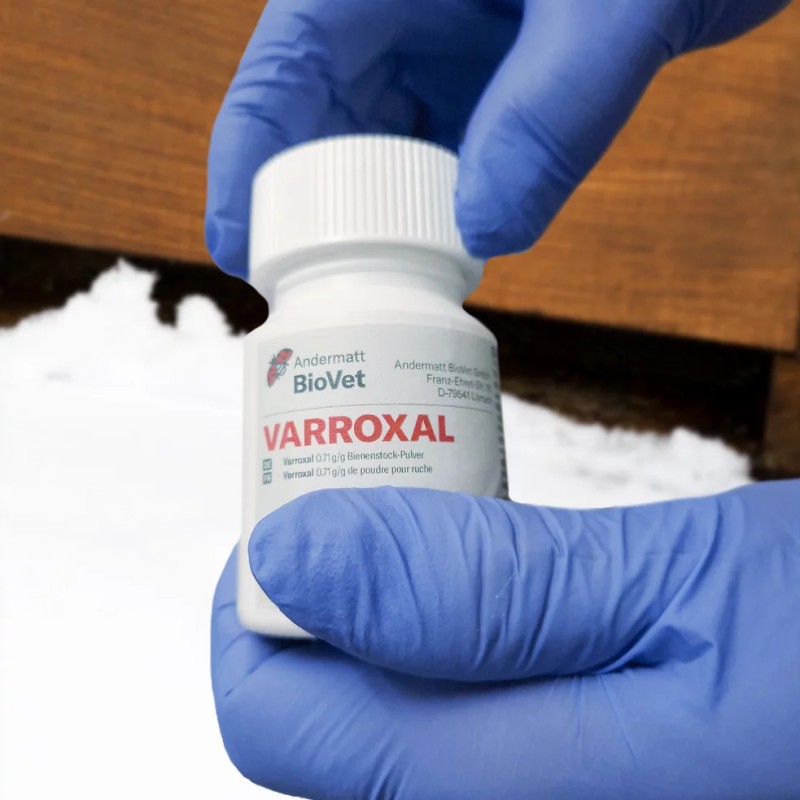
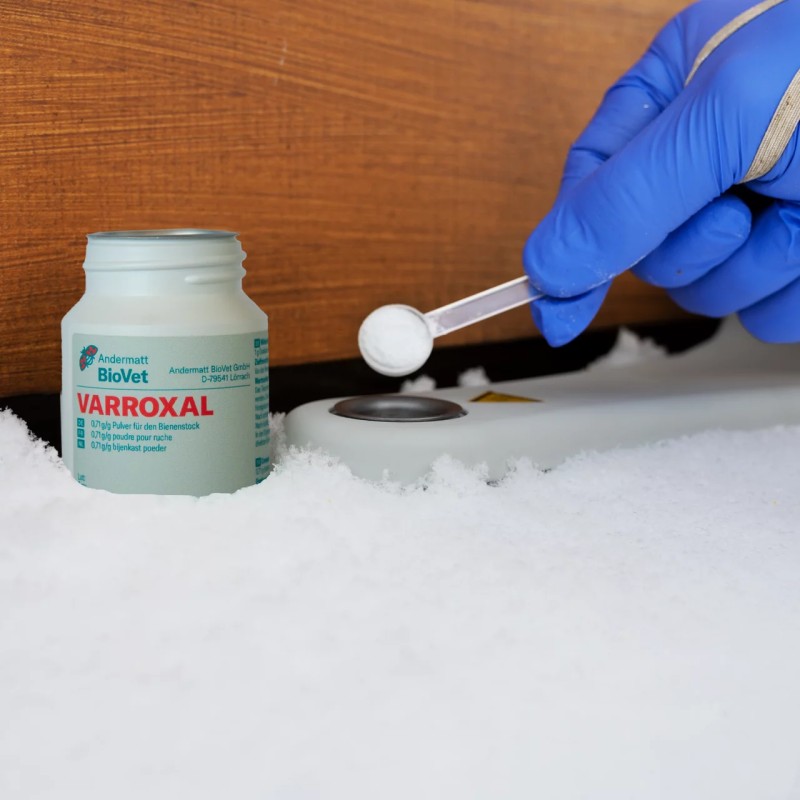
This format is the75 g jar with a 1 g dosing spoon. Sublimating at 2 g per hive it covers37 hives; trickling or spraying the yield changes, because the dose goes by solution. To sublimate you also need avaporiser: the product is the powder, not the device. Varroxal isnot subject to veterinary prescription.
| ✓ FITS | Broodless colonies, swarms and artificial colonies. Any frame size: the dose goes by dm² of comb. |
| ✕ DOESN'T FIT | Colonies with capped brood, use during the honey flow and treatment with supers on. |
| ⚠ NOTE | The jar keeps until its expiry date once opened, butthe prepared solution is for immediate use: mix only what you are going to use there and then. |
| Name | Varroxal 0.71 g/g powder for hives |
|---|---|
| Registration no. | 4250 ESP · ATCvet QP53AG03 |
| Active substance | 0.71 g of oxalic acid per gram (equivalent to 1 g of oxalic acid dihydrate) · white crystalline powder |
| Indication | Varroa infestation in colonieswith no brood · does not pass through the capping |
| Evaporation | 2 g per hive, at 2-10 °C, autumn/winter · a second treatment at 2 weeks only if infestation exceeds 6 % |
| Trickling (southern Europe) | 6 sachets or 12 spoonfuls in 200 ml of 1:1 syrup → 6 % solution, for 4 hives · 0.25 ml/dm² |
| Spraying | 3 sachets or 6 spoonfuls in 200 ml of water → 3 % solution, for 3 hives · 0.3 ml/dm², max. 80 ml/hive |
| Withdrawal period | Honey: zero days. Do not use during the honey flow · in producing hives, treat with no supers on |
| Pack and shelf life | 75 g jar with a 1 g spoon (37 hives by sublimation) · 5 years · prepared solution for immediate use · dry and out of direct sunlight |
| Supply status | Veterinary medicine not subject to prescription |
Data sheet
Specific References