

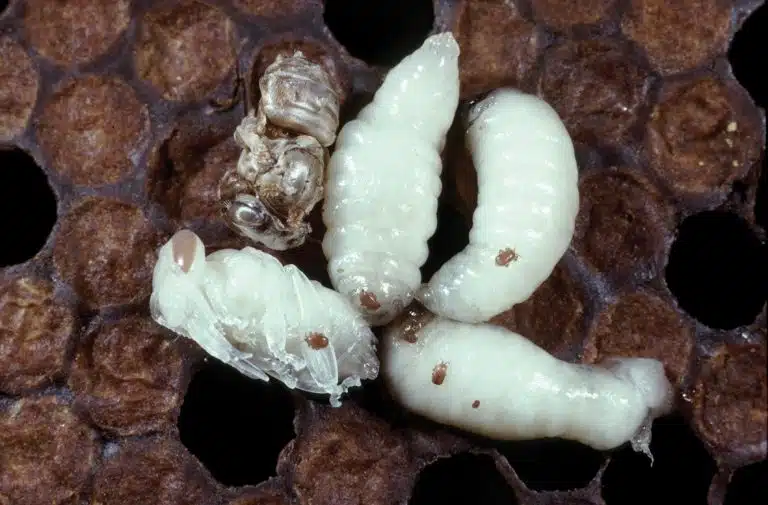
Tropilaelaps mites are small, fast-moving parasites associated with honey bee brood. T. mercedesae has been reported in Russia, Georgia and Türkiye. If you find an unfamiliar narrow mite moving rapidly on the comb, leave the hive and equipment in place and contact the competent bee health authority.
This guide is for recognition and early reporting. In a region where the pest has not been reported, the first response is official investigation. Trials carried out in affected countries are background information, not a prescription for managing a suspect hive.
Six things to know
- Geographical reports include Russia, Georgia, Uzbekistan and an outbreak in Artvin, Türkiye, officially reported in August 2026. Check current official notifications for changes.
- The mite is about 1 mm long and 0.5 mm wide, elongated and fast-running. Varroa is wider than it is long and moves slowly.
- Look in capped worker brood, not drone brood. An alcohol wash or icing sugar shake, which work for Varroa, fail to detect it in most infested colonies.
- It survives without brood longer than was thought: several days on adult bees (the maximum described on honey bees is 6) and 7–8 days on pupae or dead bees. Follow official movement and inspection rules.
- A brood break is what has held it back in trials. In Thailand, caging the queen for 24 days left worker brood below 0.11% infestation, against 15% in untreated colonies. It cannot establish that a colony is safe to move.
- If you suspect the mite, keep colonies, comb and equipment on site and notify the competent veterinary service.
Field reference for recognising Tropilaelaps

Use the illustrated field reference to recognise a possible suspect. Confirmation and decisions on movement or control belong to the competent bee health authority.
Keep a record of the suspected finding
- Record the site, hive and date, and follow the inspector’s directions.
- Keep colonies and equipment in place while the competent authority assesses the report.
What is Tropilaelaps?
Tropilaelaps is a genus of mites associated with Asian honey bees. Four species are recognised. T. clareae and T. mercedesae have also been reported on the western honey bee, Apis mellifera. The species in the recent westward reports is T. mercedesae.
Asian giant honey bees, including Apis dorsata and A. laboriosa, are its original hosts. They nest in the open on a single comb, migrate and abandon the nest when the parasite load is high, and all of that breaks the mite’s cycle from time to time. The western honey bee rears brood almost all year inside a box and has none of those escapes.
Older papers often used T. clareae more broadly. The revision by Anderson and Morgan in 2007 distinguished several species. Bear that in mind when comparing old records with reports of T. mercedesae.

Where has it been reported?
Long associated with southern and south-eastern Asia, the mite has also been documented farther west. Investigators reported it in north-eastern Türkiye in 2026. Türkiye subsequently notified the finding through the World Organisation for Animal Health.
| Country or region | Date in the cited reports | Reported status |
|---|---|---|
| Russia (Krasnodar and Rostov; also Tyumen, in western Siberia) | At least since 2021 in the published record | Established populations have been reported in European Russia. |
| Uzbekistan | Identification published in 2024 from earlier samples | Identification reported using morphological and molecular evidence. |
| Georgia | 2024 | Confirmed in Samegrelo-Zemo Svaneti and reported to the World Organisation for Animal Health. |
| Türkiye | July 2026 field investigation | Artvin province: all 8 apiaries inspected, and 22 of the 24 colonies examined, were positive. Türkiye notified WOAH through WAHIS on 31 August 2026 (event 7792). |
| Iran, Azerbaijan and Tajikistan | Unconfirmed in the sources cited | Treat unofficial reports separately from confirmed notifications. |
| Ukraine | Status unresolved in the sources cited | Apimondia called for clarification of the surveillance picture. |
| European Union | No confirmed detection in the cited assessment | The Apimondia statement of 16 October 2026 reported no confirmed EU outbreak. |
It almost always travels with human help: the trade in queens, package bees and nuclei, migratory beekeeping and illegal trade. Follow restrictions on the movement and purchase of bees and hive material. Check official certificates, origin and the latest rules with your veterinary authority before any import or move.
Two recent findings explain why the old idea that it dies within two days without brood no longer holds. In July 2025 a swarm of Apis dorsata carrying 28 live mites was intercepted on a ship bound for the United States after at least 29 days without brood (Ramirez et al. 2026). And a 2026 study confirms that honey bee swarms also carry it from place to place (Uzunov et al. 2026). A quick look at the adults is not a health certificate.
How to distinguish it from Varroa

| Varroa destructor | Tropilaelaps mercedesae | |
|---|---|---|
| Shape and size | Broad and oval, roughly 1.1 mm long and 1.6 mm wide. | Narrower and longer than wide, roughly 1 mm by 0.5–0.6 mm. |
| Colour and movement | Adult females are generally reddish brown and move comparatively slowly. | Usually lighter reddish brown and conspicuously quick on a comb. Under magnification, the first pair of legs can appear raised. |
| Where you see it | On adult bees and inside brood. | Almost always in brood, when uncapping. Very rarely on adult bees. |
| Does it feed on adult bees? | Yes, which is why it can last for months without brood. | No: it cannot pierce their cuticle. On an adult bee it only waits for the next cell. |
| Time off brood | Weeks or months. | Several days on live bees (maximum described: 6); 7–8 days on pupae or dead bees. |
| Offspring per foundress female | 1.7 on average. | 1.5 on average: similar. |
| Preferred brood | Drone brood: 3 to 8 times more than worker brood. | Worker brood: in Thailand, 9 times more than drone brood. |
| Population growth (daily rate) | 0.021 | Between 0.010 and 0.057: highly variable. |
| Can a beekeeper identify the species from a count? | Counts estimate infestation under the method used. | Species confirmation needs a qualified laboratory or inspector. |
A much-quoted “25 times” figure comes from counts in Thai colonies, where up to 25 Tropilaelaps were found for every Varroa mite. It is a ratio in those colonies, not its rate of reproduction: each female leaves offspring similar to Varroa’s. Its advantage is that it spends very little time outside the brood and reproduces again almost at once.
A bee louse, Braula coeca, is a wingless fly with six legs, typically seen on an adult bee. A mite has eight legs as an adult. A clear image can help the inspector decide what needs confirmation.
Why the brood nest matters
The female enters the cell of a larva shortly before it is capped, around day 8 of worker development. Inside, she lays her eggs and her offspring feed on the pupa; when the bee emerges, the mother and her now adult daughters leave with it and quickly look for another cell about to be capped. This is one reason the brood may look abnormal while routine inspection of adult bees reveals little.

A beekeeper may first see scattered brood, damaged pupae or workers emerging abnormally. Keep a record of what you see and avoid moving frames between hives.
Two differences from Varroa change management. First, it cannot feed on adult bees, so on them it survives only a few days. Second, with open brood within reach, a female has lived for up to four weeks (Woyke 1994): a brood break that leaves open larvae does not clear it. What is known about survival off brood has changed in two years: on live adult bees it lasts several days, with a maximum of 6 described on honey bees; on dead pupae it reaches 7 days and on dead bees 8 (Gill et al. 2025); and in a swarm of its original host it survived more than 29 days. In practice, frames with dead brood, used equipment and captured swarms can carry it. Leave the assessment of suspect material to the competent authority.
Signs of injury in the colony
- A patchy brood pattern, empty cells mixed with healthy brood and injured or malformed pupae.
- Emerging workers may have deformed wings, shortened abdomens or damaged legs, weigh less and live shorter lives. The mite also transmits viruses, including deformed wing virus (Khongphinitbunjong et al. 2016). Similar signs occur with other bee health problems.
- Abnormal white pupae or brood remains removed by workers and found at the entrance or on the floor.
- A rapid loss of population and collapse if nothing is done. In untreated colonies in Thailand, worker brood infestation rose from 0.4% to 15% in 60 days (Tokach et al. 2024). Suspect it particularly when brood damage is more severe than the Varroa record would suggest.
- Severely affected colonies may dwindle or abandon the hive.
Several of these signs overlap with uncontrolled Varroa. Unexpected brood damage or a narrow, fast-moving mite is sufficient reason to call the bee health service. Laboratory confirmation establishes the diagnosis.
Would a Spanish winter rule it out?
Do not count on it. Tropilaelaps mercedesae has become established in areas with much harsher winters than Spain’s: northern China, Korea, southern Russia, Tyumen in western Siberia and Uzbekistan. And in much of Spain colonies are never completely broodless in winter, or only for a few weeks. With days of survival on adult bees and weeks if some open brood remains, a short break does not clear the colony. Climate alone cannot establish that an apiary or a shipment is free of the mite.
What is still not well understood is why it grows quickly in some apiaries and slowly in others. The first study of its population growth found very different rates and points to humidity as a factor to investigate (Aurell et al. 2026).
How a suspected infestation is investigated
Because almost all the mites are inside capped brood, that is where you look, and in worker brood: unlike Varroa, it does not prefer drone brood. Varroa methods on adult bees (alcohol wash, icing sugar or CO₂) collect very few: in Papua New Guinea, the alcohol wash found it in only 41% of infested colonies (Schouten et al. 2026). A negative result rules nothing out.
1. Rapid decapping with a wax strip
This is the method used to confirm the Turkish outbreak (Uzunov et al. 2025). It works like this:
- Choose a frame of capped worker brood at the white- to purple-eyed pupa stage (days 13 to 17 from egg laying), with more than 250 cells in a continuous patch.
- Press a depilatory wax strip onto the cappings for about 10 seconds so that it sticks. If it is cold, warm it between your hands first.
- Pull it off in one go.
- Film the uncapped area with your phone held steady above it for 30 seconds.
- Review the video and count the adult mites that come to the surface. Tropilaelaps runs and is easy to pick out.
It takes about 10 minutes per colony. In the study it detected more than 90% of infestations, and 94% of the uncapped brood survived. In a comparison of six methods in Papua New Guinea, a variant of this rapid decapping was the cheapest (Schouten et al. 2026). If you see a suspect mite, leave the frame in its hive, keep the video with the date and hive number and contact the bee health authority. A single negative check does not establish absence.

2. Bumping the frame over a white surface
Take out a frame with open larvae and brood about to be capped, shake off the bees and bump it hard against a white tray or sheet, twice on each side. Mites that were in the open cells fall and can be seen moving (Pettis et al. 2013). It is quick and, of the rapid methods, the one that detects it at the lowest infestation levels (Tokach et al. 2026). Even so, it misses many colonies: in Papua New Guinea it found it in only one in three infested colonies (Schouten et al. 2026). If something turns up, confirm it by uncapping; if nothing does, that rules nothing out.
3. Uncapping with a fork or tweezers
Lifting cappings with an uncapping fork and pulling out pupae one by one also works, but it is slow. Open large areas: the mites may be concentrated in one part of the comb and absent from another. If you find something, follow official instructions on any collection, handling and packaging.
4. Floor debris and monitoring boards
A sticky board under a screened floor collects the mites that drop, and the mesh stops the bees removing them. In a trial in Thailand it was the most sensitive method, ahead of uncapping and the bump test (Tokach et al. 2026). The drawback is that the mites are small and pale: the board has to be checked with a magnifier and good light, and it does not give an on-the-spot result as uncapping does.
Official surveillance programmes combine the board with an acaricide that makes the mites drop within 24 hours. In Papua New Guinea that found it in 92% of infested colonies, and environmental DNA swabs analysed in a laboratory found it in 100% (Schouten et al. 2026). These are diagnostic tools for the veterinary services, not treatments.
What to do if you suspect Tropilaelaps
Tropilaelaps infestation is notifiable in the EU. In Spain, reporting arrangements include Royal Decree 779/2023. If you see a possible case, take the following steps.
- Contact your autonomous community’s official veterinary service or local agricultural office promptly.
- Leave hives, combs and equipment at the site until the authority gives instructions.
- Keep photographs or video and record which hives you examined and when.
- Collect or send a sample only as instructed, using the designated route.
Early reporting gives the authorities the best opportunity to investigate and protect other apiaries. The official service decides movement restrictions and further action.
What do management studies show?
The October 2026 Apimondia statement reported no EU veterinary medicine specifically authorised against Tropilaelaps. Findings from affected countries are evidence for research, not permission to treat a suspected European case.
Research on brood interruption
Without brood the mite cannot reproduce and dies within a few days. In Chiang Mai (Thailand) the queen was caged for 24 days and, after 60 days, worker brood had less than 0.11% infestation, against 15% in untreated colonies (Tokach et al. 2024). Making up a nucleus with the queen also reduced the mites in both the parent colony and the nucleus (Pettis et al. 2017). None of this establishes a universal eradication procedure.
15%
worker brood infested after 60 days in untreated colonies
<0.11%
with the queen caged for 24 days
None
of the treatments tested eliminated every mite
Two details matter. The break must last until no brood is left, open or capped: after 14 days with the queen caged there is still brood to emerge. And the break clears Tropilaelaps but not Varroa, which survives on adult bees. In an apiary with both mites, the brood break is the moment to apply the authorised Varroa treatment.
Besides caging the queen, there is another way to stop brood rearing: ringing her. A small plastic ring is fitted round her abdomen so that she cannot bend it to lay, while she still moves freely about the hive. In a 2024 trial, ringing stopped brood rearing as well as caging did, with no difference in colony strength, although after the rings were removed one queen was lost and another was found alongside a daughter queen (Uzunov et al. 2024). It was tested with Varroa in mind; with Tropilaelaps the logic is the same: without brood, it has nowhere to reproduce.
What does not help here is removing drone brood, which does help against Varroa: Tropilaelaps mainly enters worker brood (Buawangpong et al. 2015).
Research on medicines and other interventions
In northern Thailand, of the products tested, formic acid was the only one that reduced the mites at 8 weeks without side effects. Powdered sulphur also reduced them but weakened the colonies; hop extract weakened them, and amitraz strips had no effect (Pettis et al. 2017). Combined with a brood break, formic acid left the brood with no detectable mites but the colonies somewhat weaker; oxalic acid added nothing to the break (Tokach et al. 2024). Those results do not provide a treatment authorisation for a Spanish apiary.
The synthetic acaricides used against Varroa are not a fallback either. In a laboratory trial with mites from colonies in Chiang Mai, coumaphos, flumethrin and fluvalinate did not reach 50% efficacy and amitraz reached 64% (Gill et al. 2024, preprint not peer reviewed). In the hive its biology adds to the problem: those products act on mites carried by adult bees, and Tropilaelaps spends very little time off the brood. An unapproved substitution can delay diagnosis and appropriate measures.
Heat has also been tested. In central Thailand, heating hives with heating blankets cut Tropilaelaps by 85% in three weeks, more slowly than formic acid, which kept it close to zero, and with a rebound of mites in the second week (Sankovitz et al. 2025).
In an area without confirmed establishment, surveillance, early reporting and compliance with movement controls remain the immediate priorities.
What a beekeeper in Spain can do now
- Buy bees only from traceable, permitted sources and retain their health and movement documentation. Check restrictions with the competent authority before ordering.
- When you receive a queen, move her to a new cage with bees from your own apiary and destroy the accompanying workers and the shipping cage. The Spanish agriculture ministry has a protocol for separating them.
- Captured swarms: if you can, house them away from your apiary and, once they have brood at the pupal stage (about three weeks later), check the brood with a wax strip.
- Avoid accepting used material with an uncertain health history. Keep comb from dead or suspect colonies out of the common equipment stream.
- Never exchange or move frames when a pest or disease is suspected.
- Learn to read the brood: a wax strip on two or three colonies per apiary when you do your Varroa counts costs little and shows you what normal brood looks like. It is easier to spot an unfamiliar pattern when you have dated records from normal inspections.
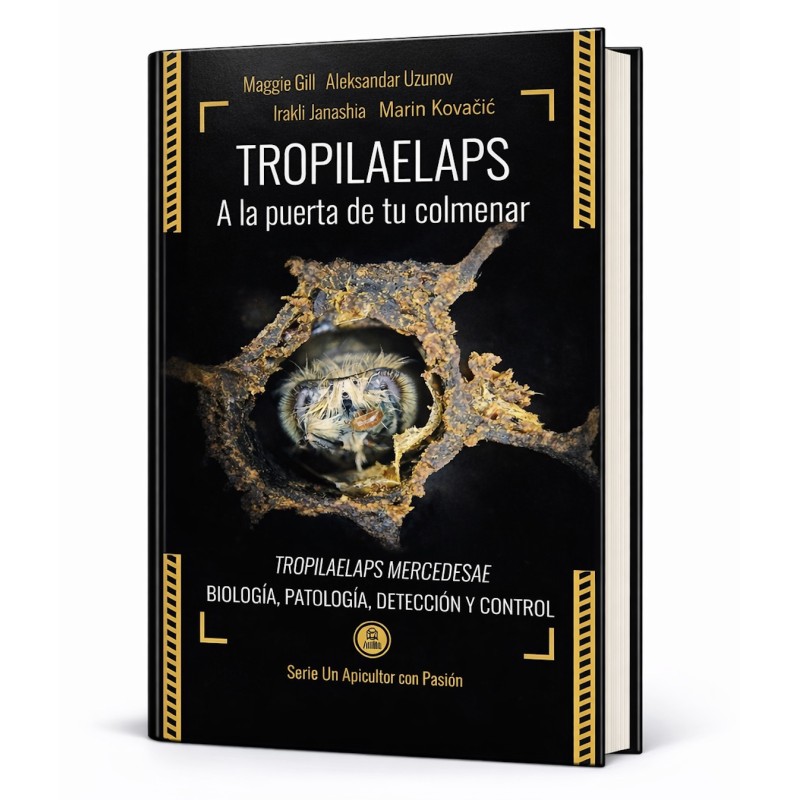
- Maggie Gill, Aleksandar Uzunov, Irakli Janashia and Marin Kovačić, who wrote several of the studies cited here, explain how to recognise it and look for it in Tropilaelaps. A la puerta de tu colmenar, a full-colour manual that we distribute in Spanish. An inspector or laboratory confirms a suspect finding.
Frequently asked questions
Has Tropilaelaps been reported in Spain?
No confirmed outbreak in Spain was reported in the official and specialist sources reviewed for this November 2026 guide. Türkiye notified an outbreak in August 2026. Check current information with Spain’s veterinary authorities.
How can I tell it apart from Varroa?
The adult mite is about a millimetre long, narrow rather than broad, and moves quickly. Its shape and movement on brood provide clues, but a laboratory or inspector should confirm the species.
How is it detected?
In capped worker brood, not on adult bees. The most practical method is rapid decapping: press a depilatory wax strip onto pupae with white to purple eyes, pull it off and film the area with your phone for 30 seconds to count the mites that emerge. An alcohol wash or icing sugar cannot rule it out. Report a suspect and follow the sampling instructions you receive.
Is a treatment authorised against Tropilaelaps in the EU?
Apimondia’s October 2026 statement reported no specifically authorised EU medicine. A suspected infestation requires official veterinary direction. Do not attempt to resolve it by applying an unrelated Varroa treatment.
Does a brief broodless period make a hive safe to move?
No. It survives longer than was thought: several days on live adult bees (the maximum described on honey bees is 6), 7–8 days on dead pupae or bees and up to four weeks if it can reach open brood. In a swarm of giant Asian honey bees it survived at least 29 days. The competent authority decides what can be moved.
What should I do if I think a colony is affected?
Notify your regional veterinary service promptly. Keep colonies, combs and equipment on site. Retain the date, hive identity and any photographs, and follow the inspector’s instructions.
Sources and surveillance references
- Özkırım and colleagues (2026), report on the first finding in Türkiye. The cited version is a preprint.
- Apimondia’s statement on Tropilaelaps in Europe, 16 October 2026.
- Franco, Duquesne and Laurent (2025), EU Reference Laboratory note on geographical spread.
- Brandorf and colleagues (2024), report of established populations in European Russia.
- Janashia and colleagues (2024), first report in Georgia.
- Ramirez and colleagues (2026), pest interception in an incoming shipment.
- The EU Reference Laboratory’s beekeeper leaflet summarises official prevention and reporting guidance.
- Uzunov and colleagues (2025), scientific note on rapid brood examination.
- Tokach and colleagues (2026), comparison of monitoring sensitivity.
- Schouten and colleagues (2026), field assessment of early detection methods.
- Buawangpong and colleagues (2015), prevalence and reproduction of Tropilaelaps mercedesae and Varroa destructor in colonies infested with both mites.
- Woyke (1994), survival of Tropilaelaps females for four weeks with open brood.
- Gill and colleagues (2025), survival of Tropilaelaps mercedesae on different substrates.
- Uzunov and colleagues (2026), swarming and the dispersal of Tropilaelaps mercedesae.
- Aurell and colleagues (2026), first estimates of Tropilaelaps mercedesae population growth. The cited version is a preprint.
- Tokach and colleagues (2024), field study of cultural and chemical management.
- Pettis, Rose and Chaimanee (2017), management approaches in northern Thailand.
- Gill and colleagues (2024), laboratory study of acaricide susceptibility, cited as a preprint.
- Sankovitz and colleagues (2025), field comparison of management approaches.
- Uzunov and colleagues (2024), comparative study of queen management.
- Pettis and colleagues (2013), survey methods for detecting Tropilaelaps.
- Khongphinitbunjong and colleagues (2016), effects on worker condition and longevity.
- Anderson and Morgan (2007), taxonomic revision of Tropilaelaps.
- WOAH Terrestrial Manual, chapter 3.2.6, infestation of honey bees with Tropilaelaps species.
- de Guzman and colleagues (2017), review of Tropilaelaps and bee health management.
- Spanish agriculture ministry guidance on queen consignments.
Further reading
- Varroa destructor: recognising and managing the mite
- Monitoring Varroa and interpreting results
- An integrated Varroa management plan
- What to do about a swarm of honey bees
Updated for the November 2026 edition. The geographical situation can change. If you suspect a case, the current instructions of the competent veterinary authority take precedence.


