 Apipasta with vitamins 15kg
 Beecomplet® Spring 14Kg
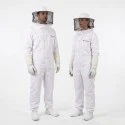 Beekeeper suit with round veil
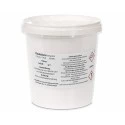 Oxalic acid 1kg
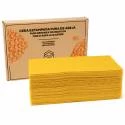 Beeswax Foundation 5kg
 Fresh royal jelly 20g
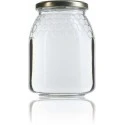 Classic honey jar 1kg comb-lines TO77 - Pack of 16 units
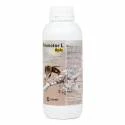 Promotor L Apis 1 litre
- -€3.00

 Share in WhatsApp
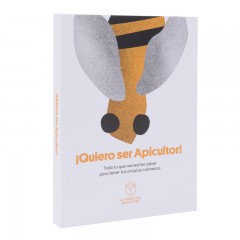
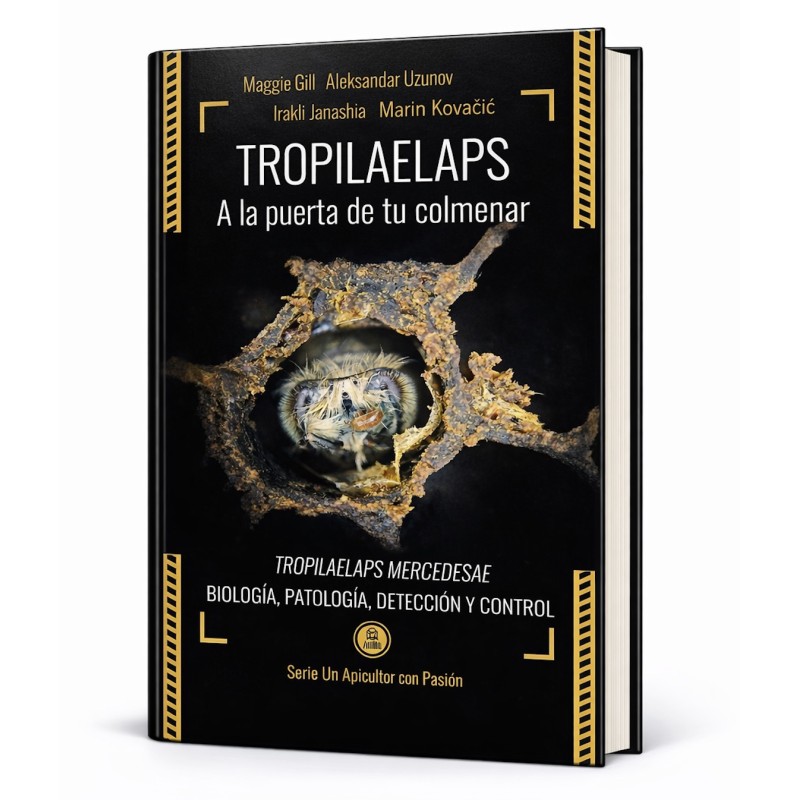
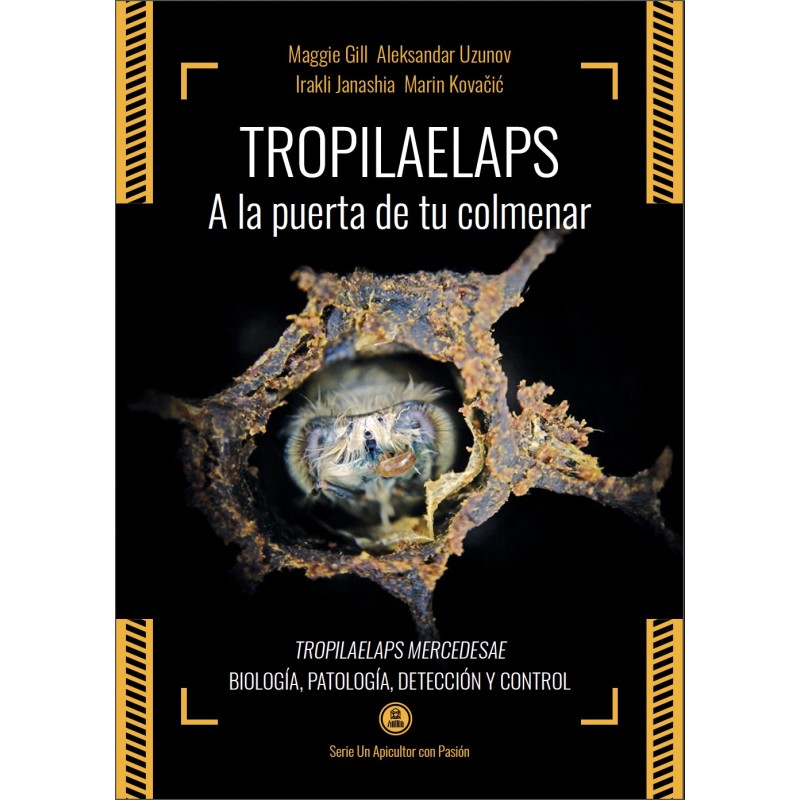
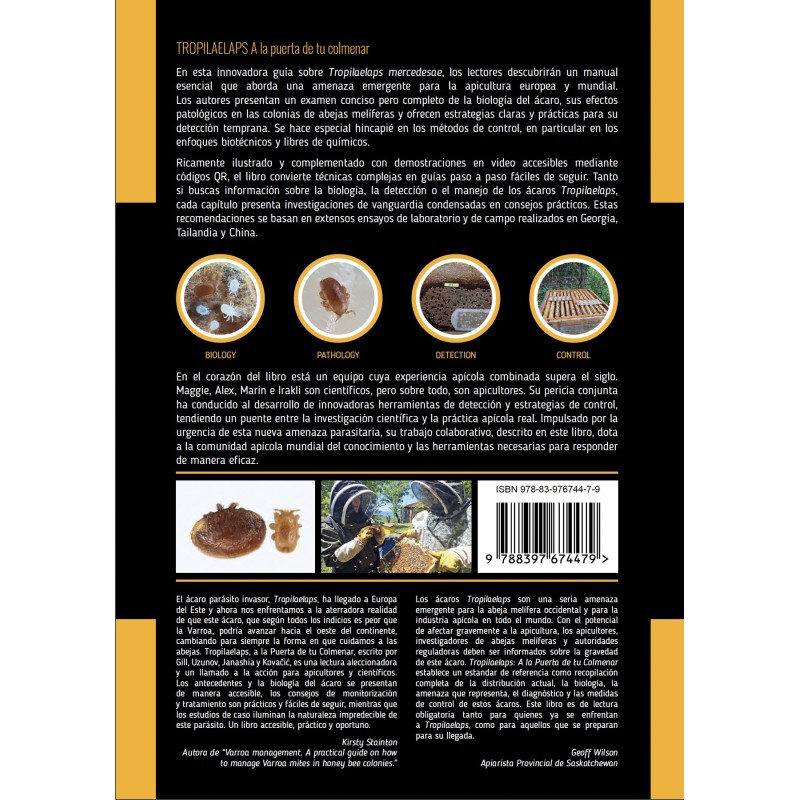
The European reference work on Tropilaelaps mercedesae. 95 full-colour pages, hardcover, with interactive content and video access. Written by scientists with hands-on experience with the mite in Georgia, Thailand and China. Clear protocols for surveillance, differential diagnosis from Varroa and control methods.
The European reference work on Tropilaelaps: 95 pages in full colour, hardback, 2026 edition, with access to videos and audiovisual material.
This book does not teach you to treat Tropilaelaps: it teaches you to detect it. With a notifiable mite, detection is exactly the part that falls to the beekeeper.
01 · WHY IT MATTERS NOW
Tropilaelaps mercedesae jumped in Asia from the giant bees — Apis dorsata and A. laboriosa — to our Apis mellifera, causing tropilaelapsosis. Recent reports place it in the eastern part of the continent, with the Balkans and the Mediterranean offering favourable conditions.
What speeds its arrival is the trade in queens, packages and swarms. And what makes it more dangerous here than in Asia is that, with milder winters, many colonies now keep brood all year round.
02 · NOT A SMALLER VARROA
This is the difference that explains everything. Varroa can ride adult bees for months; Tropilaelaps barely survives without open brood, because its mouthparts are not built to pierce an adult. Hence a brood break checks it — and hence a colony rearing twelve months a year is the scenario that sets it loose.
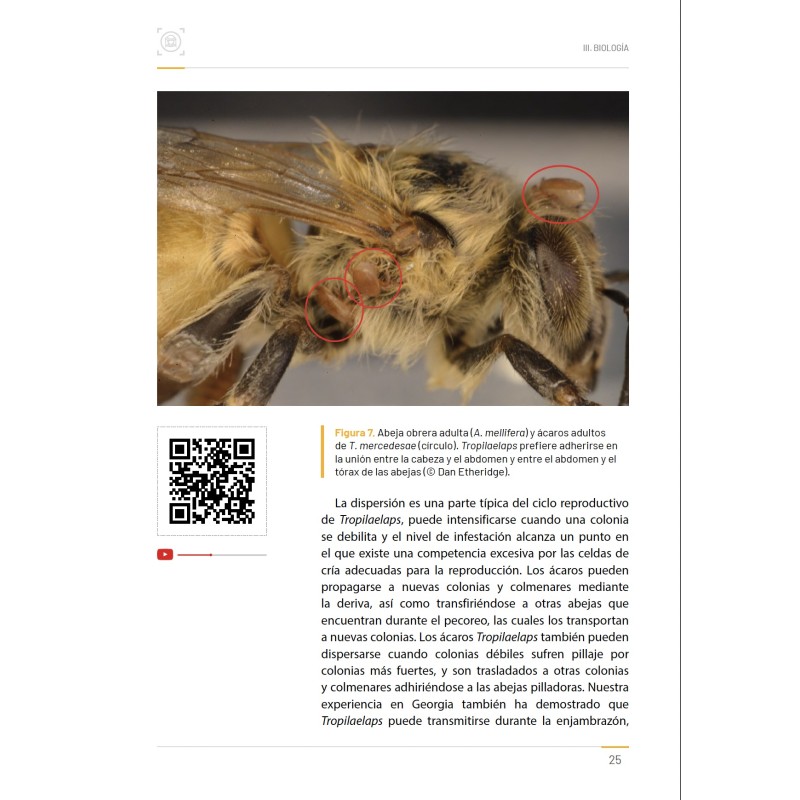
It also changes how you look. The sugar or alcohol roll on adult bees, which works for varroa, underestimates Tropilaelaps because the mite is mostly inside the capping: you have to open brood. By eye it is smaller, elongated — longer than wide, the opposite of varroa — and it moves very fast across the comb.
03 · IT IS NOTIFIABLE
This is not a pest you settle at home: tropilaelapsosis is among the notifiable diseases. On suspicion, what follows is alerting the official veterinary service, not trying treatments.
That is why this book's value is in detection: what it is and why it worries people, how to tell it from varroa, how it affects the brood and the colony, and inspection and sampling methods a beekeeper can apply on normal rounds. The colour images are what stop you confusing it.
04 · WHO WROTE IT
This is not desk writing: all four have worked directly with Tropilaelaps in colonies in Georgia, Thailand and China. Maggie Gill, over 20 years in pollinator research, regional bee inspector in Wales and now senior scientist at Defra. Dr Aleksandar Uzunov, 30 years studying the honey bee, heads the Bee Laboratory at Ss. Cyril and Methodius University in Skopje.
Dr Marin Kovačić, third-generation beekeeper, runs one of Europe's largest queen-rearing operations from Croatia. Dr Irakli Janashia, vet and beekeeper in Georgia, researches Tropilaelaps, varroa and the bee gut microbiota.
05 · BEFORE YOU BUY
It is a detection and prevention manual, not a book of treatments: with this disease, the treatment is not the beekeeper's call.
| ✓ RIGHT FIT | Learning to recognise it before it arrives, and not confusing it with varroa. |
| ✕ WRONG FIT | If you want treatment protocols: there are none here, and rightly so. |
| ⚠ NOT INCLUDED | It does not replace notifying the veterinary service on suspicion. |
| Subject | Tropilaelaps — detection, prevention and control |
|---|---|
| Extent | 95 pages in full colour |
| Binding | Hardback, made for the honey house |
| Edition | 2026 |
| Extra | Interactive content with access to videos and audiovisual material |
| Authors | Maggie Gill · Dr Aleksandar Uzunov · Dr Marin Kovačić · Dr Irakli Janashia |
| Focus | Recognition, telling it from varroa, inspection and sampling |
| Weight | 400 g |
Specific References
The European reference work on Tropilaelaps mercedesae. 95 full-colour pages, hardcover, with interactive content and video access. Written by scientists with hands-on experience with the mite in Georgia, Thailand and China. Clear protocols for surveillance, differential diagnosis from Varroa and control methods.
check_circle
check_circle