

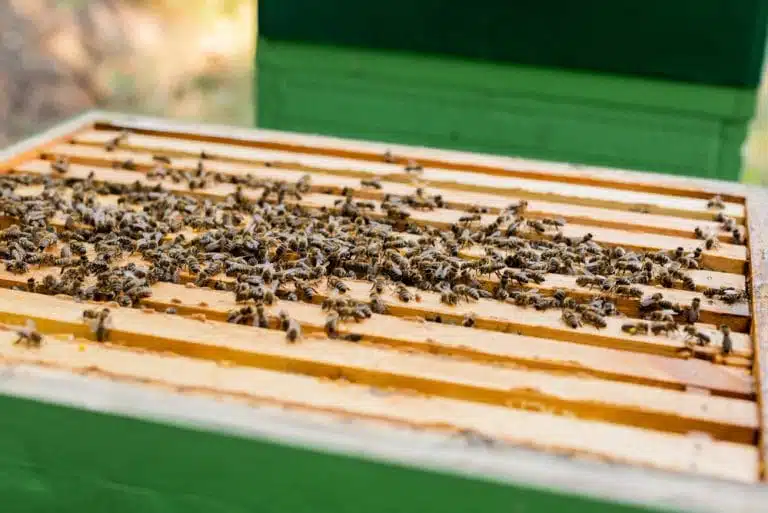
Two weak colonies can take more work to maintain than one viable colony. The newspaper method gives bees from the two boxes time to mix gradually. The harder part is deciding whether the declining colony needs a union, a change of queen or a simpler correction.
The newspaper method in five steps
- Choose the base hive, usually the more populous colony with more returning foragers and sound equipment. Leave it on its existing stand. Decide separately which queen you want to keep.
- Lay one or two sheets of plain newspaper across the top bars and make a few small holes near the centre.
- Place the second brood box on top. It should have the same footprint and frame format so the bees cannot bypass the barrier.
- Fit the crownboard and roof. Give the bees time to work through the paper.
- Check after about a week. Paper outside the entrance shows the bees have chewed the barrier. On a suitable day, look for a laying queen, brood and bees working together. Reorganise the boxes gradually if necessary.
Reading before uniting colonies

This Spanish-language guide covers brood, stores and signs of disease. Check queen status and establish why a colony is weak before deciding whether two healthy colonies can be united.
Record the decision for each colony
- Record queen status, adult population, brood, stores and any sign of disease.
- Decide which colony stays on its stand and which queen will head the united colony.
Before uniting: colony strength and population size

Two observations help you decide whether the colony can recover unaided.
| What to assess | What it means | What to look for in the apiary |
|---|---|---|
| Colony vigour | How actively the colony is developing and foraging | Adult population, foraging activity, regularity of the brood pattern and the speed at which bees draw comb |
| Minimum viable population | Enough bees to carry out essential work under the current conditions | How many frames are covered with bees, and whether the workers can cover and maintain their brood |
There is no single threshold for every colony. A colony of 10,000 bees in April and one of the same size in August face different forage, brood and weather conditions.
The same population at different times of year
| A colony covering five or six frames | How to interpret it |
|---|---|
| Going into winter | It may be viable, depending on the climate, hive type, stores and health |
| During spring build-up | Restricted growth at a good site is a reason to check what is holding it back |
Judge weakness in relation to the season, the local flow and the other colonies at the site.

When to intervene
Disease, poisoning, predation and queen problems can all reduce the population. A colony that keeps losing workers despite having a mated queen may reach a point where the remaining bees cannot cover the brood. Establish the reason before choosing an intervention.
Check whether a simpler change would address the cause.
- Adjust the space. Reduce unnecessary volume so that the bees can cover the combs they occupy.
- Improve insulation where appropriate. Check draughts and damp and help the bees regulate temperature.
- Correct a shortage of food if the population is still adequate and the immediate problem is stores.
- Consider requeening if a failing queen or poor brood pattern explains the decline.
What changes before winter
A colony unable to cover the combs it needs for winter in your area is unlikely to make a strong spring start without intervention. Hive design, climate, queen, health and stores all affect that judgement. If both colonies are healthy enough to contribute, one strong wintering unit can be preferable to two that are unlikely to recover separately.
Queen selection also matters. Antonio Gómez Pajuelo points to differences in the bees’ ability to gather stores, temperament and disease resistance. If a consistently poor queen is the cause, making a deliberate replacement decision allows the better-performing queen to head the united colony.
Uniting, strengthening or taking bees away

| Operation | When it may be appropriate | Intended result |
|---|---|---|
| Unite | Two small, healthy colonies that together can form a viable population | Fewer occupied hives, with one stronger colony. Drifting, worker losses and changes in the brood nest mean the populations do not simply add together. |
| Strengthen | A viable colony with a specific, temporary shortfall | Add stores or, where appropriate, sealed brood from a healthy colony. Check the donor’s health and Varroa situation before moving brood. |
| Reduce the strength | A very populous colony in which crowding is becoming a problem | A targeted intervention may help manage swarming. There is little reason to make every hive the same size. |
Giving good brood to a colony with an unresolved underlying problem can waste the donor’s resources. Conversely, uniting a healthy colony that only needs more space can cost you a productive unit.
Uniting with newspaper, step by step
Newsprint provides a temporary barrier between the bees. Workers from different colonies have different odours. The sheets slow their first contact while air and odours can pass between the two boxes.
The bees gradually chew through the paper over the next few days. By the time the opening is larger, the two groups will often mix with little fighting. Occasional losses remain possible.
1. Choose the base hive
The more populous colony usually stays on its stand so that its returning foragers arrive at their usual entrance. Also consider the condition of the equipment and which colony is in decline. The queen to retain may be the one from the smaller colony.
2. Prepare the upper box
Use compatible brood boxes with matching footprints and frame layout. If the weak colony has no brood or only one or two brood frames, look at its queen and history. A low brood count has different implications during a seasonal break and during an otherwise strong flow.
3. Decide which queen to keep
If one colony is confirmed queenless, retain the good queen. If both have queens, choose one before combining the boxes. Remove the other first or keep her in a separate reserve nucleus. Leaving the choice to a fight can cost you the queen you wanted.
4. Lay the newspaper over the frames
Spread one or two sheets across the base colony and make a few small holes near the centre. Make sure the whole box is covered before placing the other brood box above it.
Which paper to use
Choose clean, ordinary newsprint. Remove staples, plastic and adhesive tape.
5. Close the hive and give it time
Replace the crownboard and roof. The lower entrance must remain usable. Avoid repeated inspections while the bees are working through the paper.
6. Inspect after about a week

Check for a laying queen or fresh eggs, brood and a settled population. If the bees occupy both boxes and the weather allows, start arranging brood below and stores above as appropriate for the hive. Avoid chilling brood or crushing bees in an attempt to do everything in one inspection. Recheck how much space the colony occupies later.
Mistakes that can spoil a union
- Combining a sick colony with a healthy one. Check for uncontrolled Varroa (in Spanish), Nosema disease, foulbrood or another cause of weakness first. Keep suspected cases separate and seek a diagnosis.
- Moving the base colony unnecessarily. The established base stays below on its stand and the second brood box goes above.
- Leaving gaps around the paper. Mismatched boxes can let workers bypass the barrier and meet too abruptly.
- Making a large opening. A few small holes provide a starting point for chewing. A wide tear defeats the purpose of gradual contact.
- Opening again after just two days. Unless something needs urgent attention, let the bees settle before the planned inspection.
- Expecting a union to solve every weakness. Two colonies with too few bees in total or an unresolved queen or health problem may still be unviable after uniting.
When should I unite two honey bee colonies?
Consider a union when healthy colonies are unlikely to recover separately and adjusting space, stores or insulation will not address their shortage of bees. Assess the combined population, queen and local wintering requirements.
How do I unite colonies using newspaper?
Lay plain newspaper with a few small holes across the base hive, then place the other brood box above. The barrier delays direct contact while the workers gradually chew through it.
Do I have to kill one queen to unite two colonies?
Decide which queen will head the united colony and separate the other before introducing the bees. A useful spare queen can be kept in a nucleus. Check first that a colony thought to be queenless really is queenless.
How long does it take for the colonies to unite?
Allow about a week before the routine check, taking weather into account. Paper at the entrance shows the barrier has been chewed. A settled population and signs of a laying queen provide better evidence that the union worked.
Can I unite a diseased colony?
Keep it separate. Uniting a colony affected by foulbrood, uncontrolled Varroa or another unresolved disease can put the healthy colony at risk. Establish the diagnosis and follow the advice of the appropriate bee health service.


