

In the earliest parts of eastern and southern Spain, three important early resources are white wall-rocket, almond and rosemary. They may open as the January cold eases. The pollen and nectar they bring can help colonies build enough workers for the main flows. Their order and timing vary with the season and site.
Reading for comparing the honeys

The Iberian honey guide is printed in Spanish. Use it to compare profiles. Batch traceability and laboratory findings are needed to support a claim of botanical origin.
Record what actually flowers at your site
- Note flowering, pollen coming in and changes in food reserves.
- Keep the origin and harvest date with each lot when comparing honeys.
| Plant | Family | Flowering period | Value to the colony | Honey characteristics | Indicative pollen reference |
|---|---|---|---|---|---|
| White wall-rocket Diplotaxis erucoides | Brassicaceae | After rain and a spell of mild weather | Abundant nectar and lipid-rich pollen | Very pale, with a faint radish-like aroma. Tends to crystallise quickly. | — |
| Almond Prunus dulcis | Rosaceae | Late January to April, depending on site and cultivar | Abundant nectar and pollen | Very pale and fruity, with slight acidity and fine crystallisation | About 25% almond pollen in the cited guide |
| Rosemary Salvia rosmarinus (syn. Rosmarinus officinalis) | Lamiaceae | Early in the season, sometimes with a second autumn flowering | Often the first substantial honey crop in eastern and southern Spain | Very pale, with a delicate floral aroma and sometimes a camphor-like note | About 12% rosemary pollen in the cited guide |
White wall-rocket

White wall-rocket, Diplotaxis erucoides, is a familiar Mediterranean member of the cabbage family, Brassicaceae. The four petals form a cross. As is typical in this family, the flower has four longer stamens and two shorter ones. Honey bees visit it readily.
It often flowers after rain when temperatures are mild. Check fresh flowers, soil moisture and incoming pollen instead of counting a fixed number of days from the rainfall. It can supply abundant nectar and pollen rich in lipids.
Look on roadsides, fallow or untilled ground, in almond orchards and among crop stubble. It can form large stands. Where winter stores are running low, this early pollen and nectar can be valuable as brood rearing and colony population increase.

When rainfall and mild weather coincide, white wall-rocket can contribute to the rosemary crop. In particularly favourable years and places, it can supply enough nectar for a unifloral harvest in its own right.
The honey is very pale. The faint radish-like note is neither intense nor long-lasting. Its relatively high glucose content can encourage rapid crystallisation, including in a harvest in which it accompanies another floral source.
Other brassicas flowering at a similar time include yellow-flowered Brassica species such as oilseed rape and turnip, members of Sisymbrium, and the pale, veined flowers of wild radishes in the genus Raphanus.
Almond

Almond, a tree of Asian origin belonging to the rose family, has been cultivated in temperate regions for thousands of years.
How winter chilling affects bloom
Almond cultivars differ in how much cold they need before flowering. A commonly cited range for the material described here is around 200–500 hours between 0 and 7 °C, although cultivar and chill model matter. In Spain, flowering can fall anywhere from late January to April. A late frost after an early bloom can undo the apparent advantage.
In orchards of self-incompatible cultivars, bees carry pollen between compatible trees and are important for fruit set. California’s almond orchards are a well-known example of paid colony rental, although fees vary by season and contract. Self-fertile cultivars reduce dependence on compatible pollen donors. Our article covers pollination as a professional beekeeping service (in Spanish).

Almonds generally bloom before the leaves are fully out. As dormancy ends, the rounded flower buds can be distinguished from the more pointed vegetative buds. Counting them gives an indication of the bloom to come, subject to frost and other weather.

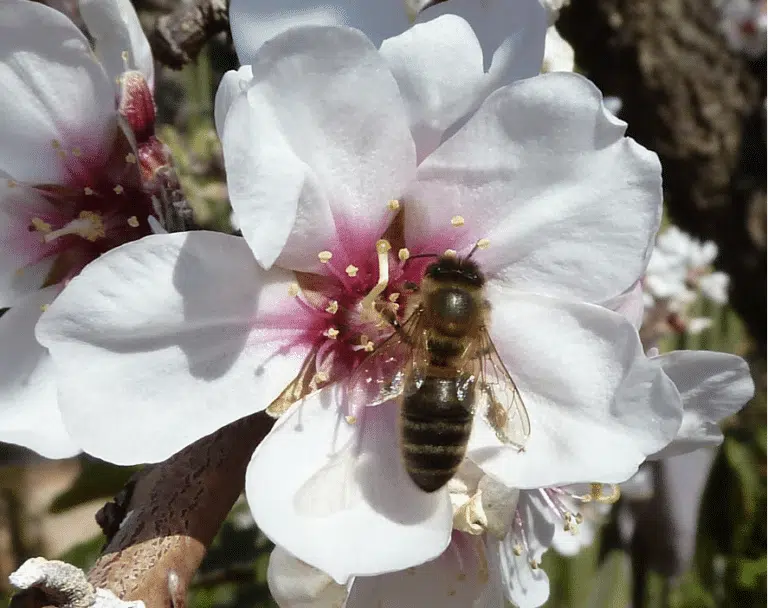
An almond flower has five white or pinkish petals, five sepals, numerous stamens and a central ovary. Pink markings on the petals often guide visitors towards the nectaries.
Almonds can produce abundant nectar and pollen. In suitable weather, bees often work the flowers once the morning has warmed and again in the early afternoon. Much of this forage supports brood rearing. A surplus honey crop requires extensive planting and favourable conditions.
Almond blossom often accompanies rosemary in the same harvest. The honey is usually very pale, with a fruity aroma and slight acidity. Some older cultivars can contribute bitter notes. It tends to crystallise finely, giving a creamy texture. Almond pollen may be over-represented. The guide’s percentage is a reference which must be interpreted with the sensory and physicochemical profile when declaring botanical origin.
Rosemary

Salvia rosmarinus, formerly Rosmarinus officinalis, is an evergreen Mediterranean shrub in the mint family. Its narrow aromatic leaves have rolled-under edges that help limit water loss. Young flowering shoots are square in section and hairy. Rosemary is common in scrubland on limestone, including areas associated with holm oak woodland.
In eastern and southern Spain it is often the first substantial spring crop, though weather can still affect it. Autumn rain can prompt a second, usually weaker flowering. Local beekeepers sometimes find a less abundant spring bloom after a strong autumn flowering.

How rosemary flowers transfer pollen
Five fused petals form the two lips: two petals form the upper lip and three the lower. The male and female functions take place in succession.
- Male phase. Early in the flower’s life, the two stamens extend into a position where they deposit pollen on a bee visiting for nectar.
- Female phase. As the stamens move out of the way, the style brings the stigma into a position where it can touch pollen already carried on the bee’s upper thorax from another flower.
This arrangement encourages cross-pollination and helps explain why a nectar-foraging bee can transfer rosemary pollen effectively.
Rosemary honey is usually very pale, with a delicate floral aroma, sometimes a camphor-like note, and predominantly sweet flavour with slight acidity. White wall-rocket can make it crystallise faster, while almond blossom can favour a fine, creamy set. Rosemary pollen tends to be under-represented. The reference percentage must be read alongside the tasting and analytical results when assessing a unifloral claim.
Our article on pollen analysis in honey explains how pollen percentages are measured. Continue through the season with our guides to spring honey flows (in Spanish) and summer bee forage (in Spanish).
Which are the first important bee forage plants in this part of Spain?
White wall-rocket, almond and rosemary are three of the key early sources in the mildest parts of eastern and southern Spain. Their timing varies with the year, soil moisture and altitude.
When does white wall-rocket flower?
It can flower after rain followed by mild weather. The interval varies with temperature, soil and locality, so a new flush of flowers is a better guide than a fixed date.
Why does almond bloom at different times?
Flower buds need winter chilling followed by suitable temperatures. The cultivars discussed here are often described as requiring roughly 200–500 hours at 0–7 °C. Requirements vary, and a late frost can damage open blossom.
What pollen percentage is used for unifloral rosemary honey?
The Iberian guide uses around 12% rosemary pollen and 25% almond pollen. The plants contribute different amounts of pollen relative to their nectar. These are reference values, not universal legal thresholds for declaring a honey unifloral.
Why do these pale honeys crystallise differently?
The mix of sugars and flowering sources matters. White wall-rocket nectar can encourage a rapid set, while almond blossom may give a much finer, creamier crystallisation.


