

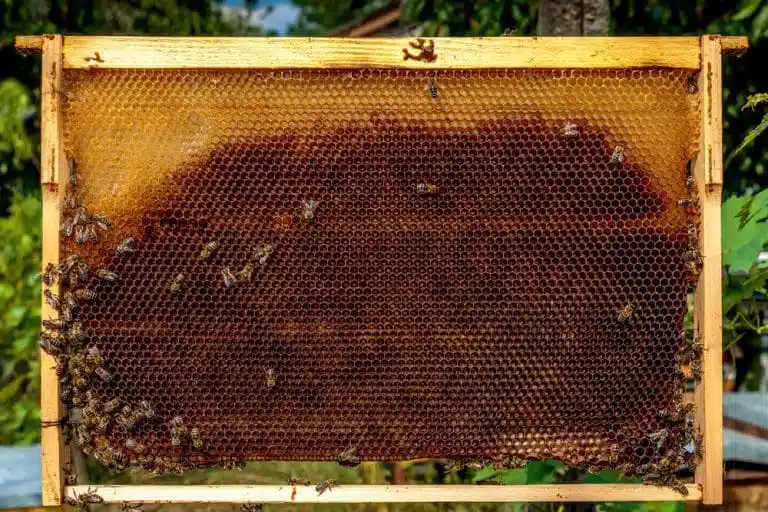
Finding an almost empty hive is an observation, not a diagnosis. Colony collapse disorder (CCD) describes a particular pattern: most adult workers disappear while a queen, brood and food stores remain, with few dead workers in or near the hive. Winter losses from starvation, Varroa or other causes can look superficially similar. This guide looks at three practical areas worth checking.
Look for more than one explanation
A colony may experience several stresses at once, or one severe shortage may be enough to cause a loss. There is no dependable scoring rule that converts “high”, “medium” or “low” levels of three factors into a diagnosis.
Record what you actually find: the position of the last cluster and stores, the brood pattern, autumn mite counts and treatment history. These observations are more informative than the presence of an empty box alone.
Monitoring equipment and a reference book


A consistent Varroa count and a history of stores help investigate a loss. The book is printed in Spanish. Neither the monitoring device nor the book can diagnose the cause of an individual colony loss.
Gather the colony history
- Record Varroa counts, stores and field observations.
- Keep dates and interventions with the notes for your bee health adviser.
For the broader picture, see Are honey bees disappearing? What colony losses and hive counts tell us (in Spanish).
Three factors to investigate

1. Varroa pressure while winter bees are reared
A heavy Varroa infestation (in Spanish) in late summer or autumn can damage the generation that must survive winter and rear the first spring brood. The timing matters. Compare mite counts and the result of any intervention with the dates when the local colony was raising its winter population.
2. Pesticide residues in the hive

Residues may enter the hive with forage from treated crops or arise from products used within the hive. The balance varies by substance, site and management history. Some fat-soluble acaricides can remain in beeswax through successive seasons.
Why wax history matters
Some compounds persist in beeswax for years. The 2019 Pajuelo guide notes long-term detections, including reports as long as 15 years after particular products were no longer used. This is not a fixed lifetime for every acaricide. Ordinary rendering cannot be relied on to remove all residues, and recycled foundation may carry material from several sources.
Sampling wax and stored pollen can help investigate exposure. A value in parts per billion must be interpreted for the substance measured, the route and duration of exposure, and the colony’s history. One concentration cannot predict the same effect for every pesticide.
| What may be affected | How to interpret it |
|---|---|
| Physiological responses | Some exposures can affect detoxification or immune responses. The effect depends on the specific compound and dose. |
| Worker lifespan | Experimental exposures may shorten lifespan. A percentage from one study is not a general estimate for an affected apiary. |
| Foraging | Changes in foraging frequency or duration can reflect exposure, weather, forage availability or other stresses. |
| Drone fertility | Some exposures can affect drone semen quality. A drone-laying queen or colony has other possible explanations and does not establish exposure by itself. |
3. Inadequate food or poor access to stores

A colony entering winter short of accessible honey, or raising its winter bees during a pollen shortage, may be less able to withstand a long dearth. Check food in relation to the cluster as well as the total quantity in the hive. See signs of malnutrition and starvation in honey bee colonies (in Spanish).
Reducing the risk of winter losses
Varroa monitoring, traceable wax and adequate stores address different problems. Use the findings from your own colony to decide where to act.
Monitor Varroa before and during the rearing of winter bees

Choose the timing of Varroa management (in Spanish) for the local brood cycle, monitor the result and follow the label of any authorised product. Our integrated Varroa management guide explains how monitoring fits into the wider plan.

Choose wax with a known history
- Keep known-origin super wax or cappings separate from brood comb that may have been exposed to treatments.
- Mark exposed combs so they can be excluded from the wax you plan to reuse for low-residue foundation.
- When buying foundation, ask for the batch origin and analytical data. A description such as “filtered” alone cannot establish residue levels.
- Use authorised treatments according to the label, including the required dose, timing and withdrawal conditions.
Check food reserves and access
Learn to recognise the shortfall before selecting a supplement. Our guides explain when and what to feed and how to assess an autumn feeding need.
What is colony collapse disorder?
CCD is a particular pattern in which most adult workers disappear, leaving behind the queen, brood and stores and relatively few dead bees. An ordinary winter loss or an empty hive does not, by itself, establish CCD.
What causes a colony to collapse?
Colony losses have several possible causes. Investigate Varroa and associated disease, nutrition and access to stores, queen status, weather and possible exposure to harmful substances. The evidence needed depends on what was found at the hive.
How long can acaricide residues remain in wax?
Some fat-soluble compounds can remain detectable for years, especially where wax is repeatedly recycled. Their persistence varies and ordinary rendering does not reliably remove them all.
Is there a single residue concentration that predicts damage?
No. Identify the substance and sample type, then consider exposure route, duration, the bees’ life stage and other stresses. A result of 100 ppb for one compound cannot be interpreted as a universal toxicity threshold.
Is Varroa control enough to prevent every winter loss?
Good Varroa management is essential but cannot correct starvation, an inaccessible food supply, a failing queen or all other sources of winter stress. An individual loss still calls for examination.
Source for the original Spanish field guidance: Guía de buenas prácticas de sanidad (2019), Pajuelo Consultores Apícolas.


