

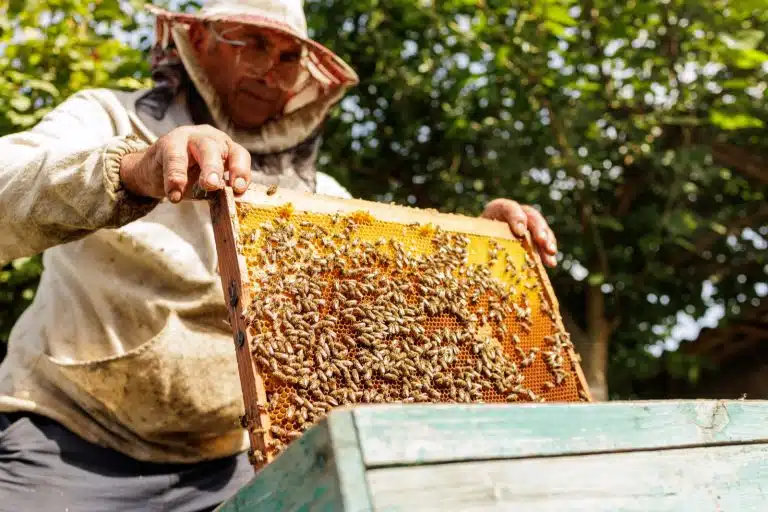
When you rear queens, you multiply the colony you take the larvae from. If it is gentle, productive and healthy, you will end up with more colonies like it. If it swarms every spring or has spotty brood, you will multiply that too. That is why choosing the breeder colony matters more than the rearing method you use.
Equipment for this task

The hygienic test needs no special equipment. To keep a good breeder queen going, a vertical queen excluder confines her to three frames.
Photograph the piece of brood
- Take a photo when you put the piece back and another at 48 hours, with the hive number in shot.
- Counting the cells on screen is easier than doing it with the frame in your hand.
Gilles Fert sums it up with a quote from Brother Adam: there is no queen rearing without selection, whatever the method. In this guide you will see which criteria to use when choosing your breeder, how to carry out the hygienic test and how to keep a record card for each queen so you can compare one year with the next.
What to look for in a breeder colony
What interests most beekeepers above all is honey production. But production on its own is misleading: a colony may produce more because it is better sited or because you gave it a frame of brood in spring. Always compare colonies that have been managed the same way, in the same apiary and in the same year.

Besides honey, Fert asks you to look at four things:
- Swarming. A highly productive line loses much of its value if it tends to swarm. It is one of the clearest reasons to rule out a breeder.
- Aggressiveness. Do not rear from aggressive colonies. Fert points out that aggressiveness has not been shown to go hand in hand with higher honey production: it is not worth putting up with.
- Brood quality. If 20% or more of the brood is not viable and the comb looks spotty, that colony is no good as a breeder.
- Health. A breeder must be free of disease. Hygienic behaviour, measured with the hygienic test, is the best practical indicator.
Bee colour, on the other hand, tells you little on its own. Fert regards it as a first impression that only biometric measurements can confirm.
Don’t forget the drones. The daughter queen mates with drones from your apiary and the apiaries around it. Their influence on the offspring is as great as the queen’s. If you can, choose the colonies that will produce drones using the same criteria.
The hygienic test step by step
Colonies with marked hygienic behaviour, which Fert calls good cleaners, detect dead or diseased brood sooner and remove it. According to Fert, these colonies are more resistant to brood diseases such as foulbrood and carry fewer varroa mites: workers aged 15 to 18 days locate the cells where varroa is reproducing and clean them out.
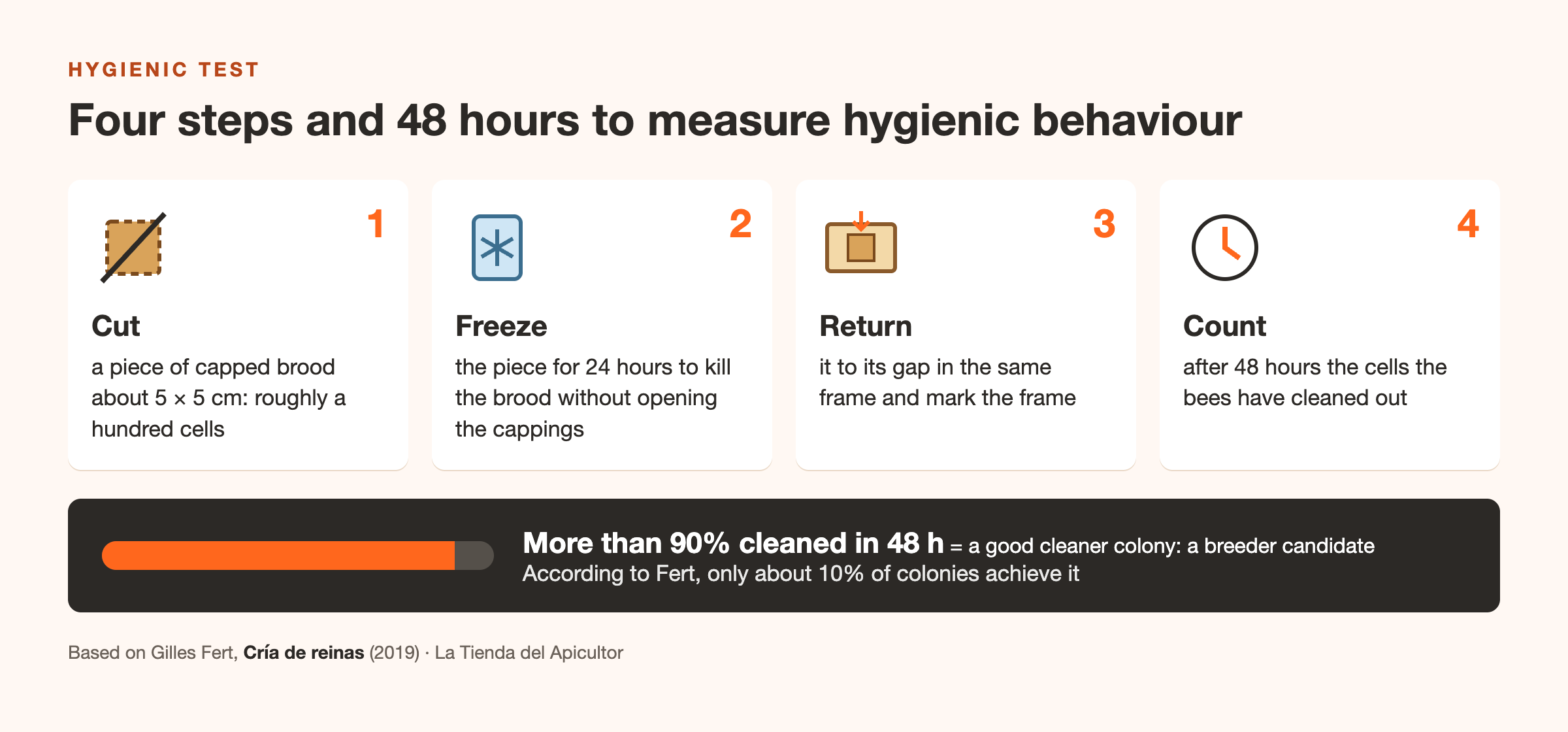
The test measures that ability. It is simple and any beekeeper can do it.
What you need
- A frame of capped brood from the colony you want to assess.
- A craft knife or a template to cut out a piece about 5 cm square, roughly a hundred cells.
- A freezer.
- A drawing pin or a marker pen to mark the frame, and your phone to take photos.
How to do it
- Cut out the piece of capped brood, about 100 cells, and note which colony it came from.
- Kill the brood. Put the piece in the freezer for 24 hours. You can also pierce the brood with a needle or a cocktail stick, but Fert prefers freezing: it seems to matter that the bees detect the dead brood through the capping without it having been pierced.
- Put the piece back in its gap in the same frame and return the frame to the hive. Mark it so you can find it later.
- Check after 48 hours. Count how many cells the bees have uncapped and emptied.
How to read the result
- More than 90% cleaned within 48 hours: the colony is a good cleaner. Fert uses it to produce queens and drones.
- Below that: do not rule it out on this result alone, but do not use it as a breeder if you have better ones.
According to Fert, this trait appears in around 10% of colonies. The speed of cleaning varies between races. The European dark bee and the Iberian bee (A. m. iberiensis) are considered good cleaners.
A test does not replace varroa monitoring. A hygienic colony still needs its mite levels checked: for that, see our guide to varroa diagnosis.
The record card for each queen
Selection does not happen in one season. It takes years of observation, and for that you need to record the same things for every queen, in the same way. Fert suggests a simple card. Here is our version to copy into a notebook or a spreadsheet:

| Item | What to record |
|---|---|
| Queen | Number or code, year (marking colour) and race |
| Mother | Number of the mother queen, year and race |
| Daughters | How many queens you have reared from her |
| Drones | How many drone frames she has produced |
| Honey | Two supers, one or half |
| Aggressiveness | High, medium or low |
| Brood | Good, average or poor |
| Diseases | None, or which ones |
| Swarming | No, or the date |
| Hygienic test | Percentage cleaned at 48 hours, and date |
| Notes | Anything that does not fit above |
With two or three seasons of cards you will see which queens genuinely stand out and which just had a good year. If you would rather not do the selection yourself, Fert suggests another route: buy good stock from a recognised breeder. Many breeders work with the record cards their customers send back to them.
How to keep a good breeder queen
A valuable breeder queen can be kept in use for several years if you slow down her laying, because she then does not use up her spermatheca so quickly. Fert does this with a hive divided by a queen excluder:
- The queen is confined to three frames, in the compartment furthest from the entrance.
- Foragers store nectar and pollen mainly in the queenless compartment. That way the queen keeps room to lay even during a heavy nectar flow.
- Five or six days before grafting, put a frame of dark drawn comb in her compartment. You will have larvae of exactly the right age, and white larvae are easier to see against dark comb.
In a Langstroth hive you can set up this division with a vertical queen excluder.
Fert replaces the breeder queens that supply larvae every two years, and those that supply drones every three.

Selecting without losing diversity
Selecting also means eliminating, and that reduces genetic variety. Fert warns that pushing selection to the extreme on very few criteria impoverishes the population, and he argues for working within a well-defined local population, with as few introductions of non-local bees as possible. In practice: do not rear all your queens from a single breeder year after year. Use several good breeders.
Frequently asked questions
How long should the brood stay in the freezer?
Fert gives 24 hours. The piece then goes back into the hive and you check it after 48 hours.
What percentage of cleaned cells indicates a good colony?
More than 90% of cells cleaned at 48 hours. According to Fert, only around 10% of colonies achieve it.
Can you do the test without a freezer?
Yes, by pricking the capped brood cell by cell with a fine needle. Fert prefers to freeze the piece so that the bees detect the dead brood through an intact capping.
How many breeder colonies should you rear from?
More than one. That way you spread the risk and do not reduce the genetic diversity of your apiary.
Further reading
- Queen rearing: a step-by-step guide to get started
- The queen bee: what she does, how to recognise her and how long she lives
- Honey bee types: subspecies, local bees and breeding stocks
- Varroa diagnosis: detection and decision-making
Main source: Gilles Fert, Cría de reinas, the 2019 Spanish edition of L’élevage des reines.


