

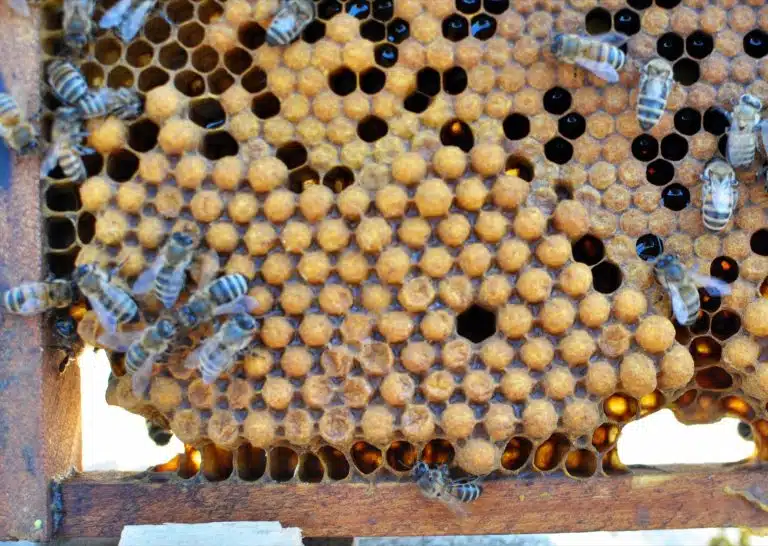
The drone is the male honey bee. He has no sting and no pollen basket, he doesn’t collect nectar, and his only job is to mate with queens. For anyone rearing queens, he is half the result: each queen mates in flight with 15 to 20 drones, and the genetics of those males pass on to all her workers.
Equipment for this task


Drone foundation or a drone frame concentrates drone brood where you decide. Whether fertile drones are ready in time depends on the colony, feeding, varroa and the weather.
Graft when your first drones emerge
- It's Fert's tip for beginners: by the time the virgins fly, those drones will be just the right age.
- Note the date the first drone eggs are laid, not when you first see drones flying.
The problem is time. A drone takes almost six weeks to go from egg to fertile male. If you wait until you see drones in your hives before you start rearing queens, the ones you need should have been laid a month ago. In this guide you’ll see when they mature, how many you need and how to prepare their colonies, mainly following Gilles Fert’s book Cría de reinas.
What a drone is and when it becomes fertile
A drone develops from an unfertilised egg. The queen lays it in a cell wider than a worker cell, which is why colonies build drone comb along the edges and in gaps. He weighs about 230 mg, more than twice as much as a worker. To see how he differs from the queen and the workers, read our guide to the queen, workers and drones in a honey bee colony.

What matters for queen rearing is his timetable:
| When | What happens |
|---|---|
| About 24 days after the egg is laid | The drone emerges |
| Around day 6 of life | First short orientation flights |
| Around day 12 | He starts going out for half an hour at a time and visiting drone congregation areas |
| Around day 15 | He is fertile, as long as the temperature has been right |
| About three weeks more | He stays fertile. Fert warns that once he is past a month old, he is no longer fertile |
Add it up and it comes to almost six weeks from egg to mature drone. And his fertile life is short. So rearing one batch of drones isn’t enough: they need to be the right age when the queens fly.
How queens are mated
Drones don’t wait for the queen in the apiary. They gather in fixed places, drone congregation areas, which are usually more than a kilometre from the hives and stay in the same spot year after year. On average, each one draws about 12,000 drones from many different colonies. Fert reckons at least 1,000 drones are needed for one to form.
On average, drones fly between 2 and 6 km from their hive. They only go out to the congregation areas when it’s above 19 °C and the wind is below 20 km/h, roughly between 11:00 and 17:00, with a peak around 15:00. The virgin queen goes out to mate from her sixth day of life and makes several flights over two or three days.
Two practical consequences:
- Your drones mix with the ones around you. With open mating, you don’t control which drones mate with your queens. What you can do is put plenty of drones from chosen colonies into the area.
- The weather decides. In cold, rain or strong wind there are no flights. A spell of bad weather can let your drones’ best age slip by.
When to start: 45 days before grafting
Fert sets it in his calendar: 45 days before grafting, you choose the colonies that will supply the drones, start stimulating them, put in the drone frame and treat the whole apiary for varroa.
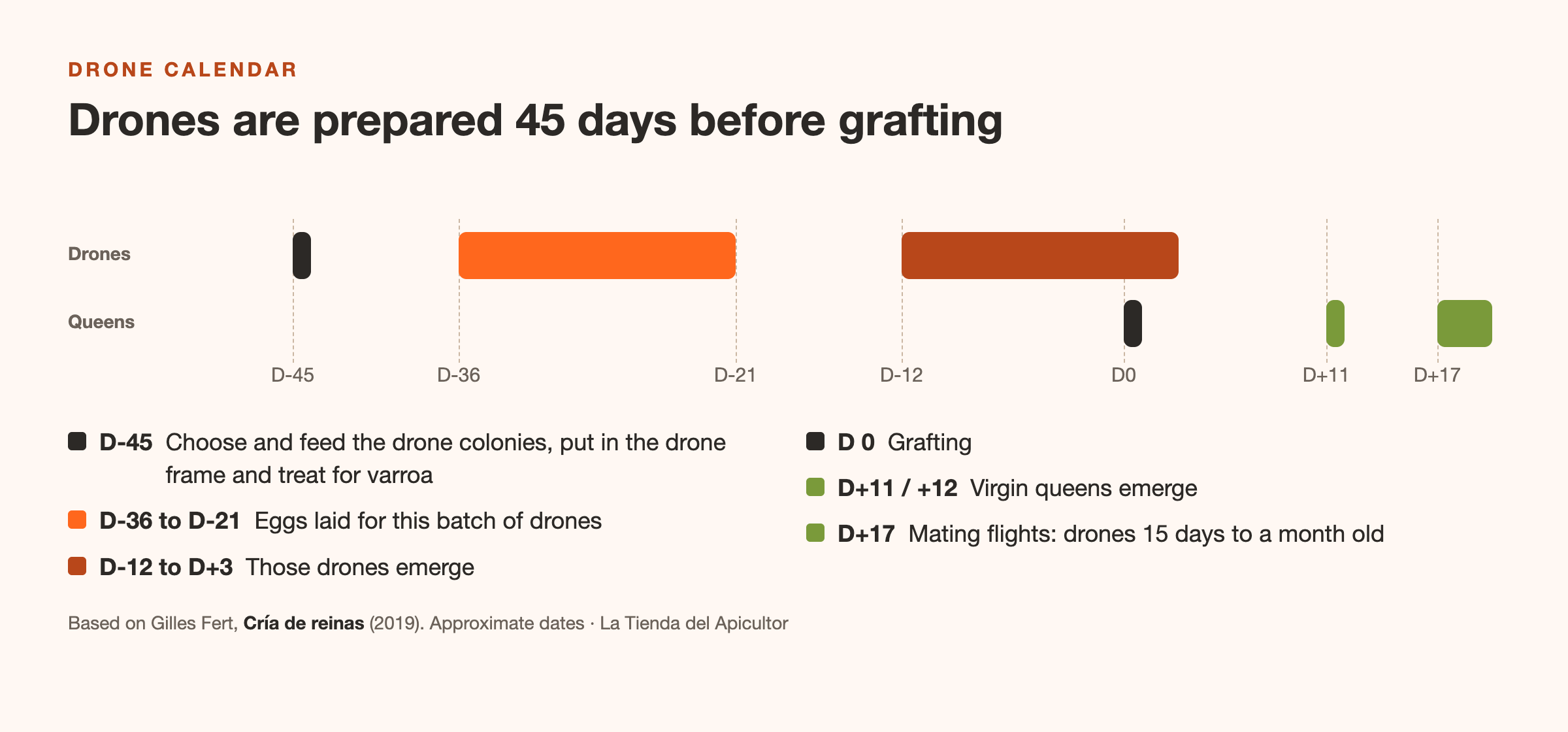
The timing follows from the figures above. If you graft on day D, the virgins emerge around D+11 or D+12 and go out to mate from D+17. By then you need drones between 15 days and a month old:
| Day (D = grafting) | What happens |
|---|---|
| D-45 | You choose and feed the drone colonies, put in the drone frame and treat the whole apiary for varroa |
| From D-36 to D-21, approximately | The eggs of the drones for this batch are laid |
| From D-12 to D+3, approximately | Those drones emerge |
| D+11 and D+12 | The virgins emerge |
| D+17 onwards | Mating flights. The drones are between 15 days and a month old |
The 45 days give the colony time to draw out the frame and the queen time to lay in it. If you’re planning several batches in a row, keep putting in drone frames: Fert renews them every ten days.
An example. If you want to graft on 15 May, start preparing the drone colonies on 31 March. And base the date on the first drone eggs you see, not on the first time you see drones flying: those are already weeks old.
Which colonies to choose for drones
- Selected colonies, chosen on the same criteria as the breeder. Drones provide half the genetics. Choose gentle, healthy, productive colonies with a low swarming tendency, as we explain in how to choose a breeder colony.
- Not the one that supplies the larvae. Fert uses some colonies for larvae and others for drones, and there’s a genetic reason for it. A drone develops from an unfertilised egg and carries only his mother’s genes. If the virgins you rear, daughters of the breeder colony, mate with drones from that same queen, they are mating with their brothers. That inbreeding shows in the brood: some of the fertilised eggs produce males that the workers remove as soon as the larva hatches, and the frame ends up with spotty brood.
- Strong. At least seven frames of brood and a one-year-old selected queen.
- Close to the nucs. Fert advises keeping selected drone colonies within a radius of at least 5 km around the mating nucs.
How to prepare the drone frame
Bees rear drones wherever they have wide cells. If you give them those cells in a particular frame, you concentrate drone brood where you want it and on the date that suits you.
With a sheet of drone foundation. Drone-cell foundation has 7 mm cells. Fert has it drawn out during a good flow, in any strong colony, and then extracts the honey: the frame is then ready to go into the drone colony.
With a plastic frame or an open window. The plastic drone-cell frame is Langstroth size and needs no foundation. In Dadant Blatt, the drone brood frame has foundation only at the top and leaves a gap at the bottom where the colony builds drone comb on its own. Fert describes a similar trick: fix just a 3 or 4 cm strip of ordinary foundation and let the bees build the rest while the flow is on.
Where to put it. At the edge of the brood nest, next to a frame of pollen. Fert stresses that position matters a great deal.
Watch the wax. Fert has seen more and more sterile drones since certain synthetic miticides, which are retained in the wax, came into use, and he points to coumaphos and fluvalinate. The effect of coumaphos has been measured: in a Virginia Tech study, drones reared in colonies treated with it had fewer live sperm throughout the six weeks of the trial (Burley et al., 2008). For these frames, use cappings wax or wax of known origin. There’s more in our guide to beeswax quality.

How to feed and care for drone colonies
A drone doesn’t feed himself: the nurse bees feed him. A drone colony needs to be looked after as well as the one rearing your queen cells. Every three days Fert gives it 50% (1:1) stimulative syrup and a protein patty of about 200 g, and keeps this up for as long as production lasts. You’ll find patties among our protein feeds and pollen substitutes.
Two signs show they’re short of protein:
- Dead drones at the entrance. They may be short of protein, and sometimes of nurse bees too. Fert gives them protein patty and emerging worker brood.
- Drone pupae with their heads eaten. If the workers uncap drone pupae and eat their heads, that is cannibalism caused by a lack of protein. Give them a patty straight away.
Varroa. Varroa breeds mainly in drone brood: according to Fert, 70% of the mites in a colony develop there. So treat the whole apiary before you start, on day D-45 of the calendar, not during rearing. Treatment strips put in while you’re rearing unsettle the bees and lower queen cell acceptance. In these colonies, don’t use the drone frame as a trap to remove varroa: here you want the drones to emerge. To decide whether you need to treat, see varroa diagnosis.
How many drones you need
Fert advises rearing more drones than seems necessary. Although the queen mates with many, she keeps only a small part of the semen she receives: he puts it at a tenth.
- A drone frame can produce about 2,000 drones.
- But a queenright colony doesn’t usually keep more than 1,000 or 1,500 drones at a time. Bee-eaters and other birds also eat a lot of them.
- Fert allows 5 drone colonies for every 100 mating nucs.
For a hobbyist with 10 or 20 nucs, that means one or two strong, well-prepared colonies, plus the drones from your own apiary and your neighbours’.
On a larger scale: the drone bank. A queenless colony tolerates far more drones than a queenright one. Professional breeders set up ‘drone banks’:
- They make up queenless colonies that receive the frames of drone brood.
- They add worker brood that’s about to emerge, so there are nurse bees.
- They feed them syrup and protein patty.
- They destroy their queen cells every week.
Every ten days, Fert moves the drone frames from the selected colonies into these banks.
Be wary of small drones. Those reared in worker cells, from laying workers for example, rarely mate with queens and can pass through a queen excluder. If a colony has turned drone-laying, its drones are no use to you for queen rearing.
The limits of control
Rearing plenty of drones from your chosen colonies ‘saturates’ the area and raises the chance that your queens mate with them. Fert cites beekeepers in Texas who achieved between 83 and 93% success with this method. It works best early in the season, when there are no adult drones from other colonies yet.
But it isn’t complete control. Drones from other apiaries and from wild colonies for several kilometres around also come to the congregation areas. For real control you need:
- an isolated site, such as a mountain valley or an island, where every colony in the area is of the chosen line;
- or instrumental insemination.
Frequently asked questions
How long does it take a drone to become fertile?
About 24 days to emerge and about 15 more to mature: almost six weeks from the egg. After that he stays fertile for about three weeks.
How many drones does a queen mate with?
15 to 20 on average, over several flights to the congregation areas.
How many drone colonies do I need?
Fert reckons on 5 for every 100 mating nucs. A queenright colony keeps between 1,000 and 1,500 drones at a time.
Can I use a drone trap comb against varroa in drone colonies?
Not in the ones you want to supply drones for rearing. A trap comb works by removing drone brood before it emerges, exactly the opposite of what you’re after. Treat for varroa before you start.
Further reading
- Queen rearing: a step-by-step guide for beginners
- How to choose a breeder colony for queen rearing
- Queen cell, virgin or mated queen: which to introduce and how
Main source: Gilles Fert, Cría de reinas, the 2019 Spanish edition of L’élevage des reines.


