

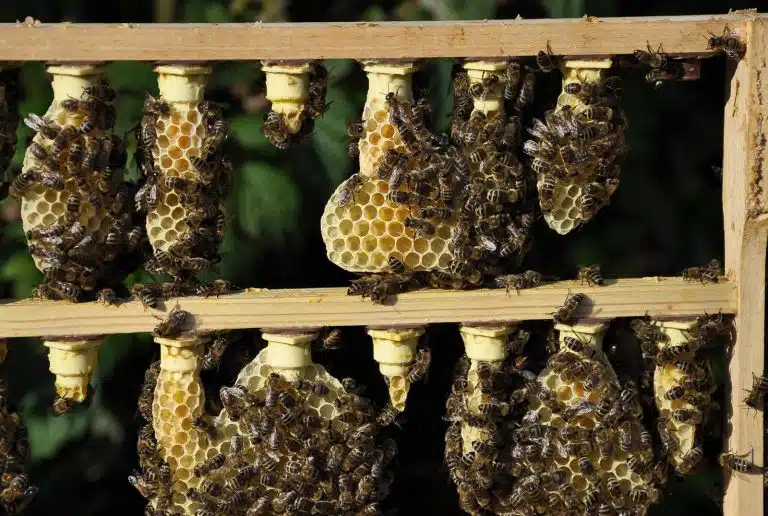
A queen cell is the cheapest way to give a nuc a queen, and it is well accepted, but you lose days before the queen starts laying and you can’t see her beforehand. A virgin queen can be seen and marked, and she travels better than a cell, but she is the one the colony rejects most easily. A mated queen interrupts laying the least and is the best accepted. She is also the most expensive.
Equipment for this task


Each option needs its own equipment: a protector for the queen cell, a push-in cage or an introduction cell for the virgin. No accessory guarantees acceptance: what decides it is queenlessness, the population and the timing.
Note the date of every cell
- Write the day you put the cell in on the roof of the nuc.
- The mated queen is usually ready to collect between 15 and 22 days later, depending on the weather and the strength of the nuc.
In this guide we compare the three and explain how to introduce each one, drawing mainly on Gilles Fert’s book Cría de reinas. To requeen a production colony with a mated queen, you’ll find the full protocol in how to introduce a mated queen.
The three options at a glance
| Queen cell | Virgin queen | Mated queen | |
|---|---|---|---|
| Acceptance | High, better than a virgin | The lowest of the three | The highest |
| What you see before introducing her | Nothing: the queen is inside the cell | Her appearance, and you can mark her | Her appearance and her laying. She can be marked and her wing clipped |
| Timing flexibility | Very little: it goes in the day before she emerges | Up to her sixth day of life | Plenty: she travels for several days and keeps for months in a queen bank |
| Days until laying | The most: she has to emerge, mature and get mated | Fewer than with a cell | Hardly any |
| Cost | The lowest | In between | The highest |
| Main risk | The cell gets damaged or the queen doesn’t come back from her mating flight | Rejection, or she flies off when released | Rejection if she has stopped laying for many days in transit |
Before introducing any queen
Some precautions apply to all three options. Fert sums them up like this:
- Check that the colony is queenless. It mustn’t have laying workers or a hidden virgin queen either. Destroy any queen cells it has started to raise.
- Pick your moment. Acceptance is better during a nectar flow and in a colony that isn’t too strong. If there’s no flow, feed.
- Introduce in the evening, with a light feed: about two glasses of syrup, roughly 20 cl.
- Reduce the entrance so the syrup doesn’t set off robbing.
- Don’t introduce a queen with varroa strips in the hive, and make sure the colony is healthy first.
- The fewer old bees, the better. They’re the ones that reject a new queen. That’s why queens are accepted better in small nucs of young bees.
Race matters too. Fert has very few problems with the Italian bee and quite a few with the black bee of western Europe. Rejection is also more common when the queen is of a different race from the colony. If you’re going to put yellow queens into an apiary of dark bees, take every precaution.
How to introduce a queen cell
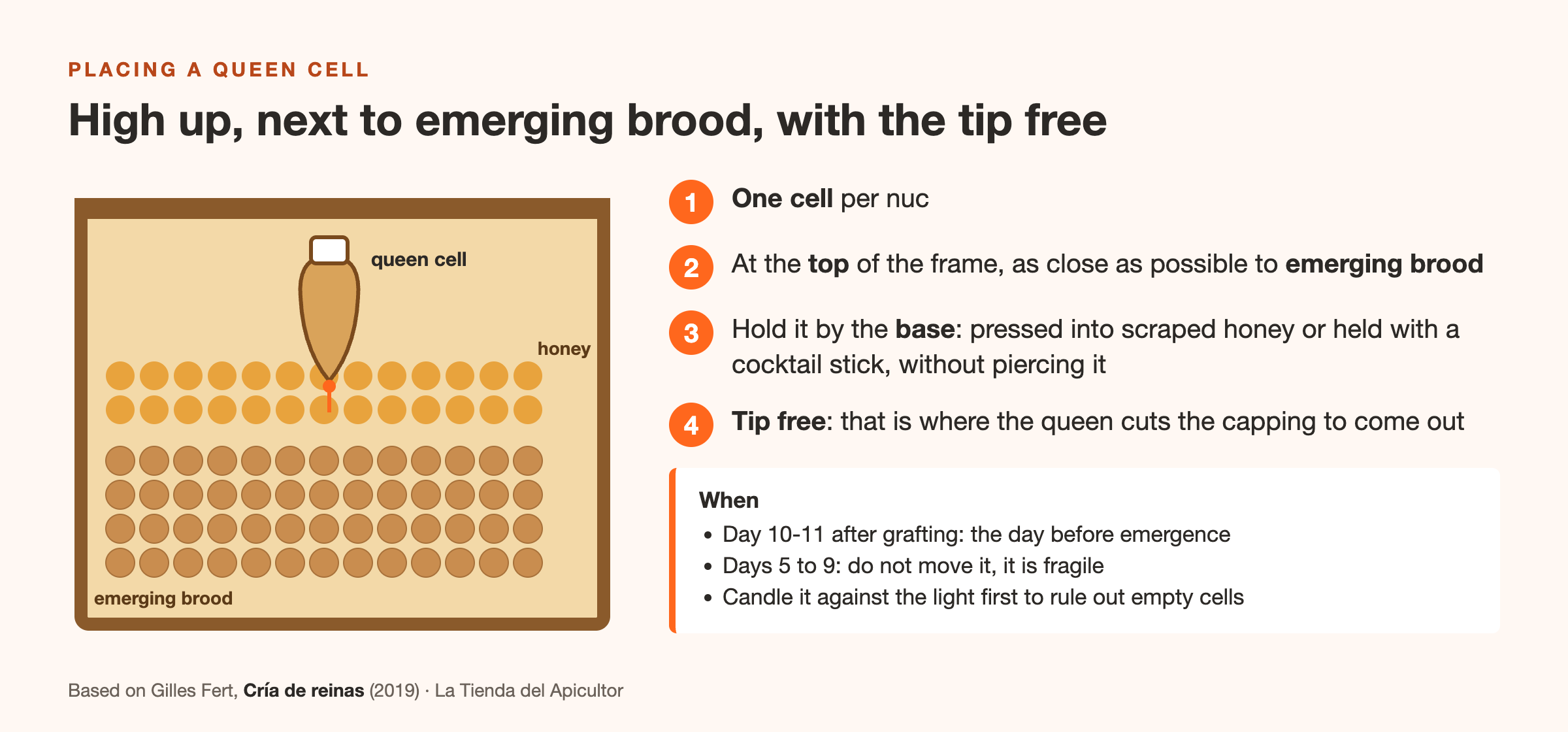
When. The cell goes in ripe, the day before the queen emerges. Counting from grafting, that’s around day 10 or 11. Don’t move it between days 5 and 9: the pupa is forming and the cell is fragile. If you’re taking it from the cell-raising colony or the incubator to the mating apiary, carry it in a box covered with a damp cloth, without jolting it.
Check first that it’s alive. Hold it up to the light, the way you candle hens’ eggs. That way you weed out empty cells and cells with a dead queen.
How to place it.
- Put just one cell per nuc.
- Place it at the top of a frame, as close as possible to brood that’s about to emerge. You can press it gently into scraped honeycomb or hold it with a toothpick pushed into its base, without piercing the cell.
- Always hold it by the base or by the cell cup holder. Don’t squeeze it or bend it out of shape.
- Leave the tip clear: that’s where the queen will cut through the cap to come out.
How long queenless? In a small nuc, 24 hours without a queen is enough: that’s what many queen breeders do when they take out a mated queen and put in the next cell. If you protect the cell with a hair roller cage or a protector tube, you can put it in at the same moment you remove the queen, because the bees can’t destroy it from the sides. That’s the job of the CNE8 queen cell protector, which lets the queen emerge free inside the hive, and of the CNE5 hair roller cage, which holds her in when she emerges so you can collect her.
A breeder’s trick. Fert recommends dipping the ten-day-old cell in syrup for five to ten minutes before placing it. The wax soaks it up and the bees come to the cell straight away.

How to introduce a virgin queen
This is the trickiest of the three. A virgin has the advantage that you can see her and mark her, but the window is short: she has to be introduced before her sixth day of life. After that, the colony accepts her far less readily.
Better on emerging brood than in the shipping cage. Fert advises using a cage pushed into the comb rather than leaving her in the shipping cage:
- Pick a frame with brood about to emerge and clear it of bees.
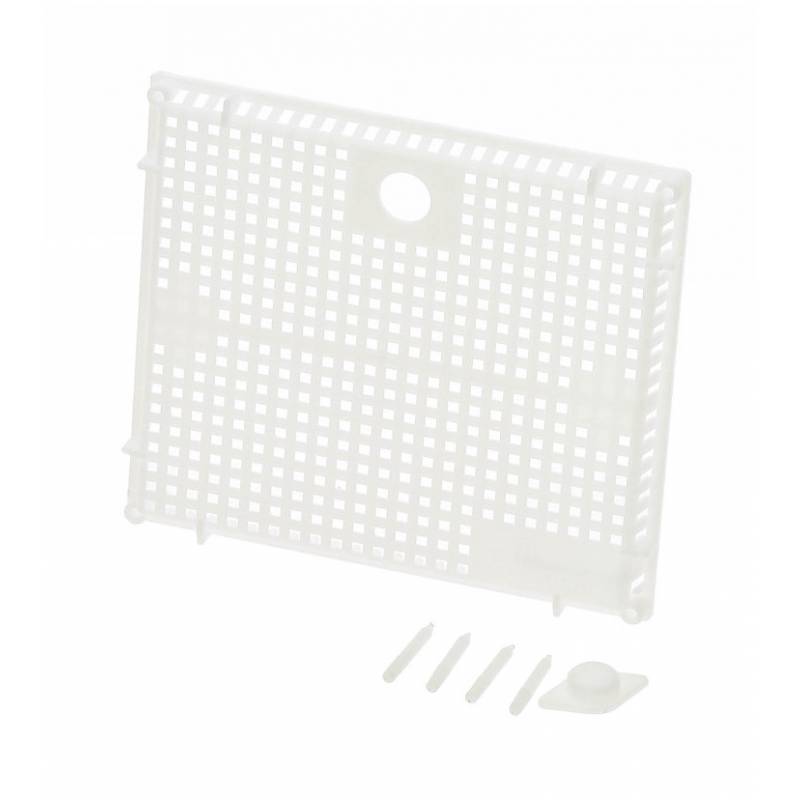
- Push the NICOT push-in introduction cage into the comb and put in only the queen, with no attendants.
- The workers that emerge inside the cage look after her from the very start.
- After two days, release her carefully: a virgin that feels free may fly off.
With a plastic cell. Another option is the KNE9 introduction cell. It mimics a queen cell: you put the virgin inside and close it with a thin wax cap, which she cuts through herself. For the colony it’s like a second emergence. It goes upright between two frames, near the brood.
The fewer bees, the better. A virgin is accepted better in a small nuc of young bees. If you work with black bees, Fert advises against introducing virgins into normal colonies. He recommends using populations of young bees taken from several hives: the mix of pheromones makes them more tolerant.
Don’t mark her when she emerges. Virgin queens lose much of the hair on their thorax during mating, and the mark often wears off on the flights. Fert also notes that a marked virgin is rejected more often. Mark her once she’s laying.
If you’re buying the virgin, the virgin queen product page explains how to prepare the nuc to receive her.
How to introduce a mated queen
The procedure for requeening a production colony is in how to introduce a mated queen. Fert adds these details:

- Remove the attendant bees from the cage before putting it in. They can carry disease and cause friction with the colony’s workers through the mesh.
- Prepare the queen candy. Take out the plug or tab from the candy compartment, pierce the candy right through with a matchstick and check that no dead bee is blocking the way.
- Place the cage flat with the mesh facing down, or hang it between two brood frames. The workers will eat the candy and release the queen.
- Plan the queenless period. Fert leaves the hive queenless for two or three days before introducing the queen. Our requeening guide works with 24 to 48 hours. Either way, the aim is for the colony to know it’s queenless before it receives the queen.
If the queen has travelled for several days. A queen that has stopped laying in transit produces fewer pheromones and is accepted less readily. Fert first introduces her into a small nuc and, twelve days later, unites that whole nuc with the queenless hive. When you open the cage, bear in mind that a mated queen that hasn’t laid for days is lighter and can fly.
Why you shouldn’t cage the queen too young
Fert cites an Australian study by Rhodes and Somerville that links a queen’s survival after introduction to her age when she was caged:
| Queen’s age when caged | Alive 14 days after introduction | Alive 15 weeks later |
|---|---|---|
| 7 days | 15% | 10% |
| 14 days | 47.5% | 17.5% |
| 21 days | 85% | 62.5% |
| 28 days | 85% | 60% |
| 35 days | 90% | 72.5% |
The practical upshot is that a queen caged at three weeks old or more is accepted much better and lasts longer. If you rear your own queens, don’t take them out of the nuc before that age. If you buy them, ask how old they were when they were caged.
High-value queens: the emerging brood method
For a queen you can’t afford to lose, such as an inseminated breeder queen or one from a selected line, Fert uses a slower, safer method:
- Make up a nuc with a frame of honey and pollen, an empty frame of drawn comb and the bees from three or four frames of brood about to emerge. Those bees are young.
- Reduce the entrance to one or two bees wide and move the nuc to the other side of the apiary, at least 10-20 metres away.
- Wait 24 hours. The old bees will have gone back to their original hive.
- In the evening, put the queen on her own under a push-in cage pressed into brood about to emerge.
- Give about 20 cl of 50/50 syrup (1 litre of water to 1 kg of sugar).
- After two or three days, remove the cage. The queen will already be laying in the cells the bees have emerged from.
- Boost the nuc with a frame of emerging brood every six days.
Fert also recommends this method when you’re introducing a mated queen into a black bee colony.
What equipment you need for each option
| You’re introducing | Equipment |
|---|---|
| Queen cell | CNE8 protector tube or CNE5 hair roller cage if you want to put it in without waiting for the nuc to realise it’s queenless |
| Virgin queen | NICOT push-in introduction cage or KNE9 introduction cell |
| Mated queen | Her shipping cage, such as the NICOT queen travelling cage, with queen candy. With black bees or valuable queens, the push-in cage |
Frequently asked questions
Which is accepted better, a queen cell or a virgin queen?
The queen cell. According to Fert, its acceptance rate is higher than a virgin’s and, if it fails, you lose less. The trade-off is that you don’t see the queen until she emerges and you wait longer for her to start laying.
Up to what age can you introduce a virgin queen?
Up to her sixth day of life. After that she is accepted less well. That’s why virgins have to be shipped and introduced very quickly.
Can you mark a virgin queen?
You can, but it’s best not to do it when she emerges. The mark often wears off during mating flights and a marked queen is rejected more often. Mark her once she’s laying.
When does a queen introduced as a cell start laying?
Queens can start laying about eight days after their last mating flight. In practice, queen breeders collect the mated queen between 15 and 22 days after putting in the cell, depending on the weather and the strength of the nuc.
Further reading
- How to introduce a mated queen: a requeening guide
- Queen rearing: a step-by-step beginner’s guide
- Requeening: when to replace a queen and why
Main source: Gilles Fert, Cría de reinas, the 2019 Spanish edition of L’élevage des reines.


