

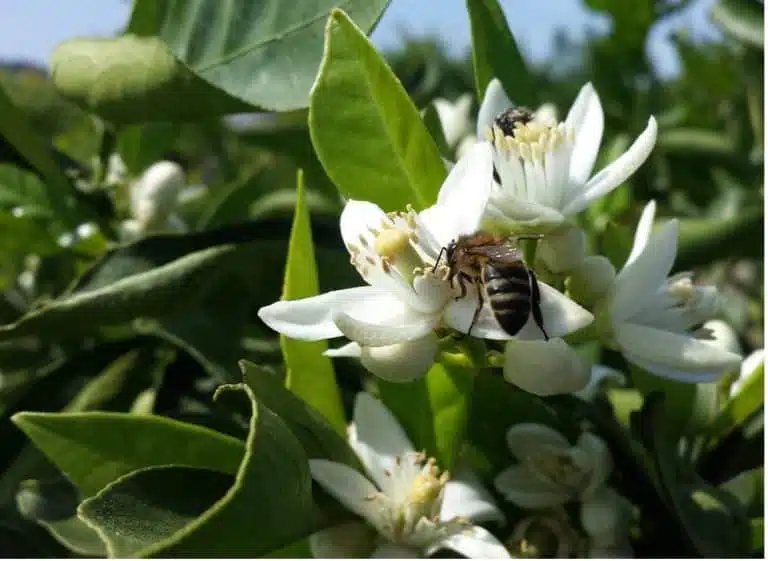
Spring brings the widest flowering and the most rapid build-up in many Spanish apiaries. It is also a season for swarming and storing honey. Four broad forage groups can produce a surplus: legumes, citrus, bugloss and the mint family, particularly thymes and French lavender.
A guide for comparing spring honeys

The printed Spanish-language guide sets out pollen, sensory and physicochemical profiles. Keep the harvest record with the sample when comparing spring flows.
Record the actual flowering at your apiary
- Write down the start and end of the flow each season.
- Keep the harvest date and apiary with every lot you compare.
| Flowering plants | Family | Main areas | Honey profile | Indicative pollen reference |
|---|---|---|---|---|
| Legumes, including clovers, sainfoin and albaida | Fabaceae | Across the Iberian Peninsula | Often pale, mild and slightly flour-like in aroma. Mixed crops may fit the meadow honey profile. | Depends on the species |
| Citrus blossom (Citrus) | Rutaceae | Mediterranean coastal areas and the Guadalquivir valley | Pale, floral and citrus-scented, sweet with some acidity | Citrus pollen is under-represented. Interpret it with the appropriate reference, methyl anthranilate and sensory findings. |
| Bugloss (Echium) | Boraginaceae | Often flowers alongside citrus or French lavender | Pale, faintly scented and sometimes slightly oily on the palate | About 70% of the pollen count in the guide |
| Thymes (Thymus) | Lamiaceae | Mediterranean scrub | Light amber to amber, with noticeable acidity and a phenolic aroma | About 12% of the pollen count in the guide |
| French lavender (Lavandula stoechas) | Lamiaceae | Central and south-western Iberia | Pale with a gentle floral aroma | About 12% of the pollen count in the guide |
A beekeeping spring that lasts for months
On the southern Mediterranean coast, the beekeeping spring can start in February. In the northern mountains it may not arrive until June. Moving colonies between these areas lets a beekeeper follow successive spring flows over several months.
Migratory beekeeping is widespread in Spain. The official livestock register counted 2,741,400 hives in March 2026. Roughly four-fifths were classed as migratory. The total was slightly lower than a year earlier.
Most spring flows mix annual herbs and perennial shrubs, in proportions that vary from site to site. Legumes supply much of the forage. French lavender, thyme and bugloss can make large contributions. Chicories, sow-thistles and bellflowers appear in smaller amounts. In parts of eastern Spain and Andalusia, cultivated citrus dominates.
Legumes or pea-family plants

Many annual herbs and perennial shrubs that flower in spring belong to the pea family, Fabaceae. The older family name, Leguminosae, refers to the characteristic pod. The broad bean, Vicia faba, is one familiar member.
Herbaceous legumes
| Common name | Genus | Main areas |
|---|---|---|
| Bird’s-foot trefoils | Lotus | Widely distributed |
| Escobizo and related trefoils | Dorycnium | Widely distributed |
| Vetches | Vicia | Moister meadows |
| Wild medicks and lucerne | Medicago | Meadows and irrigated lucerne where cutting is delayed until after flowering |
| Clovers | Trifolium | Meadows |
| Sweet clovers | Melilotus | Higher ground |
| Sainfoins | Onobrychis | Poor soils, in cultivation and as naturalised stands |


Shrubs and trees
Important shrubby legumes include albaida (Anthyllis spp.), several brooms and yellow broom (Retama sphaerocarpa), whose main flowering comes nearer summer.

Black locust (Robinia pseudoacacia) produces the well-known central European acacia honey. Spain has some harvests in the Basque Country. Another tree legume, carob (Ceratonia siliqua), belongs to the coastal Mediterranean landscape but flowers in autumn. In a favourable wet season it can give a dark, distinctive honey and useful winter stores.

As with almond and rosemary, the abundance of rounded flower buds early in the growth cycle gives a rough indication of the coming display.
Honey from legumes
Many legumes provide abundant nectar and pollen, and some yield monofloral honeys. The honeys are generally pale, mildly scented, reminiscent of fresh flour and simply sweet. Yellow broom and carob are exceptions to the usual pale colour.
When “meadow honey” describes a crop well
Where the pollen spectrum and the harvest record support it, meadow honey describes the plant community more precisely than a general multifloral label. On the Mediterranean coast a mixture of legumes with rosemary and thyme may instead fit the profile of garrigue, the local scrub vegetation.
Citrus blossom

Citrus trees originated in Asia and belong to the rue family, Rutaceae. Spain also has native relatives such as Ruta. Commercial orchards extend along the eastern and southern coasts and into the Guadalquivir valley. Lemons are important in Murcia, oranges in Valencia and Andalusia, and mandarins in Castellón and southern Tarragona.

Citrus blossom gives pale honeys with a recognisable floral and citrus scent, associated in part with methyl anthranilate. The sweetness is often balanced by a clear acidic note.
Why a pollen count alone cannot identify citrus honey
Citrus pollen can be scarce in honey, particularly in crops taken from supers. Assess the pollen against a citrus-specific reference, alongside the sensory profile and methyl anthranilate. Some buyers use a value above 1.0 mg/kg in their specifications. No single result establishes the botanical designation.
| Citrus source | Honey profile | Pollen in the honey |
|---|---|---|
| Orange | Usually the most aromatic and acidic of the three | Sometimes 5% or less |
| Lemon | Generally paler and sweeter | Often above 20% |
| Mandarin | An intermediate sensory profile | Often above 15% |
Navel oranges were selected for seedless fruit and often produce very little viable pollen. Seedless mandarins can behave differently: some produce pollen but need a compatible variety to set seed. Orchard layout and neighbouring cultivars therefore matter.
Citrus bloom is also an important season for coastal pollination services.
Bugloss or viper’s bugloss

Spanish names such as argamula, chupamieles and viborera refer to several Echium species. Among the most important are E. plantagineum and E. vulgare. They belong to the borage family and bees visit them for both nectar and pollen.

These annuals or biennials have bristly leaves, a basal rosette and blue-violet flowers with five fused petals. The stamens and forked style project beyond the flower.
Spring rain strongly influences the display. Biennial species can be particularly abundant after two favourable springs. A major flow is far from guaranteed every year.
The honey is usually pale, mildly scented and sweet, sometimes leaving a slightly oily mouthfeel. The plants can also contribute conspicuously dark pollen.
Dark pollen and food safety
Some Echium species contribute pyrrolizidine alkaloids to bee products. EU Regulation 2023/915 sets a maximum for pollen and pollen products, including pollen-based supplements. It has no maximum specific to honey. If you harvest pollen, consider the botanical origin in your food safety plan. Our guide to dark bee pollen (in Spanish) explains the limit and how to assess a lot.
Bugloss can accompany citrus in Andalusia and French lavender in central and south-western Spain. Its pollen is abundant. The guide uses around 70% as an indicative reference, compared with about 12% for rosemary or thyme. Botanical attribution also takes account of sensory and physicochemical evidence.
Thymes

The name covers species of Thymus and sometimes related plants. The peninsula has around thirty thyme species, although only a handful are common at many beekeeping sites.
Thymes are small aromatic shrubs with young stems often square in cross-section and hairy. Like other members of the mint family, they have two-lipped flowers formed from fused petals. The leaves are small, often with rolled edges, which helps limit water loss.

Thyme honey ranges from light amber to amber depending on companion forage. It is noticeably acidic and can have an intense phenolic aroma reminiscent of certain disinfectants. Thyme pollen is often under-represented, so interpret a percentage with the flavour and chemistry of the lot.
A harvest shared between rosemary and thyme
On some migratory routes the rosemary flow leaves supers only partly filled and thyme finishes the crop. The result can be an excellent mixed honey. If neither flower clearly predominates, market it without a single-flower claim unless the complete analysis supports one.


Sainfoin often flowers alongside thyme. Other local mint-family forage includes savory (Satureja spp.), ironwort (Sideritis spp.) and sage (Salvia spp.).
French lavender

French or Spanish lavender, Lavandula stoechas, belongs to the mint family. It is a true Lavandula species but differs from the lavenders traditionally called espliego in Spain.
It is a low woody shrub with aromatic, rolled-edged leaves and young hairy, square stems. The flowers form a head on a stalk, topped by distinctive showy bracts.

Adequate spring rain can produce a useful crop. The honey is pale, with a mild floral scent and a mainly sweet taste that can include a little acidity. As with thyme, pollen is often under-represented. The full assessment includes sensory and physicochemical evidence.
In France, lavender and lavandin honeys have a strong identity in the market. French lavender (L. stoechas), sometimes called lavande maritime, gives a different product. State the actual floral origin when comparing it with spike lavender, true lavender or their hybrids.
The percentages in this article come from honey pollen analysis. Earlier in the season, read about early spring forage. Next in the calendar come the summer flows (in Spanish).
Which plants produce major spring honey flows in Spain?
Legumes such as clovers, sainfoin, albaida and brooms, citrus in coastal regions, bugloss species and mint-family plants such as thyme and French lavender can all contribute a crop.
Why is pollen alone insufficient to identify citrus honey?
Citrus may contribute little pollen relative to its nectar. Orange honey can contain 5% or less in some cases. Use its sensory profile, the appropriate pollen reference and, when relevant, methyl anthranilate. A buyer’s numerical specification is only one part of the assessment.
How much bugloss pollen is expected in monofloral bugloss honey?
Around 70% is an indicative figure in the guide because Echium contributes abundant pollen. It is a guide value, not a universal legal threshold. Consider the chemistry, taste and harvest records as well.
What is meadow honey?
The term describes a harvest from a meadow plant community, often rich in legumes, when its pollen and other characteristics support that description. Such honeys are often pale and gently scented.
What if a harvest contains rosemary and thyme but neither predominates?
It can be sold as honey without a single-flower statement. A mixed harvest is common when the bees start filling supers on rosemary and finish on the following thyme flow. Use the full analysis before choosing a floral label.


