

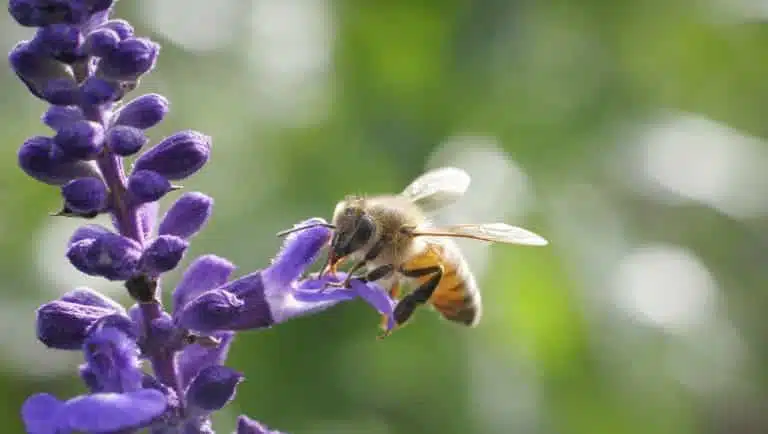
Nectar plants provide the sugars bees turn into honey. Others supply pollen without floral nectar. Iberia has roughly 8,000 plant species. In one district bees might visit about a hundred, with only some forty important to the annual forage cycle. Knowing which plants feed bees, and when, helps explain why one site thrives while another runs short in August. The calendar and plant list below will also help you choose what to plant.
Iberian bee forage in numbers
8.000
plant species across the peninsula
About 100
visited by bees in a particular district
About 40
major forage sources locally
Other plants may be scarce, less attractive or useful only under particular weather conditions. Go straight to the plant list.
Identify the forage before sowing


Use the field guide to identify local plants. Phacelia seed is an option for a suitable cultivated plot where flowering dates leave a gap.
Start with the calendar at your site
- Record the weeks when little nectar or pollen is coming in.
- Choose suitable plants for the site and check local restrictions.
In this guide
- How flowers evolved and their role in pollination
- What bees collect and what determines the supply
- How plants are named by genus, species and family
- What to plant in a garden, field or hedge
- The Iberian bee forage list
An introduction to bee botany
Plants have evolved many ways to reproduce. The structures that protect an ovule and deliver pollen to it are particularly relevant to a beekeeper.
Gymnosperms, including firs, cypresses, junipers and pines, belong to ancient seed-plant lineages. They do not have flowers in the usual sense. In conifers, male cones release pollen and female structures bear exposed ovules. Wind carries the pollen, and a fertilised ovule can develop into a seed.
In flowering plants, or angiosperms, the ovules are enclosed in an ovary. Fossils record flowering plants more than 100 million years ago. Many flowers have coloured petals, scents, nectar and accessible pollen that attract animals. As an insect or bird moves between flowers, pollen can reach a receptive stigma.
Flower structure is one of the features botanists use to recognise and classify these plants.
What flowers offer bees
Flowers vary enormously, but a typical flower has several recognisable parts.
- The ovary contains the ovules. The number of ovules and the position and arrangement of the ovary vary between groups. Almond, apple and kiwifruit illustrate different arrangements.
- The stamens are the pollen-producing organs. A typical stamen consists of a filament bearing an anther. Both their number and arrangement can help identify a plant.
- Petals often surround the reproductive parts. Their colour and shape can guide pollinators towards pollen and nectar. They commonly fall after flowering.
- Sepals form an outer protective layer. They are often green, although their shape, colour and arrangement vary.
- Nectaries produce nectar, a solution of sugars in water. Their position and the amount and concentration of nectar vary by species, time of day and weather.

Bees visit flowers for pollen, a source of protein, lipids and other nutrients, and for nectar, their main source of sugars.
Pollen varies in shape, size and composition. Identifying grains can reveal which plants contributed to a harvest. Nectar also varies in water content and in its proportions of glucose, fructose and sucrose. A greater proportion of glucose generally favours faster crystallisation in the honey.
Flowering depends on the plant’s nutrient and site requirements. Rosemary often favours limestone, for example, while many heathers grow best on acidic, siliceous soils.
Roots take up water and dissolved mineral nutrients. Rainfall, irrigation and local moisture must be available at the right stages of growth and flowering.
Through photosynthesis, green tissues use light, carbon dioxide and water to make sugars and release oxygen. The plant uses these sugars, with mineral nutrients, to build other compounds and new tissue.
Pollen contains reserves that help it germinate and grow a pollen tube towards the ovule. Following fertilisation, seeds develop and the ovary grows into the fruit. Petals often fall as the flower’s role ends.


A plant needs enough healthy leaf area to support a good supply of nectar and pollen. Weather during vegetative growth can therefore affect a flow well before the first flowers open.
Each plant has a temperature range in which nectar secretion works well. Some winter and early spring flowers secrete below 20 °C. Excess heat or cold can reduce secretion.
Soil, water and temperature affect both the period of growth and the flowering itself. A hillside covered in flowers does not always mean the bees are bringing in nectar.
In species with alternating heavy and light crops, the previous season can influence the formation of flower buds. The number of buds and the nectar produced by each flower can vary independently.

Leaves, roots, stems and the arrangement of flowers all help in identifying plants. Scientific names let people in different regions refer to the same species even where local names differ. Modern binomial nomenclature dates back to Linnaeus in the eighteenth century.
How scientific plant names work
A genus groups related species. Thymes, for example, belong to Thymus. The second part of a scientific name distinguishes the species: common thyme is Thymus vulgaris, Spanish marjoram is T. mastichina, wild thyme is T. serpyllum and another Iberian thyme is T. zygis.
Related genera form a botanical family. Thyme, lavender, sage, savory and rosemary all belong to the mint family, Lamiaceae. Its older name, Labiatae, refers to the two lips of many of its flowers. Rosemary is now Salvia rosmarinus, formerly Rosmarinus officinalis.
Of the roughly 8,000 Iberian plant species, a beekeeper in one district may see bees visiting about a hundred. A much smaller group, perhaps forty, usually provides the main forage. Learn the locally important ones first.

What to plant for bees
Start with plants native to the site, offering nectar or pollen and flowering at different times. A mix of families can feed a wider range of pollinators in a garden, on a farm boundary or around an apiary.
Scale matters. A circle of 1–1.5 km around a hive covers roughly 300–700 hectares, and bees can forage farther. A small garden will rarely alter a honey crop appreciably, but can bridge a local flowering gap and support wild bees that nest nearby.
Choosing the plants
- Use local natives. Match the plant to the ground and climate: rosemary on suitable limestone, heathers on suitable acidic soils. A well-matched plant is more likely to establish with little extra care.
- Stagger flowering. Look particularly at gaps in summer, often the leanest season in Mediterranean Spain. See our guide to summer honey flows (in Spanish).
- Include several families. Mints, legumes, daisies and members of the rose family offer different pollen and suit different visitors.
- Choose single flowers. In many double-flowered cultivars stamens are replaced by petals. An impressive display can offer little accessible pollen.
- Protect pollinators from sprays. Avoid insecticides on flowering forage and follow the authorised label and local restrictions for any treatment.
- Check invasive-species rules. The Spanish invasive species catalogue includes butterfly bush, tree of heaven and silver wattle, with territorial provisions for some entries. Strawberry tree is also listed for the Canary Islands. Check the current entry for your site before planting.
A seasonal planting calendar
The following selection comes from the plant list below. Choose several suitable species in each part of the year to spread the supply of flowers.
| Plant | Flowering period | What it offers and where it fits |
|---|---|---|
| Almond and other fruit trees | January–April | Nectar and pollen early in the season. Protect visitors while trees are flowering. |
| Willows, Salix (trees) | February–May | Early pollen and nectar on damp ground and beside water. |
| Rosemary (shrub) | Autumn to spring, depending on rain | Nectar and pollen. Choose a sunny site and suitable calcareous soil. |
| Thyme (small shrub) | February–May | Mainly nectar, with comparatively little pollen. |
| Hawthorn (shrub or small tree) | March–June | Nectar and pollen. Useful in a boundary hedge. |
| Borage (herb) | April–September | Nectar and pollen. It readily self-seeds. |
| Sainfoin, clovers and bird’s-foot trefoil (herbs) | April–October | Nectar and pollen. Also suitable for forage or a meadow mixture. |
| Brambles (shrubs) | May–August | Nectar and pollen. Some wild bees nest in old stems. |
| Lime or linden (tree) | June–July | Nectar. Best on a site with sufficient moisture. |
| Sweet chestnut (tree) | June–July | Nectar and pollen on suitable northern and mountain soils. It can yield chestnut honey. |
| Spike and true lavender (shrubs) | June–September | Nectar. Plant in full sun. |
| Fennel (herb) | June–November | Nectar and pollen. Old stems can provide nest sites. |
| Savory (small shrub) | August–September | Nectar towards the end of summer. |
| Ivy (climber) | September–November | Abundant nectar and pollen as winter bees are being reared. |
| Carob (tree) | September–November | Nectar and pollen on suitable Mediterranean coastal sites. |
| Strawberry tree (shrub or small tree) | October–December | Nectar. Do not plant it in the Canary Islands, where it is listed as invasive. |
Trees that provide bee forage
Almond and other fruit trees, willow, lime, sweet chestnut, carob and strawberry tree can all be valuable where they belong. Cultivated citrus gives citrus blossom honey, while avocado can produce a very dark avocado honey. A visit from bees is no reason to introduce an invasive tree.
Sowing phacelia to bridge a forage gap
Phacelia (Phacelia tanacetifolia) can be direct-sown on a suitable cultivated plot. The guide describes shallow cover of 1–2 cm, moisture during establishment and sowing from April to late August under suitable conditions. First flowers can appear after six to eight weeks and last a month or more. Staggered sowings about three weeks apart extend the flowering period. The example rate is 500 g for roughly 250–500 m²; check your seed instructions and site.
A modest patch is supplementary forage and can attract as many bumblebees as honey bees. Our shop carries phacelia seed in 500 g packs.

Nesting places for wild bees
Iberia has roughly a thousand bee species, most of them solitary. Many nest in bare ground and others use holes in dead wood or hollow or pithy stems. A habitat guide from CREAF suggests three practical ways to provide nesting opportunities.
- Leave small patches of bare, fairly firm soil.
- Where suitable, provide dry, sheltered nesting cavities. The source describes diameters of 3–8 mm and depths of 8–15 cm, with shallower cavities for the narrower diameters and entrances facing south-east.
- Retain pithy stems such as bramble, fennel, mullein and elder.
The guide also lists plants for twelve vegetation communities in Catalonia. Outside Catalonia use its habitat-based approach and select plants local to your area. Rodrigo and Bosch (2019), Mesures per afavorir els pol·linitzadors en la restauració ambiental, CREAF and Generalitat de Catalunya.
Iberian plants visited by bees
The table follows the Spanish alphabetical order used in the original field guide. It gives English common names, scientific names and families for common constituents of Iberian honey pollen spectra. Entries marked “pollen only” do not provide floral nectar in this comparison.
| Plant | Botanical family |
|---|---|
| Black locust or false acacia, Robinia pseudoacacia | Pea family, Fabaceae |
| European holly, Ilex aquifolium | Holly family, Aquifoliaceae |
| Chicory, Cichorium intybus | Daisy family, Asteraceae |
| Avocado, Persea americana | Laurel family, Lauraceae |
| Savory, Satureja spp. | Mint family, Lamiaceae |
| Wild garlic and onions, Allium spp. | Amaryllidaceae (formerly placed in Liliaceae) |
| Buckthorns, Rhamnus spp. | Buckthorn family, Rhamnaceae |
| Albaida, Anthyllis spp. | Pea family, Fabaceae |
| Cork oak, Quercus suber | Beech family, Fagaceae · pollen only |
| Medicks and lucerne, Medicago spp. | Pea family, Fabaceae |
| Almond, Prunus dulcis | Rose family, Rosaceae |
| Carob, Ceratonia siliqua | Pea family, Fabaceae |
| Poppies, Papaver spp. | Poppy family, Papaveraceae · pollen only |
| Amaranths, Amaranthus spp. | Amaranth family, Amaranthaceae |
| Myrtle, Myrtus spp. | Myrtle family, Myrtaceae |
| Catchflies and campions, Silene spp. | Pink family, Caryophyllaceae |
| Citrus blossom, Citrus spp. | Rue family, Rutaceae |
| Bishop’s weed, Ammi spp. | Carrot family, Apiaceae |
| Borage, Borago spp. | Borage family, Boraginaceae |
| Ling heather, Calluna vulgaris | Heather family, Ericaceae |
| Heaths, Erica spp. | Heather family, Ericaceae |
| Spurge flaxes, Thymelaea spp. | Daphne family, Thymelaeaceae |
| Field marigold, Calendula arvensis | Daisy family, Asteraceae |
| French lavender, Lavandula stoechas | Mint family, Lamiaceae |
| Field eryngo, Eryngium campestre | Carrot family, Apiaceae |
| Thistles, Carduus and Galactites spp. | Daisy family, Asteraceae |
| Carline thistles, Carlina spp. | Daisy family, Asteraceae |
| Globe thistle, Echinops ritro | Daisy family, Asteraceae |
| Sweet chestnut, Castanea sativa | Beech family, Fagaceae |
| Turnsole, Chrozophora spp. | Spurge family, Euphorbiaceae |
| Goosefoots, Chenopodium spp. | Amaranth family, Amaranthaceae |
| Knapweeds and cornflowers, Centaurea spp. | Daisy family, Asteraceae |
| Sow-thistles, Sonchus spp. | Daisy family, Asteraceae |
| Cypresses, Cupressus spp. | Cypress family, Cupressaceae · windborne pollen only |
| Bugloss and viper’s bugloss, Echium spp. | Borage family, Boraginaceae |
| Bindweeds, Convolvulus spp. | Bindweed family, Convolvulaceae |
| Knotweeds and bistorts, Polygonum in the traditional broad sense | Knotweed family, Polygonaceae |
| Kermes oak, Quercus coccifera | Beech family, Fagaceae · pollen only |
| Bird’s-foot trefoils, Lotus spp. | Pea family, Fabaceae |
| Dandelions, Taraxacum spp. | Daisy family, Asteraceae |
| Honeydew elements (HDEs), counted separately from pollen | Various families |
| Holm oak, Quercus ilex | Beech family, Fagaceae · pollen only |
| Junipers, Juniperus spp. | Cypress family, Cupressaceae · windborne pollen only |
| Sainfoins, Onobrychis spp. | Pea family, Fabaceae |
| Lavenders, Lavandula angustifolia, L. latifolia and the older name L. vera | Mint family, Lamiaceae |
| Rockroses, Cistus and Helianthemum spp. | Rockrose family, Cistaceae · pollen only in this guide |
| River red gum and blue gum, Eucalyptus camaldulensis and E. globulus | Myrtle family, Myrtaceae |
| Fruit trees, Malus, Prunus and Pyrus spp. | Rose family, Rosaceae |
| Wild strawberry, Fragaria vesca | Rose family, Rosaceae |
| Large-fruited asphodel, Asphodelus cerasifer | Asphodel family, Asphodelaceae (formerly placed in Liliaceae) |
| Onionweed, Asphodelus fistulosus | Asphodel family, Asphodelaceae (formerly placed in Liliaceae) |
| Brooms, Genista and Cytisus spp. | Pea family, Fabaceae |
| Sunflower, Helianthus annuus | Daisy family, Asteraceae |
| Mignonettes, Reseda spp. | Mignonette family, Resedaceae |
| Field pea, Pisum sativum | Pea family, Fabaceae |
| Ivy, Hedera helix | Ivy family, Araliaceae |
| Fennel, Foeniculum vulgare | Carrot family, Apiaceae |
| St John’s worts, Hypericum spp. | St John’s wort family, Hypericaceae (historically grouped with Clusiaceae) |
| Mustards, hedge-mustards and oilseed rape, Brassica and Sisymbrium spp. | Cabbage family, Brassicaceae |
| Gum rockrose, Cistus ladanifer | Rockrose family, Cistaceae · pollen only in this guide |
| Plantains, Plantago spp. | Plantain family, Plantaginaceae · pollen only |
| Spurges, Euphorbia spp. | Spurge family, Euphorbiaceae |
| Strawberry tree, Arbutus unedo | Heather family, Ericaceae |
| Maize, Zea mays | Grass family, Poaceae · pollen only |
| Common hawthorn, Crataegus monogyna | Rose family, Rosaceae |
| Mallows, Malva spp. | Mallow family, Malvaceae |
| Anise, Pimpinella anisum | Carrot family, Apiaceae |
| Sweet clovers, Melilotus spp. | Pea family, Fabaceae |
| Escobizo or prostrate canary clover, Dorycnium pentaphyllum | Pea family, Fabaceae |
| Willows and osiers, Salix spp. | Willow family, Salicaceae |
| Wattles, Acacia spp. | Pea family, Fabaceae |
| Forget-me-nots, Myosotis spp. | Borage family, Boraginaceae |
| Olive, Olea europaea | Olive family, Oleaceae · pollen only |
| Stonecrops, Sedum spp. | Stonecrop family, Crassulaceae |
| Horned poppies of the genus Hypecoum | Poppy family, Papaveraceae · pollen only |
| Pines, Pinus spp. | Pine family, Pinaceae · windborne pollen only |
| Pennyroyal and other mints, Mentha spp. | Mint family, Lamiaceae |
| Cinquefoils, Potentilla spp. | Rose family, Rosaceae |
| White wall-rocket, Diplotaxis erucoides | Cabbage family, Brassicaceae |
| Ironworts, Sideritis spp. | Mint family, Lamiaceae |
| Bellflowers and rampions, Campanula spp. | Bellflower family, Campanulaceae |
| Yellow broom, Retama sphaerocarpa | Pea family, Fabaceae |
| Oaks, Quercus spp. | Beech family, Fagaceae · pollen only |
| Rosemary, Salvia rosmarinus (syn. Rosmarinus officinalis) | Mint family, Lamiaceae |
| Loosestrifes, Lythrum spp. | Loosestrife family, Lythraceae |
| Sages, Salvia spp. | Mint family, Lamiaceae |
| Limes or lindens, Tilia spp. | Malvaceae (formerly Tiliaceae) |
| Thymes, Thymus spp. | Mint family, Lamiaceae |
| Bitumen-clover and relatives, Psoralea in the traditional sense | Pea family, Fabaceae |
| Clovers, Trifolium spp. | Pea family, Fabaceae |
| Vetches, Vicia spp. | Pea family, Fabaceae |
| Brambles, Rubus spp. | Rose family, Rosaceae |
| Hedysarums, including sulla, Hedysarum spp. | Pea family, Fabaceae |
On the next apiary visit, look beyond the flowers that attract the most bees. A less conspicuous plant may be filling an important gap.
Frequently asked questions about bee forage plants
How many plant species do bees visit in Spain?
Iberia has roughly 8,000 plant species. In one district honey bees might visit around a hundred, with about forty making the main contribution. The local figure depends on the habitat and season.
What is the difference between a nectar plant and a pollen-only plant?
A nectar plant supplies the sugars used to make floral honey. A pollen-only plant can still be important food for the colony but contributes no floral nectar. Poppies and oaks are examples in this guide. An oak may separately provide honeydew.
Why does a plant yield honey one year and little the next?
Soil moisture, temperature and conditions during growth and flowering all affect the crop. Some plants form flower buds on growth produced the previous year, so two consecutive seasons can influence the result.
Why do rosemary and heather grow on different ground?
Rosemary often favours calcareous soil, while many heathers prefer acidic or siliceous ground. Local geology helps explain forage patterns alongside climate and altitude.
Why learn a plant’s botanical family?
Related species share identifying features and often have similar flowers. Recognising the family helps you compare forage plants and understand the names used in a honey pollen report.
What can I plant to help bees?
Choose locally native plants from several families with overlapping flowering periods. Suitable examples in parts of Iberia include rosemary, thyme, lavender, borage, fennel, bramble and ivy. Match the species to your site, favour accessible flowers and avoid invasive plants.
Which trees provide useful nectar or pollen?
Depending on the area, almond and other fruit trees, willow, lime, chestnut, carob and strawberry tree can all contribute. Citrus and avocado are important in suitable cultivation areas. Check local invasive-species rules before planting any non-native tree.
Will flowers in my garden increase the honey crop?
A garden forms a very small part of the area available to a colony. Its main benefits are filling gaps in flowering and supporting local wild bees. Even a field of phacelia is usually supplementary forage unless a much wider area contributes.
Further reading
- Follow the flowering calendar through early spring, the main spring flows (in Spanish), summer (in Spanish) and autumn.
- Honey pollen analysis shows how a laboratory turns plant evidence into a report.
- How to choose an apiary site with local forage in mind.


