

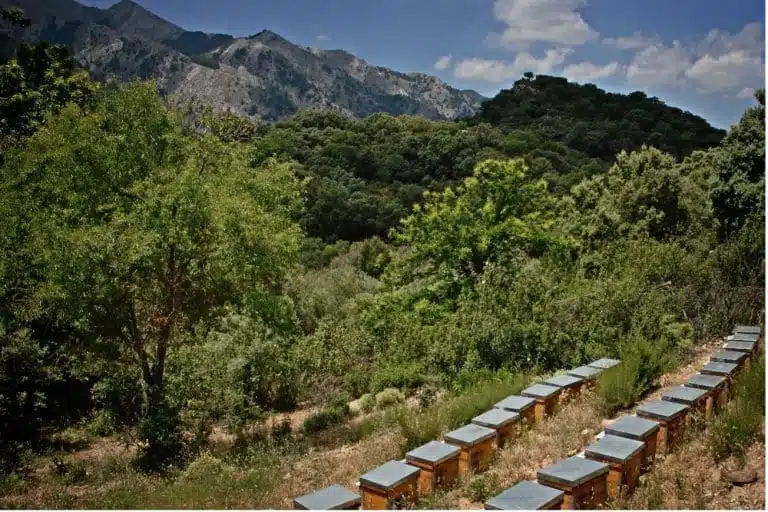
Heat and lack of rain can bring Mediterranean lowland flowering to a standstill. Summer crops then depend on mountains, irrigated land and a small number of cultivations. Each poses a different practical question: water at sunflower sites, a balanced pollen supply under eucalyptus, and the weather needed for an oak honeydew flow.
Summer honey flows at a glance
| Forage source | When | Where | Indicative pollen reference |
|---|---|---|---|
| Sunflower | June–July in Cádiz, Huelva and Seville; roughly a month later in the two Castile regions | Large arable areas in southern and central Spain | 45% |
| River red gum E. camaldulensis | July | Extremadura and especially Andalusia | 83% in the cited trade reference; 70% under the Miel de Galicia PGI |
| Tasmanian blue gum E. globulus | Winter in Huelva; later in the north | Huelva and the northern, Cantabrian coast | Overlapping flowers make a monofloral crop less common in the north. |
| Heathers | Summer for the Atlantic species | North-western and northern Iberia | About 35% in the reference used here |
| Bramble | Early summer | Moist areas across the peninsula | About 45% |
| Sweet chestnut | Summer | North-west, Cantabrian coast and mountain areas of Cáceres, Salamanca, Cádiz, Granada and Catalonia | 85% in a cited European reference; 70–75% under some Spanish PDO and PGI specifications |
| Mountain forage | Summer | Montane vegetation, roughly 600–1,800 m in the landscape profile | Multifloral; no single-flower percentage |
| Honeydew | From around mid-August in the regions described | Holm oak, other oaks and chestnut | Depends on light, moisture and other site conditions |
Water and a field guide for the summer flows


Check water access before moving colonies to a dry summer site. The Spanish-language guide helps compare the characteristics of the resulting honeys.
Compare flowering with colony condition
- Record the water supply, weather and incoming pollen.
- Check available super space during brief summer flows.
Mediterranean summers are generally hot and dry. Flowers often become scarce in lowland areas, but cooler, moister mountain sites can still sustain a flow. Irrigated areas and particular crops provide other opportunities.
The following sources can yield a summer crop.
Sunflower
Sunflower comes originally from the Americas and is grown for seed and oil. It used to be a particularly dependable source of Spanish honey. Some shorter-cycle modern varieties yield less nectar, so the colony needs a large foraging population ready at the start of the flow.
As in other extensive monocultures, colonies may have little choice of pollen. In wetter years flowering field margins can provide a more varied diet and support brood rearing.
The Spanish source describes a crop occupying more than 700,000 ha in the period discussed. The sown area varies from year to year.

The sunflower head contains many small florets. Flowering moves inwards from the outside of the head. Individual disc florets first release pollen and then become receptive. Variety and accumulated warmth after sowing influence the start of flowering. It can begin in June or July in Cádiz, Huelva and Seville, and roughly a month later in Castilla-La Mancha and Castilla y León.
At these temperatures a reliable water source matters. Bees use water to cool the brood area and regulate humidity. If the colonies cannot reach a dependable source, install suitable drinkers and plan how often they must be refilled.

Sunflower honey is pale with orange tones, a floral aroma and a persistent sweet taste. It can set quickly into coarse crystals. A reference of about 45% sunflower pollen is common. Use the applicable guide or protected specification, and compare the count with the lot’s taste, chemistry and harvest information.

Eucalyptus
Eucalypts are Australian members of the myrtle family. Spanish plantations have been used for pulp and timber, and the rules for new planting vary by territory. Brazil, Argentina and Uruguay are also important producers of eucalyptus honey.
River red gum (Eucalyptus camaldulensis) is the Spanish summer eucalyptus in this guide. It commonly flowers around July. Its bark sheds in reddish-brown strips, and its flowers and fruit are small. Stands occur in Extremadura and especially Andalusia.
Tasmanian blue gum (Eucalyptus globulus), locally known as white or winter eucalyptus, has pale bark and larger flowers and fruit. In Huelva it flowers in winter and in a favourable year can support a crop or a major colony build-up. Along the Cantabrian coast flowering is later and overlaps other sources.
Large single-species plantations can produce honeys with a high proportion of eucalyptus pollen. The trade reference cited here is 83% for some imported samples. Spanish stands often have flowering margins. The Miel de Galicia PGI specification uses 70% for its eucalyptus honey.
Pollen from some eucalyptus sources can be low in isoleucine, an essential amino acid. Where eucalyptus dominates for a long time, check pollen variety and brood condition, especially if the colony arrived without other reserves. In some Australian and Uruguayan operations, beekeepers supplement an identified shortfall or move the colonies when the crop finishes.

A native member of the same family, common myrtle, flowers in early summer. It can form useful stands in parts of Andalusia.
Heathers
The heathers in this section belong to the genus Erica. Other bee forage in the family includes bearberry (Arctostaphylos uva-ursi), ling (Calluna vulgaris) and strawberry tree (Arbutus unedo). Cultivated blueberries and cranberries are related. Monitor nutrition when colonies spend a pollination contract on a large area with limited alternative pollen.
Heathers are shrubs with white, pink or violet bell-shaped flowers. The petals are largely fused. Their narrow leaves often have rolled margins that reduce water loss, and many species grow on acidic or siliceous soils.
For an Iberian beekeeper it helps to distinguish two broad groups.
- Atlantic heathers grow through the north-west and the northern belt, where summers are milder and wetter. Relevant species include E. arborea, E. australis, E. ciliaris, E. cinerea, E. tetralix and E. vagans. The summer-flowering stands provide much of the market’s Spanish heather honey.
- Mediterranean species include tree heath (E. arborea) in cool, moist ravines, Portuguese heath (E. lusitanica), Mediterranean winter heath (E. multiflora) and E. umbellata. Most of the group described here contribute in spring, apart from winter-flowering E. multiflora. They often help colony development more than they yield a separate crop.
Several species are particularly worth learning to recognise.
- Spanish heath (Erica australis) has reddish stems and can grow on exposed siliceous ground. The leaf edges are strongly rolled under. Its pink or reddish bell-shaped flowers have stamens that almost reach the opening.

- Dorset heath (E. ciliaris) favours wetter acidic soils in Atlantic parts of western Iberia. The deep pink to purple tubular flowers bulge on one side, with the petal tips turning outward and the stamens remaining inside.

- Bell heather (E. cinerea) occurs on siliceous or strongly leached soils in northern Iberia, including comparatively dry sites. It has violet-pink flowers, short stamens, a projecting style and small glossy leaves arranged in threes.

- Cornish heath (E. vagans) has long clusters of rounded pink flowers and projecting anthers. It grows on lime-poor or leached ground in the north. Its honey can be very dark and bitter and sometimes crystallises in the comb.

Heather honeys are often dark, with strong earthy, humus-like aromas and bitter or salty notes. Around 35% heather pollen is an indicative reference in this article. Individual guides and protected specifications should be checked for the particular claim.
Brambles
Brambles are thorny Rubus shrubs in the rose family. They spread readily in damp areas throughout Iberia. One widespread species is Rubus ulmifolius.

Flowering begins in early summer. The flowers form clusters, have five white or pink petals and develop into blackberries. Leaves usually have three or five leaflets with hairs underneath.

Bramble can supply both a pollen crop and abundant nectar. The pollen pellets tend to be grey-green. The honey is amber and fruity, with a little acidity, a characteristic also found in other rose-family honeys. About 45% bramble pollen is a common reference for a monofloral profile.
Bramble can also contribute to mountain honey alongside heather, chestnut and oak honeydew.
Sweet chestnut
Sweet chestnut (Castanea sativa) has been cultivated for centuries for nuts and timber. It grows in north-western and Cantabrian Spain and in mountain areas of Cáceres, Salamanca, Cádiz, Granada and Catalonia. It belongs to the beech family with holm oak, cork oak and other oaks.
The long male catkins may reach about 20 cm. The less conspicuous female flowers occur towards the base of the flowering structures. Leaves are long with toothed margins, and the developing nuts are enclosed in spiny burs.
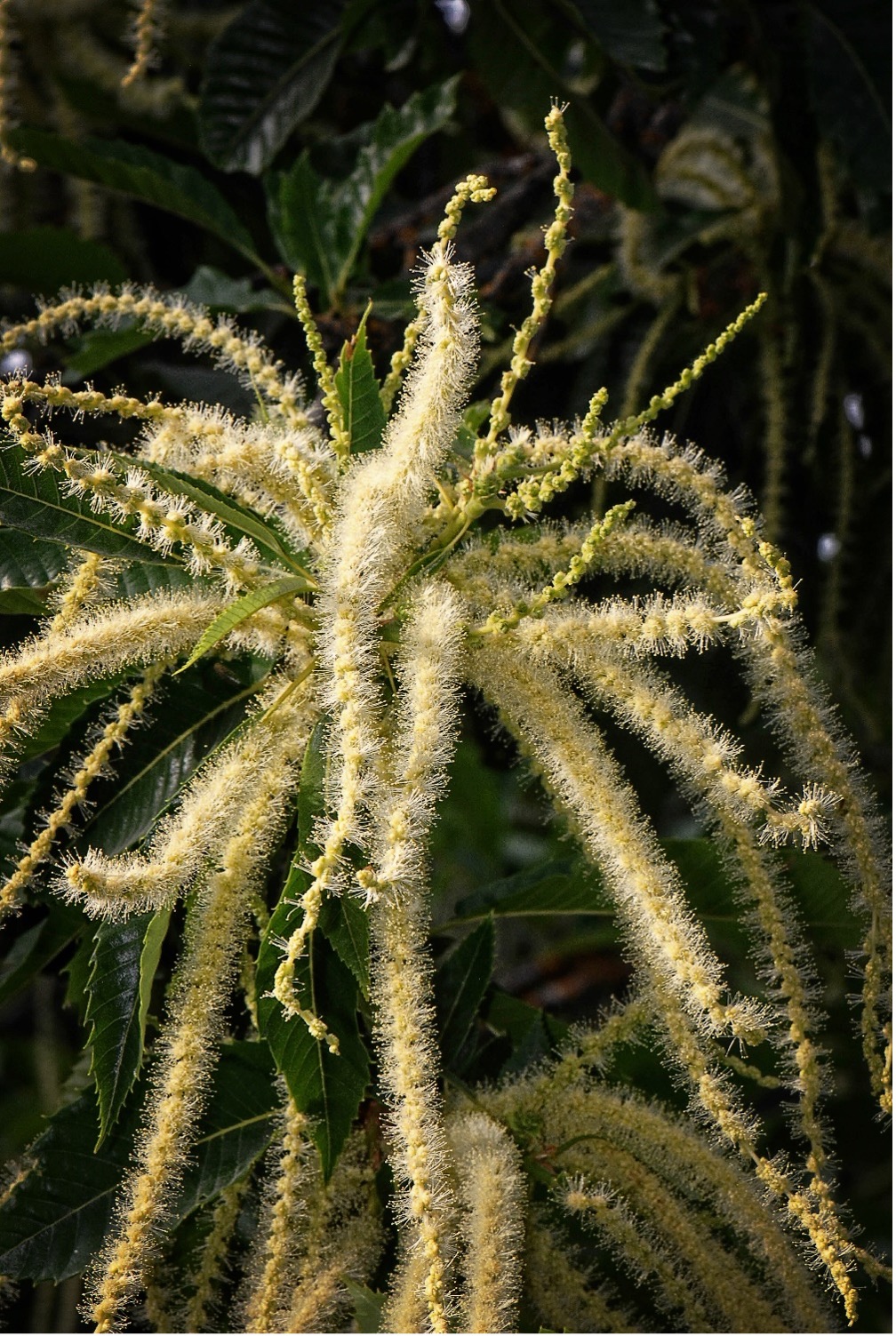
Where other plants flower alongside it, chestnut can be an important component of mountain honey.
Chestnut supplies abundant nectar and pollen and can also contribute non-floral sugary secretions. Its honey ranges from amber to dark amber, often with dry-wood aromas and salty or bitter notes. The reference quoted for extensive European chestnut woods is 85% pollen. Some Spanish protected specifications use 70% or 75%. Check the specification applying to the particular lot.
Mountain forage
The montane landscape described here lies roughly 600–1,800 m above sea level, with little cultivated land. Separately, the EU’s optional quality term “mountain product” has specific conditions. For honey, the bees must have gathered nectar and pollen in mountain areas as defined for the scheme.
This summer honey is multifloral. Depending on the site the bees may work heathers, sweet chestnut, brambles, meadow and scrub legumes, with smaller contributions from thyme, rockroses, thistles or other daisy-family plants.

Nearby smallholdings or naturalised crops can leave traces of sainfoin, sunflower or fruit-tree pollen in the same harvest.
The honeys are often amber to dark amber, with a strong, persistent aroma and sweetness accompanied by some salty notes.
Honeydew
Honeydew honey comes mainly from the sweet excretions of sap-feeding insects on living plants, or from secretions of living plant parts. In Iberia, holm oak, other oaks and chestnut are important sources. Fir and pine can also contribute under suitable conditions.
In the Spanish areas described, honeydew can become available from around mid-August, with bright weather and adequate moisture. Summer storms may provide water, while cool nights on north-facing slopes and at higher elevations can also help. A particular tree or season does not guarantee a flow.

The deposit can start pale and darken over time. Its sugars, nitrogen-containing compounds and minerals contribute to the eventual colour.
In very dry weather, the material can become too thick for the bees to collect.
Under Atlantic conditions, and occasionally in cooler Iberian sites, aphids and other sap-feeding insects can provide significant honeydew flows on fir, pine and other trees. The bees collect the sugary liquid excreted by the insects.
Iberian honeydew honeys are often dark amber to nearly black, slow to crystallise, and malty or reminiscent of toasted grain. Sweetness may be accompanied by a persistent salty note. They are generally richer in minerals than many blossom honeys.
Spain’s Royal Decree 1049/2003 gives a general minimum conductivity of 0.8 mS/cm for honeydew and chestnut honey and a general maximum of 0.8 for blossom honey, with named exceptions. Chestnut alone shows why a high reading cannot identify honeydew. Laboratories assess conductivity, pollen, honeydew elements and sensory findings together. A commercial reference of 0.9 mS/cm sometimes used for oak honeydew is separate from the general legal criterion.
Material on leaves and branches can pick up fungal fragments, microscopic algae and other particles counted as honeydew elements (HDEs). In humid Atlantic climates these can be conspicuous in a honey analysis. Dry Mediterranean samples may have few or none, which makes the overall pollen spectrum, conductivity and sensory evidence particularly important.
Where oak honeydew overlaps with heather, bramble and other flowers, the harvest can have both nectar and honeydew characteristics. The market often calls this forest honey. The Apinevada and Pajuelo guide describes a conductivity band of about 0.7–0.9 mS/cm alongside an appropriate pollen spectrum.
Frequently asked questions
Which honeys are harvested in Spain in summer?
Common examples are sunflower, river red gum, heather, bramble and chestnut honey, mixed mountain honey and honeydew from holm oak, other oaks and chestnut. Irrigation and altitude can sustain flows when dry lowland sites stop flowering.
How much pollen makes a honey monofloral?
There is no universal percentage. The reference depends on the plant and any applicable protected specification. Examples here include around 35% for heather, 45% for sunflower or bramble and higher values for eucalyptus or chestnut. Combine pollen with the sensory profile and physicochemical evidence.
Why do modern sunflower fields sometimes yield less honey?
Some short-cycle varieties produce less nectar than older cultivars. Conditions and irrigation also affect the flow. A strong foraging population must be ready when the crop begins.
Why provide water during sunflower flowering?
The flow coincides with hot weather. Colonies use water to cool the nest and maintain the humidity needed by developing brood. Provide a dependable source if there is none nearby.
What nutritional problem can arise on eucalyptus?
Some eucalyptus pollens can be low in isoleucine. A colony relying heavily on one source for an extended period may benefit from alternative forage or a suitable supplement if a real shortage is identified.
What is honeydew honey?
It comes mainly from sweet excretions of sap-feeding insects or from secretions of living plant parts. In the areas considered here, oaks and chestnut can provide a flow from mid-August when weather and moisture allow.
What does mountain honey mean?
In this forage guide it refers to a mixed summer harvest from montane vegetation, often heather, bramble, chestnut and legumes. The legal term “mountain product” has its own criteria for where the bees forage.
Further reading
- Early spring forage and the main spring honey flows (in Spanish).
- Bee forage plants (in Spanish) and their identifying features.
- Choosing an apiary site to make the most of local flowering.
- Protein supplementation when a crop offers limited pollen variety.


