

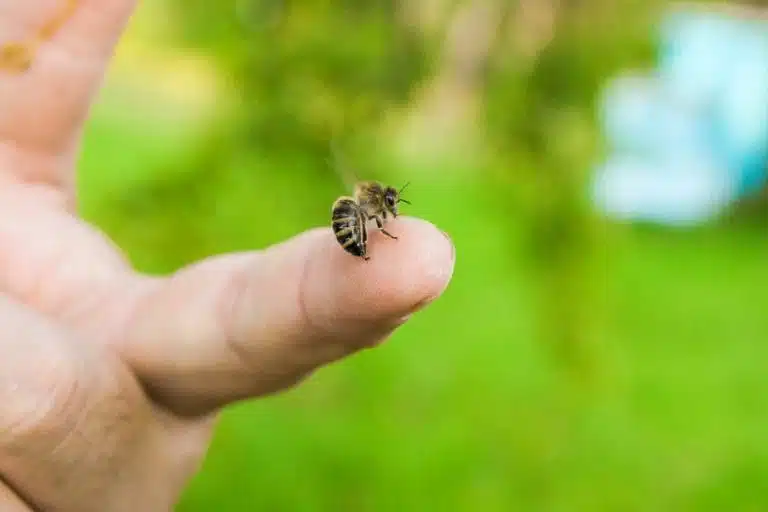
Workers defend the queen, brood and food stores. Only female honey bees, the workers and the queen, have a sting, which evolved from an egg-laying organ. A drone cannot sting. A worker foraging on a flower is unlikely to sting unless trapped or pressed, but a colony may react defensively near its entrance.
Protective clothing for hive inspections


The ventilated AIR suit includes a fencing veil. Gloves and boots are chosen separately. Correct fit and intact closures help reduce exposure to stings.
Check the closures before opening the hive
- Check the veil, zip, cuffs and overlaps with gloves and boots.
- Plan the inspection and keep a clear route away from the hive.
Anyone working regularly with honey bees is likely to be stung eventually. Recognising defensive behaviour, wearing suitable protection and knowing how to respond make the risk easier to manage.
How an egg-laying organ became a sting
The sting is a modified ovipositor. In the evolutionary ancestors of bees and wasps this organ laid eggs. In stinging species it became part of a defensive apparatus, which is why only females possess it. The drawing shows the worker’s sting and associated gland and sac.

Which honey bees have a sting?

Only workers and queens have a sting.
A worker’s backward-facing barbs can lodge in elastic mammalian skin. When she pulls away, the sting apparatus can tear free and the injury usually kills her. Against another insect she can often withdraw the sting and survive.

A queen’s sting is much less strongly barbed. She usually uses it against rival queens and can generally withdraw it.
A drone has neither a sting nor the associated apparatus.
Why do honey bees sting?
A bee on a flower is usually occupied with foraging. Defensive behaviour is concentrated around the colony, where guards watch the entrance and respond to disturbances that could threaten brood or food stores.
Sharp movements, knocking the hive, standing across the flight line, strong scents and dark clothing can draw defensive attention. Weather, a nectar dearth, robbing or queenlessness can also change a colony’s response. Wear light-coloured protection, work from the side, avoid blowing on the frames and move deliberately.
Bees respond to movements, breath and alarm signals. They do not need to detect a person’s fear to react to a swipe or a sudden approach. Alarm signalling helps explain why workers may focus on an area after a sting. If stung, move calmly away from the hive.
One component of the alarm scent smells rather like banana. The smell is memorable, and so is a sting in an unprotected spot.
Colony defence helps protect a concentrated store of food and vulnerable brood from animals that would otherwise exploit them.
Why a swarm often seems calmer
A newly departed swarm has no established brood nest or honey stores to defend. Many workers have taken on honey before leaving. The clustered bees are looking for a new nest site, such as a tree cavity.
Photographs sometimes show a beekeeper holding a swarm with bare hands. A swarm can still sting. Keep your distance and contact an experienced beekeeper if one settles where people pass.

Genetics, selection and temperament
Genetics affects defensiveness alongside colony condition, brood, stores, weather and handling. Colonies can behave quite differently within one subspecies or breeding line. Judge temperament from repeated observations under comparable conditions.
The Iberian honey bee, Apis mellifera iberiensis, predominates in Spain. Genetic studies describe substantial diversity and a geographical gradient involving mitochondrial lineages A and M. That pattern of variation is a poor basis for predicting how every colony in a region will behave.
A photograph of a person covered with bees says little about how another colony will react. Deliberately exposing bare skin to large numbers of bees carries a serious risk.

Stingless bees of the tribe Meliponini live in tropical and subtropical parts of the Americas, Africa, Asia and Australia. The name meliponas is especially associated with American species. They lack a functioning sting, but some defend their nests by biting or using sticky substances.
How beekeepers read their bees
A colony need not recognise its owner for an experienced beekeeper to work it calmly. Much of the apparent rapport comes from noticing small changes in sound, movement and behaviour and adjusting the inspection.
An experienced beekeeper avoids blocking the flight line and handles combs without sudden knocks. Even skilled, gentle handling cannot remove every risk of a sting.
Plan the inspection, use cool smoke appropriately and wear suitable protective clothing. Our guide explains how to choose a beekeeping suit and veil.
Repeated stings do not guarantee immunity. Beekeepers have a higher risk of systemic reactions than less-exposed groups. A 2024 systematic review found that roughly one in four beekeepers across the studies reported a systemic reaction at some point, with considerable variation. Anyone who has experienced symptoms away from the sting site should seek medical assessment. The EAACI guideline describes when a specialist may recommend venom immunotherapy.

Experience improves handling. Protective clothing, observation and a planned way to step away still matter.

How the body responds to a bee sting
Bee venom contains a mixture of substances that can produce pain and local inflammation. Pain and swelling at the sting site are different from a systemic allergy. Honey bee venom allergens can trigger an allergic reaction in a sensitised person.
Research on sting-related pain helps explain local tenderness and sensitivity. For practical care, see the NHS guidance on insect stings.
Several components of the sting and the body’s own response contribute to pain and swelling. The reaction can differ markedly from one person to another.

A sting left in the skin can continue delivering venom. A controlled study of sting removal found that delay mattered. Remove the sting promptly, for example by brushing or scraping it sideways with a fingernail or the edge of a card.
The response depends on the person, the site and number of stings, and previous sensitisation.
Types of reaction
- Local reaction. Pain, redness, itching and some swelling around the sting are common and usually improve over a few days.
- Large local reaction. Swelling may extend over more than 10 cm and increase over a day or two. A sting on a finger can swell the whole hand. Seek medical advice if symptoms worsen or you are concerned.
- Systemic allergic reaction. Symptoms appear away from the sting, for example widespread hives. Tongue or throat swelling, difficulty breathing, severe dizziness or collapse can indicate anaphylaxis and require emergency help.
- Multiple stings. Many stings can cause serious illness even in someone with no known allergy. Move away and seek urgent medical advice.
What to do after a bee sting
- Remove a retained sting promptly. Brush or scrape it sideways without squeezing the venom sac.
- Move away from the hive to reduce the chance of further stings.
- Wash the area with soap and water and apply a cold pack wrapped in a cloth.
- If anaphylaxis is suspected, use your prescribed adrenaline auto-injector immediately according to your action plan. Call the emergency services straight away (112 in Spain and the EU) and say it may be anaphylaxis. Follow the dispatcher’s instructions.
- After a generalised reaction, ask your doctor about referral to an allergy specialist, even if the symptoms have settled.
Reactions can change over time. Previous stings without a systemic reaction do not guarantee the same response next time.
How dangerous are stings? What the figures show
Fatal reactions are uncommon, but they do occur. Xesús Feás analysed Spanish death certificates and identified 78 deaths between 1999 and 2018 coded for contact with hornets, wasps or bees, about four per year. The reported average was 0.09 per million people per year in Spain, compared with 0.26 in a wider European study.
| Indicator | Spain, 1999–2018 | Europe, 32 countries, 1994–2016 |
|---|---|---|
| Recorded deaths | 78 | 1.691 |
| Average annual rate per million people | 0.09 | 0.26 |
| Men | 85.9% | 78.1% |
| Most frequent age group | 65 or older (52.6%) | 25–64 (66.7%) |
| Location unspecified | 67.9% | 44.2% |
Code X23 groups bees, wasps and hornets together, so these figures cannot tell us how many deaths were caused by honey bees alone. Many records also lack a precise location.
Men accounted for most cases. In the European data the largest age group was 25–64, while the Spanish data had a larger share aged 65 or older. Half of the Spanish deaths occurred in July and August. The authors of the European study discuss occupational exposure, including beekeeping, farming, forestry and outdoor utility work.
In a series from north-western Iberia cited by the authors, the yellow-legged hornet accounted for about three in four recent cases of Hymenoptera anaphylaxis. Galicia recorded an X23 death rate of 2.22 per million in 2018, a single-year figure during the hornet’s expansion. Learn how to identify the yellow-legged hornet, keep away from suspected nests and leave their management to the appropriate service.
Frequently asked questions
Can every bee sting?
In honey bees, workers and queens have stings and drones do not. Stingless bees lack a functioning sting. Among solitary bees, females of many species can sting but rarely do so unless trapped or handled.
Can a male honey bee sting?
No. The drone has no sting. The sting evolved from an egg-laying organ and is present only in females.
Will a bee sting if I leave it alone?
A forager on a flower is unlikely to sting unless trapped in clothing, stepped on or pressed. At a hive entrance, guards can respond to someone crossing the flight line or disturbing the colony without touching a bee.
Why does a worker sting if she may die?
Stinging is a defensive response. A worker can die if her barbed sting lodges in elastic skin and tears away, but she can often withdraw it from another insect. Defending the brood and queen benefits the colony.
Can bees smell fear?
There is no evidence that a honey bee recognises human fear as such. It does react to disturbances, fast movements, breath close to the hive and alarm signals from other bees.
Can honey bees sting at night?
Yes. Foragers are generally inside after dark, but bees disturbed at the hive can crawl onto clothing or towards a light and sting. Anyone working around hives after dark still needs suitable protection.
Do honey bees sting or bite?
Their sting is their main defence against a large animal. They also have mandibles for working wax, cleaning and holding objects. A bite by a honey bee is rarely significant on human skin.
What if I am stung many times?
Get away from the bees, remove retained stings promptly and seek urgent medical advice. If breathing becomes difficult, the tongue or throat swells or you feel faint, use prescribed emergency adrenaline as directed and call the emergency services immediately.
Further reading
- Choosing protective clothing for work in the apiary.
- Yellow-legged hornets: identification and apiary precautions.
- First aid for insect bites and stings, from the NHS.
- Mistakes to avoid when starting beekeeping.
If someone develops signs of a serious allergic reaction after a sting, call the emergency services immediately. In Spain and across the EU, call 112.


