

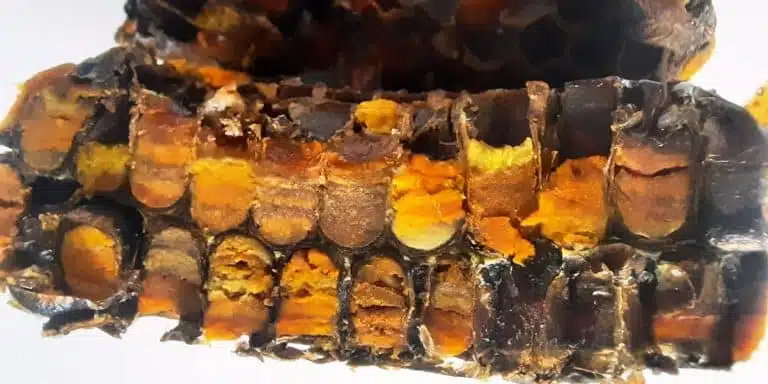
Honey and pollen are the natural diet of bees, but food brought in from an unknown colony comes with a history you cannot see. Disease and residues from hive treatments are the main concerns. For a colony that needs supplementary feed, choose a traceable, suitable product made from ingredients that have not been in contact with other colonies.
How the risks differ between honey, pollen and wax
| Honey | Pollen | Wax | |
|---|---|---|---|
| Composition | Mostly sugars in water | Contains some fat | A lipid-rich material |
| Acaricide residues | Generally lower for fat-soluble substances | Can be present, including after contact with wax | Often the highest concentrations of persistent fat-soluble substances |
| Disease concerns | May carry agents of bee disease, even if it looks normal | Trapped pollen can be contaminated, including in colonies with chalkbrood | Comb can retain contamination from earlier use |
| Concern when offered as feed | Depends on origin, age and history | Particular care is needed with both source and storage | — |
Options for replacing a missing feed source


Apifonda supplies carbohydrate. Ultra Bee is a ready-to-use protein patty without natural pollen. Choose after checking stores, incoming pollen, health and feed condition.
Identify the gap before feeding
- Distinguish an energy shortage, a pollen shortage and a colony health problem.
- Record the product, lot and consumption for the next inspection.
In this guide
- The natural diet and what each food provides
- Disease risks when food moves between colonies
- Residues from hive treatments
- How storage affects the feed
- Lower-risk alternatives
The natural diet of honey bees
Colonies need both carbohydrate and pollen. The Spanish article gives illustrative diets of about 80% honey and 20% pollen during brood rearing, and 90% and 10% during a cold winter with little brood. These proportions vary with brood, forage, temperature and colony size.
Honey supplies mainly sugars, often about four-fifths of its mass. Bees use them for heat and movement and as building blocks for other compounds, including chitin and energy reserves.
Pollen supplies carbohydrates, proteins, lipids, vitamins and other micronutrients. The composition varies widely by plant. Rough figures in the source include around 40% sugars and 20% protein in some pollens.

Both foods may also contain material introduced during foraging or through previous management. The history of the colony is therefore relevant when anyone proposes using them as feed.
Disease risks
Surveys have detected bee pathogens even where there were no obvious clinical signs. The studies by Antúnez and colleagues in Uruguay and Garrido and colleagues in Spain illustrate why appearance alone is a poor guide to health status. Detection in a survey is different from diagnosing disease in an individual hive.
Bees have several natural defences, including antimicrobial peptides produced by the immune system. These defences support bee health but cannot establish that a particular batch of feed is safe.
Nurse bees need adequate amino acids and other nutrients. Different plants provide different amino-acid profiles, so diversity of pollen supports the bees’ ability to produce proteins, including antimicrobial peptides.
Poor condition may accompany brood diseases such as European foulbrood (in Spanish) or chalkbrood, adult-bee problems such as nosemosis, or American foulbrood. If you suspect a serious brood disease, obtain local bee health advice promptly.
Individual immune responses, including antimicrobial peptides, work alongside hygienic behaviour at colony level. Workers can detect and remove abnormal brood. Neither behaviour nor the apparent strength of a donor colony provides a health guarantee for its stores.
Bees kept in neighbouring hives may drift or rob. Sound apiary hygiene includes keeping materials from suspect colonies separate and maintaining records of where food and comb came from.
Trapped pollen from a colony with chalkbrood can be contaminated even after visible debris is removed. Sorting the pellets by sight does not make such pollen suitable for feeding.
Avoid offering honey or pollen of unknown origin or uncertain health status to colonies.
Residues from hive treatments
Honey and pollen can contain traces of substances used in or around the hive. Certain fat-soluble acaricides accumulate particularly readily in wax and can also occur in pollen. Refer to the active substance and the treatment history rather than applying the same assumption to every product.

Pollen collected at the entrance is not automatically free from residues. Bees and the equipment they contact can carry traces of substances used in the colony or encountered while foraging.
Residues in wax can transfer to the pollen stored next to it. Research cited in the source examines effects on brood and adult bees. The studies by Murcia and colleagues, Cushman and colleagues and Orantes and colleagues concern particular exposures and colonies. Their findings are reasons to keep treatment and comb records.
Time in contact with wax is one factor affecting exposure. A date alone cannot establish that stored pollen is suitable for feeding.
Whether offered as entrance-trapped pollen or as bee bread, its source, treatment history and storage conditions matter.
How storage affects honey and pollen
| Food | Time frame discussed in the source | What changes |
|---|---|---|
| Honey | Several years; four to five years is an example of very old stock | HMF rises with heating and age. There is no single age or HMF reading that makes an unknown batch suitable for feeding bees. |
| Dried pollen | About a year in the cited comparison | Nutritional quality can deteriorate substantially during storage. |
| Bee bread in the comb | Changes can become apparent within a few months. | Storage temperature and the history of the comb affect the condition of the pollen. |
Old or reheated honey is a poor choice for bees. Heating promotes formation of HMF, and the literature does not identify a universal safe cut-off for all diets and conditions. Our article on the risks of overheating homemade invert syrup explains the practical implications.
Quality can decline sooner in pollen. The source discusses loss of nitrogen-containing nutrients during dry storage and changes in pollen kept in the warm hive. See the work cited from Somerville and Vásquez and colleagues. Condition and storage history matter as well as age.

Choosing a feed
Honey or pollen from colonies with an unknown health and Varroa-treatment history can expose the recipient colony to avoidable risks.
Choose a suitable bee feed with traceable ingredients. Match it to the actual shortage: carbohydrate when energy stores are low and a suitable protein feed when pollen is deficient. Our guide to using Apipasta and similar feeds discusses how format and season affect placement and access.

Frequently asked questions
Can I feed honey to my bees?
Do not give them honey of unknown origin. Check the source colony’s health and treatment history, together with the age and condition of the honey. A suitable commercial carbohydrate feed avoids the particular disease risks of reusing unknown honey.
Is it risky to feed collected pollen?
It can be. Pollen can carry disease contamination and residues. Its lipid content and contact with wax matter, and there is no reliable visual test for either problem.
Why is pollen from a colony with chalkbrood a concern?
The collected pollen can remain contaminated after visible debris is removed. Keep suspect material out of feed and seek advice about the affected colony.
How long does honey keep as bee feed?
There is no universal safe age. Old or overheated honey can have high HMF, and a recently collected batch of uncertain origin may still pose a disease risk. Choose feed whose composition and history you can verify.
How long does stored pollen remain suitable?
Dried pollen and bee bread both change with time. The studies discussed in the article report substantial nutrient changes during a year of dry storage and within months in the warm hive. Age alone does not establish suitability.
What does nutrition have to do with bee disease?
A varied pollen supply provides amino acids and micronutrients needed by nurse bees and the immune system. Good nutrition supports resilience, while signs of disease still require the appropriate investigation.
What can I use instead?
Use a traceable feed suited to the colony’s condition and season. Carbohydrate and protein meet different needs. Confirm what is lacking and choose a format the bees can reach.
Further reading
- Honey bee nutrition and when to supplement a colony.
- Protein supplementation when natural pollen is insufficient.
- Dark pollen and its quality (in Spanish) when collecting bee pollen.
- Chalkbrood and the signs to look for on the comb.
Keep unknown-origin honey and pollen out of bee feed. If you suspect a notifiable disease, contact the competent veterinary or bee health authority.


