

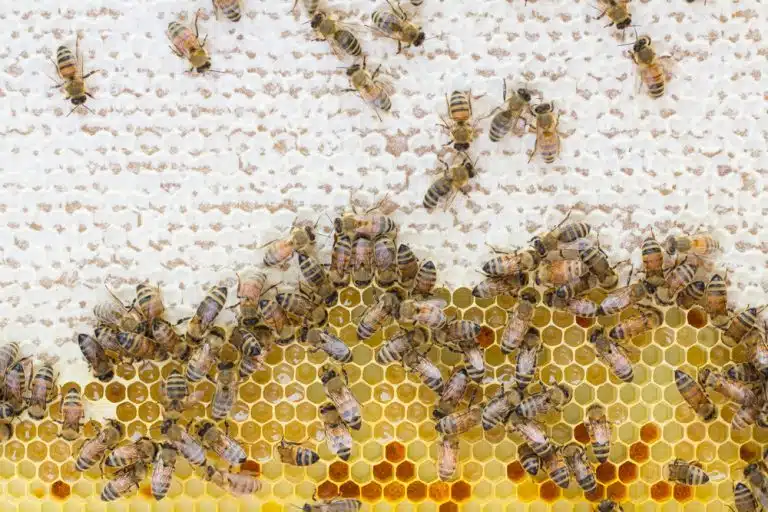
A load of nectar can be concentrated into honey in one to three days if the weather is warm and the air is dry. A whole comb takes a good deal longer: between one and two weeks from the nectar coming in to the bees capping it. There is no number of days that holds for every hive, so you decide the harvest by looking at the frame and measuring the moisture, not by counting days.
To check that the honey is ripe
 LED-RHB-90 honey refractometer with LED light
 Refractometer ATAGO Master-Honey/Bx
 Honey Refractometer Calibration Set
The capping is a guide and the refractometer measures. Both refractometers read the water in honey on a dedicated scale; the calibration set does not include a refractometer.
Measure several cells, not just one
- Take honey from open and capped cells on several frames and decide on the highest reading.
- Record the moisture of each harvest alongside the batch.
The timing depends on how much water the nectar carries, the strength of the colony and the weather. A midsummer honey from inland areas ripens quickly and comes off at 16 % moisture or less; a rosemary honey in a wet spring, or a strawberry tree honey in autumn, is a much closer call. This guide goes through how long each stage takes, what it depends on and how to check that the honey is ready before you take the supers to the extractor.
How long does honey take to ripen in the hive?
The answer changes with what you measure. How long a drop of nectar takes to lose water is one thing; how long a frame takes to be full, dry and sealed is another.
A load of nectar: one to three days
Nectar usually reaches the hive at 65-70 % water, although it varies a great deal from one plant to another. Some of that is lost on the way home: in a trial on macadamia, the foragers’ crops held twice the sugar concentration of the nectar in the flower. The forager hands it over to the house bees, which push it out and draw it back in on the tongue again and again to expose it to the air, and then spread it in small drops over many cells. The fanning bees do the rest. The classic work of O. W. Park, from the 1920s and 1930s, and the manuals that draw on it give between one and three days for that nectar to reach the concentration of honey when the weather helps.
A full comb: one to two weeks
In a real comb the nectar keeps coming in for as long as the flow lasts, and the bees mix the contents of the cells and move them around. A team from Agroscope and the University of Bern followed that process by tomography in free-flying colonies fed sugar syrups. Between the first and the second day the concentration rose by an average of 10.6 points. Between day 5 and day 12 the rate fell to 1.8 points a day, and the first cappings did not appear until day 12.
The same study saw two things that explain why the frame takes longer than the drop. Many cells are emptied partway through: what the bees took out was around 64 % sugars and what they put into another cell was about 77 %. Honey also goes on losing water once capping has begun. Freshly sealed cells averaged 85 % sugars, which is the concentration of finished honey.
| What is measured | Approximate time | What happens |
|---|---|---|
| A load of nectar | 1 to 3 days in warm weather with dry air | The bees work it on the tongue, spread it in drops and fan |
| The first cappings | Between day 5 and day 12 in the two trials cited | Fast drying at first and slow afterwards; honey moved from cell to cell |
| The capped frame | 1 to 2 weeks, longer in damp weather or on very heavy flows | The honey finishes drying and the bees seal it with wax |
One field study puts figures on the whole process. On an oilseed rape flow in Zhejiang (China) in 2019, five strong colonies started capping on the fifth day and finished on the fourteenth. What is interesting is the moisture of the honey at each point:
| Day | Capped area | Water in the honey |
|---|---|---|
| 5 | 2 % | 21 % |
| 7 | 22 % | 19.9 % |
| 10 | 69 % | 20 % |
| 12 | 85 % | 19.2 % |
| 14 | 100 % | 18.5 % |
With more than two thirds of the comb sealed, that honey was still at 20 % water, and with the whole comb capped it ended up at 18.5 %. This is oilseed rape in a humid climate, but it shows why it pays to measure even a frame that looks ready.
What changes in the nectar as it ripens
Ripening means losing water, but it is also chemical work. As they pass the nectar from one to another, the bees add enzymes from their glands:
- Invertase splits the sucrose in the nectar into glucose and fructose, the two main sugars in honey.
- Glucose oxidase produces gluconic acid and hydrogen peroxide. That is where much of honey’s acidity comes from, and much of its defence against microbes while it is still watery.
- Diastase is the enzyme later measured in the laboratory as an indicator of freshness: the Spanish honey standard (Royal Decree 1049/2003, which transposes EU Directive 2001/110/EC) requires at least 8 on the Schade scale.
That part takes time and cannot be speeded up from outside. This is why honey harvested in the middle of a honey flow can give the right moisture on the refractometer and still have too much sucrose left unsplit. Antonio Gómez Pajuelo warns of this for rosemary in very good years: with flows that fast, some batches exceed the 5 % sucrose that the standard allows as a general rule.
Factors that affect honey ripening
How do humidity and temperature affect ripening?
Warm air holds more water vapour, and the bees keep the brood nest at 33-36 °C and fan to renew the air. With long days, heat and dry air, the hive dries nectar quickly. In cold, rain or fog, the air coming in is already laden with water and drying takes longer.
Air humidity also sets a limit. Honey is hygroscopic: if the air around it is more humid than its equilibrium point, it stops drying and starts to absorb water. For a clover honey the equilibrium looks like this:
| Relative humidity of the air | Equilibrium moisture of the honey | What happens to ripe honey left exposed |
|---|---|---|
| 50 % | 15.9 % | Goes on losing water |
| 55 % | 16.8 % | Stays dry |
| 60 % | 18.3 % | Equilibrium point of a normal honey |
| 65 % | 20.9 % | Absorbs water until it passes the legal limit of 20 % |
| 70 % | 24.2 % | Takes up moisture quickly, especially at the surface |
| 80 % | 33.1 % | The top layer becomes diluted |
Two practical consequences follow from this table. First: above 60 % relative humidity, honey that is ripe but not yet capped gains water, which is why the bees are in a hurry to seal it. The authors of the Swiss study describe it as a race against dilution. Second: the same limit applies to the beekeeper who leaves supers, buckets or drums open in a damp room.
How long does honey take to reach the right moisture?
It depends on the flow, the weather, the free space in the supers and the strength of the colony. In Spain honeys usually come off at 17-18 % moisture, but the picture varies a great deal from season to season:
- Midsummer. Nectars come in more concentrated, it is hot for many hours and the air is dry. Honey ripens in a few days, sits at around 16 %, and batches at 14 % are not unusual.
- Early spring (rosemary, orange blossom). More watery nectars, short days and high relative humidity, worse still in a wet year. Give the hive more time and always measure.
- Late autumn (strawberry tree, ling heather). The bees may cap at 20 % moisture, and that honey sometimes ferments in the comb itself.
The colony and the flow matter too. A strong hive, with plenty of house bees and room to spare in the supers, spreads the nectar in a thin layer and dries it sooner. A colony short of bees, or a flow so heavy that it leaves no free cells, lags behind. And some honeys are wetter by origin: Calluna honey has its own legal limit of 23 %. The dates of each harvest are in the guides to spring honey flows and summer honey flows.
How do you know when honey is ripe enough to harvest?
With three checks, from least to most reliable: how much of the frame is capped, whether nectar drips when you shake it, and what moisture the refractometer reads.
What percentage of capped comb means the honey is ripe?
Antonio Gómez Pajuelo’s rule, which is the rule we follow, is to harvest with at least two thirds of the frame capped in normal conditions. You can only go below that in midsummer in a warm area, in July and August. Many manuals ask for rather more, between 80 and 90 % on both sides, and that is a good benchmark if the climate is damp or the honey is going to be stored for a long time.
| Frame capped (both sides) | What it usually means | What to do |
|---|---|---|
| Three quarters or more | Ripe honey in most cases | Ready to consider for harvest. Measure if the weather has been damp or it is a spring or autumn honey |
| Between two thirds and three quarters | Depends on the weather and the flow | Shake the frame and measure the open cells before deciding |
| Less than two thirds | Half-ripened nectar, except in a dry midsummer | Leave the frame in the hive and check it again later |
Capping is a good sign, not a guarantee. In very dry summers there are open cells with the honey already below 18 %. In damp autumns the opposite happens: sealed frames at 20 %. The comb is not uniform either: look at both sides and take a sample from the centre and from the edges.
The shake test
This is for frames with uncapped areas. Hold the frame horizontally over the open hive and give it one sharp shake downwards. If drops fall, that is still nectar and the frame stays. If nothing falls, the honey is thick and can be measured. It is only a rough test: in cold weather honey thickens and drips less even when it holds too much water.
The refractometer has the final say
The measurement that counts is the one from the honey refractometer. One drop is enough, but a drop from a single cell tells you little: measure open and capped cells from several frames separately. If one area reads higher than the others, repeat the reading with another drop; if it is confirmed, set that frame aside rather than mixing it with the rest. As a guide for deciding:
- Up to 17 %. A wide margin. It is unlikely to ferment. Below 16 % honey is very viscous and harder to extract and handle.
- Between 17 and 18 %. The usual range for our honeys. It keeps well with good hygiene and closed containers.
- Between 18 and 18.5 %. The ceiling set by many buyers and some quality schemes. From here on it is better to wait.
- From 18.5 to 20 %. Within the standard, but with a real risk of fermentation as soon as the temperature rises.
- Over 20 %. Outside the general legal limit.
If the refractometer only reads in degrees Brix, the quick rule is Brix + 2 + moisture ≈ 100, but it is an approximation: for 80 °Bx it gives 18 % and the Chataway table gives 18.4 %. Close to the limit, use the refractometer’s water scale or the table. To record the moisture of a batch that has already been extracted, take a representative sample, mix it and take two readings. The step-by-step method for measuring and calibrating is in the guide to honey moisture.
Rule of thumb: the capping tells you where to look; the refractometer tells you whether to harvest.

How to know when it is time to extract the honey
With ripe honey in the frame, what remains is not to spoil it between the hive and the drum. From the moment the super comes off until the container is closed, the honey is exposed to the air, and we have already seen what damp air does.
- Choose a dry day. Taking supers off in fog, after rain or first thing in the morning with dew about means taking the honey at its worst moment.
- Extract promptly, in a closed, dry room, below 60 % relative humidity. Supers should not sit stacked in a damp store.
- Work with the honey warm. At about 30 °C it flows well through the extractor and the strainers; at 20 °C it is several times more viscous.
- If the frames have come in slightly on the wet side, the combs can be left, before uncapping, in a closed room with a room dehumidifier. According to Pajuelo, in 24 hours the moisture of the honey can drop by something like 1 to 1.5 points; it depends on the room and on how much comb is open, so measure before and after.
- Close tanks and drums as soon as they are full and keep them somewhere cool.
- Work clean. Keep frames off the floor, clean the equipment and the room after each day’s work and use clean containers. The fewer yeasts the honey carries, the more margin it has at the same moisture.
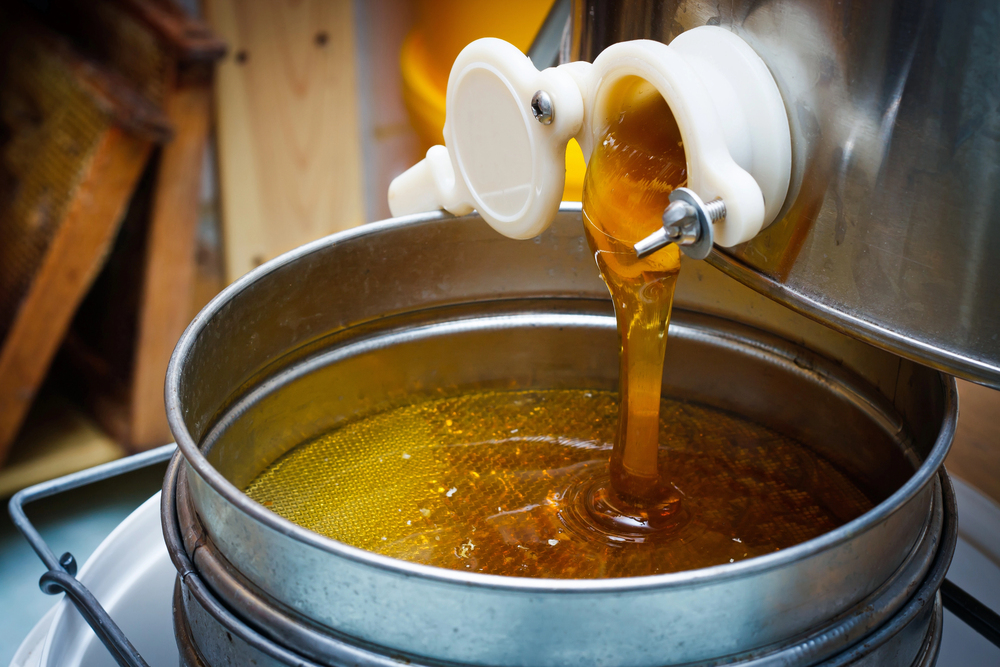
Uncapping and straining each have their own guide.
After extraction: settling in the honey tank
In beekeeping the tank where honey rests after extraction is traditionally called a ripener, which is why many people talk about ‘ripening the honey’ when they mean that rest. The name is misleading. A cheese or a wine changes as it matures; honey reaches the tank already finished, because the bees completed the ripening in the comb. What happens in the settling tank is just that, settling: the honey clears itself.
During extraction the honey picks up air bubbles, bits of wax and the odd fragment of bee and propolis. All of that is lighter than honey and slowly rises to the surface, where it forms a layer of scum that is skimmed off before bottling. What is left underneath runs clean and bright from the tap at the bottom.
- How long. If the honey goes in strained and the honey house is warm, one or two days are enough for the scum to rise. Cold or very thick honey takes longer, and an unstrained drum may need from several days to a few weeks. Particle size counts too, as the finest particles take longest to rise, and so does the height of the tank.
- Tank closed. Honey is still hygroscopic in the settling tank. With the lid on it picks up neither water nor odours.
- Do not wait for it to crystallise. Fast-crystallising honeys, such as oilseed rape or sunflower, have to be bottled before they set in the tank.
- Scum off. The top layer concentrates the impurities and is the wettest part of the tank. Skim it off without stirring and bottle from the tap.
- Watch for the signs. A freshly formed layer of air and wax is normal. If you see new gas, pressure under the lid or a sour or alcoholic smell, set the batch aside: skimming does not put a fermentation right.
Settling does not fix honey that was harvested unripe. In a closed tank honey loses no water, so the moisture it goes in with is the moisture it comes out with. That is why the important decision is made earlier, at the hive. In the shop you will find honey settling tanks in different capacities, and in the guide to straining we explain when settling is enough and when you need to strain.
What happens if you harvest honey too early?
The first risk is fermentation. All honey carries sugar-tolerant yeasts, and the only thing holding them back is the lack of available water. With moisture to spare and a warm store, they multiply, consume sugars and produce alcohol and carbon dioxide; with air, the alcohol ends up as acetic acid. A classic study by Lochhead of 319 honeys related the risk to moisture and to the number of yeasts:
| Honey moisture | Risk of fermentation |
|---|---|
| Less than 17.1 % | Safe at any yeast count |
| 17.1-18 % | Safe with fewer than 1,000 yeasts per gram |
| 18.1-19 % | Safe with fewer than 10 yeasts per gram |
| 19.1-20 % | Safe with fewer than 1 yeast per gram |
| Over 20 % | Always at risk |
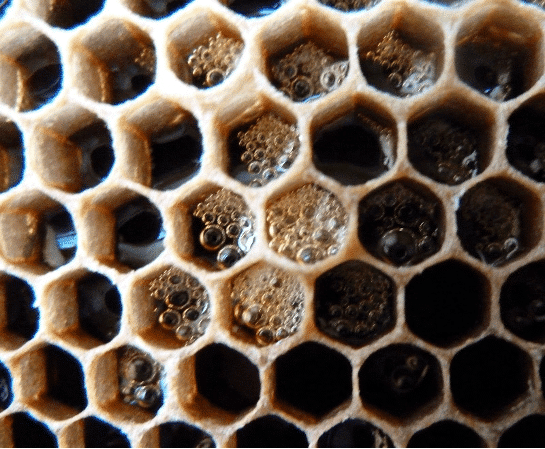
Crystallisation makes matters worse. When glucose forms crystals it releases part of the water it was holding, and that water stays in the liquid phase. Honey that went into the drum at a borderline 18 % can ferment months later, once crystallised, without anyone having added a drop. We explain this in the guide to honey crystallisation.
There are other consequences, even if the honey never gets as far as fermenting:
- Fewer enzymes and more sucrose. Unripe honey is short of work by the bees, and it shows in the diastase, in the sucrose and in the aroma, which is flatter.
- Poorer texture. It is watery and crystallises unevenly, with a liquid phase on top.
- Legal problems. The Spanish honey quality standard sets a general maximum of 20 % water and 50 meq/kg of free acidity, and does not allow honey to have begun fermenting. Honey that has begun to ferment can only be sold as baker’s honey, and only if it meets the requirements of that category.
- Commercial problems. Many bulk buyers ask for a maximum of 18 or 18.5 %.
Systematically harvesting unripe honey in order to dry it afterwards by machine has a name. Apimondia has included it among honey frauds since its 2020 statement: the loss of water is part of ripening and is the bees’ job. Apimondia itself distinguishes that from the case of the beekeeper who, with honey that is already ripe but slightly too moist because of the weather, keeps the supers for a few days in a dry room before extracting, which is what is described above. For that case, the moisture guide explains what to do if honey has too much moisture. If the batch is sound and only a little high, another way out is to blend it with a drier one: 60 % of honey at 16 % with 40 % at 19 % comes out at 17.2 %. We explain it in the guide to blending honey.
Frequently asked questions about honey ripening
How long does honey take to ripen?
A load of nectar can be concentrated in one to three days in warm weather with dry air. A full comb, from the nectar coming in to the comb being capped, takes between one and two weeks: in a trial on oilseed rape, the bees started capping on the fifth day and finished on the fourteenth.
How much of the frame should be capped before harvesting?
At least two thirds in normal conditions. With three quarters or more capped, on both sides, the honey is usually ripe. In a damp climate, or with early spring and autumn honeys, it is worth confirming with the refractometer.
Can you harvest uncapped honey?
Yes, if it is ripe. In midsummer and in dry areas there are open cells with honey below 18 % moisture. Shake the frame to check that it does not drip and measure those cells with the refractometer.
What is the moisture content of ripe honey?
Spanish honeys are usually between 17 and 18 %, and midsummer honeys around 16 %. The general legal limit is 20 %, but to store honey without risk it is best not to go above 18 or 18.5 %.
What happens if I take the honey off too early?
It comes off with too much water and can ferment in the drum or in the jar, sometimes months later and once it has crystallised. It also has fewer enzymes, more sucrose and less aroma than honey the bees have finished.
How long should honey settle after extraction?
One or two days in the settling tank if the honey goes in strained and the honey house is warm; longer if it is cold or very thick, and from days to weeks in an unstrained drum. During that rest the air and the bits of wax rise and are skimmed off with the scum. The honey does not ripen there or lose water: it only clears.
What should I do if a capped frame reads higher in moisture than the others?
Repeat the reading with another drop from the same area. If it is confirmed, leave that frame in the hive or extract it separately: mixed in with the rest, it raises the moisture of the whole batch. It happens mostly in early spring and in autumn.
Sources
- Eyer, Neumann and Dietemann (2016): A look into the cell: honey storage in honey bees, Apis mellifera. PLOS ONE.
- Zhang et al. (2021): Investigation of the maturity evaluation indicator of honey in natural ripening process: the case of rape honey. Foods.
- Nicolson et al. (2022): Honey bees save energy in honey processing by dehydrating nectar before returning to the nest. Scientific Reports.
- Bogdanov: The Honey Book, chapters on the physical properties, composition and control of honey. Bee Product Science.
- Royal Decree 1049/2003: quality standard for honey, consolidated text.
- Apimondia: Statement on Honey Fraud (2020) and Statement on Immature Honey Production.
- Antonio Gómez Pajuelo, Pajuelo Consultores Apícolas: course material on honey quality.
Content reviewed on 22 November 2026. Times and thresholds are a guide: each batch is decided on its own measurement.


