
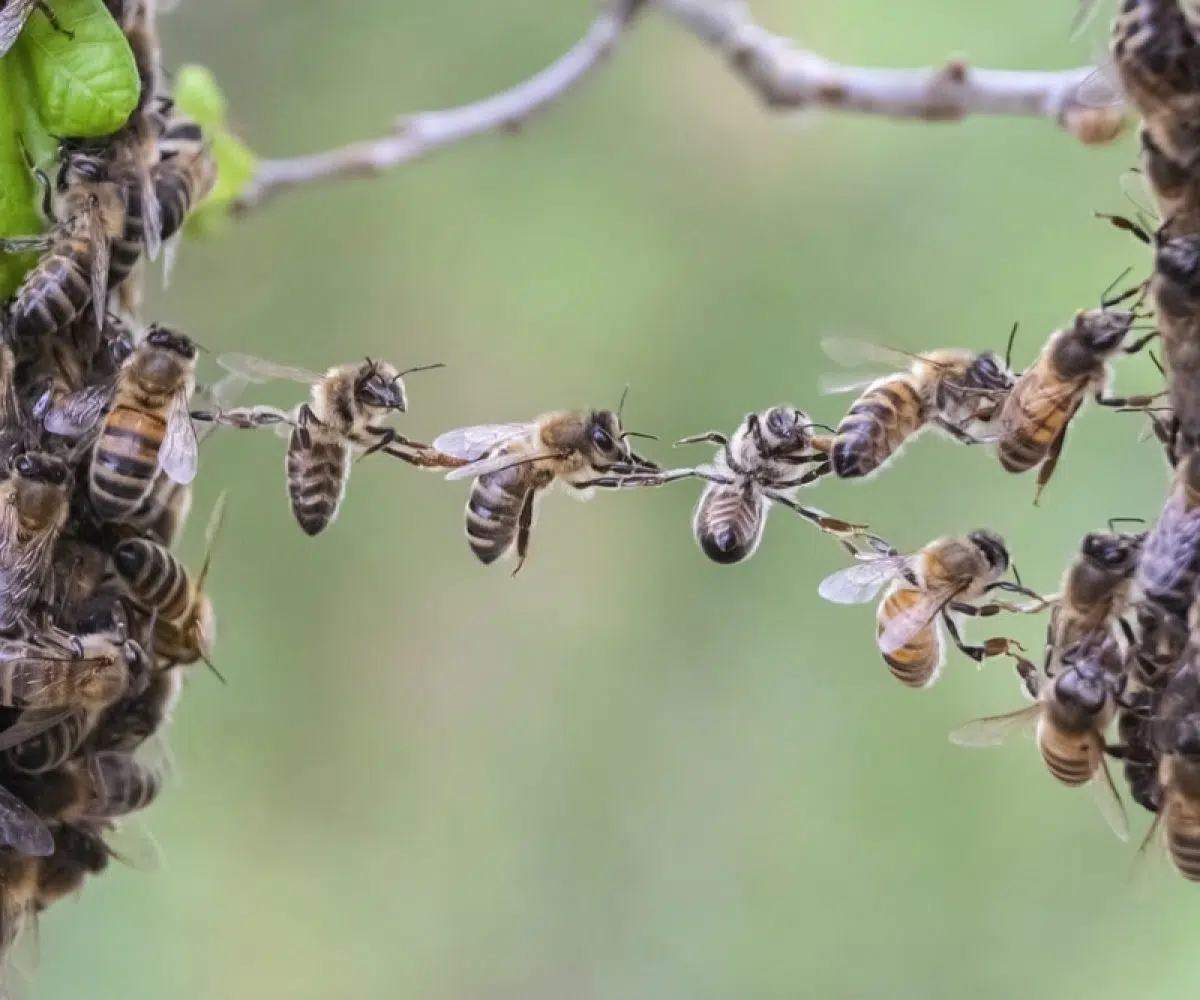
Festooning is the curtain of honey bees linked together by their legs that you may see between frames when a colony is building comb. It is a familiar sight, but recognising the pattern is easier than explaining its precise role. Here we look at what festooning is, the main proposed functions and the limits of the evidence behind them.
At a glance
- Bees grip one another with the claws on their feet, forming an open living network rather than a solid ball.
- It is often seen around newly built comb, during periods favourable for colony growth and wax working.
- Four familiar explanations involve measuring, scaffolding, warmth and wax secretion. They are hypotheses, not four established functions.
- Festooning is different from bearding outside the entrance and from the rocking movement called washboarding.
What is honey bee festooning?
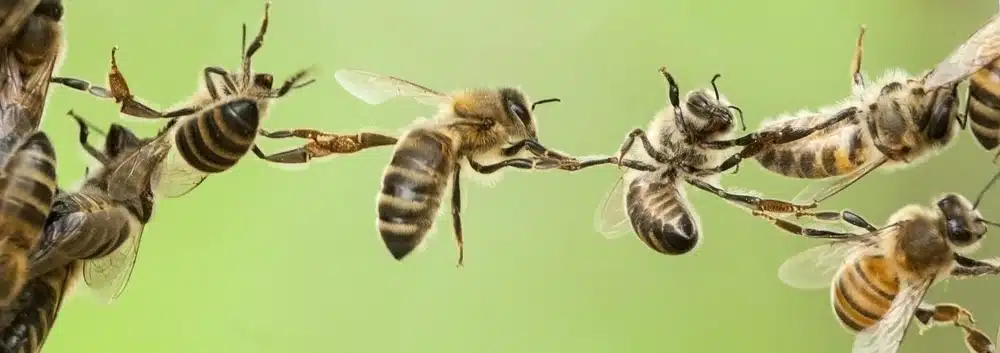
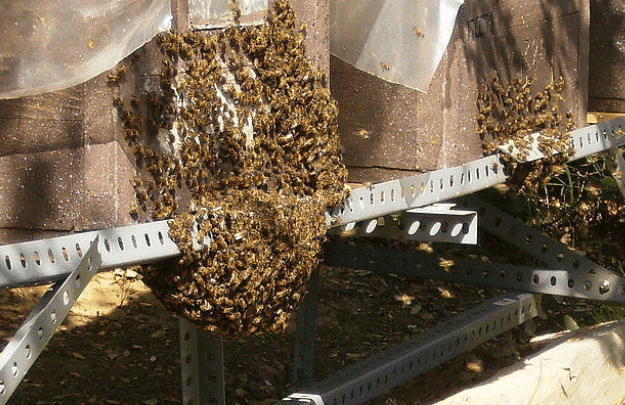
Workers hang from one another in chains that can join into a loose sheet. The result resembles living scaffolding, with gaps between the bees, rather than a rigid structure or a tightly packed cluster. “Scaffolding” describes its appearance; it does not, by itself, prove what the bees are doing.
Their anatomy makes this possible: the tarsal claws at the ends of their legs let bees grip one another and maintain the links.
You will often notice festoons where bees are drawing new comb. Chains can bridge adjacent frames, and a broader network may extend across a frame. During an inspection, separate frames slowly and give linked bees time to release their grip. Do not deliberately pull the chains apart to test how far they stretch.
Four proposed functions
Several explanations have been suggested for this conspicuous behaviour. They need not all be mutually exclusive, but they should not be presented as equally well tested or definitively established:
| Hypothesis | What it proposes | What the evidence can and cannot show |
|---|---|---|
| Measuring distances | Linked workers help assess space between combs or frames. | Bee space matters in nest architecture, but that does not prove a chain acts as a measuring tape. |
| Construction scaffolding | The living network supports or organises workers around a building site. | Its association with new comb makes this plausible; observation alone does not establish the exact mechanism. |
| Maintaining warmth | Aggregated workers help maintain conditions suitable for working wax or tending brood. | Temperature matters, but a festoon’s open shape is not proof for or against a thermal role. Direct measurements are needed. |
| Increasing wax secretion | Hanging in chains stimulates workers to secrete more wax. | Muller and Hepburn found that festoons accounted for only a small share of newly secreted wax, challenging the idea that secretion is centred there. |
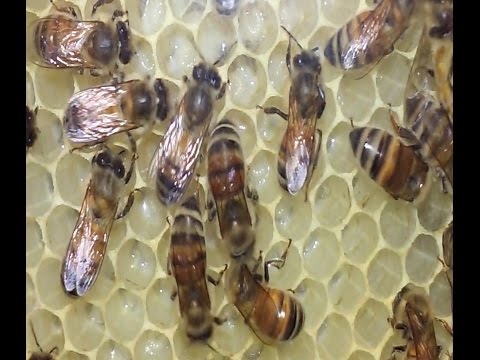
Association is not the same as explanation. Festoons occur around comb-building activity, but that does not show that every linked bee is secreting wax, measuring a gap or generating heat. A convincing explanation has to distinguish what bees are observed doing from the benefit the structure provides.
Why the explanation is not straightforward
One important result comes from Muller and Hepburn’s 1992 study of Cape honey bees in South Africa. Wax secretion varied with worker age and season, and comb-building festoons contained only a small fraction of the newly secreted wax in the nest. That is more precise than saying the experiment proved identical output in every festooning and non-festooning bee. It challenges a simple “chains are where wax is made” explanation, without ruling out every possible role in wax working.
A visible pattern is not a complete explanation. Bees can be linked around new comb or repairs to existing comb, yet the function of the links must still be tested rather than inferred from appearance alone.
Editorial note: this is a summary of the uncertainty, not a verbatim quotation. Jürgen Tautz’s book is listed below for broader background on colony organisation.
The interesting question is not whether bees form chains—we can see that—but which mechanisms and benefits explain the behaviour in each setting. Even familiar hive activity leaves room for careful observation and controlled experiments.
When are you likely to see it?
In practice, festooning is often noticed during active comb building. The following conditions provide useful context, not a checklist of necessary or sufficient causes:
- Forage and colony growth: a nectar flow provides energy, while pollen supports colony nutrition. Abundant pollen alone is not a test for festooning.
- Warm conditions: comb building requires a suitable local temperature for working wax; weather alone does not determine whether bees form chains.
- New comb construction: for example, around newly fitted wax foundation or partly drawn frames.
- Colony expansion: this can overlap with the swarming season, but festooning is not evidence that a colony is about to swarm.
Seeing festoons alongside fresh white comb can be encouraging, but it is not a colony-health certificate or a reliable swarming signal. Continue checking food stores, brood, space and queen cells as appropriate. During spring expansion, use the usual signs described in our guide to swarming; do not diagnose swarming from a chain of bees alone.
Festooning, washboarding and bearding
| Behaviour | Typical location | What to look for |
|---|---|---|
| Festooning | Often between frames or around comb under construction | Open chains or sheets of bees linked by their legs |
| Washboarding | Inner or outer surfaces near the hive entrance | Workers rock back and forth on their middle and hind legs while moving their mouthparts over the surface; cleaning is a proposed function, not a complete explanation |
| Bearding | Outside the hive, usually around or below the entrance | A resting aggregation, often in several layers, associated with hot conditions and nest cooling; it can persist into the night |
Bearding is a common source of confusion. Its connection with heat and hive ventilation differs from the association between festoons and comb building. Experimental research on bearding supports its thermoregulatory role and shows that beards can remain overnight. Meanwhile, research on washboarding describes rhythmic surface movements, not hanging chains. None of these behaviours should be identified simply from the number of bees in one place.
What is honey bee festooning?
Festooning is an open chain or sheet of honey bees linked together by their legs. It is often seen between frames or around newly built comb, rather than as a tightly packed ball of bees.
Why do honey bees festoon?
Proposed explanations include measuring space, supporting comb-building activity, maintaining warmth and influencing wax secretion. Their precise contribution is not established simply by observing a chain, and wax secretion also occurs away from festoons.
Is festooning the same as bearding?
No. Festooning involves linked chains, often around comb under construction. Bearding is a resting aggregation outside the hive, usually around the entrance, associated with nest cooling in hot conditions; it can continue into the night.
Is festooning a good sign?
It can accompany active comb building, but it does not prove that a colony is healthy, adequately fed or about to swarm. Assess stores, brood, available space and the usual swarming signs during your normal inspections.
References and further reading
1. Michael L. Smith, Phoebe A. Koenig and Jacob M. Peters. The cues of colony size: how honey bees sense that their colony is large enough to begin to invest in reproduction. Journal of Experimental Biology 220 (2017), 1597–1605. Background on colony size and investment in drone comb, not proof that festoons measure gaps.
2. Jürgen Tautz. The Buzz about Bees: Biology of a Superorganism. Springer. General background.
3. H. R. Hepburn and L. A. Whiffler. Construction defects define pattern and method in comb building by honeybees. Apidologie 22 (1991), 381–388.
4. M.-X. Yang, K. Tan, S. E. Radloff, M. Phiancharoen and H. R. Hepburn. Comb construction in mixed-species colonies of honeybees, Apis cerana and Apis mellifera. Journal of Experimental Biology 213 (2010), 1659–1664.
5. H. R. Hepburn. Honeybees and Wax: An Experimental Natural History. Springer-Verlag (1986).
6. Bee scaffolding and bio heaters: new research reveals hidden beehive behaviours. BBC Science Focus Magazine, July 2021. Popular-science further reading, not an experimental demonstration of festoon function.
7. W. J. Muller and H. R. Hepburn. Temporal and spatial patterns of wax secretion and related behavior in the division of labour of the honeybee (Apis mellifera capensis). Journal of Comparative Physiology A 171 (1992), 111–115. Publisher’s summary consulted.
8. K. Bohrer and J. Pettis. Effects of substrate, worker age and cross-fostering on washboarding behavior in the honey bee, Apis mellifera. Entomological Society of America meeting abstract (2003).
9. E. B. Rowe, P. Prathibha, P. R. Marting and M. L. Smith. Honey bee beards: internal and external factors driving mass thermoregulatory evacuation. Insectes Sociaux 73 (2026), 201–211; first published online in July 2025.

ISNI 0000 0005 1801 1100 | Joshua Ivars is the manager of LA TIENDA DEL APICULTOR and the author of this blog, where he shares technical and practical guidance for beekeepers. Drawing on extensive experience in the beekeeping sector, he offers advice and solutions based on beekeepers’ real needs, sharing his knowledge of equipment and essential beekeeping practices.


