
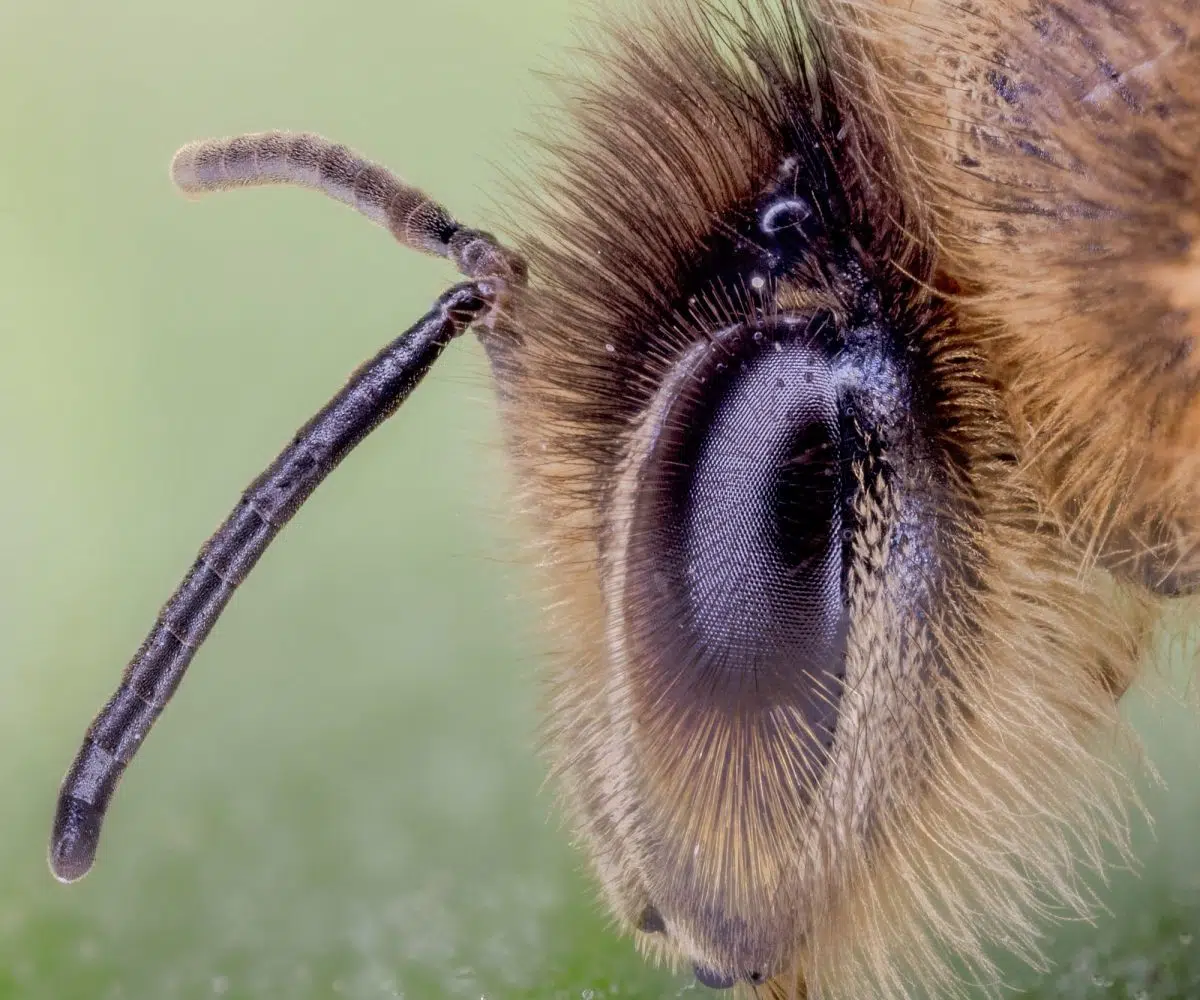
A worker honey bee has five eyes: two compound eyes and three ocelli. These eyes do different jobs. Together, they detect ultraviolet light, colour, contrast, movement and landmarks. Their visual system helps a bee find flowers, control her flight, learn her surroundings and return to the hive.
How many eyes does a bee have?
Short answer: five. The two compound eyes and three ocelli complement each other, but do not produce a single image as if they were five identical cameras.
2 compound eyes
- They are made up of thousands of ommatidia.
- They detect colour, contrast, shapes and movement.
- They are involved in flight, landing and landmark recognition.
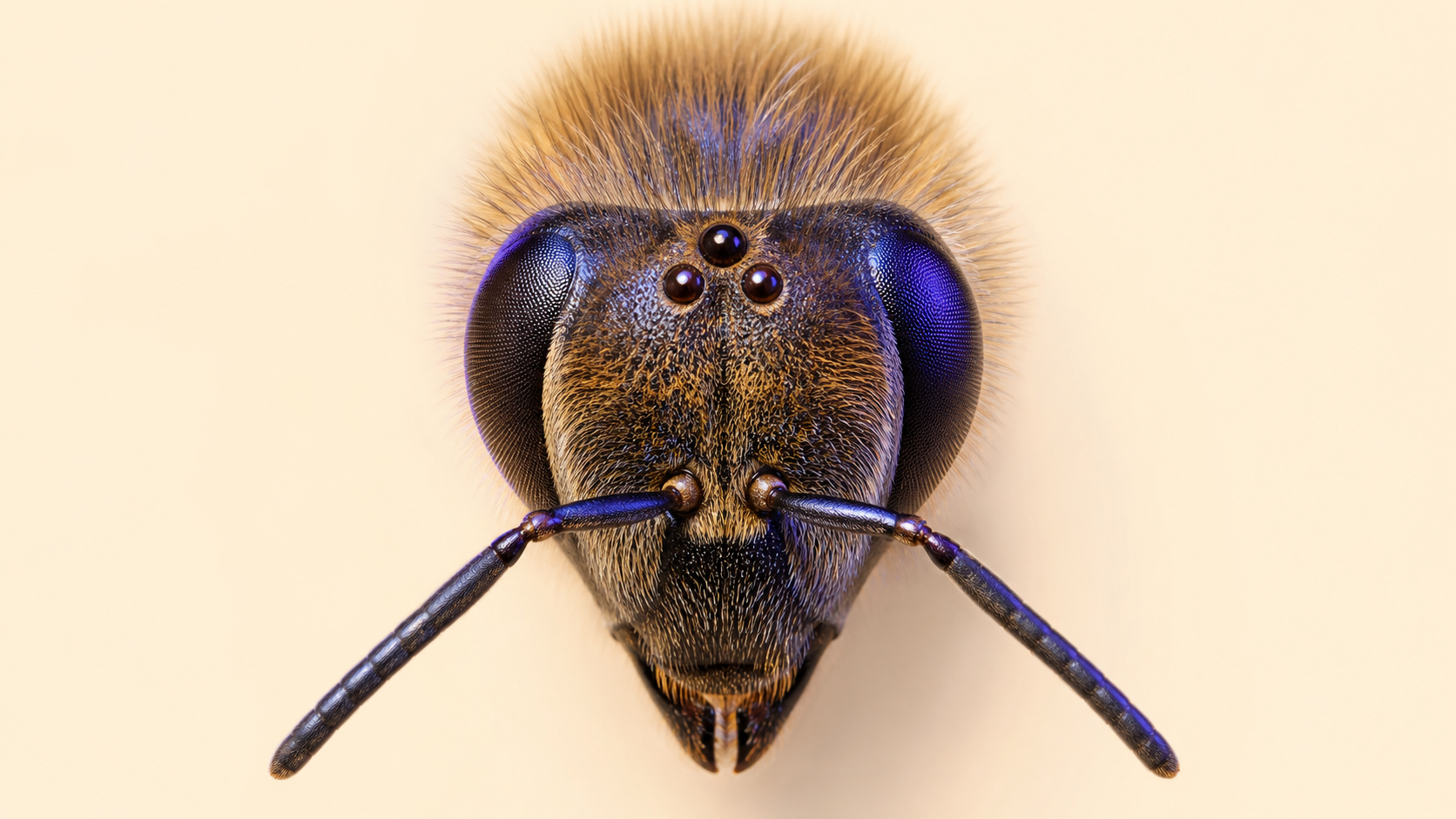
3 ocelli
- They are simple eyes located on the top of the head.
- They do not form detailed images.
- They detect light from the sky and help control orientation in flight.
Ocelli and compound eyes: how they work together
The three ocelli are simple eyes: two lateral and one median. They do not provide the detailed spatial vision of the compound eyes. Anatomical research found retinal regions looking towards the sky and horizon, consistent with a role in flight-attitude control and a possible contribution to a polarised-skylight compass. This is not the same as demonstrating that the ocelli navigate independently.
That is why it is incorrect to describe the ocelli as a ‘GPS’ or claim they calculate how much time is left until sunset. They are fast light and orientation sensors that work together with the compound eyes, the brain and other environmental signals.
The two compound eyes occupy much of the sides of the head. Each is made up of thousands of visual units called ommatidia. Not all ommatidia are identical: in the honeybee, different combinations of receptors sensitive to ultraviolet, blue and green light have been described. This organisation allows processing of colour, contrast and movement without the bee perceiving the world as a human does.
Vision does not work alone. Smell, touch and the mechanical information received by honey bee antennae complete their perception of the environment.
Trichromatic vision: bees compared with humans
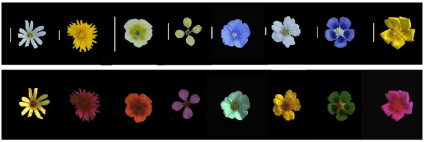
Honey bees and most humans have trichromatic colour vision, but the three receptor types differ. Human cones are sensitive to short, medium and long wavelengths, often described as blue, green and red. Honey bee colour receptors are sensitive to ultraviolet, blue and green. Bees can therefore detect ultraviolet signals that are invisible to us.
The phrase ‘bees cannot see red’ needs nuance. They do not have a specialised receptor for red wavelengths, so a surface reflecting only red offers little chromatic signal. However, a red object may also reflect ultraviolet, blue or green, or stand out by brightness and shape. It does not necessarily disappear from their visual field.
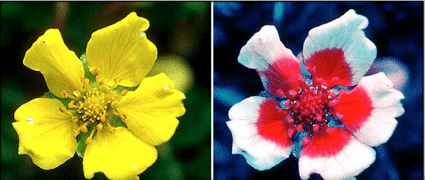
Many flowers reflect ultraviolet light unevenly, creating patterns that can guide pollinators towards the centre of the flower. These are known as nectar guides. This link between floral perception and behaviour helps explain why pollination is also a specialised service provided by beekeepers (further reading in Spanish).
How honey bees learn visual cues
Bees learn associations between colours, scents, shapes, locations and rewards. In colour discrimination experiments, prior learning enabled them to distinguish between very similar colour stimuli. The ability exists, but it is not advisable to turn this into a universal rule such as ‘five visits to learn a colour’: results depend on task difficulty, training, reward and context.
Before becoming foragers, worker bees perform orientation flights. Radar tracking showed these repeated flights provide different views of the hive and surrounding landscape, and that environmental learning is progressive. Other return experiments indicate that texture, contrast and position of nearby landmarks change how a bee approaches its target.
During flight, a bee also uses optic flow: the apparent movement of the visual scene across her eyes. This provides information for flight control, approaching a target and assessing the surrounding space.
What does bee vision mean for apiary management?
Controlled experiments are not a direct test of every apiary layout, and visual cues cannot eliminate drifting between colonies on their own. The following are practical inferences from how bees learn landmarks, not a guarantee that every returning bee will find the right entrance:
- Keep landmarks around the entrance stable. After installing or moving a hive, avoid unnecessary changes to nearby objects or the appearance of the hive front during the first orientation flights.
- Make hive entrances distinguishable in a crowded apiary. Simple shapes, strong contrasts and different front markings can provide extra landmarks. Combine shape, contrast and position rather than relying on colour alone.
- Do not use pure red as the sole visual signal. The bee does not have a red receptor like humans. If red is used, it should be accompanied by a contrasting pattern or another reference.
- Recognise orientation flights. A bee that leaves, turns back towards the hive and flies progressively wider arcs is learning the position and landscape; this behaviour should not be automatically mistaken for disorientation.
Important: these visual signals are helpful, but not a guarantee against drift. Distance between hives, their orientation, apiary layout, wind and colony condition also play a role.
In summary
- A bee has five eyes: two compound eyes and three ocelli.
- The compound eyes process ultraviolet, blue, green, contrast and movement.
- The ocelli are not a GPS: they register light and contribute to orientation control.
- Bees learn landmarks; stable, distinctive entrance cues can help them orient in the apiary.
References
- Avarguès-Weber, A., Mota, T. and Giurfa, M. (2012). New vistas on honey bee vision. Apidologie, 43, 244–268. DOI: 10.1007/s13592-012-0124-2.
- Braun, E., Dittmar, L., Boeddeker, N. and Egelhaaf, M. (2012). Prototypical components of honeybee homing flight behavior depend on the visual appearance of objects surrounding the goal. Frontiers in Behavioral Neuroscience, 6, 1. DOI: 10.3389/fnbeh.2012.00001.
- Calvin, C. L. and Wilson, J. S. (2013). Using Nectar Guides to Increase Bee Sample Size. Biology Posters, 83. Poster record.
- Capaldi, E. A. et al. (2000). Ontogeny of orientation flight in the honeybee revealed by harmonic radar. Nature, 403, 537–540. DOI: 10.1038/35000564.
- Hempel de Ibarra, N., Vorobyev, M. and Menzel, R. (2014). Mechanisms, functions and ecology of colour vision in the honeybee. Journal of Comparative Physiology A, 200, 411–433. DOI: 10.1007/s00359-014-0915-1.
- Reser, D. H., Wijesekara Witharanage, R., Rosa, M. G. P. and Dyer, A. G. (2012). Honeybees (Apis mellifera) Learn Color Discriminations via Differential Conditioning Independent of Long Wavelength (Green) Photoreceptor Modulation. PLOS ONE, 7(11), e48577. DOI: 10.1371/journal.pone.0048577.
- Ribi, W., Warrant, E. and Zeil, J. (2011). The organization of honeybee ocelli: Regional specializations and rhabdom arrangements. Arthropod Structure & Development, 40(6), 509–520. DOI: 10.1016/j.asd.2011.06.004.
- Wakakuwa, M., Kurasawa, M., Giurfa, M. and Arikawa, K. (2005). Spectral heterogeneity of honeybee ommatidia. Naturwissenschaften, 92(10), 464–467. DOI: 10.1007/s00114-005-0018-5.

ISNI 0000 0005 1801 1100 | Joshua Ivars is the manager of LA TIENDA DEL APICULTOR and the author of this blog, where he shares technical and practical guidance for beekeepers. Drawing on extensive experience in the beekeeping sector, he offers advice and solutions based on beekeepers’ real needs, sharing his knowledge of equipment and essential beekeeping practices.


