
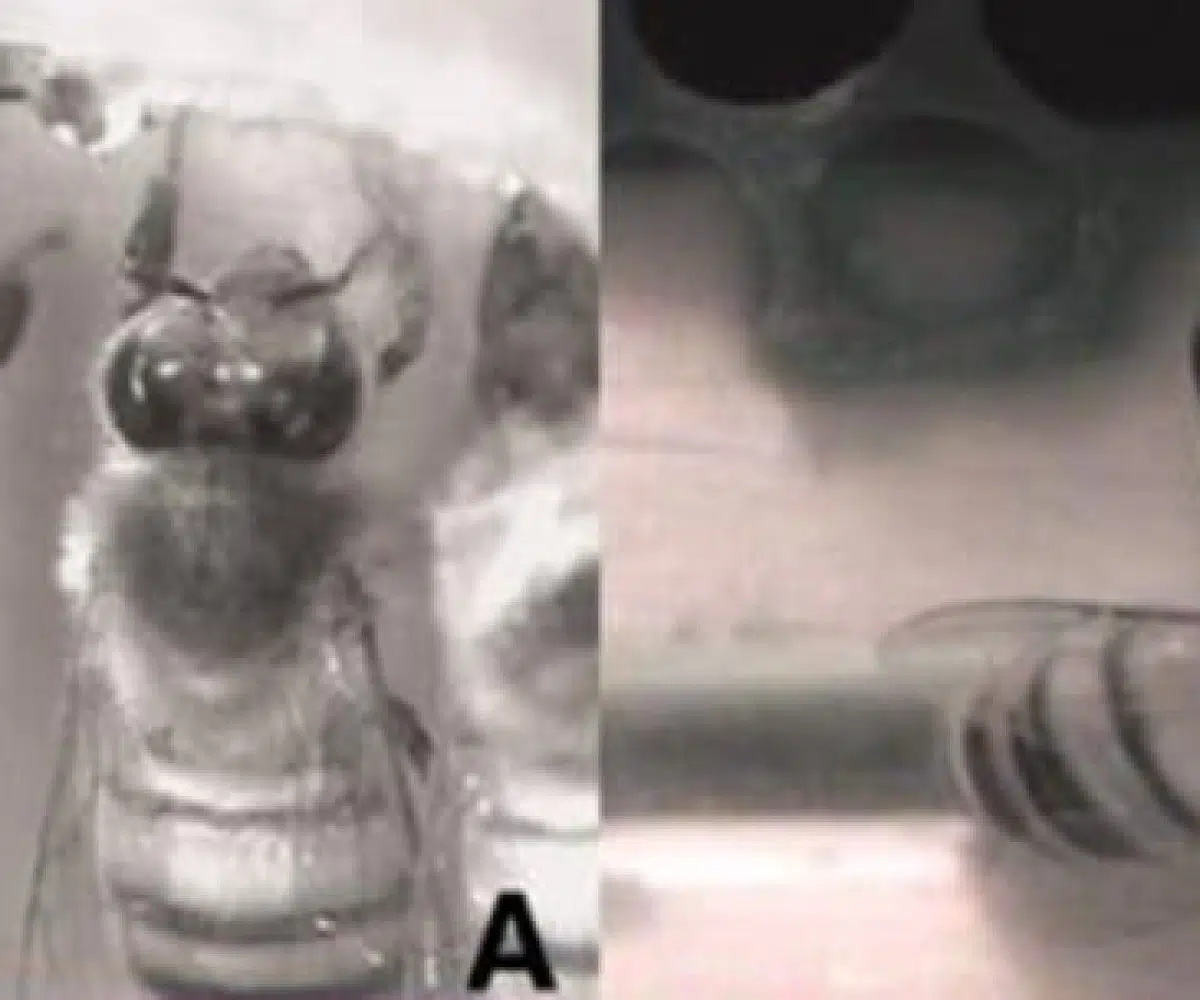
Yes, honey bees sleep. They were among the early invertebrates investigated for a sleep-like state, notably by Kaiser and Steiner-Kaiser in 1983. What makes them particularly interesting is that workers in the same colony do not all sleep in the same way: their age and the tasks they perform are associated with when, where and how they sleep.
The key points
- Recognising sleep: a relaxed, drooping posture and little antennal movement are useful clues, considered together with other signs.
- Foragers have a marked day–night sleep rhythm: they sleep mainly at night and are active mainly during the day.
- Nurse bees sleep in bouts during both day and night. Sleep becomes more strongly organised around night-time as workers move into older task groups.
- Sleep matters: sleep deprivation can reduce the precision of directional information in a forager’s waggle dance.
How to recognise a sleeping honey bee
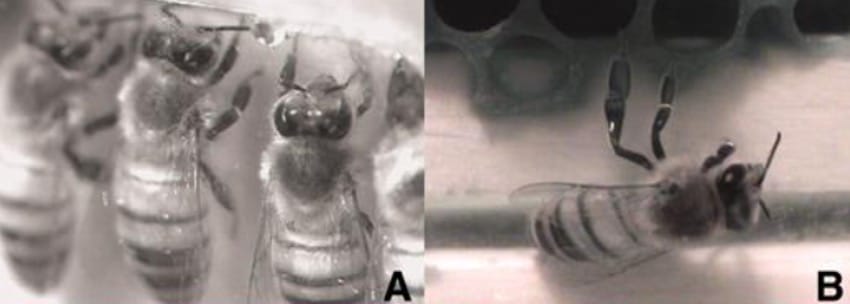
The posture is distinctive: the body, head and antennae relax, with very little movement. Researchers often watch the antennae, which may droop and remain still or show only small movements. They also consider other signs, including pauses between bouts of abdominal ventilation and a reduced response to disturbance; a motionless bee is not automatically asleep.
This state can last for an extended period, yet it is readily reversible. Contact from a passing nestmate can wake a sleeping worker, as the original research video below illustrates (Klein et al., 2008).
Different jobs, different sleep patterns
Our guide to the life of honey bees explains how workers change jobs as they develop. Sleep also varies between these task groups. The research calls them worker castes; here that means age- and task-related groups such as nurses and foragers, not separate queen, worker and drone castes. The progression is flexible, not a rigid timetable.
| Pattern | Foragers | Nurse bees |
|---|---|---|
| Daily rhythm | A clear day–night rhythm; most sleep occurs at night | No equally marked rhythm; sleep occurs by day and night |
| During the day | Foraging activity, with some daytime sleep | Sleep bouts between in-hive tasks |
| As workers develop | Foraging is typically a later-life task, associated with more organised night-time sleep | The pattern changes as workers age and move into other task groups |
| Sleeping sites | Often outside cells and farther from uncapped brood | Often near the brood; younger workers frequently sleep inside cells |
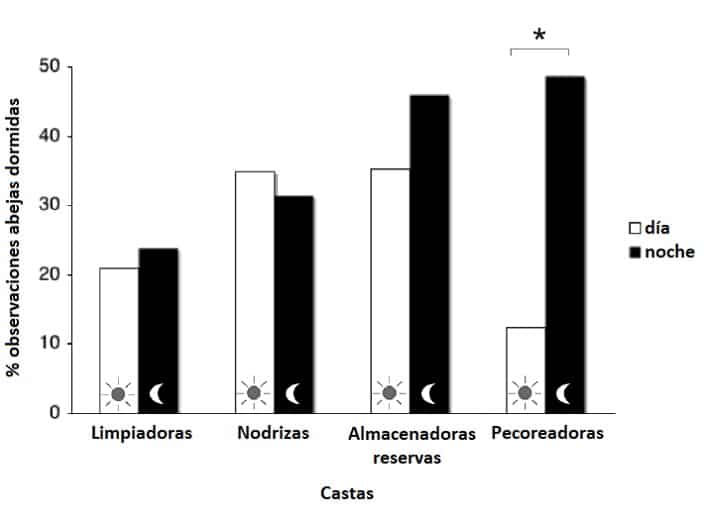
The graph compares cell cleaners, nurse bees, food storers and foragers. In this study, foragers showed the clearest day–night contrast, with substantially more sleep at night; the asterisk marks that significant difference. Cell cleaners and nurses slept during both periods. These group comparisons do not show that simply moving farther from the brood nest causes a bee to sleep more at night.
Where do workers sleep?
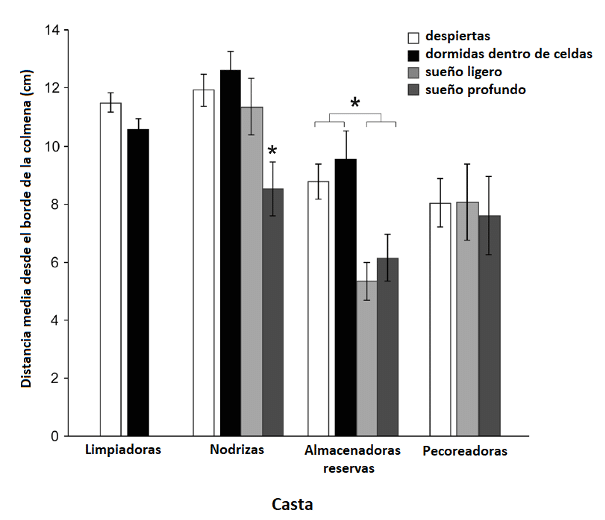
Sleeping locations differ too, although no worker has a permanently assigned bed:
- Young workers and nurse bees often sleep near the brood. Many sleep inside cells; as workers age and change tasks, more sleep takes place outside cells. Reduced disturbance and the local temperature may help explain this, but these explanations remain hypotheses.
- Foragers tend to sleep farther from uncapped brood, often towards the nest perimeter and in cooler areas. Less contact with busy nestmates is a proposed benefit, not a guarantee that every resting forager is undisturbed.
These patterns broadly fit the division of labour: brood-tending workers remain near the brood, while older workers spend more time farther from it. This does not mean that every forager sleeps beside the entrance. Researchers observed individuals sleeping in different places, and the layout of an observation hive can influence the pattern.
Why flexible sleep patterns make sense
Different sleep schedules within one colony need not be a mismatch. They may help reconcile rest with changing foraging opportunities and brood-care demands. Greater flexibility could also help a colony respond to parasites or predators, but that is a possible functional interpretation, not an outcome demonstrated by these sleep-mapping experiments.
- Nurse bees alternate work and rest around the clock, supporting brood care and other in-hive tasks. The absence of a strong daily sleep rhythm does not mean that they never sleep.
- Foragers generally match their activity to daylight and available forage, resting mainly at night. This describes the usual pattern, not an absolute rule for every environment or bee.
What happens if bees lose sleep?
Losing sleep can impair performance. In honey bees, Klein et al. (2010) found a specific effect: sleep-deprived foragers conveyed direction less precisely in their waggle dances, the movements used to advertise food locations. The experiment did not find the same effect on the precision of the distance signal.
Put simply, a sleep-deprived forager may give less consistent directions. That could make it harder for nestmates to locate a food source efficiently. It is a plausible colony-level consequence, not evidence that the experiment measured a reduction in honey production or food stores.
To explore the organisation and communication of the colony, read queens, workers and drones and our guide to honey bee pheromones.
Do honey bees sleep?
Yes. Honey bees show a recognisable sleep state, with a relaxed posture and little movement of the body or antennae. Research on honey bee sleep dates back to Kaiser and Steiner-Kaiser in 1983. Stillness alone is not enough to identify sleep.
When do honey bees sleep?
It depends on the worker’s age and task. Foragers sleep mainly at night but may also sleep during the day. Nurse bees take sleep bouts throughout the day and night, without the same marked day–night rhythm.
Where do honey bees sleep inside the hive?
Young workers often sleep inside cells near the brood area. Older workers, especially foragers, tend to sleep outside cells and farther from uncapped brood. These are group patterns, not fixed sleeping places for every bee.
What happens when a honey bee loses sleep?
In a controlled experiment, sleep-deprived foragers gave less precise directional information in their waggle dances. This could make food recruitment less efficient, but the study did not demonstrate a measured loss of honey yield.
References: Kaiser and Steiner-Kaiser (1983), Neuronal correlates of sleep, wakefulness and arousal in a diurnal insect; Klein et al. (2008), Caste-dependent sleep of worker honey bees; Klein et al. (2010), Sleep deprivation impairs precision of waggle dance signaling in honey bees (PDF); Klein et al. (2014), Mapping Sleeping Bees within Their Nest.

ISNI 0000 0005 1801 1100 | Joshua Ivars is the manager of LA TIENDA DEL APICULTOR and the author of this blog, where he shares technical and practical guidance for beekeepers. Drawing on extensive experience in the beekeeping sector, he offers advice and solutions based on beekeepers’ real needs, sharing his knowledge of equipment and essential beekeeping practices.


