
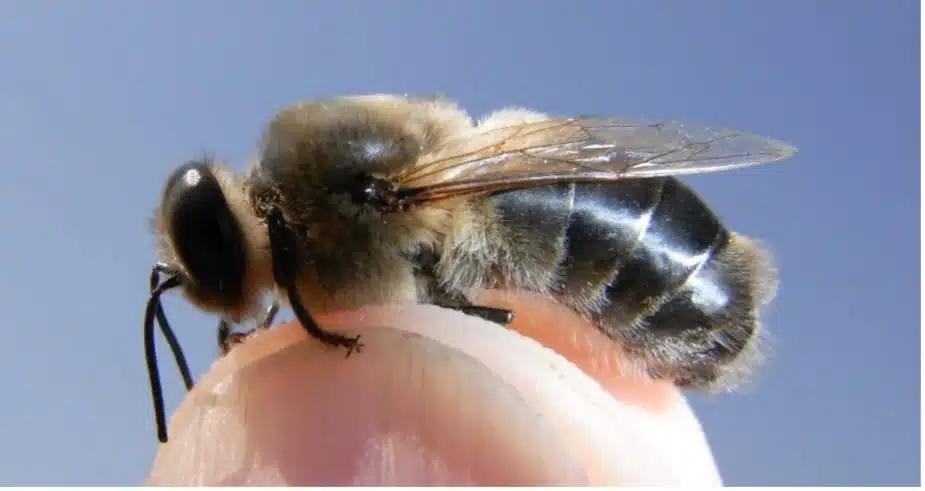
Western honey bees, Apis mellifera L., are social insects that live in highly organised colonies. Their roles depend on their reproductive type, age, physiological condition and the needs of the colony. A colony contains three familiar types of bee: the queen, workers and drones. This article follows their adult roles and their development from egg to emerging bee.
The queen
A colony normally has one laying queen. She is its principal reproductive female, laying the eggs that produce new generations of bees. Workers can sometimes lay unfertilised eggs that develop into drones, particularly after prolonged queenlessness, so it is not quite accurate to call the queen the only bee capable of laying eggs. Two queens may also coexist temporarily during queen replacement.
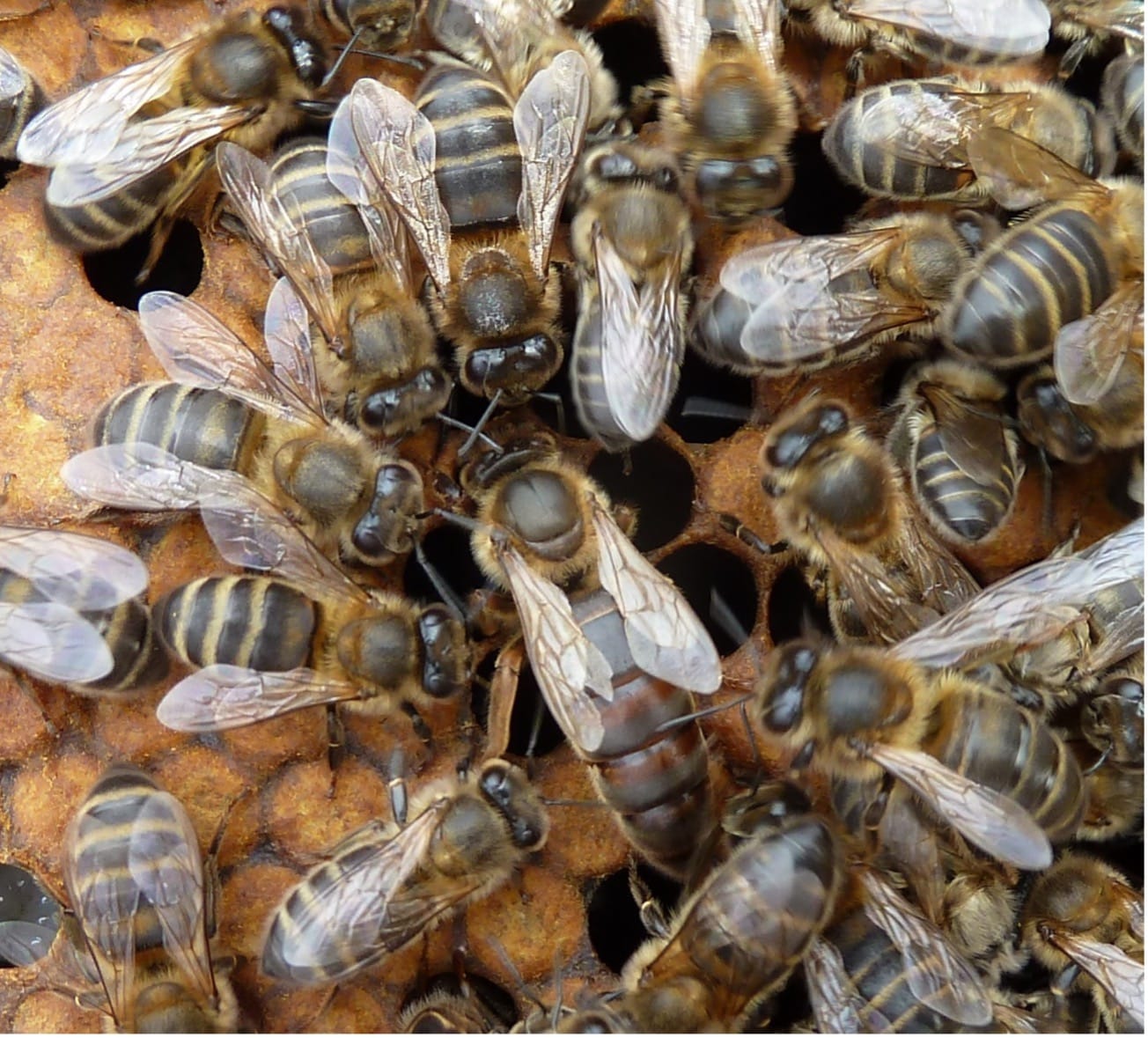
A laying queen is usually recognised by her long abdomen. Unlike workers, she is not equipped with specialised pollen baskets or functional wax-producing glands for building comb. She does have a digestive tract, including a crop; she is not a worker-style nectar forager. Attendant workers provide her with food, allowing her to concentrate on egg laying. This dependence should not be explained simply by the length of her tongue.
Queens and workers both develop from fertilised eggs. The quantity and composition of larval food are central to which form develops. Queen-destined larvae receive abundant royal jelly throughout larval development and grow in enlarged, vertically hanging queen cells, often compared with a peanut. A queen usually emerges about 16 days after the egg was laid. See Penn State’s guide to queen development for the distinction between queen and worker diets.
After a period of maturation, a virgin queen takes one or more mating flights, weather permitting. She mates with several drones, often more than ten; the number is variable, not a fixed 15–20 for every queen. Drones that successfully mate die afterwards. The queen stores sperm in a specialised organ in her abdomen, the spermatheca, and uses it to fertilise eggs during her laying life.
The queen also contributes to colony organisation through pheromones. Workers attending her pick up and spread these chemical signals through contact and interactions with other bees. Trophallaxis, or mouth-to-mouth food exchange, is part of the colony’s wider communication network, but not every queen signal is transmitted simply through food. These signals influence worker reproduction, queen rearing and other aspects of colony behaviour; the queen is not issuing conscious orders.
Worker bees
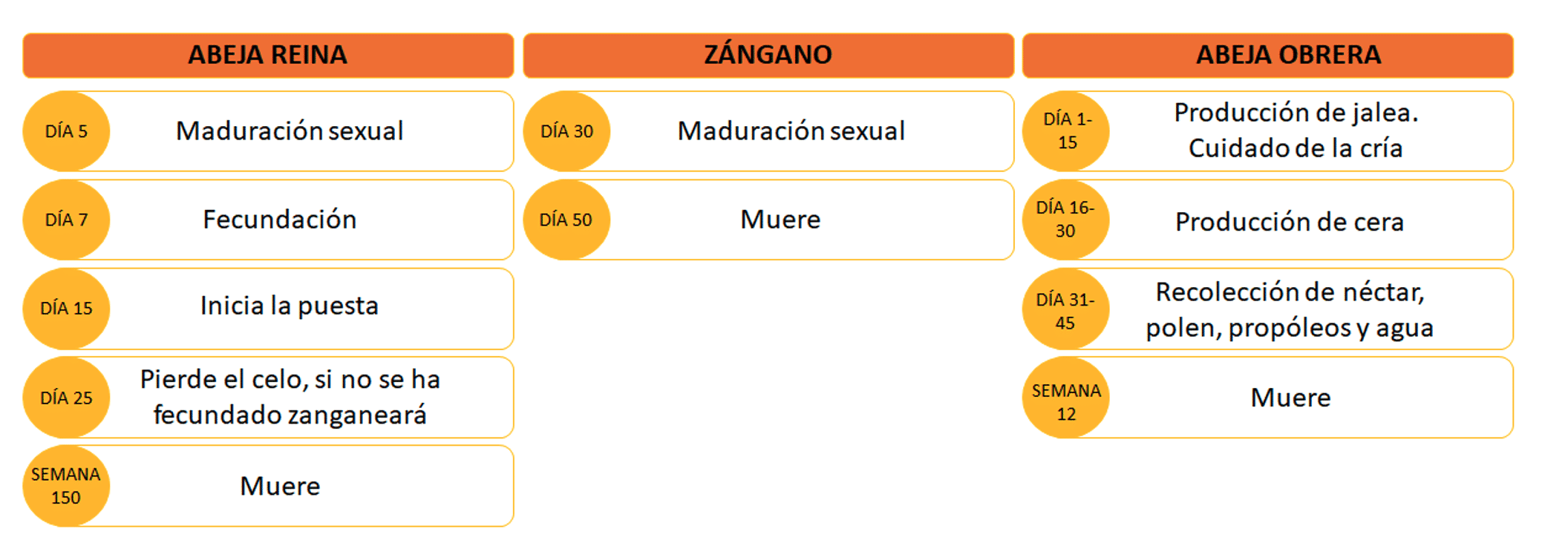
Workers are the other females in the colony. Different generations live and work together. Their tasks change with age and colony demand, although the transition is flexible: the same worker may perform several jobs, start foraging early or return to nursing if the colony needs her to.
Newly emerged workers begin with in-hive duties, including cell cleaning. During roughly their first two weeks, many tend and feed the brood. Well-developed hypopharyngeal glands help nurses produce larval food. Middle-aged workers often secrete wax, build and maintain comb, receive food and perform other in-hive tasks. Guarding and orientation flights also occur before or around the transition to foraging. These activities overlap: glands and jobs do not switch irreversibly on fixed birthdays.
Older workers collect nectar, pollen, water and plant resins used to make propolis. In the active season, a forager may work for another two or three weeks, but this is not a guaranteed lifespan. Workers reared towards winter can live for several months: that is longer adult survival, not several months of continuous winter foraging. Their activity changes with brood rearing, weather and food availability. Age and task also affect how workers sleep and rest.
| Approximate adult age | Common tasks—not exclusive roles |
| Days 2–12 | Cleaning cells, helping warm the brood and feeding larvae. Nurses produce glandular brood food, including royal jelly. |
| Days 12–16 | Wax secretion and comb building or maintenance, alongside other in-hive duties. Workers may help rear a replacement queen when the colony needs one. |
| Days 17–21 | Guarding and other entrance or in-hive duties; orientation flights may begin earlier. |
| From about day 22 | Foraging for nectar, pollen, water and resins. In a typical active-season example this may continue to around day 42, but neither starting age nor lifespan is fixed. |
Drones
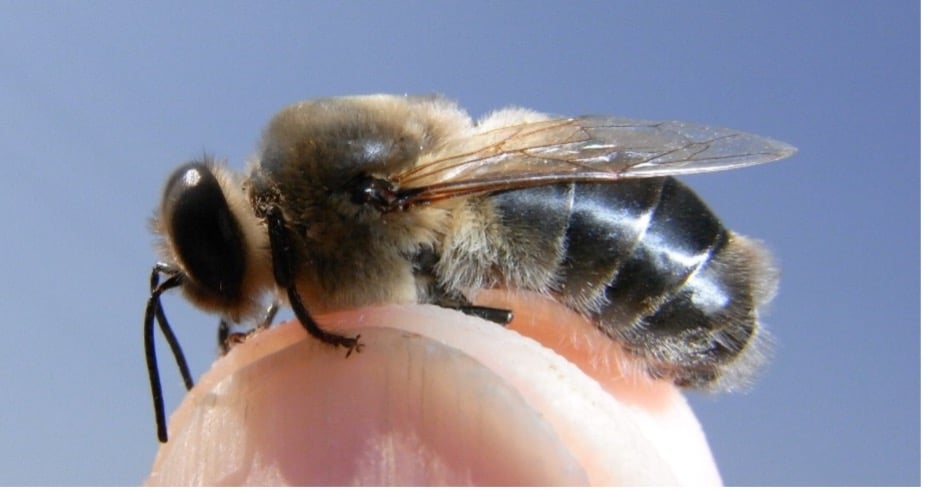
Drones are the males of the colony; their main reproductive role is to mate with virgin queens. They normally develop from unfertilised eggs, laid in the larger drone cells. A colony may rear hundreds during the breeding season, but numbers vary with resources and colony condition. In temperate climates, workers often evict drones as forage declines towards autumn. Expelled drones generally die without the colony’s food and shelter. Their role should not be presented as equivalent to the workers’ routine ventilation and maintenance duties.
Development from egg to adult
Honey bees undergo complete metamorphosis: egg, larva, pupa and adult (also called the imago). Typical egg-to-emergence periods are 16 days for a queen, 21 for a worker and 24 for a drone, with some variation. These timings are described in the University of Georgia’s honey bee biology guide and the University of Florida’s species profile.
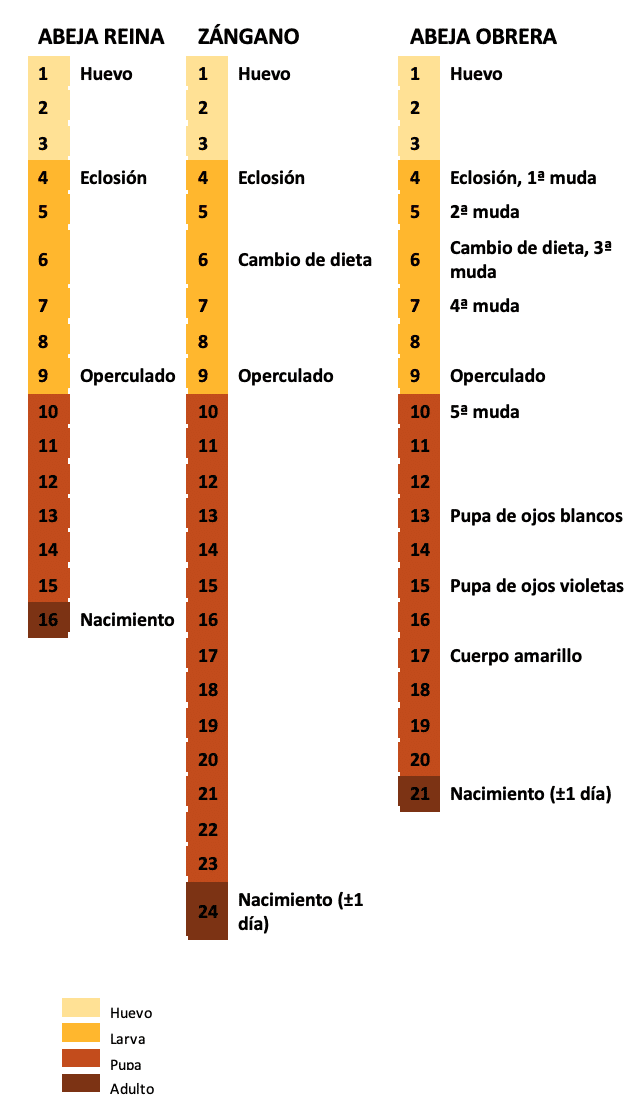
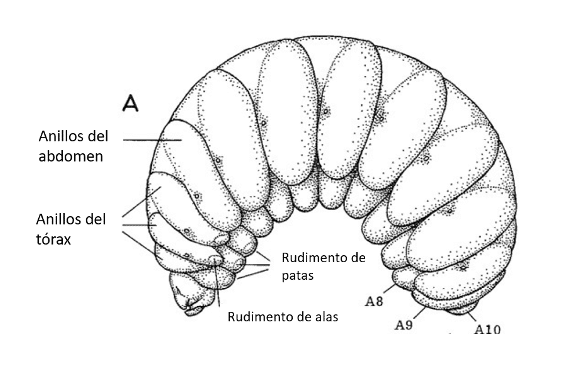
A successfully mated queen normally begins laying after a further maturation period. Her eggs are white, slender and roughly 1–1.5 mm long. The egg stage lasts about three days. A newly laid egg stands upright and usually becomes more inclined as it develops, eventually lying near the cell floor. The newly hatched larva is a small, pearly-white, C-shaped grub. It has no developed adult legs, wings or compound eyes; feeding and growth dominate this stage.
Larvae grow through successive moults, and the length of this period differs between queens, workers and drones. Nurse bees provide glandular larval food. Queen-destined larvae receive abundant royal jelly throughout development; food supplied to older worker and drone larvae changes in composition. This is not simply a switch to eating stored bee bread directly. Nurses use pollen and carbohydrate resources to produce and supply brood food.
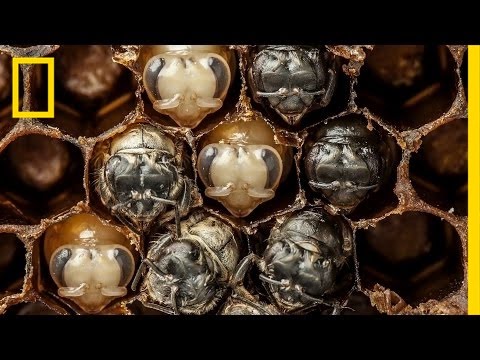
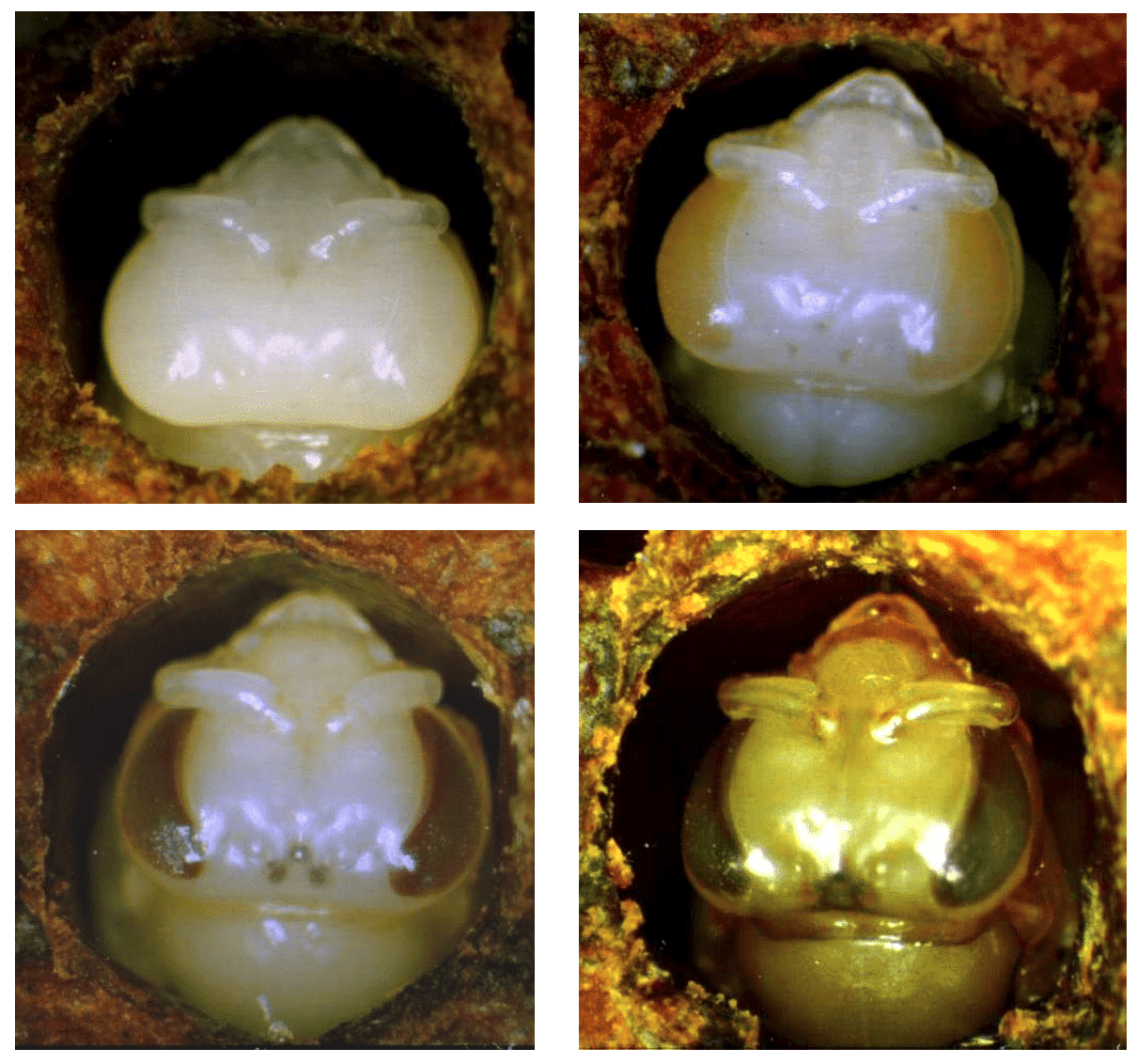
Towards the end of larval development, workers seal the brood cell with a wax capping. The larva stretches out and spins a silken cocoon before the pupal stage; puparium is not the correct term for a honey bee cocoon. During metamorphosis the adult head, thorax, abdomen, legs and wings become distinct. The eyes darken from white through pinkish or purple stages, followed by increasing body pigmentation. Once development is complete, the adult chews through the capping with its mandibles and emerges. It then takes its place in the colony’s division of labour—the coordinated living system often described as a superorganism.
Would you like to learn more about beekeeping?
Explore our online introduction to beekeeping course.
The course is intended for people who want a structured introduction to practical beekeeping, with specialist teaching and a broad syllabus. Check the course page for its current content and access details. The original promotional video below is retained in Spanish.
![Introducción al Curso de Apicultura [SÚPER COMPLETO]](https://www.latiendadelapicultor.com/blog/wp-content/plugins/wp-youtube-lyte/lyteCache.php?origThumbUrl=https%3A%2F%2Fi.ytimg.com%2Fvi%2FuJomNRA0UP8%2F0.jpg)

ISNI 0000 0005 1801 1100 | Joshua Ivars is the manager of LA TIENDA DEL APICULTOR and the author of this blog, where he shares technical and practical guidance for beekeepers. Drawing on extensive experience in the beekeeping sector, he offers advice and solutions based on beekeepers’ real needs, sharing his knowledge of equipment and essential beekeeping practices.


