

A honey bee worker carries a specialised community of gut bacteria that helps process its diet and influences its physiology and defences. A few major bacterial groups dominate, but these are not simply five individual species. Young workers acquire their microbiota through life in the colony. Understanding this relationship is useful; treating every microbial change as a disease, or every supplement as a cure, is not.
The main bacterial groups
| Bacterial group | Typical location and role |
|---|---|
| Snodgrassella, including S. alvi | Associated with the wall of the ileum |
| Gilliamella, including G. apicola | Mainly in the ileum; members can process dietary carbohydrates |
| Firm-4 (Bombilactobacillus) and Firm-5 (Lactobacillus) | Two major groups, not two individual species; common in the rectum and involved in fermentation |
| Bifidobacterium spp. | Common in the rectum; members process pollen-derived compounds |
| Other bacteria | Groups such as Bartonella and Frischella can also occur, with variable abundance |
In this guide
- What the microbiota is;
- its role in pollen digestion;
- how workers acquire it;
- yeasts and moulds;
- its relationship with immunity;
- the evidence for probiotics.
What is the gut microbiota?
The gut microbiota is the community of microorganisms living in the digestive tract. The older term ‘gut flora’ is still used, although these organisms are not plants. In honey bees, research has focused particularly on the specialised bacterial communities of adult workers.
Research on this community has expanded our understanding of bee nutrition and health. It also makes an important distinction: the microbes associated with a bee, its food stores and its surroundings are not all equivalent to the stable residents of its gut.
There are useful parallels with mammalian gut communities: social contact helps transmit microbes, and gut bacteria interact with the host’s diet and physiology. That does not mean that a bacterial strain or probiotic developed for humans will work in a honey bee.
The core is commonly described in terms of five major groups: Snodgrassella, Gilliamella, the Firm-4 and Firm-5 lactobacilli, and Bifidobacterium. Firm-4 is now placed in Bombilactobacillus; Firm-5 remains within Lactobacillus. Each group can contain diversity below that label, and other bacteria occur too. Queens have their own characteristic communities, with some groups shared with workers. Larval communities also differ from those of adult workers and change during development.
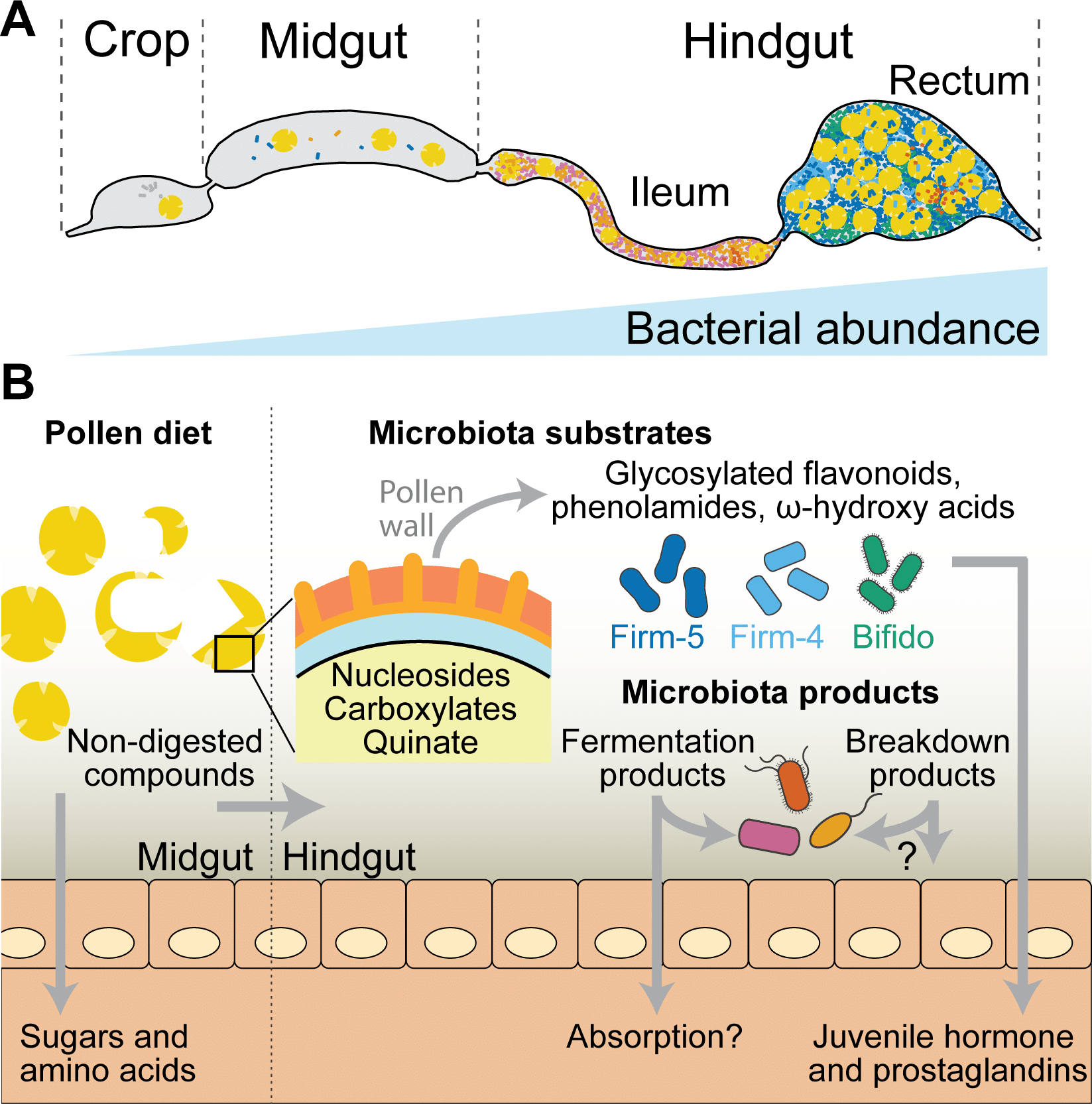
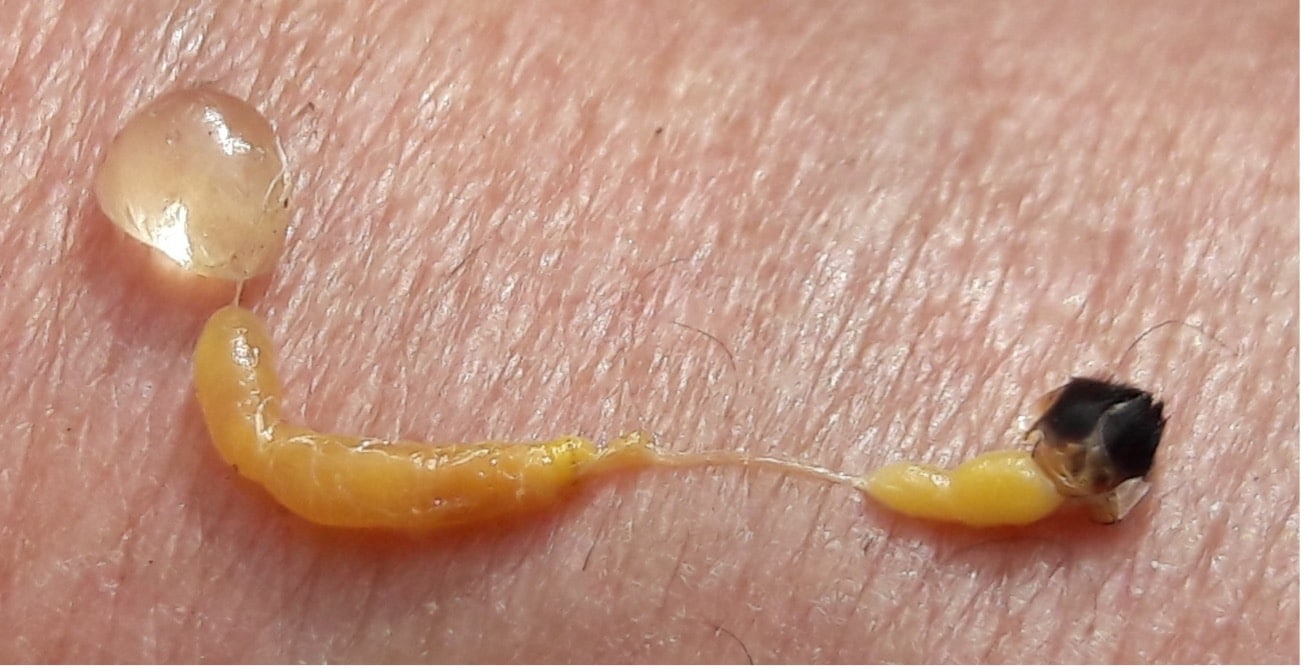
The bacteria are not distributed evenly. Most occur in the hindgut, comprising the ileum and rectum, rather than in the crop or midgut. Different groups occupy different gut regions, as illustrated below.
How gut bacteria help process pollen
Gut bacteria help break down some of the less accessible compounds in pollen. This microbial processing in the hindgut complements the bee’s own digestion; it should not be confused with the whole process of pollen digestion taking place there.
Much digestion and nutrient absorption take place in the midgut, not the foregut. Food material is enclosed by a peritrophic matrix. Residues reaching the hindgut encounter dense bacterial communities that can process further pollen-derived compounds, including some components associated with the pollen wall.
Bacterial metabolism produces organic acids and other compounds, some of which can be used by other microbes or interact with the host. In controlled experiments, Bifidobacterium asteroides altered the abundance of bee metabolites associated with hormone pathways. Such findings help explain possible physiological effects; they do not establish a guaranteed immune benefit from adding that organism to a hive.
Panel B of Figure 1 brings these pathways together. It separates the bee’s uptake of accessible nutrients in the midgut from microbial processing of residues in the hindgut.
The microbiota and the immune system
The microbiota does more than process food. Experiments have shown that native gut bacteria can stimulate aspects of the bee’s immune response. These relationships are specific: it is too simple to describe one bacterial group as the ‘source’ of the immune system or the whole community as a universal detoxification system.
Disturbing the community can affect bee health. For example, experimental antibiotic exposure has disrupted gut bacteria and reduced survival, including increased susceptibility to an opportunistic pathogen. Diet, age and chemical exposure must be considered in context: a change in bacterial abundance does not automatically mean disease, and effects depend on the substance, dose and conditions. Microbiota concerns are not a reason to abandon necessary Varroa control.
Scientific background: Raymann and Moran (2018) and Raymann et al. (2017). Effects depend on the community and experimental conditions; a microbiota change alone does not diagnose disease.
How workers acquire their gut microbes
Newly emerged workers build their characteristic gut community during their first days in the colony. Contact with nestmates and the hive environment is important. Mouth-to-mouth food exchange, or trophallaxis, is part of colony life, but experiments show that oral trophallaxis alone does not reliably supply the complete core community.
Contact with nurse bees and exposure to gut-derived microbes, including a faecal route demonstrated experimentally, can establish a typical community. The idea of a shared ‘social stomach’ is therefore only a metaphor, not a complete transmission mechanism. This is not a recommendation to feed bees faecal material or transfer potentially diseased combs.
Spanish-language resources are labelled below.
Beyond bacteria: yeasts and moulds
Yeasts and filamentous fungi can also occur in bees, stored pollen and the hive environment. Finding them does not, by itself, show that they benefit the colony or cause disease. Their identity and the circumstances matter; an unexplained total of isolated microbial strains is not a useful health indicator for an individual hive.
Do not treat moulds as a general defence against brood disease. Chalkbrood is caused by Ascosphaera apis, while some Aspergillus species can cause stonebrood. Microbes in bee bread should not be equated with the worker’s gut community, nor should stored pollen be described simply as food predigested by beneficial moulds. These observations do not justify adding fungi to colonies.
Likewise, finding a yeast does not establish a diagnosis of malnutrition, poisoning or antibiotic exposure. Colony symptoms, feeding history and appropriate investigation are more informative than assigning a universal meaning to the presence of one microbial name.
What about probiotics for bees?
Ordinary feeds, such as Apipasta with vitamins, serve a nutritional purpose and should not be confused with probiotic preparations. Research is exploring bee-associated bacteria as supplements, but laboratory effects do not necessarily translate into useful colony-level outcomes. For example, a field study found no benefit from the tested honey bee-specific lactic acid bacterial supplement in colonies affected by American foulbrood.
Evaluate the evidence for the actual strains, formulation and intended use. Promising microbiome research is not proof that every commercial supplement improves colony survival or cures disease. Sound nutrition and appropriate diagnosis remain essential, and a supplement is not a substitute for disease management.
Frequently asked questions
What is the honey bee gut microbiota?
It is the community of microorganisms in the digestive tract. Adult workers have a specialised bacterial community dominated by a small number of major groups, each containing finer-scale diversity. It is not accurately described as exactly five bacterial species.
How do workers acquire their gut bacteria?
After emergence, workers acquire them through contact within the colony. Oral trophallaxis alone is not a complete explanation: contact with nestmates and exposure to gut-derived microbes also matter. Experimental transmission routes are not instructions for homemade inoculation.
What does the microbiota do?
It helps process dietary compounds and interacts with the bee’s metabolism and defences. The effects depend on the bacterial community and the conditions; the microbiota is neither a universal antidote to toxins nor a guarantee against disease.
Do queens and larvae have a microbiota?
Yes, but their microbial communities differ from those of adult workers and vary with development. Queens can share some worker-associated bacterial groups while having a different overall community.
What can disturb the microbiota?
Diet and some chemical exposures, including antibiotics, can alter gut communities. Age and other conditions also influence their composition. Not every change is harmful, and a microbiota result alone does not diagnose the cause of colony illness.
Are fungi associated with bees always harmful?
No, but their presence is not proof of a benefit either. Some Aspergillus species cause stonebrood, and Ascosphaera apis causes chalkbrood. Do not add moulds to colonies or infer health status from a yeast name alone.
Further reading
- Feeding honey and pollen to bees (in Spanish): nutritional and health considerations.
- Protein supplementation for honey bees.
- Chalkbrood: understanding a fungal brood disease.
- Bee bread: pollen stored in the comb.

ISNI 0000 0005 1801 1100 | Joshua Ivars is the manager of LA TIENDA DEL APICULTOR and the author of this blog, where he shares technical and practical guidance for beekeepers. Drawing on extensive experience in the beekeeping sector, he offers advice and solutions based on beekeepers’ real needs, sharing his knowledge of equipment and essential beekeeping practices.


