
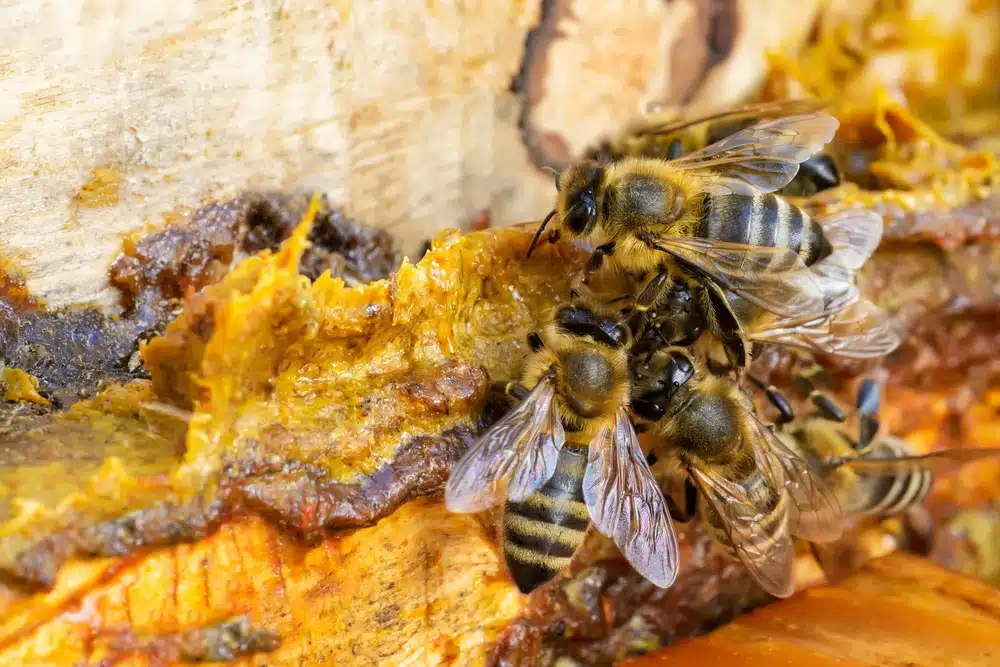
To prepare a propolis tincture it is advisable to start with clean propolis, cool it to make it brittle for chopping, mix it with food-grade ethanol, allow it to macerate in the dark and filter it. The quality of the result depends equally on the raw material, the solvent and the process: a dark colour does not by itself indicate a better extract.
Practical starting ratio: 30 g of clean propolis per 70 ml of ethanol at 70 %, following the 30/70 ratio described by the FAO for small batches. This is a loading ratio, not a final extract concentration analysis.
- Maceration: one to two weeks, in a closed and dark container.
- Agitation: brief, once daily.
- Final step: fine filtration and bottling in dark glass, with date and ratio recorded.
What is propolis?
Propolis is a resinous material that bees produce from substances collected from buds, bark and plant exudates, mixed with wax and other components from the hive. Its composition varies with the flora, region, season and colony; hence two propolis samples may differ in colour, aroma and behaviour.
Bees use it to seal cracks, reduce openings and coat surfaces. They may also enclose small bodies that they cannot remove from the hive. This function within the colony does not automatically transfer to a human therapeutic dose or effect.
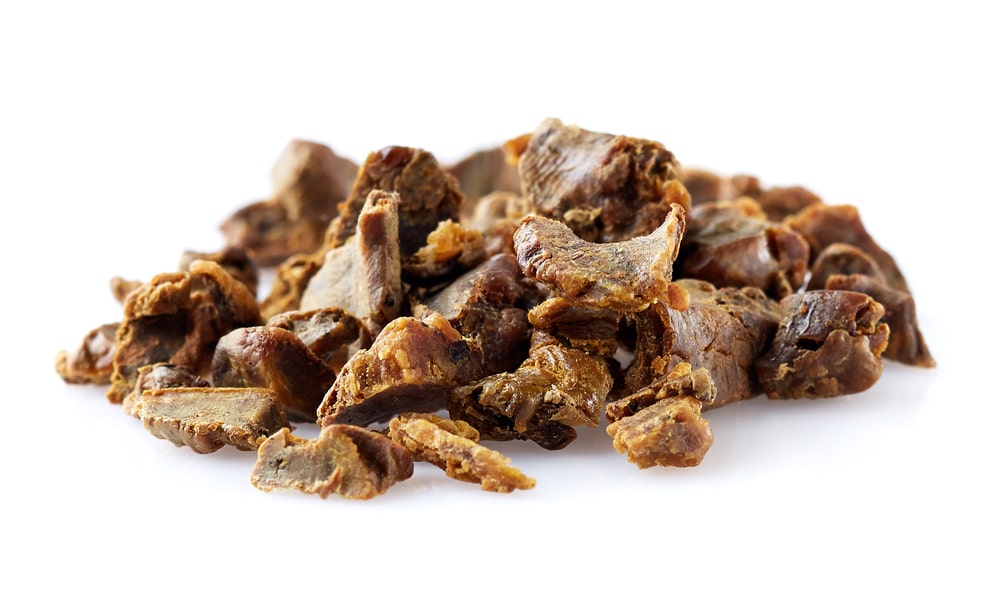
Composition and quality: why not all propolis is the same
Scientific literature has identified numerous compounds in propolis, including phenolic acids, flavonoids and terpenes. However, the chemical profile is not constant. It depends on botanical and geographical origin and on the extraction method, making it difficult to compare two homemade preparations or attribute the same activity to them.
Laboratory tests on antioxidant or antimicrobial activity serve to characterise a sample, but they do not alone prove that a homemade tincture prevents or treats diseases. For specific information on composition and evidence, you may refer to the article dedicated to the properties of propolis.
One quality indicator is not enough. That propolis sinks in water, has a certain colour or produces a very dark extract does not guarantee purity, botanical origin, concentration or safety. Standardisation requires analytical testing and process control.
How to harvest propolis from the hive
There are two common methods: the mesh collector and scraping. The mesh usually yields cleaner and more uniform material; scraping uses existing deposits in the hive but requires more careful selection of raw material.
Harvesting with a mesh
- A specific mesh is placed under the lid or inner cover, depending on the hive model.
- Bees gradually fill the slots with propolis.
- The mesh is cooled or frozen for a few hours and bent to detach the brittle material.
- Produces fewer wood and wax residues than scraping.
Harvesting by scraping
- Remove propolis from clean areas of frames, supers and lids using an appropriate tool.
- Do not scrape painted, treated or visibly contaminated surfaces.
- Discard material from the base and that is heavily mixed with wax, wood or dirt.
- Requires more careful cleaning before maceration.
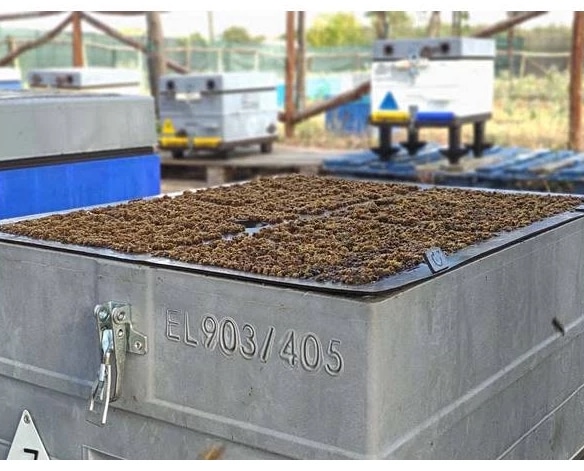
If you wish to use this method, you can use a propolis trap. First check that its dimensions are compatible with your hive lid and the way you manage the hive.
Cleaning and storage of raw propolis
- Select. Remove wood, dead bees, fibres, paint, soil and fragments with excessive wax.
- Chill. If it is sticky, refrigerate or freeze it for a few hours until it becomes hard and brittle.
- Chop. Cut the cold material into small particles. Greater surface contact ensures more homogeneous extraction.
- Protect. Store clean propolis in a sealed container, away from light, heat, moisture and strong odours.
- Identify. Record apiary, date and harvesting method. Do not mix batches if you wish to compare their performance later.
How to make propolis tincture step by step
Materials and ingredients
- 30 g of clean, chopped propolis.
- 70 ml of 70% food-grade ethanol.
- Scale, glass container with lid and label.
- Funnel and fine paper filter; a second filter may improve clarity.
- Amber glass bottle for the filtered extract.

Do not use burning alcohol, methanol, denatured alcohol or products whose label does not state they are suitable for the intended use. Ethanol is flammable: work away from flames, sparks and heat sources, with ventilation and out of reach of children.
If starting from food-grade ethanol at 96 %, the approximate ratio to obtain 100 ml at 70 % is 73 ml of ethanol and 27 ml of water. The formula is C1 × V1 = C2 × V2. For commercial or analytical processes, validated measurements and procedures must be used, not a domestic approximation.
Maceration and filtration process
- Prepare the propolis. Cool, chop and weigh 30 g of clean material.
- Add the solvent. Place the propolis in the jar and add 70 ml of 70% ethanol.
- Label the batch. Write date, origin, quantities and ethanol strength.
- Protect from light. Use a dark jar or wrap it; keep closed, at room temperature and away from heat.
- Agitate daily. Brief daily agitation helps renew contact between solid and liquid.
- Leave to macerate. The FAO technical guide recommends more than one week, with the best practical result achieved in one to two weeks.
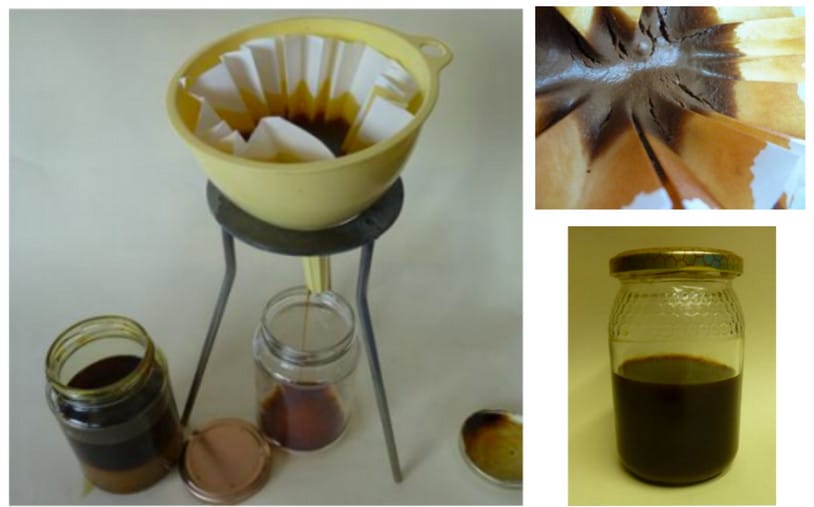
- Filter. Pass the liquid through clean, fine filter paper or cloth. If particles remain, filter it a second time.
- Bottle. Store the filtered extract in an amber glass bottle, tightly sealed and labelled.

What does ’30 % tincture’ really mean?
In domestic recipes, ’30 %’ is often used to express the initial ratio of propolis to the total propolis-solvent mixture. This does not mean the filtered liquid contains 30 % active compounds: part of the propolis does not dissolve and remains in the filter.
A study using Beijing propolis compared water and ethanol solutions at 25, 50, 75, 95 and 100 %. In that sample, 75 % provided the highest extraction yield and the greatest measured antioxidant activity. This is useful information for understanding the role of the solvent, but does not demonstrate that all raw materials have the same optimum .
Batch storage and control
- Use a clean, airtight container, preferably amber-coloured.
- Store in a cool, dry place, protected from light and heat.
- Record the date, source of the propolis, solvent ratio and strength.
- Discard the batch if there is mould, an unusual odour, contamination or a faulty seal.
- Do not assign a universal expiry date to a homemade preparation without a stability study.
Safety, use and marketing
This guide describes an extraction process; it does not set dosage or treatment recommendations. Propolis may cause contact dermatitis and other allergic reactions, including after ingestion. Anyone with known allergy to apicultural products, resins or certain balsams should consult a healthcare professional before exposure.
It is incorrect to recommend a universal daily amount or to present a homemade tincture as a treatment for colds, wounds, infections or any illness. Composition varies between batches and results are not standardised. If the product is commercial, follow the label, authorised conditions and intended use.
In Spain, selling a tincture as a dietary supplement requires business and premises registration, composition control, labelling and prior or simultaneous notification of market placement to the first commercialisation. The specific situation must be reviewed with the competent authority and up-to-date information from the AESAN on dietary supplements.
For working with raw material or already-prepared products, you may consult the category of propolis and collection materials.
Frequently asked questions
Can a propolis tincture be made using only water?
Water extracts a different fraction and generally dissolves many resinous components less effectively. It is not equivalent to substitute ethanol for water while keeping the same recipe.
How long should it macerate?
For the simple method described, the FAO recommends more than one week and suggests one to two weeks as a practical reference. Properly chopping, shaking and filtering are more effective than indefinitely prolonging maceration.
Is it better to collect using a mesh or by scraping?
Mesh collection usually yields cleaner propolis with less wood and wax residue. Scraping is usable but requires careful selection of areas and more thorough cleaning.
How do I know if the tincture is concentrated?
Neither colour, visual density nor taste can measure the concentration of extracted compounds. Only analysis or a standardised process can quantify it.
In summary
- The collection mesh typically provides cleaner raw material than scraping.
- A documented practical ratio is 30 parts of propolis per 70 of ethanol at 70 %.
- Maceration should be carried out in the dark, with brief agitation and fine filtration.
- The alcohol must be suitable for the intended use and kept away from ignition sources.
- A homemade tincture does not have a universal therapeutic dose nor a measurable concentration based on appearance.
Sources
- FAO. How to process raw propolis into propolis extracts. Cleaning method, ratio, maceration and filtration.
- FAO. Other products from bees. Collection using propolis traps, propolis properties and extracts.
- Bankova, V. (2005). Chemical diversity of propolis and the problem of standardization. Journal of Ethnopharmacology, 100(1-2), 114-117. DOI: 10.1016/j.jep.2005.05.004.
- Sun, C., Wu, Z., Wang, Z. and Zhang, H. (2015). Effect of Ethanol/Water Solvents on Phenolic Profiles and Antioxidant Properties of Beijing Propolis Extracts. Full text and DOI: 10.1155/2015/595393.
- Kocabas, G., Ipenburg, N. A., de Groot, A. and Rustemeyer, T. (2024). Results of patch testing propolis in the European baseline series: A 4-year retrospective study. Contact Dermatitis. PubMed and DOI: 10.1111/cod.14678.
- AESAN. Programme 2.7: control of notification, labelling and composition of dietary supplements, 2026.

ISNI 0000 0005 1801 1100 | Joshua Ivars is the manager of LA TIENDA DEL APICULTOR and the author of this blog, where he shares technical and practical guidance for beekeepers. Drawing on extensive experience in the beekeeping sector, he offers advice and solutions based on beekeepers’ real needs, sharing his knowledge of equipment and essential beekeeping practices.


