 Apipasta with vitamins 15kg
 Beecomplet® Spring 14Kg
 Beekeeper suit with round veil
 Oxalic acid 1kg
 Beeswax Foundation 5kg
 Fresh royal jelly 20g
 Classic honey jar 1kg comb-lines TO77 - Pack of 16 units
 Promotor L Apis 1 litre

 Share in WhatsApp
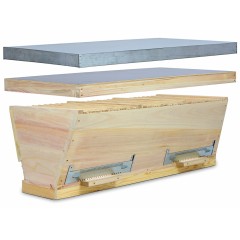
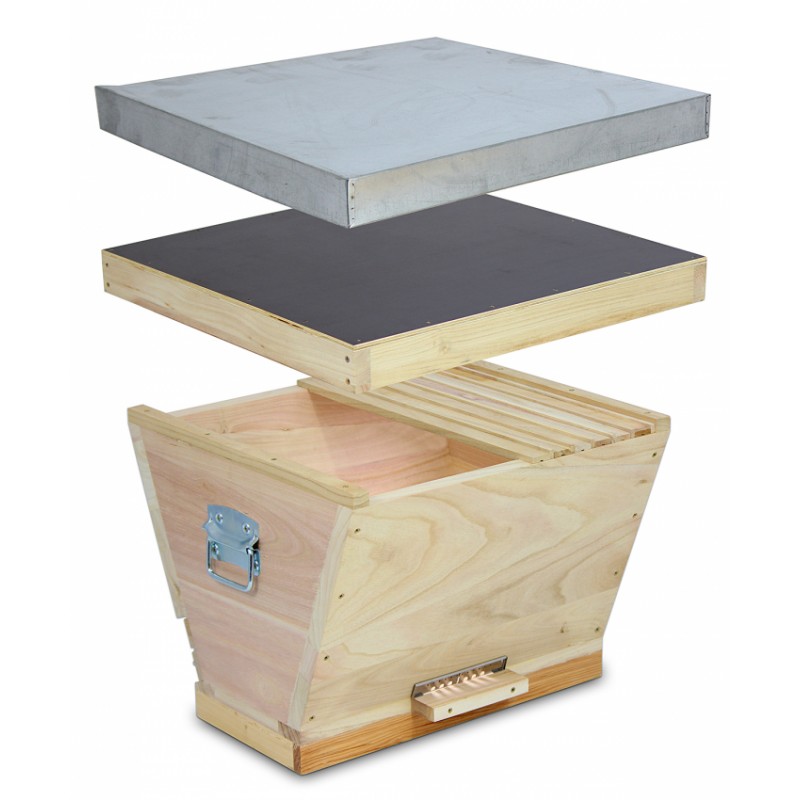
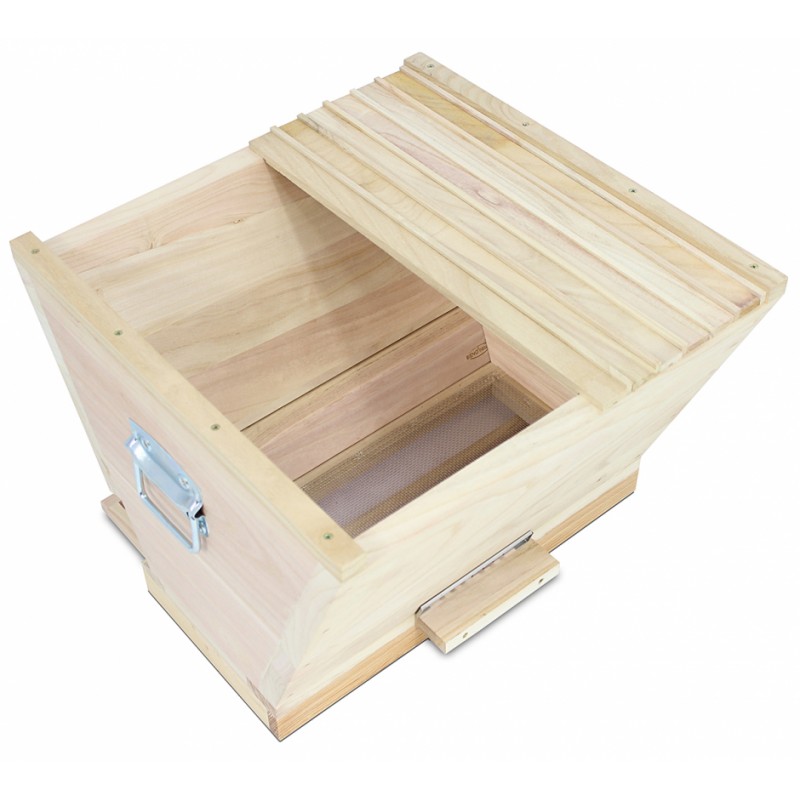
Horizontal Kenyan Top Bar hive made of wood, with all its elements. Mini size. Ideal for amateurs curious about this type of handling, not recommended for professional beekeepers.
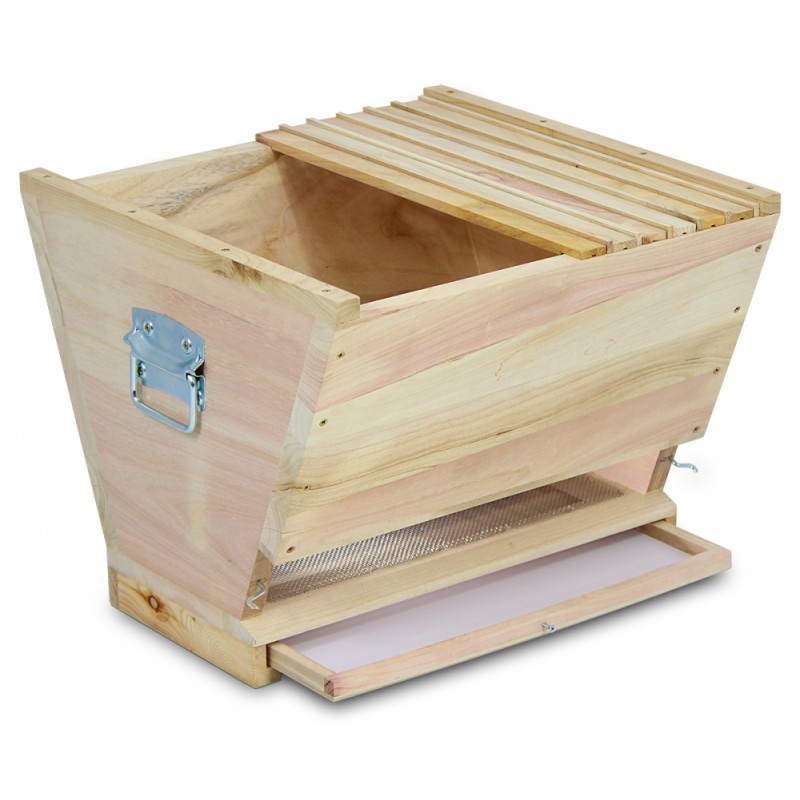
Kenyan top-bar hive with a V-shaped body and 13 unwired top bars. Includes open mesh floor with tray, reduced entrance, two handles, wooden inner cover and galvanised sheet roof. Measures 58 × 58 cm and 43 high.
Here the bees build the comb, they do not draw it on a foundation sheet. Every particularity of this hive follows from that, starting with its shape.
01 · WHY IT IS V-SHAPED
The bars are wider at the top than at the bottom, and the body narrows towards the floor. That slope lets the comb hang free and stick to the walls far less than it would in a straight-sided box.
It still sticks somewhat, and there is the first particular handling: to lift a bar you have to cut away with a hive tool whatever the bees have attached to the sides.
02 · NO WIRE, NO EXTRACTOR
They are bars, not frames: no wire and no foundation. Which means the comb will not take a centrifuge: it collapses.
The honey comes out by cutting the comb and pressing or draining it. It is a different method, not a worse one — but it is worth knowing that the resulting honey carries more particles and needs finer filtering, and that regulations recognise pressed honey as a designation of its own.
03 · HANDLE THE COMB VERTICALLY
An unwired comb holds itself only by its own weight hanging from the bar. Turn it flat to look at it, the way you would a Langstroth frame, and it breaks.
It comes out vertical, it is inspected vertical and it goes back vertical. In heat the wax is softer still, so in high summer you handle it as little as possible.
04 · SPACE IS MANAGED BY HAND
The hive does not grow upwards: it grows end to end. There are no supers, but there is work — the divider board is moved as the colony spreads, adding bars in front of it.
And after harvest you do the opposite: reduce the space so the bees warm less volume through the winter. Little material and little handling, but it asks you to keep an eye on space.
05 · WHO IT IS FOR
With 13 bars this is a small hive: enough for a hobby colony, for watching and for taking some honey and wax, not for producing. It needs no foundation, no wire, no supers and no queen excluder.
The approach is what it is: less honey and the comb lost at every harvest, but in exchange you get fresh wax and much lighter handling on the back, because you never lift a super.
06 · BEFORE YOU BUY
Ask us whether the divider board is included: the handling needs one and the contents list does not mention it.
| ✓ RIGHT FIT | Hobby beekeeping and observation, light handling and little kit. |
| ✕ WRONG FIT | Producing honey in volume or extracting with a centrifuge. |
| ⚠ NOT INCLUDED | Bees, hive tool or press. Ask about the divider board. |
| Reference | HOLT-2685-BR-2685 |
|---|---|
| Type | Kenyan top bar, horizontal development |
| Body | V-shaped, with 13 unwired bars |
| Includes | Open mesh floor with tray · reduced entrance · two handles · wooden inner cover · galvanised sheet roof |
| Does not need | Foundation, wire, supers or queen excluder |
| Extraction | Cutting the comb and pressing or draining — no centrifuge |
| Handling the comb | Always vertical: turned flat it breaks |
| External size | 58 × 58 cm · 43 cm high |
| Weight | 14 kg |
Horizontal Kenyan Top Bar hive made of wood, with all its elements. Mini size. Ideal for amateurs curious about this type of handling, not recommended for professional beekeepers.
check_circle
check_circle