 Apipasta with vitamins 15kg
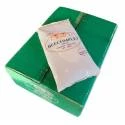 Beecomplet® Spring 14Kg
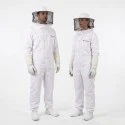 Beekeeper suit with round veil
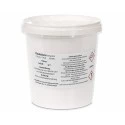 Oxalic acid 1kg
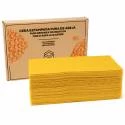 Beeswax Foundation 5kg
 Fresh royal jelly 20g
 Classic honey jar 1kg comb-lines TO77 - Pack of 16 units
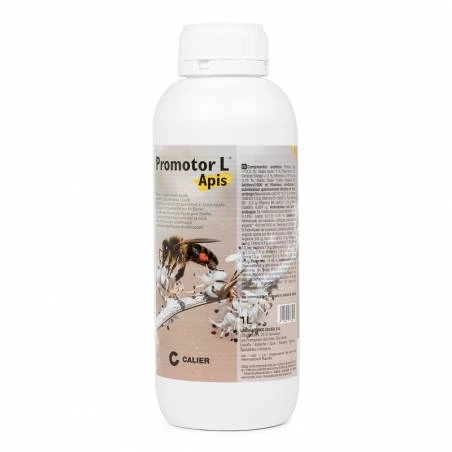
 Promotor L Apis 1 litre

 Share in WhatsApp
8 % CRUDE PROTEIN | 5 ml PER LITRE OF SYRUP |
100 L OF SYRUP PER 500 ML | 8 ESSENTIAL AMINO ACIDS |
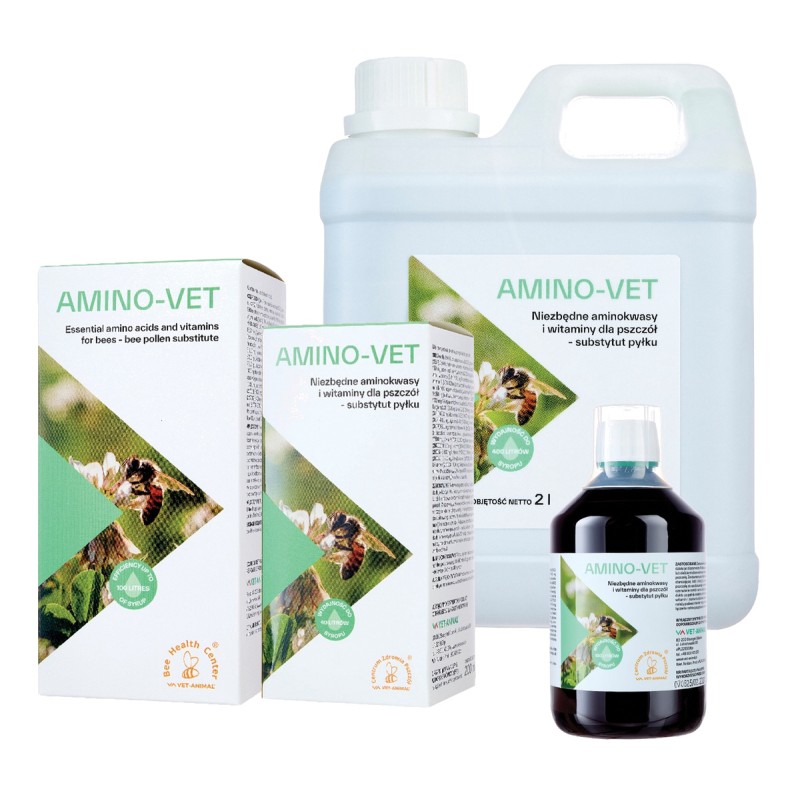
Liquid supplement of free amino acids, B-group vitamins and chelated iron to enrich the syrup or patty you are already feeding.
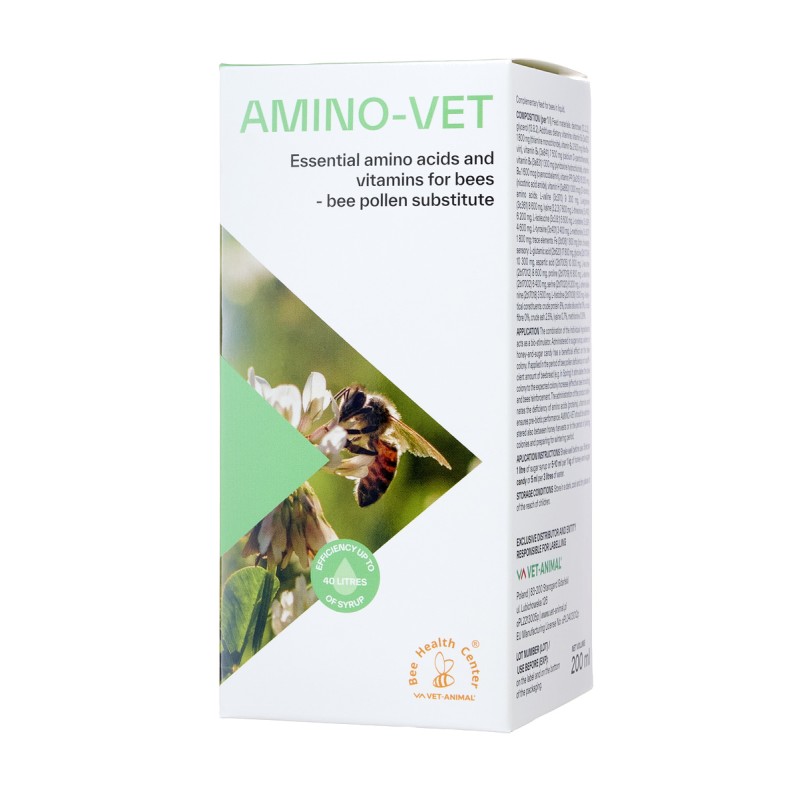
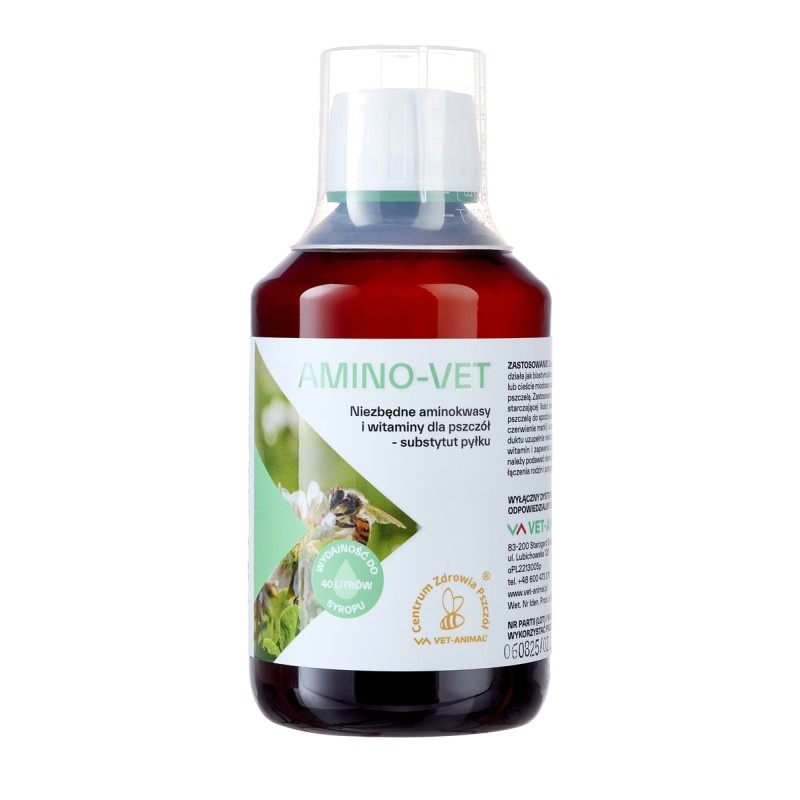
First, what it is, and what it isn’t. AMINO-VET is a liquid complementary feed made to enrich syrup or fondant you are already feeding. It is not a pollen replacement, and it’s not trying to be. When natural pollen is available, nothing beats it. But when pollen is short, or a colony is weakened and you want support without adding extra “processing work”, the liquid format helps deliver nutrients fast with less energy cost than a protein patty.
01 · WHEN IT IS NEEDED
When to use it: in three key windows where nutrition changes everything. In spring, when brood build-up runs ahead of pollen availability; between honey flows, to hold population through dearth; and in late-season prep for wintering, when you want well-nourished winter bees. The manufacturer indicates efficacy in pollen deficiency situations; if a colony is at zero reserves, this can help as a rapid intervention, but ideally you still correct the underlying protein gap as soon as you can.
02 · WHAT IS IN IT
The formula combines a complete amino acid profile (including essentials like valine, isoleucine, leucine, methionine, lysine, threonine, arginine and histidine), a full B-vitamin complex (B1, B2, B5, B6, B12, PP and biotin) and chelated iron. Together they act as nutritional support and a biostimulant, especially useful when pollen is scarce, bee bread is low, or the colony is just coming out of winter, treatments or environmental stress.
About the “cold number” many beekeepers ask for: the product declares 8% crude protein. At the standard rate of 5 ml per litre of syrup, that works out to roughly 0.4 g of crude protein per litre of enriched syrup. And here’s the key: AMINO-VET is not competing with protein patties on bulk protein. For grams of protein, you use pollen and patties. AMINO-VET plays a different role: free amino acids and vitamins that are immediately available, aimed at supporting metabolism and kick-starting a colony when it’s short, or when you don’t want to force a weak colony to process heavy protein feed. You notice it most when you need to “switch the colony back on” and stabilise it, not when you want to replace stores.
03 · HOW TO DOSE IT
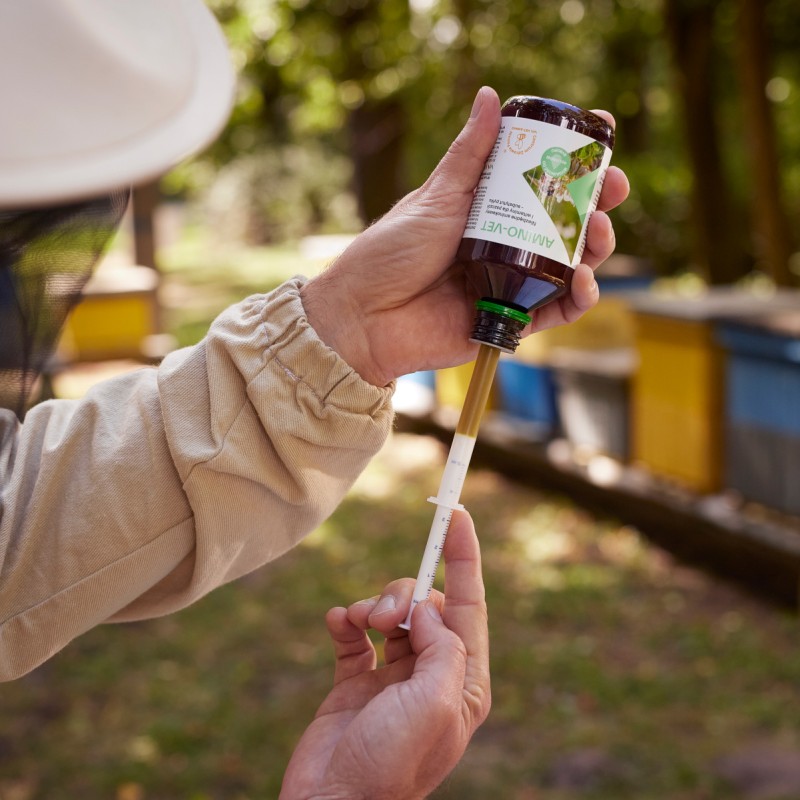
Dosage: mix 5 ml per litre of syrup you plan to feed. Alternatively, 5 to 10 ml per 1 kg of honey-sugar fondant/candy, or 5 ml per 3 litres of water. As a reference, a 200 ml bottle prepares up to 40 litres of enriched syrup, and 500 ml up to 100 litres. Dosage can be adjusted to colony condition; in severe deficiency, the manufacturer indicates the concentration can be increased.
04 · BEFORE YOU BUY
Available sizes: 200 ml and 500 ml.
| ✓ FITS | Enriching syrup or patty in spring, between flows and before wintering. |
| ⚠ NO SUBSTITUTE | For pollen or a protein patty: it does not compete on protein quantity. |
| LTA reference | AMINO-VET |
|---|---|
| Product | Liquid complementary feed for bees |
| Crude protein | 8 % |
| Essential amino acids | Valine, isoleucine, leucine, methionine, lysine, threonine, arginine and histidine |
| Vitamins | B1, B2, B5, B6, B12, PP and biotin |
| Other | Chelated iron |
| Standard dose | 5 ml per litre of syrup · 5-10 ml per kg of patty · 5 ml per 3 L of water |
| Emergency dose | 20 ml per litre of 1:1 syrup, per the maker · back to standard once stable |
| Coverage | 200 ml for 40 L of syrup · 500 ml for 100 L |
| Sizes | 200 ml and 500 ml |
check_circle
check_circle