 Apipasta with vitamins 15kg
 Beecomplet® Spring 14Kg
 Beekeeper suit with round veil
 Oxalic acid 1kg
 Beeswax Foundation 5kg
 Fresh royal jelly 20g
 Classic honey jar 1kg comb-lines TO77 - Pack of 16 units
 Promotor L Apis 1 litre

 Share in WhatsApp
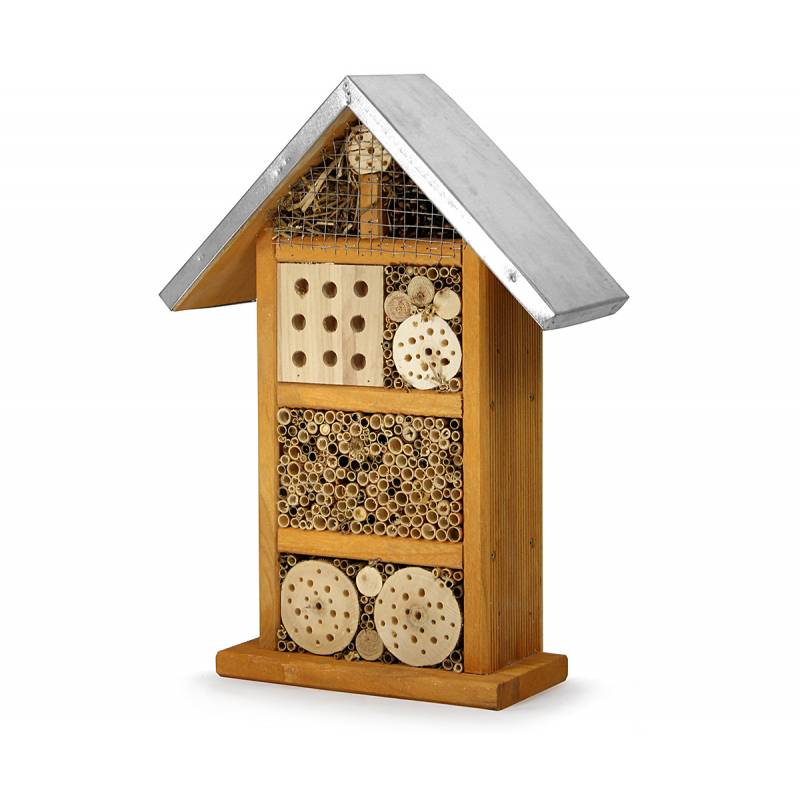
Attractive wooden insect and bee hotel for a wide variety of insects such as wild bees, ladybugs, wasps and the like.
Insect hotel in 24 mm timber with a galvanised roof, bamboo canes of several diameters, pine cones and straw. 44 × 14 cm, 59 cm tall and 5 kg.
What really gets occupied are the bamboo canes. The other compartments have tenants too, but it is worth knowing which before deciding what to expect of it.
01 · THE CANES ARE WHAT WORKS
The bamboo cavities, in several diameters, are the part that fills on its own: a solitary bee finds a tube of the calibre it is after, stocks it with pollen, lays an egg, walls it up and repeats. You can see it from outside: the ends end up sealed with mud or with cut leaf.
The central space, with its red compartment, mostly draws earwigs and lacewings. Butterflies appear in the leaflet of nearly every insect hotel and almost never use them: they overwinter in bark, leaf litter and sheds. That is no reason to rule it out, but a reason to buy it for the bamboo.
02 · SOLITARY BEES, NOT HONEY BEES
What occupies the tubes are solitary bees — mason and leafcutter bees above all — not the honey bee. Each female works on her own: no queen, no colony and no stores to defend, so they practically never sting.
As pollinators they are first rate: they carry dry pollen on the belly rather than packed on the legs, so they shed it flower by flower. That is why they are used in fruit growing.
Solitary wasps turn up too, and they are not the ones that bother you on the terrace: they hunt caterpillars and aphids and build no communal nest.
03 · WHERE TO HANG IT: THE MORNING SUN
A solitary bee needs warmth to fly. If the hotel gets the early sun — facing anywhere between east and south — the tubes warm up soon and the day starts earlier. Facing west it only gets the afternoon sun, and the cold mornings are lost.
The rest: sheltered from wind and driving rain, at 1.5 to 2 metres, and near flowers. The galvanised roof protects from above, but a hotel that takes the rain head-on rots from within.
04 · IT IS NOT AN INSECTICIDE
The lacewings and ladybirds that shelter there eat aphids, and that helps. But a hotel is not a control method: it does not wipe out a pest, it does not replace a treatment and its effect is not measured in one season.
What it does do, and it is not little, is settle pollinators and beneficial insects in a garden or a vegetable plot. You buy it for that, and because you can watch it work.
05 · BEFORE YOU BUY
Renew the canes every two or three years: a hotel that is never touched accumulates parasites and fungi, and ends up harming what it was meant to protect.
| ✓ RIGHT FIT | Settling pollinators and beneficials in a plot, a garden or beside a fruit tree. |
| ✕ WRONG FIT | Housing honey bees: those need a hive. |
| ⚠ IT DOES NOT | Control pests: it houses beneficials, it does not replace a treatment. |
| Reference | HOLT-2900 |
|---|---|
| Dimensions | 44 × 14 cm and 59 cm tall |
| Weight | Around 5 kg |
| Timber thickness | 24 mm |
| Roof | Galvanised sheet, weather protection |
| Materials | Wood, bamboo, pine cones and straw |
| Usual tenants | Solitary bees in the bamboo; earwigs and lacewings in the central compartment |
| Siting | Sunny and sheltered, at 1.5-2 m, with the morning sun |
| Maintenance | Renew the canes every 2 or 3 years |
Attractive wooden insect and bee hotel for a wide variety of insects such as wild bees, ladybugs, wasps and the like.
check_circle
check_circle