 Apipasta with vitamins 15kg
 Beecomplet® Spring 14Kg
 Beekeeper suit with round veil
 Oxalic acid 1kg
 Beeswax Foundation 5kg
 Fresh royal jelly 20g
 Classic honey jar 1kg comb-lines TO77 - Pack of 16 units
 Promotor L Apis 1 litre
- To order

 Share in WhatsApp
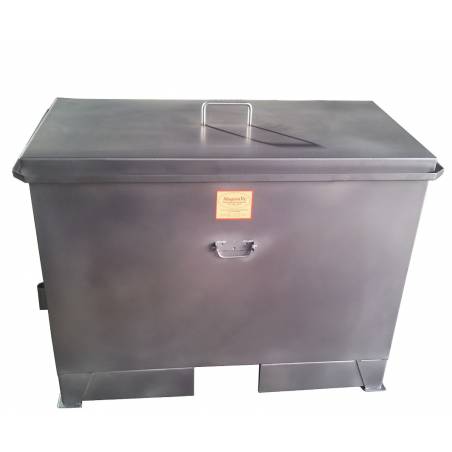
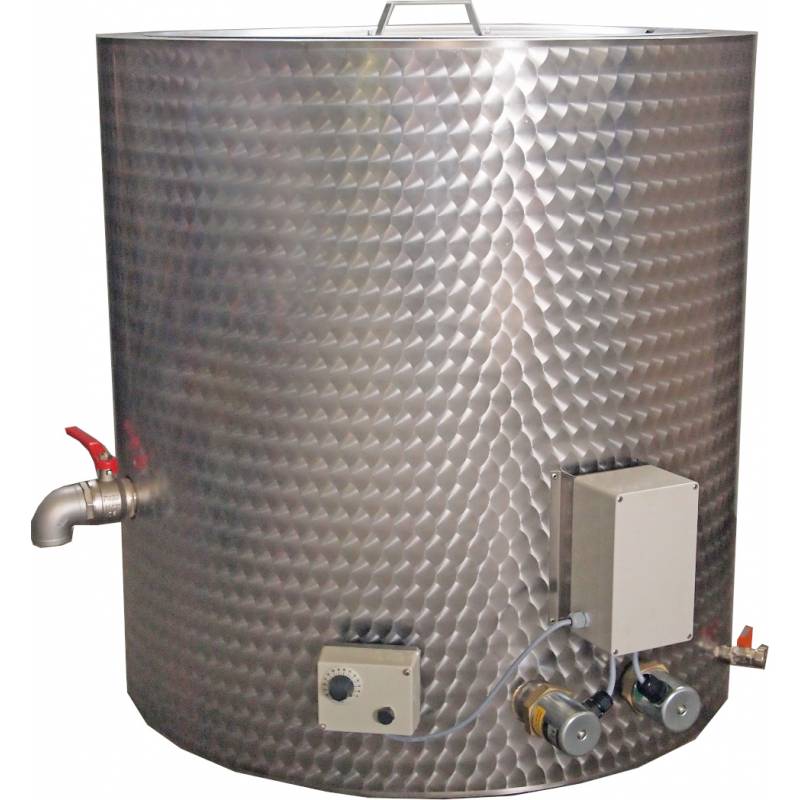
RIETSCHE 300-litre wax sterilising tank: heats to 125 °C by thermal oil, with a double safety thermostat.
Sterilising is not melting, and that is why this machine exists. Melting wax happens at a little over 60 °C. This tank works at 125 °C because its job is another one: to take wax to a temperature plain melting never reaches. Triple-walled with thermal insulation and 120 litres of oil in the chamber.
01 · 125 °C IS NOT FOR MELTING
Wax can carry spores that ordinary melting does not remove, and that is the reason a tank like this exists. It is used when wax comes in from outside, when the operation has a health history, or when material of unknown provenance is to be recycled.
The protocol — temperature and time — is set by the maker and, where the case calls for it, by the relevant health authority. The machine supplies what is needed to meet it: the capacity to take 250 kg of wax to that temperature and hold it there under control.
02 · AT THAT TEMPERATURE WAX DARKENS
This has to be said plainly, because it changes the product: beeswax begins to darken above 85 °C. At 125 it does not spoil, but it comes out darker than it went in.
In other words, sterilised wax does not go back to being pale virgin wax. Foundation sold as virgin wax starts from different raw material; this is for recovering and cleaning up stock, which is a different — and perfectly legitimate — decision.
03 · THE OIL IS THE BAIN-MARIE
The two 3 kW elements do not heat the wax directly: they heat the 120 litres of thermal oil in the inner tank, and it is the oil that spreads the heat through the wall. At 125 °C, an element in direct contact would create a spot far hotter than the mass.
Thermal oil is a consumable: it is checked and topped up over time. If you need a refill, order it with the machine.
04 · DOUBLE THERMOSTAT WITH CUT-OFF
Control is by double safety thermostat with cut-out, driven through a contactor. It is not a luxury: this is 250 kg of wax at 125 °C, and the failure of a single thermostat in that scenario is not a minor incident.
Consumption is 2 × 3 kW. And the common-sense precaution: wax at that temperature burns on contact, and is not handled without protection, nor is the tank left running unattended.
05 · 300 LITRES IS 250 KILOS
Capacity is 300 litres and 250 kg, and both figures are right at once: molten wax has a lower density than solid, around 0.82, and 300 litres at that density is exactly those 250 kilos.
The tank measures Ø 907 × 935 mm, is built in 1.4301 stainless steel, inert-gas welded and grained, and carries an aluminium lid. It is also the sterilising tank RIETSCHE offers as an option on its foundation stations.
06 · BEFORE YOU BUY
Wax sanitation, not ordinary melting.
| ✓ A GOOD FIT | Treating 250 kg of wax at 125 °C, with a double safety thermostat. |
| ⚠ IT ASKS FOR 6 KW AND THERMAL OIL | Two 3 kW elements and 120 litres of oil in the chamber, which is a consumable. |
| ✕ IT DOES NOT RETURN PALE WAX | At 125 °C wax darkens. It comes out sanitised, not virgin: pale foundation starts from other raw material. |
| Function | Wax sterilisation |
|---|---|
| Working temperature | 125 °C |
| Wax capacity | 300 litres · 250 kg |
| Thermal oil | 120 litres in inner tank |
| Construction | Triple wall with thermal insulation |
| Elements | 2 × 3 kW, 50 Hz |
| Control | Double safety thermostat with cut-out, via contactor |
| Thermostat range | Up to 150 °C |
| Outside diameter | 907 mm |
| Overall height | 935 mm |
| Material | 1.4301 stainless steel, inert-gas welded, grained |
| Lid | Aluminium |
| Built by | Rietsche, Germany |
| Reference | RKK300e |
Data sheet
1 file available
Write your question
check_circle
check_circle