 Apipasta with vitamins 15kg
 Beecomplet® Spring 14Kg
 Beekeeper suit with round veil
 Oxalic acid 1kg
 Beeswax Foundation 5kg
 Fresh royal jelly 20g
 Classic honey jar 1kg comb-lines TO77 - Pack of 16 units
 Promotor L Apis 1 litre

 Share in WhatsApp
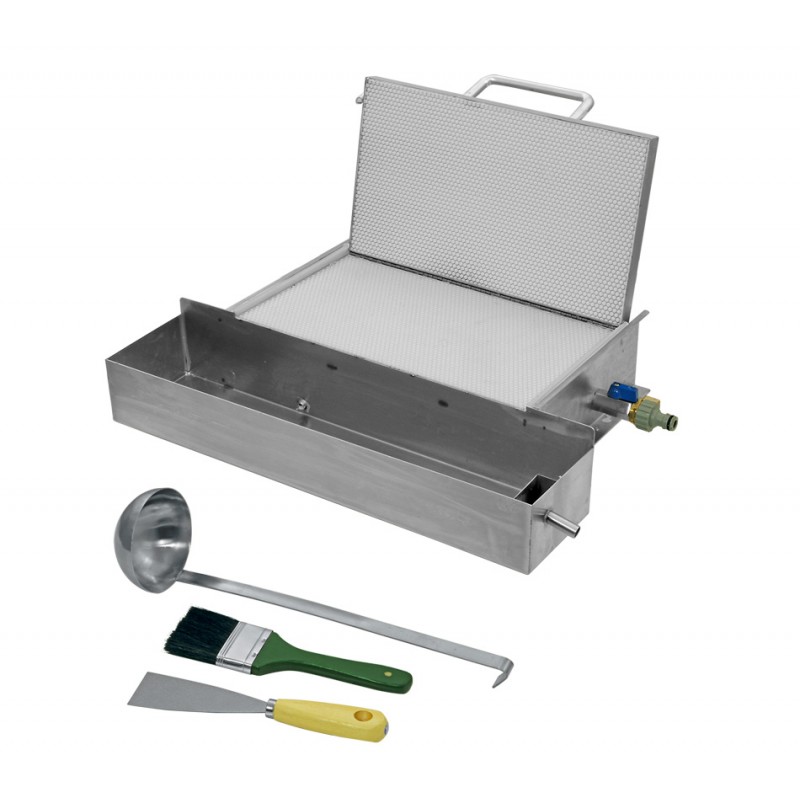
The beeswax foundation machine is an essential tool for beekeepers who want to produce high-quality foundation sheets efficiently and with precision.
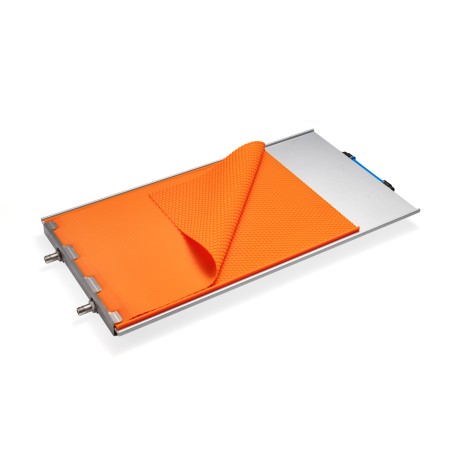
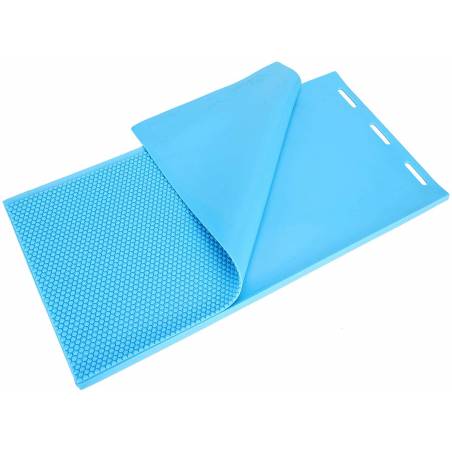
German stainless-steel mould with silicone rubber matrices and water cooling on both faces: pour in the molten wax, close it, cool it and lift out a finished foundation sheet, already cut to size.
Making your own foundation is the only thing that closes the wax cycle. What you melt from your own cappings goes back into your own hives without passing through anyone else's batch, with an embossing and a thickness you decide.
01 · HOW THE SHEET COMES OUT
Molten wax is poured onto the lower matrix at around 75 °C, the mould is closed, and the water takes the heat out through both faces at once. As soon as it sets, you open it and the sheet lifts out whole.
That circuit is the difference between making foundation and fighting it. An uncooled mould builds up heat: by the third or fourth sheet the silicone is warm, the wax is slow to set and the sheet comes out soft or stuck. With water running, the matrix returns to the same temperature every time — hence the up to 60 sheets an hour.
It is an open circuit, with no pump and no tank: you need a tap near the bench.
02 · TEMPERATURE
Beeswax melts between 62 and 65 °C. Pour it barely melted and it starts setting before it has filled the bottom of the cells, so the hexagon comes out blunt. Going the other way is no better: sustained above about 85 °C wax darkens and loses its scent, and the hotter it goes in, the more it shrinks as it cools.
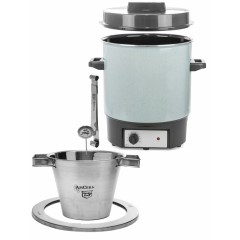
The comfortable window is that 75 °C. If you melt in a water bath the water can reach 100 °C, so let the wax come down before you fill the ladle. And fresh sheets are stacked flat; left hanging, they curl as they finish cooling.
03 · NO CONSUMABLES
Plaster moulds and roller mills need a release agent applied on every pass, which runs out and has to be dosed so that none of it stays in the wax. A silicone rubber matrix needs none: the sheet releases on its own.
One less consumable to reorder and one less thing that can end up in the comb. Since the frame is stainless, cleaning comes down to scraping off cold wax.
04 · MOULD OR ROLLERS
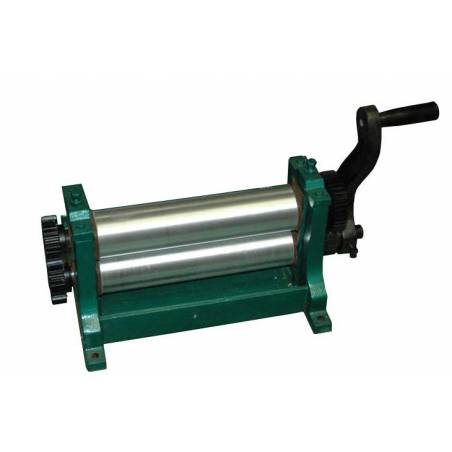
Sixty Dadant sheets an hour is on the order of 5 to 6 kg of wax. A roller mill multiplies that figure, but it needs a wax ribbon or slab made beforehand; the mould goes from liquid wax to finished sheet in one movement.
| RuBee® mould | Roller mill | |
|---|---|---|
| Starting point | Molten wax | Ribbon or slab, already formed |
| Output | ~60 sheets/hour | Up to 18 kg/hour on the Mini RIETSCHE® |
| Size | Fixed, set by the mould | Trimmed to size |
| Release agent | No | Yes |
For anyone making their own foundation in batches, the mould is plenty: the roller mill starts paying off when wax is counted in hundreds of kilos.
05 · SIZE AND CELL
The matrix is fixed: you choose the format when you order. We stock two, Langstroth 42 × 20 cm and Dadant 42 × 27 cm, and the sheet comes out already the size of the frame, with nothing to cut.
The cell is standard worker size, 5.4 mm. There is no 4.9 mm small-cell version: if your management depends on that, this is not the machine.
06 · BEFORE YOU BUY
A foundation mould is bought for its format and for the bench it will stand on, not from a catalogue photo.
| ✓ FITS | If you melt your own wax and want it back in the hive as foundation, with a tap near the bench. |
| ✕ DOESN'T FIT | If you want 4.9 mm small cell, another frame format, or continuous output measured in kilos per hour. |
| ⚠ NOT INCLUDED | The wax, the garden hose and the melter you pour from. The manufacturer's manual is in German. |
| System | Two-matrix silicone mould, water-cooled top and bottom |
|---|---|
| Output | Up to 60 sheets per hour |
| Sheet sizes | Langstroth 42 × 20 cm · Dadant 42 × 27 cm (choose one) |
| Cell size | 5.4 mm, standard worker |
| Materials | Stainless steel frame and fittings · silicone rubber matrices |
| Cooling | Open water circuit; hose connector included |
| Pouring temperature | Wax at around 75 °C |
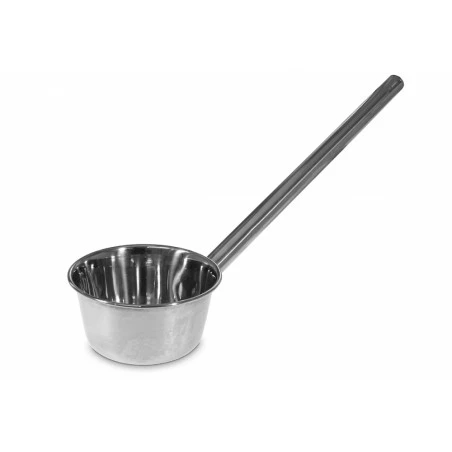
| Included | Hose connector, large ladle, spatula and brush |
| Release agent | Not needed |
| Made in | Germany |

The beeswax foundation machine is an essential tool for beekeepers who want to produce high-quality foundation sheets efficiently and with precision.
check_circle
check_circle