 Apipasta with vitamins 15kg
 Beecomplet® Spring 14Kg
 Beekeeper suit with round veil
 Oxalic acid 1kg
 Beeswax Foundation 5kg
 Fresh royal jelly 20g
 Classic honey jar 1kg comb-lines TO77 - Pack of 16 units
 Promotor L Apis 1 litre

 Share in WhatsApp
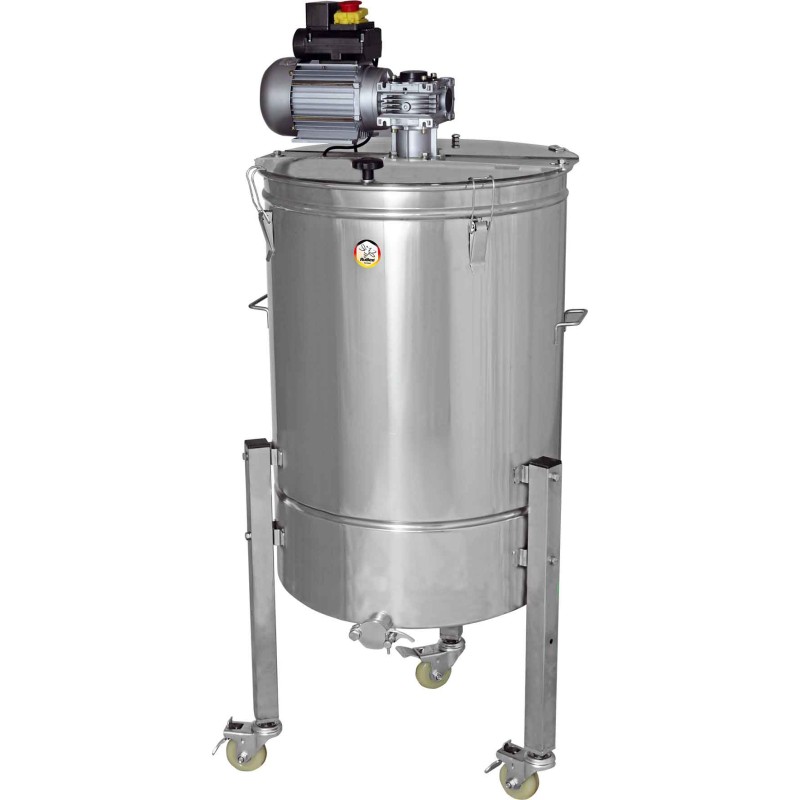
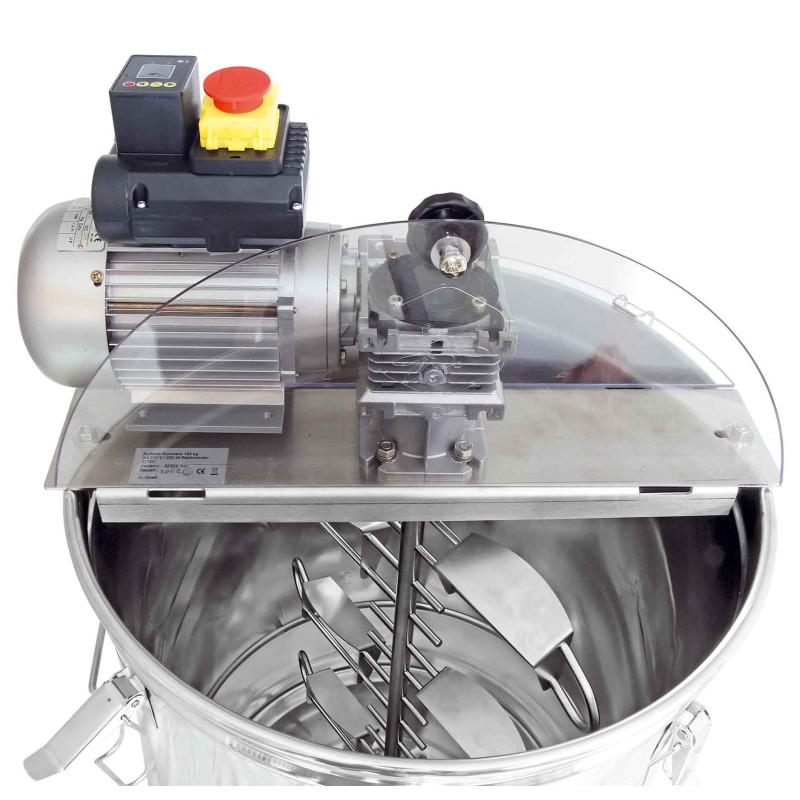
Professional 185 kg honey creamer with 750 W motor, 33 rpm slow mixing and an adjustable timer to produce smooth, fine-grain creamed honey with consistent texture and minimal aeration. Great for large batches, blending and controlled crystallization.
185 kg creamer with a 750 W motor, timer and slow 33 rpm stirring for fine-grained creamed honey.
The problem is not that honey crystallises: it is that it crystallises out of control. Coarse grain, jars that change texture from one batch to the next, and a customer who does not come back. This machine makes the process repeatable. The 185 kg tank is about 132 litres — honey weighs 1.4 kg per litre — and some 370 half-kilo jars per load.
01 · FILTER, REST AND SKIM
Filter, fill the tank and leave it to rest for a couple of days — with rape one is usually enough — so the foam and fine particles rise. Then skim the top.
Skipping that step is what separates a clean creamed honey from one that bubbles in the jar. The outlet is level with the bottom: without it half a kilo stays stuck at every emptying, because there is no way to tip 185 kg.
02 · SHORT CYCLES, NOT CONTINUOUS
Creamed honey does not come from leaving the motor on: it comes from repeating short cycles over several days. That is exactly what the timer is for.
Continuous stirring does not improve the result and does heat the honey by friction, which is the opposite of what you want. The 33 rpm is honey speed: it distributes the microcrystals without whipping or aerating.
03 · NEVER SEED INTO HOT HONEY
If you are starting from melted honey, or want to shorten the timeline, seed with very fine-grained creamed honey. How much you need depends on how well it is distributed: with a paddle creamer around 2-3 % is enough, while stirring by hand takes considerably more.
Temperature is the critical point. With the honey too warm you dissolve the very microcrystals you have just added and lose control: the batch recrystallises coarser or separates.
04 · 20-22 °C TO WORK, 14 IN THE JAR
Run the cycles with the mass at around 20-22 °C, where honey moves without needing heat. If it comes in cold and hard, warm it just enough to stir and bring it back into range.
Once jarred it is another story: in the jar, fine crystal forms fastest at around 14 °C, and that is where the first days should be spent. The moment to jar is when the mass looks uniform in colour and texture; overrun it and it turns pasty with a damp surface.
05 · PRECAUTIONS
The equipment is intended exclusively for honey and beeswax, and operation is only permitted under supervision. It must never be left running unattended, especially with the heating accessories fitted.
Those accessories are separate and are for tempering, not cooking: overheat and the fine crystals dissolve and the batch loses its texture.
06 · BEFORE YOU BUY
A process machine, not a bottling one.
| ✓ A GOOD FIT | Batches up to 185 kg (about 132 litres) creamed in cycles over several days. |
| ⚠ HEATING NOT INCLUDED | The heating accessories are separate. The machine does not temper on its own. |
| ✕ NOT TO BE LEFT UNATTENDED | Honey and beeswax only, and always supervised while running. |
| Capacity | 185 kg (about 132 litres) |
|---|---|
| Motor | 750 W with adjustable timer |
| Stirring speed | About 33 rpm |
| Paddles | Blade type, adjustable |
| Outlet | Bottom, level with the base |
| Lids | Two, plastic |
| Tank diameter | 515 mm |
| Height to tank rim | 112 cm |
| Overall height with motor | 142 cm |
| Weight | About 46 kg |
| Heating | Accessories available separately |
| Reference | BR-31325 |
Write your question
Professional 185 kg honey creamer with 750 W motor, 33 rpm slow mixing and an adjustable timer to produce smooth, fine-grain creamed honey with consistent texture and minimal aeration. Great for large batches, blending and controlled crystallization.
check_circle
check_circle