 Apipasta with vitamins 15kg
 Beecomplet® Spring 14Kg
 Beekeeper suit with round veil
 Oxalic acid 1kg
 Beeswax Foundation 5kg
 Fresh royal jelly 20g
 Classic honey jar 1kg comb-lines TO77 - Pack of 16 units
 Promotor L Apis 1 litre

 Share in WhatsApp
Caging the queen is not shutting her away: it is letting all the brood emerge so the mite is left out in the open.
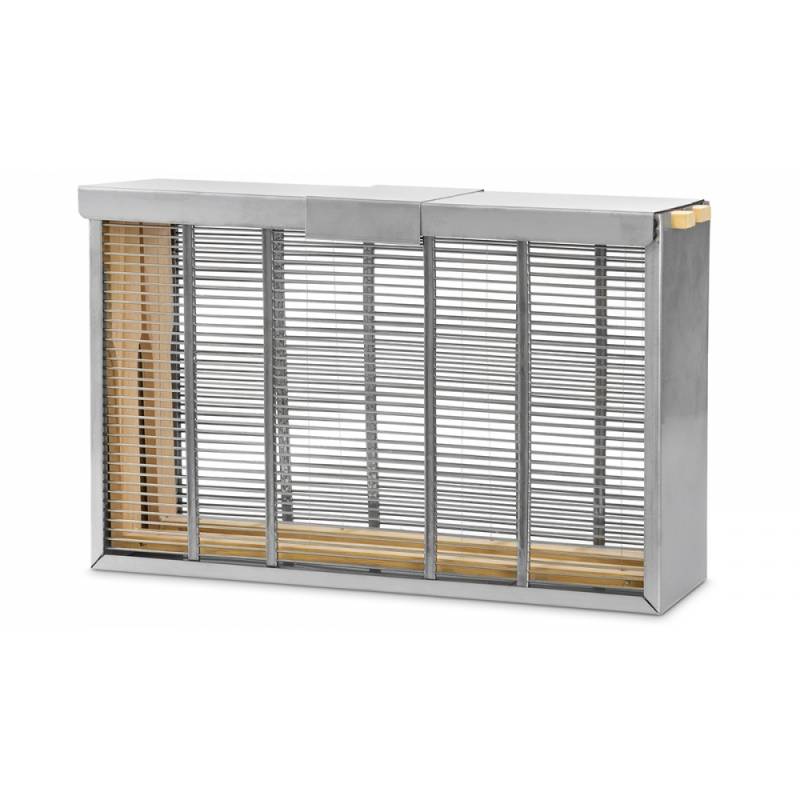
European two-frame isolation cage in galvanised steel, with a removable metal lid. Compatible with Layens, Langstroth and Dadant frames.
01 · THE PRINCIPLE
The point of caging is to force varroa into the complete phoretic phase: if all the sealed brood emerges and not one cell is left capped, the mite has nowhere to go but onto the adult bees, where treatment does reach it.
That is why duration is what matters: 24 days as a minimum, and up to 28 if the colony had drone brood, which takes longer to emerge. Any less and the brood is not fully cleared — and a handful of sealed cells is enough to take much of the point away.
And one thing to be clear about: the cage is a management tool. The treatment that follows uses a registered medicine, and the dose, the season and the route come from its datasheet, not from the cage.
02 · WHY TWO FRAMES AND NOT ONE
In a narrow cage the queen tends to move only along the edges, loses her rhythm, and her laying shuts down abruptly after a day or two. When she is released, recovery is slow and the pattern comes back irregular.
With two frames she keeps a natural movement over the comb and goes on laying small batches through the first days. The difference shows a week after release: a compact, confident pattern instead of a hesitant restart.
03 · NURSE BEES AND HEAT
Nurse bees need surface to walk on, to feed and to fan. In a one-frame cage they pile up against the mesh and drive up humidity and temperature; the colony answers by over-ventilating and getting jumpy.
With two frames they spread out, fan efficiently and the nest holds its temperature. That is what makes the method work on strong July colonies — precisely the ones that cope worst with a small cage.
04 · WHAT ELSE IT IS FOR
Beyond varroa control, the same device serves to renew combs — the queen lays where you decide — and to make up nuclei with better acceptance, because the queen arrives protected and with a space of her own.
It is galvanised steel with a removable metal lid: one of those pieces of kit that lasts more than fifteen years in the apiary if it is stored dry.
05 · BEFORE YOU BUY
It is a two-frame cage, with what that implies in space:
| ✓ FITS | Layens, Langstroth and Dadant frames · strong colonies. |
| ✕ DOESN'T FIT | As a treatment in itself: the medicine goes separately and its datasheet governs. |
| ⚠ NOT INCLUDED | Frames or the medicine for the treatment that follows. |
| Capacity | 2 frames |
|---|---|
| Material | Galvanised steel |
| Lid | Metal, removable |
| Compatibility | Layens, Langstroth and Dadant frames |
| Caging period | 24 days minimum · up to 28 if there was drone brood |
| Uses | Biotechnical varroa control · comb renewal · making up nuclei |
| Durability | More than fifteen years |
| Reference | PO51101 |
Data sheet

check_circle
check_circle