 Apipasta with vitamins 15kg
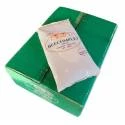 Beecomplet® Spring 14Kg
 Beekeeper suit with round veil
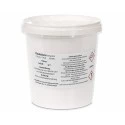 Oxalic acid 1kg
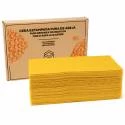 Beeswax Foundation 5kg
 Fresh royal jelly 20g
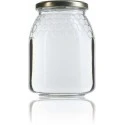 Classic honey jar 1kg comb-lines TO77 - Pack of 16 units
 Promotor L Apis 1 litre

 Share in WhatsApp
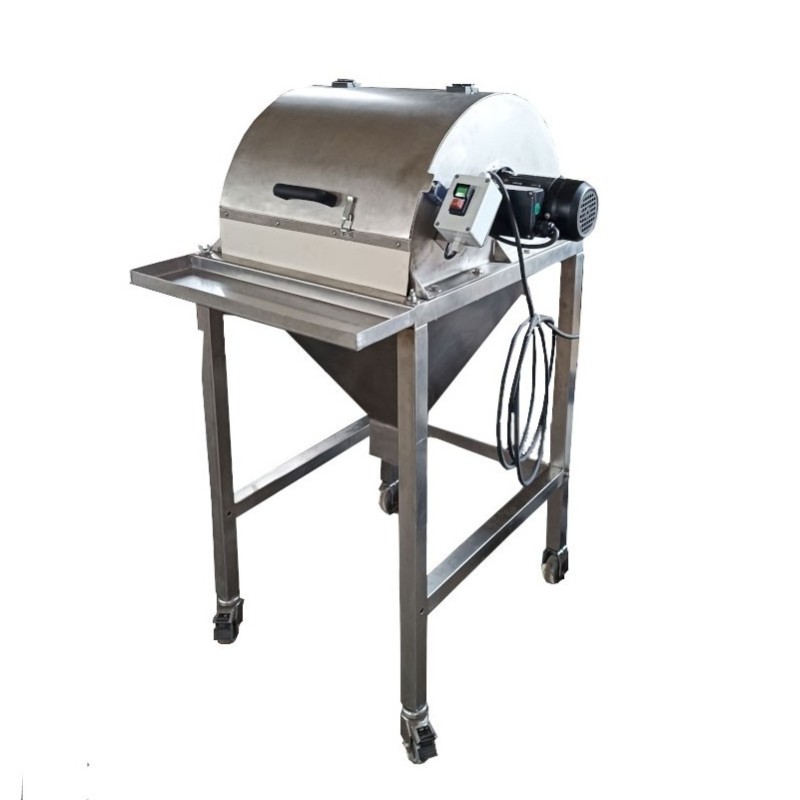
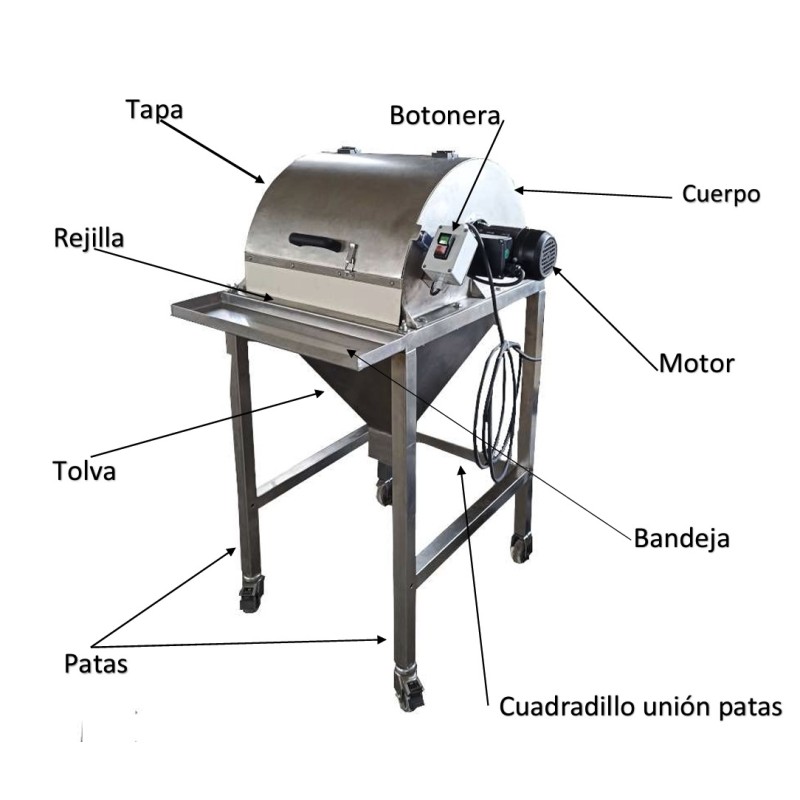
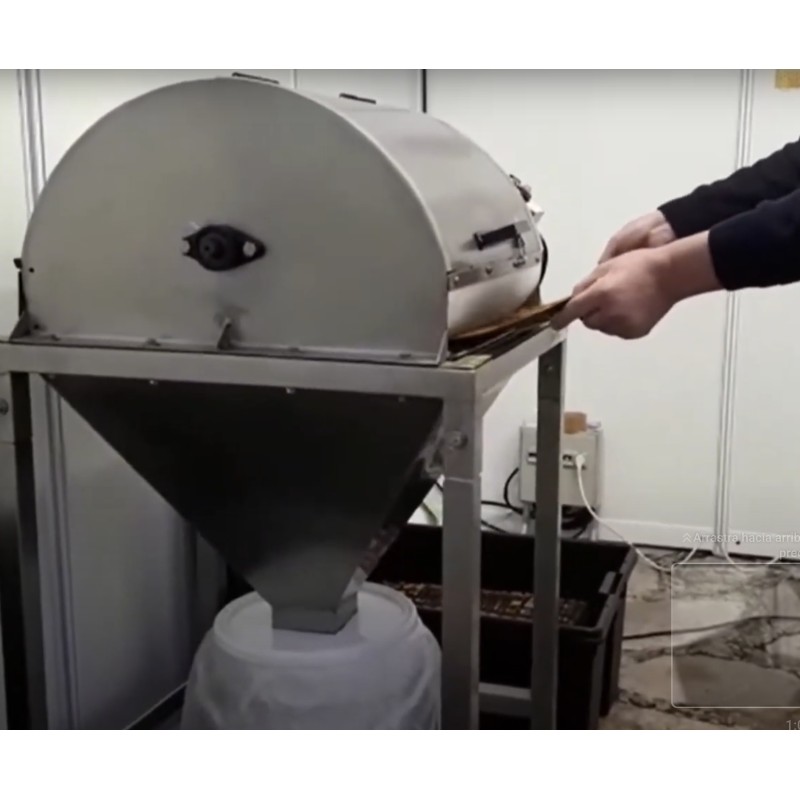
Automatic propolis extractor for collecting grids: a roller of stiff bristles beats the grid and releases the propolis, 70 to 80 grids an hour.
What it removes is the freezer, not the cold. The traditional method means freezing the grid so the propolis turns brittle and flakes off. This machine beats it instead of breaking it with cold, using a roller of stiff bristles that does not damage the grid. Stainless frame and food-grade plastics.
01 · NO FREEZING, BUT KEEP IT COOL
Not needing a freezer does not mean temperature is irrelevant. Propolis is sticky when warm and brittle when cold: at 30 degrees in the shed it smears, at 10 it comes off clean.
So the practical advice is to work in the cool part of the day or in a cold room. The machine saves you the freezer and the waiting time, not the physics of the material.
02 · IT COSTS 1,100 GRIDS
A collecting grid costs a little over two euros. What this extractor costs would buy more than a thousand grids, so the question is not whether it works: it is how many grids you harvest a year.
At 70-80 grids an hour, two hundred grids are cleaned in under three hours, once a year. Below that order of magnitude, the freezer and a bag are still the method. This is for anyone harvesting grids by the hundred.
03 · IT BEATS, IT DOES NOT SCRAPE
The roller carries stiff bristles that strike the surface and release the propolis by vibration. There is no blade or scraper against the plastic, which is what ends up deforming and cracking grids when it is done by hand.
The motor has a speed inverter: a heavily loaded grid with hard propolis does not ask for the same as a light one. That adjustment is the real handling of the machine.
04 · A SLOPED TRAY UNDERNEATH
The released propolis falls into a sloped collecting tray that gathers it at one point. It is a minor detail until you process eighty grids in a row and have to sweep the shed.
The unit measures 800 × 850 mm on the floor and 1,300 mm tall and weighs 50 kg. Supply at 230 V, with a specified 30 mA residual-current protection, and CE marking.
05 · IT COMES FULLY APART
Every component is removable. Working with a resin that sticks to whatever it touches and is then sold on, being able to open the machine and clean it thoroughly is part of the equipment, not an extra.
The plastics are food-grade and the frame is stainless steel. If the propolis is destined for food or cosmetic use, that is the starting condition.
06 · BEFORE YOU BUY
Count how many grids you harvest a year.
| ✓ A GOOD FIT | Harvesting grids by the hundred: 70-80 grids an hour with no freezer and no damage to the plastic. |
| ⚠ COLD STILL HELPS | No freezing needed, but propolis smears when warm. Work in a cool room. |
| ✕ IT DOES NOT PAY WITH FEW GRIDS | It costs what over a thousand grids cost. With two hundred, the freezer and a bag are still the method. |
| Function | Release propolis from collecting grids |
|---|---|
| System | Stiff-bristle roller, by percussion |
| Capacity | 70 to 80 grids an hour |
| Prior freezing | Not required |
| Motor | With speed inverter |
| Collection | Sloped collecting tray |
| Frame | Stainless steel |
| Plastics | Food-grade |
| Dimensions | 800 mm wide · 850 long · 1,300 tall |
| Supply | 230 V, with 30 mA residual-current protection |
| Maintenance | Fully dismountable |
| Marking | CE |
| Weight | 50 kg |
| Reference | 1002334 |
1 file available
check_circle
check_circle