 Apipasta with vitamins 15kg
 Beecomplet® Spring 14Kg
 Beekeeper suit with round veil
 Oxalic acid 1kg
 Beeswax Foundation 5kg
 Fresh royal jelly 20g
 Classic honey jar 1kg comb-lines TO77 - Pack of 16 units
 Promotor L Apis 1 litre
- Out of stock

 Share in WhatsApp
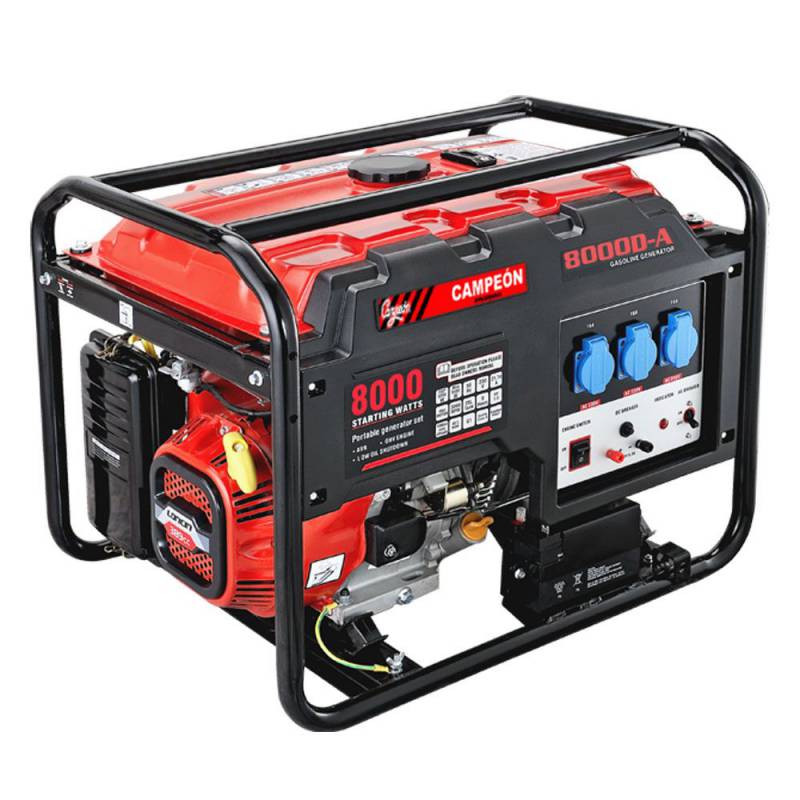
Genset of the Spanish brand Champion ideal for working in the field with two honey extractors in parallel.
Single-phase 6 kVA generating set with a 12 hp petrol engine and a 25-litre tank.
It is what takes the honey house to the field. Six kilovolt-amperes at 230 V, with a panel of three sockets, main switch, voltmeter and ammeter. Four-stroke 420 cc engine at 3,000 rpm, with oil alert and a 12 V DC output for charging batteries.
01 · 6 KVA GOES A LONG WAY FURTHER
It helps to put the figure against what actually gets plugged in. An electric honey-house extractor draws between 150 and 400 W depending on model; a professional transfer pump about 1,500 W; a bottler much the same. With 6,000 W available, two extractors do not come near the limit.
Where the sum does matter is with heated equipment: a heated-blade uncapper asks for around 2,800 W and a heated maturer 3,000. One of them fits comfortably; two at once take the whole set.
02 · STARTING ASKS MORE THAN RUNNING
An electric motor draws several times its running consumption at the instant it starts. That is why a set can drive one machine comfortably and drop out when the second one starts.
The practical rule is simple: start motors one at a time and let each reach speed before bringing in the next. With purely resistive loads — heating elements — the problem does not exist: they draw their nameplate figure from the first second.
03 · NINE HOURS, BUT AT PART LOAD
Declared autonomy is 9 hours on the 25-litre tank, which works out at about 2.8 litres an hour. Like all autonomy figures, it corresponds to partial load: ask it for the full 6 kVA continuously and consumption rises while the hours fall.
For a day's extraction in the field with the set working at half its capacity, nine hours cover the whole day without refuelling. Starting is manual, by pull cord: on a 12 hp engine that is worth bearing in mind if whoever uses it is not expecting the effort.
04 · 97 dB IS NOT A SILENT SET
The declared level is 97 dB(A) sound power. This is not one of the inverter sets called silent: it is a 420 cc petrol engine working at 3,000 revolutions, and you hear it.
In practice that means placing it away from the working area, with the hose or extension cable making up the distance, and bearing in mind noise restrictions if the site is near housing.
05 · PRECAUTIONS
It is a petrol engine and must not be run in an enclosed space or a poorly ventilated one, not even with the door ajar. Use it outdoors or with the building open, and refuel with the engine stopped and cold.
The 12 V, 8.3 A DC output lets you charge batteries in the field, which is exactly what battery-powered equipment needs — a syrup distribution pump, for instance — when the day runs long.
06 · BEFORE YOU BUY
Electrical autonomy for fieldwork.
| ✓ A GOOD FIT | Field extraction, pumps and bottlers. 6 kVA at 230 V with nine hours of autonomy. |
| ⚠ PULL START AND 97 dB | By cord, on a 12 hp engine. And it is loud: site it away from the working area. |
| ✕ NOT FOR USE INDOORS | Petrol engine: outdoors or with plenty of ventilation, always. |
| Type | Single-phase generating set |
|---|---|
| Output | 230 V · 50 Hz |
| Power | 6 kVA nominal · 6.5 kVA maximum |
| Engine | Four-stroke petrol, 420 cc, 12 hp, 3,000 rpm |
| Starting | Manual |
| Tank | 25 litres |
| Autonomy | 9 hours (at partial load) |
| Sound level | 97 dB(A) sound power |
| Panel | 3 sockets, main switch, voltmeter and ammeter |
| DC output | 12 V · 8.3 A |
| Protection | Oil level alert |
| Reference | CT8000A |
Data sheet
Genset of the Spanish brand Champion ideal for working in the field with two honey extractors in parallel.
check_circle
check_circle