 Apipasta with vitamins 15kg
 Beecomplet® Spring 14Kg
 Beekeeper suit with round veil
 Oxalic acid 1kg
 Beeswax Foundation 5kg
 Fresh royal jelly 20g
 Classic honey jar 1kg comb-lines TO77 - Pack of 16 units
 Promotor L Apis 1 litre

 Share in WhatsApp
40 × 26.5 × 16.5 cm OUTER DIMENSIONS | 1.5 kg MAXIMUM OF BEES |
2 faces OF VENTILATING SCREEN | 1 port THE ONLY WAY IN AND OUT |
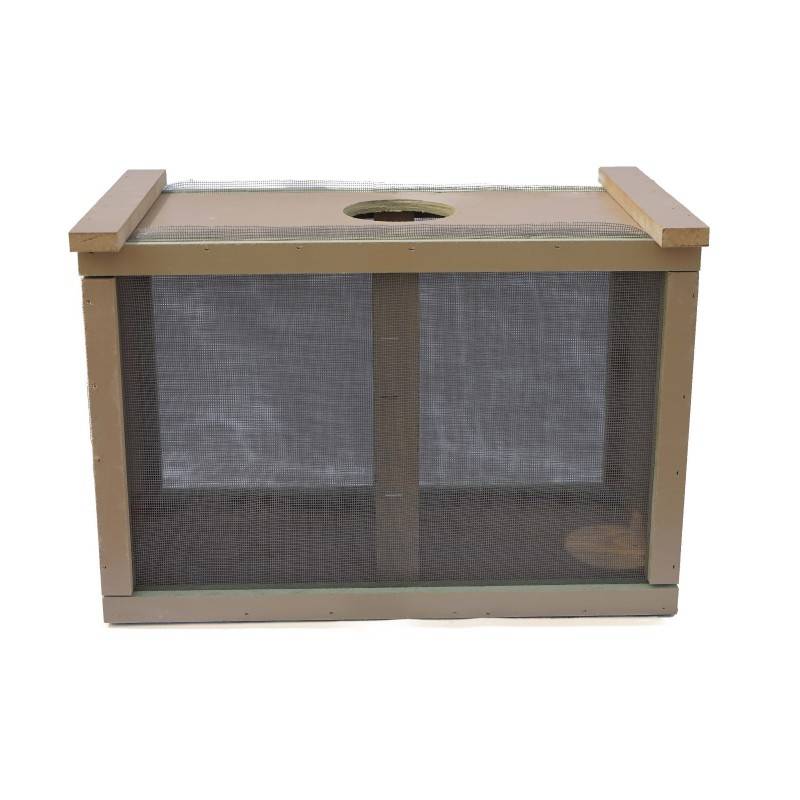
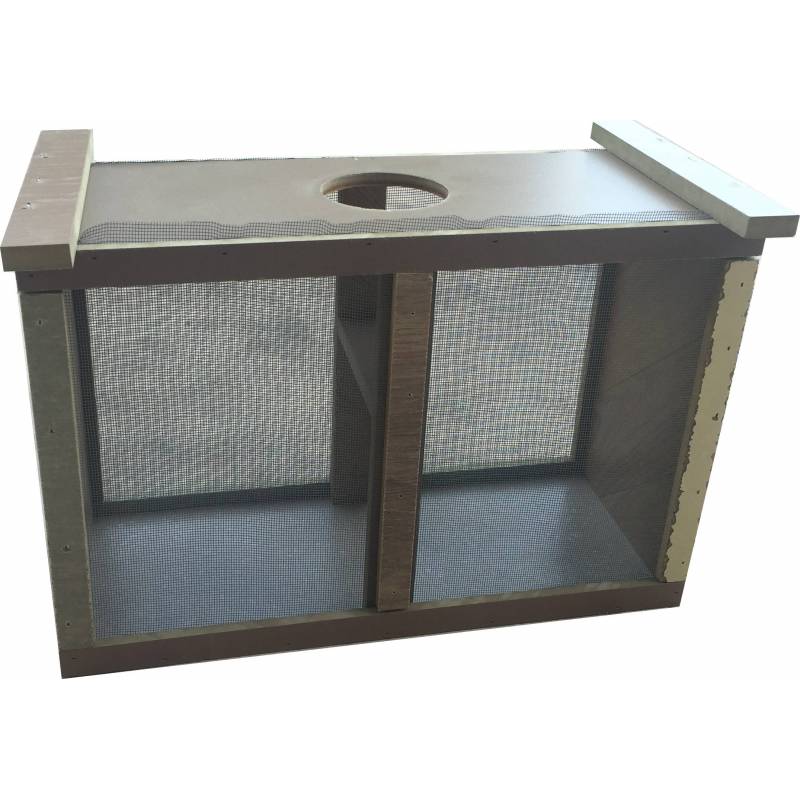
A cage for making up and moving package bees: a frame of water-repellent laminated HDF board, two screened faces and a top port for filling and feeding.
This is not a closed box. The two large faces are screen, and that is the whole design: 1.5 kg of loose bees give off heat and moisture, and without a ventilated surface to cluster on the journey goes wrong. The board is reduced to a frame: lid, floor, ends and battens.
01 · VENTILATION
Both 40 × 26.5 cm faces are covered in screen, front and back. The bees cluster against the mesh and breathe through both sides at once, which is what lets a package sit for hours on the road.
02 · TOP PORT
The lid has a round hole drilled in the centre. The funnel goes in there when you shake frames to make up the package, and that is where you close it afterwards: with a board cut to size or, better, with an inverted jar that doubles as a feeder. The lid is not meant to be opened, so that port is the only way into the box and the only way out.
03 · FEEDER
The jar is inverted over the hole and rests on its body, not on its lid, so what decides is the body diameter: it has to cover the hole with room to spare. The one used here is the 500 g plastic jar, Ø 88 mm, which covers it with a wide margin. Narrower containers cut it fine — 250 g jars run about Ø 71 mm and a half-kilo glass jar about Ø 75 mm — so try them on the empty box before you trust them with 1.5 kg of bees: a jar that slips through drops into the package. It is not supplied, and is only needed if the bees stay confined for long.
04 · TRANSPORT
Each face carries a vertical batten on the outside that stands proud of the screen, and the lid carries two more, one at each end, overhanging the outline. That stops the mesh being crushed against another cage or against the side of the van, and gives you somewhere to grip without pushing your fingers into the screen.
05 · BEFORE YOU BUY
This is a cage for MAKING packages: you fill it by shaking bees off the frames through a funnel, and empty it by tipping them into the destination hive. It is not a nucleus box: there is no rebate or runner for frames of any format, and a Dadant Blatt top bar alone measures 47 cm, a Dadant US one 48 cm — neither goes in lengthways along the 40 cm of the box. Nor is it the tool for collecting a swarm settled on a branch.
| ✓ RIGHT FOR | Making up and moving loose package bees of up to 1.5 kg: artificial swarms, selling bees, restocking hives. |
| ✕ NOT FOR | Frames of any format (Dadant Blatt, Dadant US, Langstroth, Layens), collecting settled swarms and moving an established colony. |
⚠ There are live bees inside: both screened faces must stay clear. Do not stack the cages face to face without the battens between them, and do not wrap them in plastic or a blanket.
Do not leave it in the sun or in a closed boot. A confined package heats up fast, and on a journey the heat does more harm than the movement.
Check that the port is plugged before you move the cage: with the funnel in place or the jar off, the bees come straight out of it.
| Reference | 140106 |
|---|---|
| Frame material | Water-repellent laminated HDF board |
| Screened faces | 2 · front and back |
| Outer dimensions | 40 × 26.5 × 16.5 cm |
| Top port | One, round, centred in the lid |
| Maximum load of bees | 1.5 kg |
| Frame runners | None |
| Funnel and feeder | Not included |
Data sheet

check_circle
check_circle